Preventive Strategies in the
Pediatric patient

Dr. Mohamed Magdi Hassan
Department of preventive Sciences
Division of Pediatric Dentistry
Pediatric Prevention
• What is Pediatric Dentistry ?
▫ an age-defined specialty that provides both primary and
comprehensive preventive and therapeutic oral health care for
infants and children through adolescence, including those with
special health care needs.
• What is Prevention for the pediatric patient ?
▫ To prevent is to avoid occurrence.
• What to prevent in a Pediatric Patient ?
▫ Transmission of Mutans streptococci.
▫ Development of Caries.
▫ Occurrence of Trauma.
▫ Development of anomalies and malocclusion.
• How to prevent all Theses from Occurring ?
Anticipatory Guidance, Infant oral health Assessment, Caries Risk Assessment
Pediatric Prevention
• Infectious Disease Model
Old model

Dental
Caries
Pediatric Prevention
• The old concept was to have children have their FIRST dental
visit at age 3 yrs
• Caries was epidemic.

• Anticipatory guidance began in the medical field to educate
parents on their children's growth, development and health.
• Also known as the WELL-CHILD-CARE visits.

• Adopted by Dentistry to help deal with all issues related to dental
health
Pediatric Prevention
• Anticipatory Guidance: is pro-active counseling of parents and
patients about developmental changes that will occur in the
intervals between health visits that include information about
daily care taking specific to the upcoming interval.
Caries Assessment
Tool
• Anticipatory guidance is a complement to CAT

• The aim of AG is to address protective factors in effort to prevent
oral health problem.
• AG would include discussion on oral development, diet and
nutrition, fluoride adequacy, oral habits, injury prevention and
oral hygiene.
Pediatric Prevention
• AG is age specific, which:
▫ Makes the message concise
▫ Makes the message less static
• Infancy represents a clean slate, but as the child grows the risk of
problem increases.
• Unlike the old infectious disease model, where the Doctor gave
the information and the parent listened. AG provides interaction
between the dentist and the parents.
• Individual plan is developed for each patient.
Anticipatory Guidance
Oral Development
Dental and Oral Milestone
Eruption of the first tooth
Development of occlusion
Teething and tooth eruption time
Anatomical landmarks

Diet and Nutrition
Bottle related dental caries
Weaning
Role of Carbohydrates
Role and Identification of Plaques

Fluoride Adequacy
Water evaluation and supplementation
Breastfeeding
External source of fluoride
Safety and toxicity
Dentifrice and topical agents

Habits
Non-nutritive sucking
Pacifiers

Oral Hygiene
Mouth cleaning
Streptococcus mutans testing
Tooth cleaning implements
Positioning and supervision

Injury Prevention
Child abuse and neglect
Car safety
Child proofing
Electric cord safety
Emergency instruction
Pediatric Prevention
Anticipatory Guidance
Topic

6-12 months

months 12-24

months 24-36

Dental and oral
development

•milestones
• patterns of eruption
• environmental and genetic
influences
• teething
• infant oral cavity

• occlusion
• spacing issues
• speech and teeth
• tooth calcification

•last primary tooth erupted
• exfoliation
• future orthodontic needs
• radiographs

Fluoride
supplementation

•F mechanisms
• sources of F
• choice of F vehicles
• F and vitamins
• toxicity issues/ storage
• formula and F

•F dentifrice use
• F in food sources
• avoiding excessive ingestion

•F use revisited at every interval
• daily access

Non-nutritive
habits

•pacifier use and types/safety
• mouthing/oral Stimulators

•digit habit issues
• effect on occlusion

• revisit habit issues
Topic

6-12 months

months 12-24

months 24-36

Injury prevention

• signs of trauma
• child abuse oral signs
• emergency access instructions
• implications for permanent teeth
• car seats

• daycare instructions
• electric cord safety
• re-plantation warning Re:
primary teeth
• child proofing

• helmet safety
• seat belts
• safety network

Diet

• nutrition and dental health
• bottle use and weaning
• Sippy-cup use and content
• breast feeding
• caries process

• role of carbohydrates
(juice) exposures
• retention of food
• review caries process
• revisit Sippy-cup issues

• snacks
• frequency issues
• review caries process
• role of carbohydrates
(juice) exposures
• revisit Sippy-cup issues

Oral hygiene

• oral as part of general hygiene
• acquisition of S. mutans
• positioning baby for oral hygiene
• special techniques

• child participation
• dentifrice use
• Fl dentifrice for high risk

• electric brushes/ toddler
techniques
• use of floss
• continued parental
Participation
Pediatric Prevention

Increase in irritability
Loss of appetite
Change in eating habits
Difficulty sleeping

Diarrhea
Fever
Vomiting
Discomfort – pain
Drooling
Pediatric Prevention
• Oral Health Risk Assessment:
• Systemic evaluation of presence and intensity of etiological
and contributory caries risk factors (and other diseases) to
provide disease risk estimation.
• Helps in providing preventive measures in a customized
fashion.
What to Address

What to Ask

Medical history: pre-/perinatal history
(hypoplasia), general health (healthy vs.
special needs), medications (some high in
sucrose)

Nutritional deficiencies in pregnancy
Prematurity (~ < 36 weeks gestational period)
Birth weight (~ < 2.5 kg)
Medical problems/special health care needs
(i.e. compromised salivary flow, compromised
oral hygiene due to behavior problems, high caloric
diets, etc.).
History of hospitalization and past/current medications

Oral hygiène: visible plaque on
maxillary anterior teeth is one of the
best predictors of future caries

Age brushing began?
Are the child’s teeth brushed daily, once in
while or not yet?
Who brushes the child’s teeth?
When are the child’s teeth brushed: morning,
before bedtime, morning and before bedtime
and/or after meals?
Any problems with positioning, child’s
cooperation, etc.?
What to Address

What to Ask

Infant Feeding: only formulas, Breast milk or water
in infant bottles; milk is not cariogenic, but a
vehicle for cariogenic substances (i.e. chocolate
powder); breast milk alone is not cariogenic,
prolonged on-demand nighttime feeding associated
with increased risk for caries; weaning from the
bottle/sippy-cup at age 1 and from the breast as
long as the mother and the child desires;
breastfeeding in the 1st year of life found to be
protective of future Obesity

Breastfed/Bottle-fed?
Breastfed/Bottle-fed to sleep and/or in the
middle of the night? If yes, duration and
frequency for each
If bottle-fed, content of bottle: formula, milk,
milk and sugary substances, juice/sugary
drinks and/or water?

Dietary Habits: early introduction
of unhealthy foods (i.e. sugary drinks
and snacks) can alter taste preferences
for foods and beverages and predispose
to obesity; high frequency of sugary
drinks and snacks between meals (≥ 3
times) increases caries risk; limit juice
and sugary drinks daily intake to 4-6 oz
and best given in open cups; best to limit
sweet foods/drinks at mealtimes

Does the child regularly eat sweets more than
2 a day?
What does the child like to snack on and how
frequently?
What type of container does the child usually
use for drinks?
Daily amount in oz during meals and/or
throughout the day for the following drinks:
100% juice, juice drinks, regular/diet soda
and sugary drinks (i.e. Kool-Aid)
What to Address

What to Ask

Fluoride Adequacy: daily
fluoride exposure through water or
supplementation, and monitored use of
fluoridated toothpaste (no more than a
lateral smear) can be effective primary
preventive procedures

Main water source from which the child is
drinking: city water (unfiltered, Brita/Pur
filter), city water (filtered, reverse osmosis),
well water or bottle water?
Fluoride level in the child’s drinking water?
Does the child take fluoride supplements? If
yes, dosage and frequency
Does the child use fluoridated toothpaste daily,
once in a while or not yet? If yes, amount
placed on toothbrush

Bacteria Transmission:Mutans
streptococci (MS) transmission can be
direct or indirect, vertical (usually from
mother) or horizontal (within or outside of
the family

Does the child’s mother (intimate caregiver)
have any untreated decay?
Does the child and mother (intimate caregiver)
share the same utensils, foods and cups?
Does the mother (intimate caregiver) pre-chew
the child’s food or kiss the child on the mouth?
What to Address

What to Ask

Demographic data:
low SES, low maternal educational level, and minority groups are at higher risk for ECC
Teeth characteristics:
white spot lesions considered severe ECC in children younger than 3 years of age; inspect
for enamel hypoplasia, enamel defects, retentive pits/fissures; stained pits/fissures not
common in primary dentition (possible higher risk for future cavitation?)
Iatrogenic factors:
use of braces or orthodontic/oral appliances provide hard, non-desquamating surfaces
and serve as plaque traps
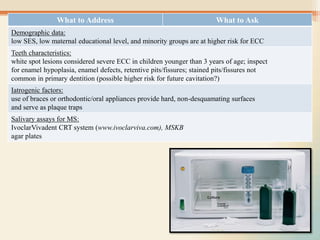
Salivary assays for MS:
IvoclarVivadent CRT system (www.ivoclarviva.com), MSKB
agar plates
Pediatric Prevention
• Summery:
The old infectious disease model was deficient

Anticipatory Guidance replaced the old infectious disease model
Anticipatory Guidance is more concise, less static, more
interactive and helps develop an individual preventive plan for
each patient
Starting with an infant represents a clean slate to prevent the
development of many oral diseases and conditions

To be effective, Anticipatory Guidance should be coupled with
Infant Oral Health Risk Assessment and Caries Risk Tool
Thank you

preventive strategies in paediatric dentistry

  • 1.
    Preventive Strategies inthe Pediatric patient Dr. Mohamed Magdi Hassan Department of preventive Sciences Division of Pediatric Dentistry
  • 2.
    Pediatric Prevention • Whatis Pediatric Dentistry ? ▫ an age-defined specialty that provides both primary and comprehensive preventive and therapeutic oral health care for infants and children through adolescence, including those with special health care needs. • What is Prevention for the pediatric patient ? ▫ To prevent is to avoid occurrence. • What to prevent in a Pediatric Patient ? ▫ Transmission of Mutans streptococci. ▫ Development of Caries. ▫ Occurrence of Trauma. ▫ Development of anomalies and malocclusion. • How to prevent all Theses from Occurring ? Anticipatory Guidance, Infant oral health Assessment, Caries Risk Assessment
  • 3.
    Pediatric Prevention • InfectiousDisease Model Old model Dental Caries
  • 4.
    Pediatric Prevention • Theold concept was to have children have their FIRST dental visit at age 3 yrs • Caries was epidemic. • Anticipatory guidance began in the medical field to educate parents on their children's growth, development and health. • Also known as the WELL-CHILD-CARE visits. • Adopted by Dentistry to help deal with all issues related to dental health
  • 5.
    Pediatric Prevention • AnticipatoryGuidance: is pro-active counseling of parents and patients about developmental changes that will occur in the intervals between health visits that include information about daily care taking specific to the upcoming interval. Caries Assessment Tool • Anticipatory guidance is a complement to CAT • The aim of AG is to address protective factors in effort to prevent oral health problem. • AG would include discussion on oral development, diet and nutrition, fluoride adequacy, oral habits, injury prevention and oral hygiene.
  • 6.
    Pediatric Prevention • AGis age specific, which: ▫ Makes the message concise ▫ Makes the message less static • Infancy represents a clean slate, but as the child grows the risk of problem increases. • Unlike the old infectious disease model, where the Doctor gave the information and the parent listened. AG provides interaction between the dentist and the parents. • Individual plan is developed for each patient.
  • 7.
    Anticipatory Guidance Oral Development Dentaland Oral Milestone Eruption of the first tooth Development of occlusion Teething and tooth eruption time Anatomical landmarks Diet and Nutrition Bottle related dental caries Weaning Role of Carbohydrates Role and Identification of Plaques Fluoride Adequacy Water evaluation and supplementation Breastfeeding External source of fluoride Safety and toxicity Dentifrice and topical agents Habits Non-nutritive sucking Pacifiers Oral Hygiene Mouth cleaning Streptococcus mutans testing Tooth cleaning implements Positioning and supervision Injury Prevention Child abuse and neglect Car safety Child proofing Electric cord safety Emergency instruction
  • 8.
  • 10.
    Anticipatory Guidance Topic 6-12 months months12-24 months 24-36 Dental and oral development •milestones • patterns of eruption • environmental and genetic influences • teething • infant oral cavity • occlusion • spacing issues • speech and teeth • tooth calcification •last primary tooth erupted • exfoliation • future orthodontic needs • radiographs Fluoride supplementation •F mechanisms • sources of F • choice of F vehicles • F and vitamins • toxicity issues/ storage • formula and F •F dentifrice use • F in food sources • avoiding excessive ingestion •F use revisited at every interval • daily access Non-nutritive habits •pacifier use and types/safety • mouthing/oral Stimulators •digit habit issues • effect on occlusion • revisit habit issues
  • 11.
    Topic 6-12 months months 12-24 months24-36 Injury prevention • signs of trauma • child abuse oral signs • emergency access instructions • implications for permanent teeth • car seats • daycare instructions • electric cord safety • re-plantation warning Re: primary teeth • child proofing • helmet safety • seat belts • safety network Diet • nutrition and dental health • bottle use and weaning • Sippy-cup use and content • breast feeding • caries process • role of carbohydrates (juice) exposures • retention of food • review caries process • revisit Sippy-cup issues • snacks • frequency issues • review caries process • role of carbohydrates (juice) exposures • revisit Sippy-cup issues Oral hygiene • oral as part of general hygiene • acquisition of S. mutans • positioning baby for oral hygiene • special techniques • child participation • dentifrice use • Fl dentifrice for high risk • electric brushes/ toddler techniques • use of floss • continued parental Participation
  • 14.
    Pediatric Prevention Increase inirritability Loss of appetite Change in eating habits Difficulty sleeping Diarrhea Fever Vomiting Discomfort – pain Drooling
  • 15.
    Pediatric Prevention • OralHealth Risk Assessment: • Systemic evaluation of presence and intensity of etiological and contributory caries risk factors (and other diseases) to provide disease risk estimation. • Helps in providing preventive measures in a customized fashion.
  • 16.
    What to Address Whatto Ask Medical history: pre-/perinatal history (hypoplasia), general health (healthy vs. special needs), medications (some high in sucrose) Nutritional deficiencies in pregnancy Prematurity (~ < 36 weeks gestational period) Birth weight (~ < 2.5 kg) Medical problems/special health care needs (i.e. compromised salivary flow, compromised oral hygiene due to behavior problems, high caloric diets, etc.). History of hospitalization and past/current medications Oral hygiène: visible plaque on maxillary anterior teeth is one of the best predictors of future caries Age brushing began? Are the child’s teeth brushed daily, once in while or not yet? Who brushes the child’s teeth? When are the child’s teeth brushed: morning, before bedtime, morning and before bedtime and/or after meals? Any problems with positioning, child’s cooperation, etc.?
  • 17.
    What to Address Whatto Ask Infant Feeding: only formulas, Breast milk or water in infant bottles; milk is not cariogenic, but a vehicle for cariogenic substances (i.e. chocolate powder); breast milk alone is not cariogenic, prolonged on-demand nighttime feeding associated with increased risk for caries; weaning from the bottle/sippy-cup at age 1 and from the breast as long as the mother and the child desires; breastfeeding in the 1st year of life found to be protective of future Obesity Breastfed/Bottle-fed? Breastfed/Bottle-fed to sleep and/or in the middle of the night? If yes, duration and frequency for each If bottle-fed, content of bottle: formula, milk, milk and sugary substances, juice/sugary drinks and/or water? Dietary Habits: early introduction of unhealthy foods (i.e. sugary drinks and snacks) can alter taste preferences for foods and beverages and predispose to obesity; high frequency of sugary drinks and snacks between meals (≥ 3 times) increases caries risk; limit juice and sugary drinks daily intake to 4-6 oz and best given in open cups; best to limit sweet foods/drinks at mealtimes Does the child regularly eat sweets more than 2 a day? What does the child like to snack on and how frequently? What type of container does the child usually use for drinks? Daily amount in oz during meals and/or throughout the day for the following drinks: 100% juice, juice drinks, regular/diet soda and sugary drinks (i.e. Kool-Aid)
  • 18.
    What to Address Whatto Ask Fluoride Adequacy: daily fluoride exposure through water or supplementation, and monitored use of fluoridated toothpaste (no more than a lateral smear) can be effective primary preventive procedures Main water source from which the child is drinking: city water (unfiltered, Brita/Pur filter), city water (filtered, reverse osmosis), well water or bottle water? Fluoride level in the child’s drinking water? Does the child take fluoride supplements? If yes, dosage and frequency Does the child use fluoridated toothpaste daily, once in a while or not yet? If yes, amount placed on toothbrush Bacteria Transmission:Mutans streptococci (MS) transmission can be direct or indirect, vertical (usually from mother) or horizontal (within or outside of the family Does the child’s mother (intimate caregiver) have any untreated decay? Does the child and mother (intimate caregiver) share the same utensils, foods and cups? Does the mother (intimate caregiver) pre-chew the child’s food or kiss the child on the mouth?
  • 19.
    What to Address Whatto Ask Demographic data: low SES, low maternal educational level, and minority groups are at higher risk for ECC Teeth characteristics: white spot lesions considered severe ECC in children younger than 3 years of age; inspect for enamel hypoplasia, enamel defects, retentive pits/fissures; stained pits/fissures not common in primary dentition (possible higher risk for future cavitation?) Iatrogenic factors: use of braces or orthodontic/oral appliances provide hard, non-desquamating surfaces and serve as plaque traps Salivary assays for MS: IvoclarVivadent CRT system (www.ivoclarviva.com), MSKB agar plates
  • 20.
    Pediatric Prevention • Summery: Theold infectious disease model was deficient Anticipatory Guidance replaced the old infectious disease model Anticipatory Guidance is more concise, less static, more interactive and helps develop an individual preventive plan for each patient Starting with an infant represents a clean slate to prevent the development of many oral diseases and conditions To be effective, Anticipatory Guidance should be coupled with Infant Oral Health Risk Assessment and Caries Risk Tool
  • 21.

Editor's Notes

  • #4 Introduced by Keys, the infectious disease model even though effective, could not solve all issues related to disease development. A small percentage of the population still remains in high risk of developing caries in spite this model. Things such as trauma (30%) in children and habits are
  • #5 Children at 3 yrs have all their primary teeth present, they are mostly ready to cooperate, they are about to go to school and have enough communication skills.
  • #7 Trauma, caries, periodontal disease, orthodontic problems (ENT issues).3rd molar discussion with a 5 yr old will not make sense. Sealant discussion postponed if till permanent teeth have erupted and exfoliation postponed if the child has thumb sucking habit then till the habit ceases.