Enterprise Strategic Architectures :
      TOGAF and Zachman
Contents

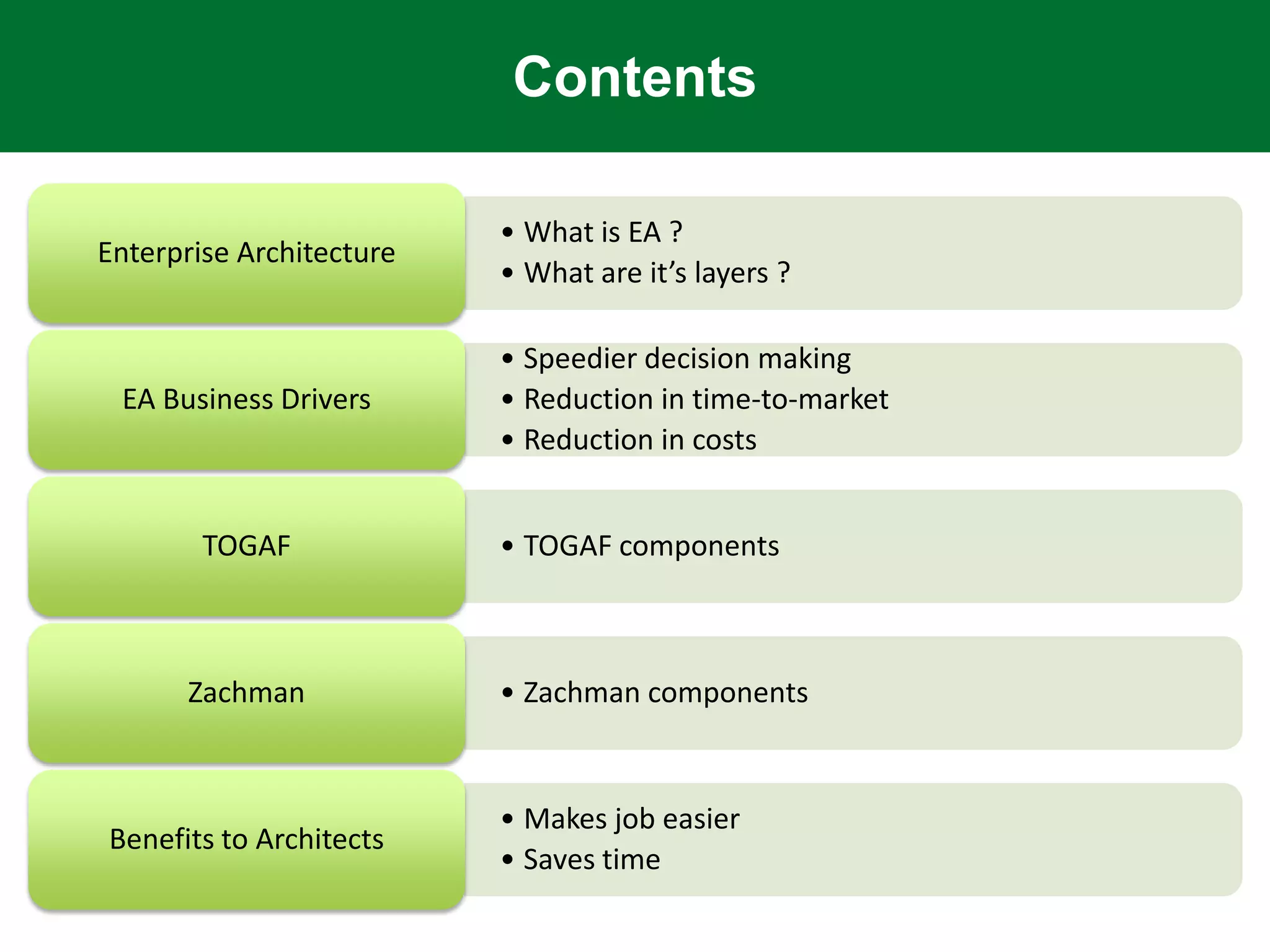
                          • What is EA ?
Enterprise Architecture
                          • What are it’s layers ?

                          • Speedier decision making
 EA Business Drivers      • Reduction in time-to-market
                          • Reduction in costs


        TOGAF             • TOGAF components


      Zachman             • Zachman components


                          • Makes job easier
Benefits to Architects
                          • Saves time
What is an Enterprise Architecture (EA)
Enterprise Architecture      EA Business Drivers   TOGAF                 Zachman              Benefits to Architects
 Enterprise Architecture is a self-improvement business function that examines the
 structure and behavior of the socio-technical aspects of an 'enterprise' and focuses on
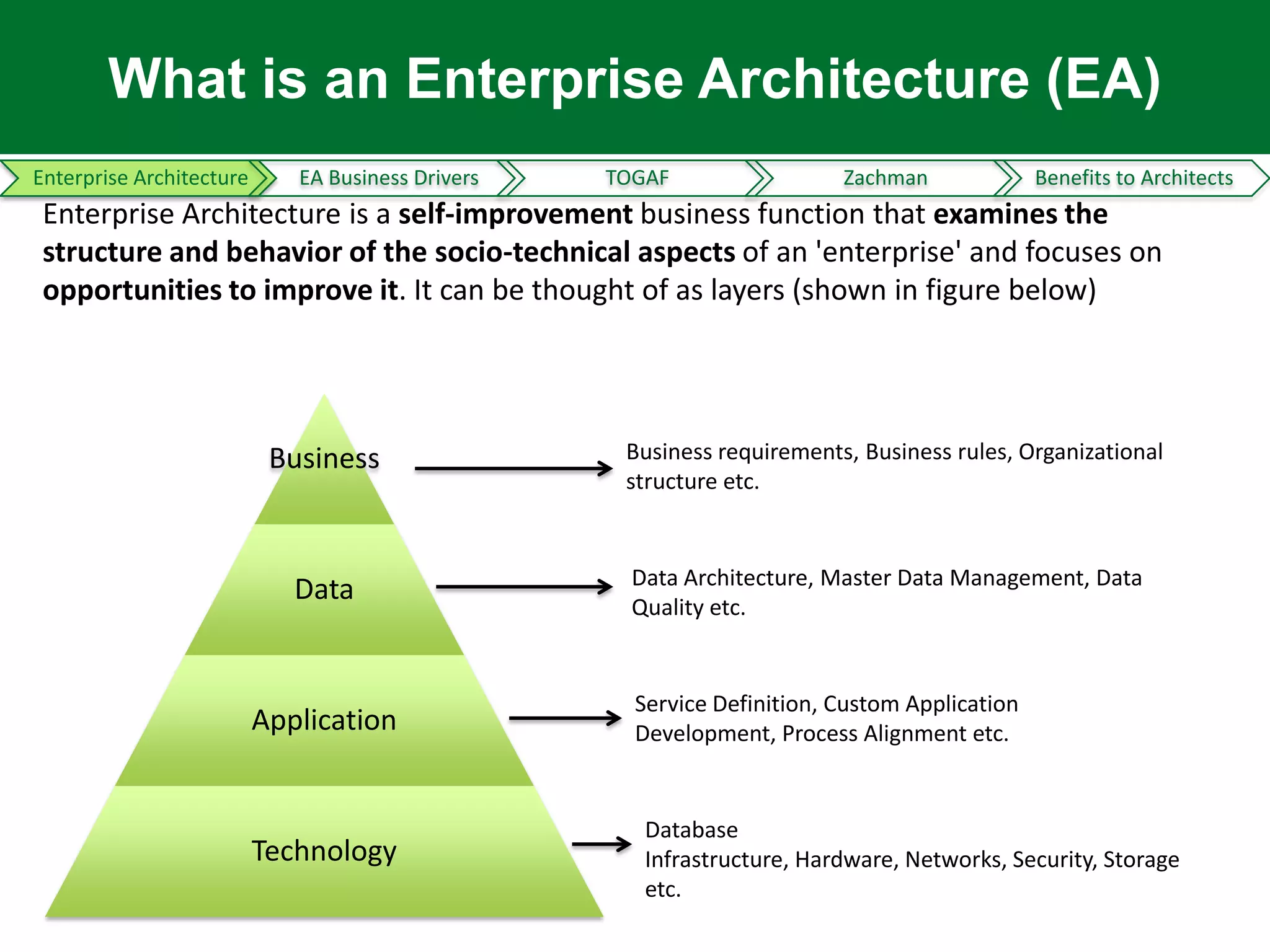
 opportunities to improve it. It can be thought of as layers (shown in figure below)


                           Business                 Business requirements, Business rules, Organizational
                                                    structure etc.


                                                     Data Architecture, Master Data Management, Data
                             Data
                                                     Quality etc.


                                                     Service Definition, Custom Application
                          Application                Development, Process Alignment etc.


                                                      Database
                          Technology                  Infrastructure, Hardware, Networks, Security, Storage
                                                      etc.
How does an EA delivers ‘Value’
Enterprise Architecture              EA Business Drivers   TOGAF   Zachman   Benefits to Architects


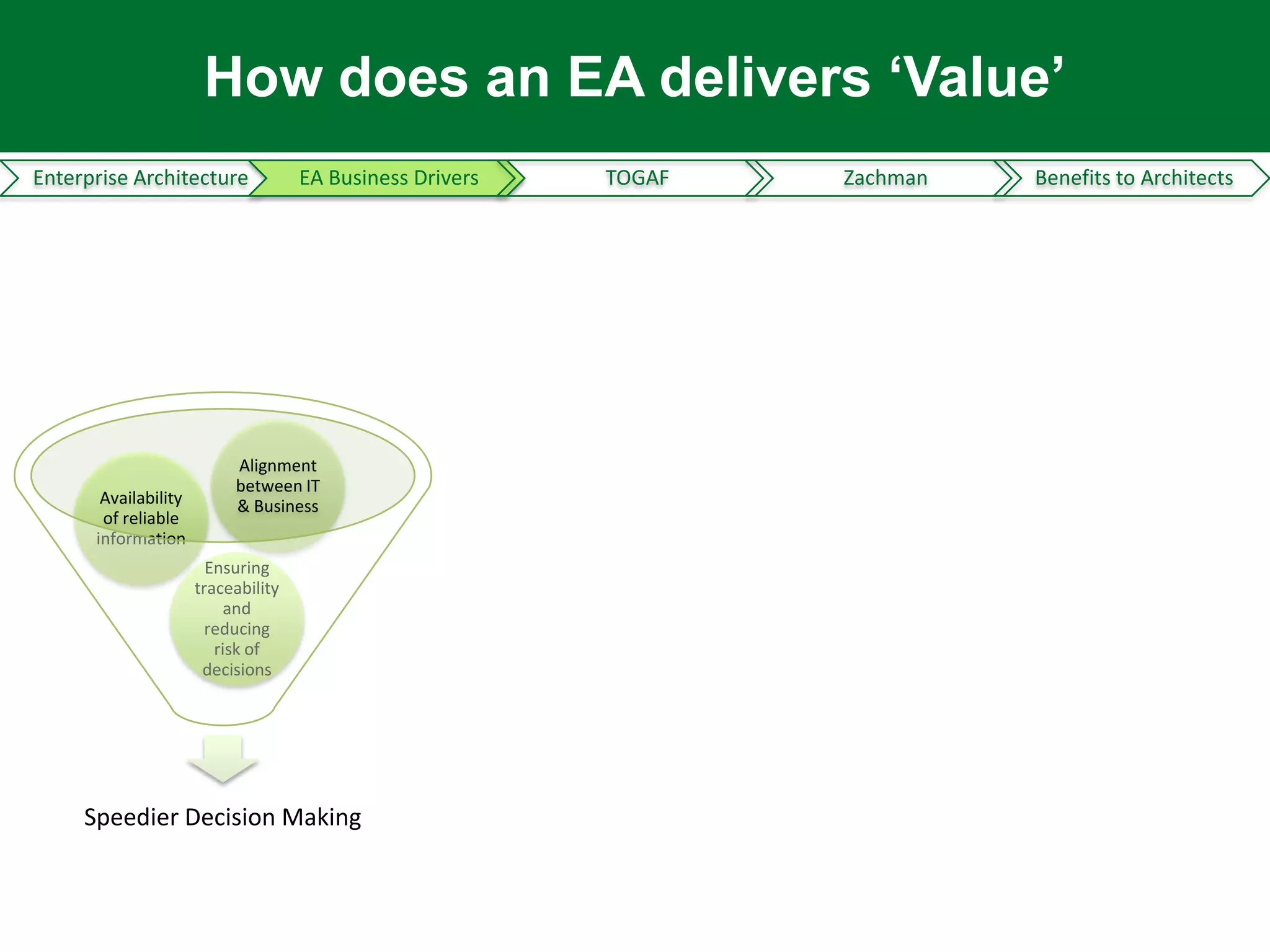
                           Alignment
                           between IT
       Availability        & Business
       of reliable
      information
                        Ensuring
                      traceability
                          and
                        reducing
                         risk of
                       decisions


     Speedier Decision Making
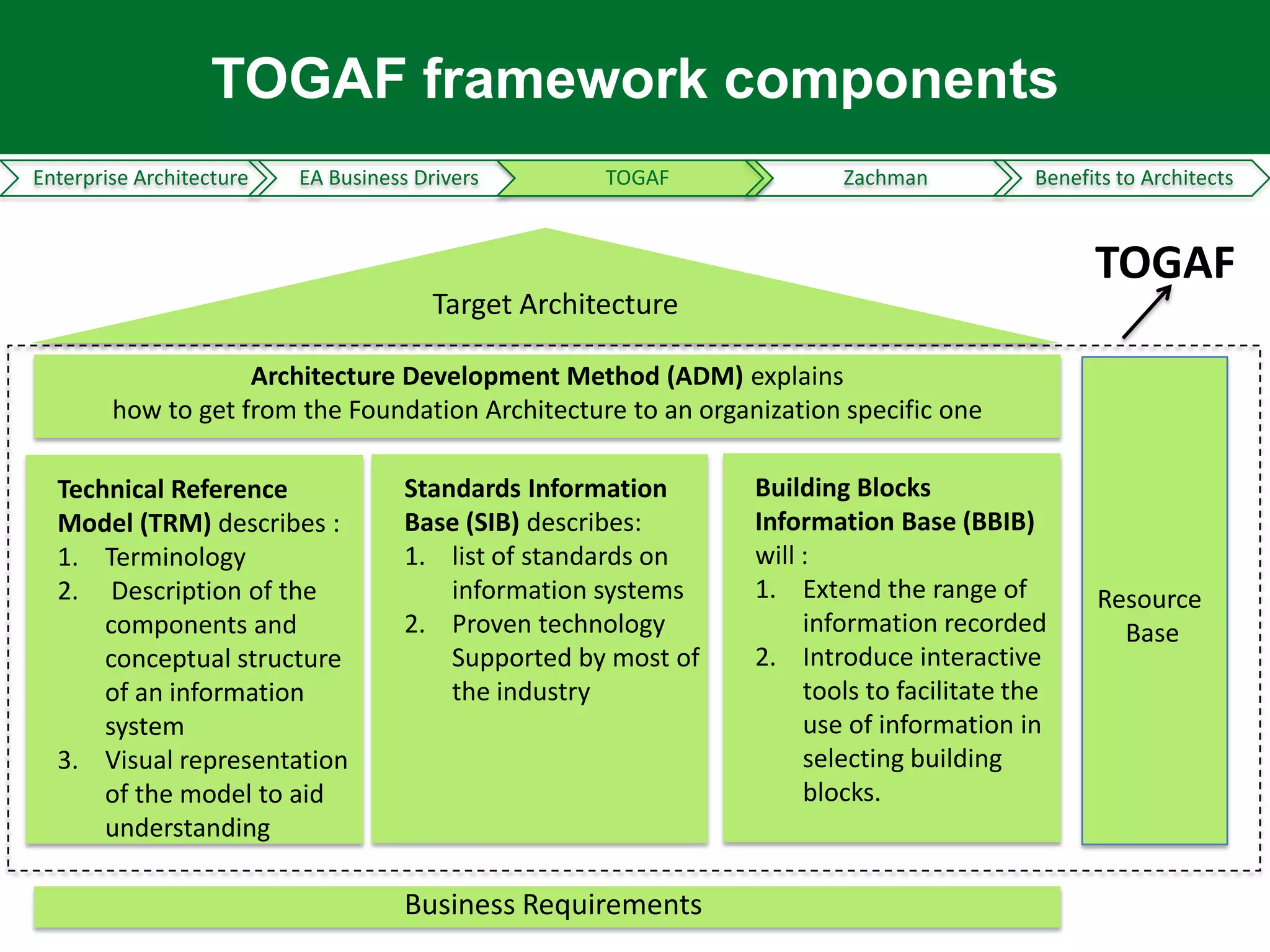
TOGAF framework components
Enterprise Architecture   EA Business Drivers        TOGAF              Zachman           Benefits to Architects


                                                                                                TOGAF
                                        Target Architecture

                    Architecture Development Method (ADM) explains
        how to get from the Foundation Architecture to an organization specific one

  Technical Reference                Standards Information      Building Blocks
  Model (TRM) describes :            Base (SIB) describes:      Information Base (BBIB)
  1. Terminology                     1. list of standards on    will :
  2. Description of the                  information systems    1. Extend the range of          Resource
      components and                 2. Proven technology            information recorded         Base
      conceptual structure               Supported by most of   2. Introduce interactive
      of an information                  the industry                tools to facilitate the
      system                                                         use of information in
  3. Visual representation                                           selecting building
      of the model to aid                                            blocks.
      understanding

                                     Business Requirements
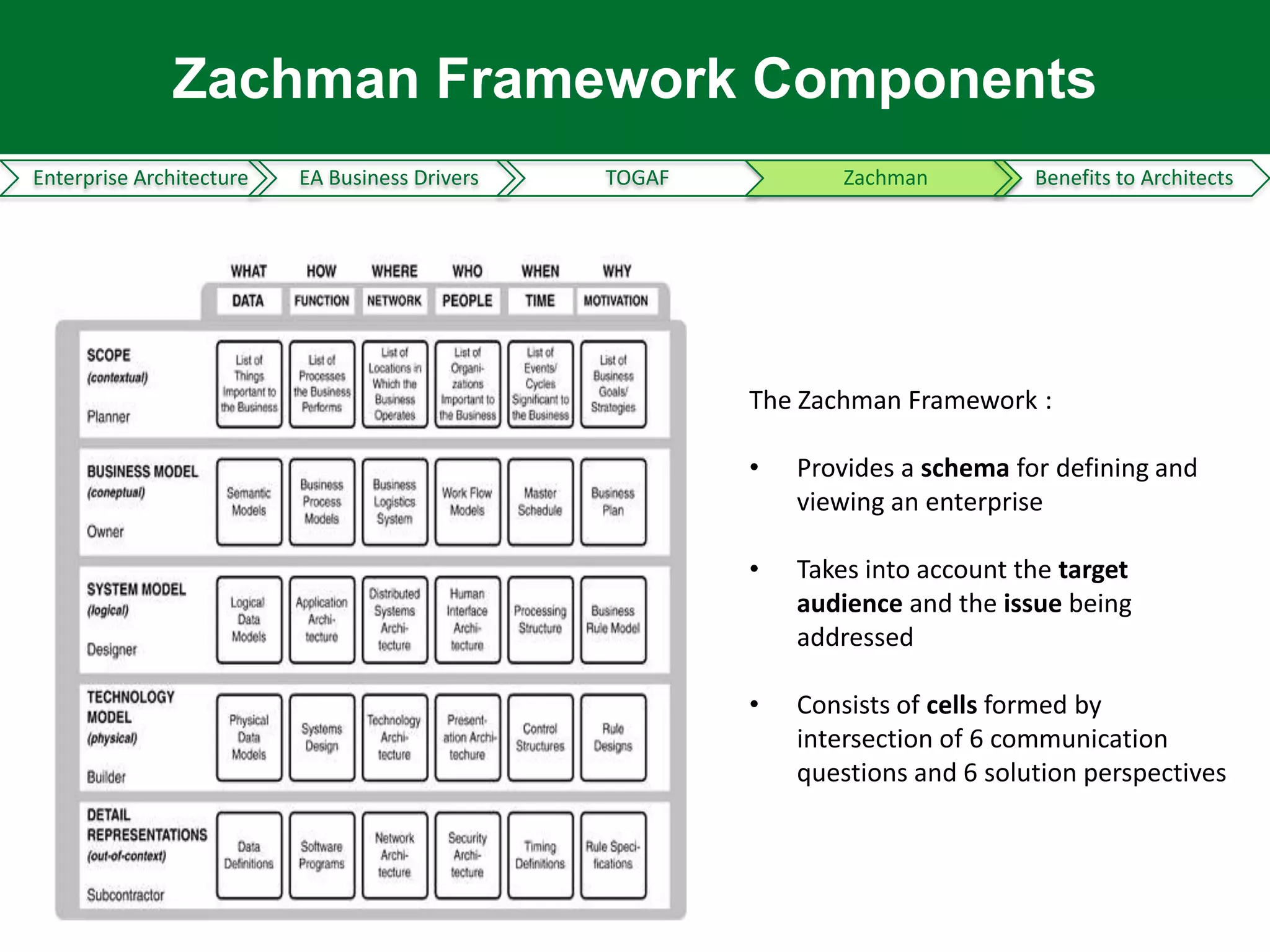
Zachman Framework Components
Enterprise Architecture   EA Business Drivers   TOGAF           Zachman         Benefits to Architects


                                                        The Zachman Framework :

                                                        •   Provides a schema for defining and
                                                            viewing an enterprise

                                                        •   Takes into account the target
                                                            audience and the issue being
                                                            addressed

                                                        •   Consists of cells formed by
                                                            intersection of 6 communication
                                                            questions and 6 solution perspectives
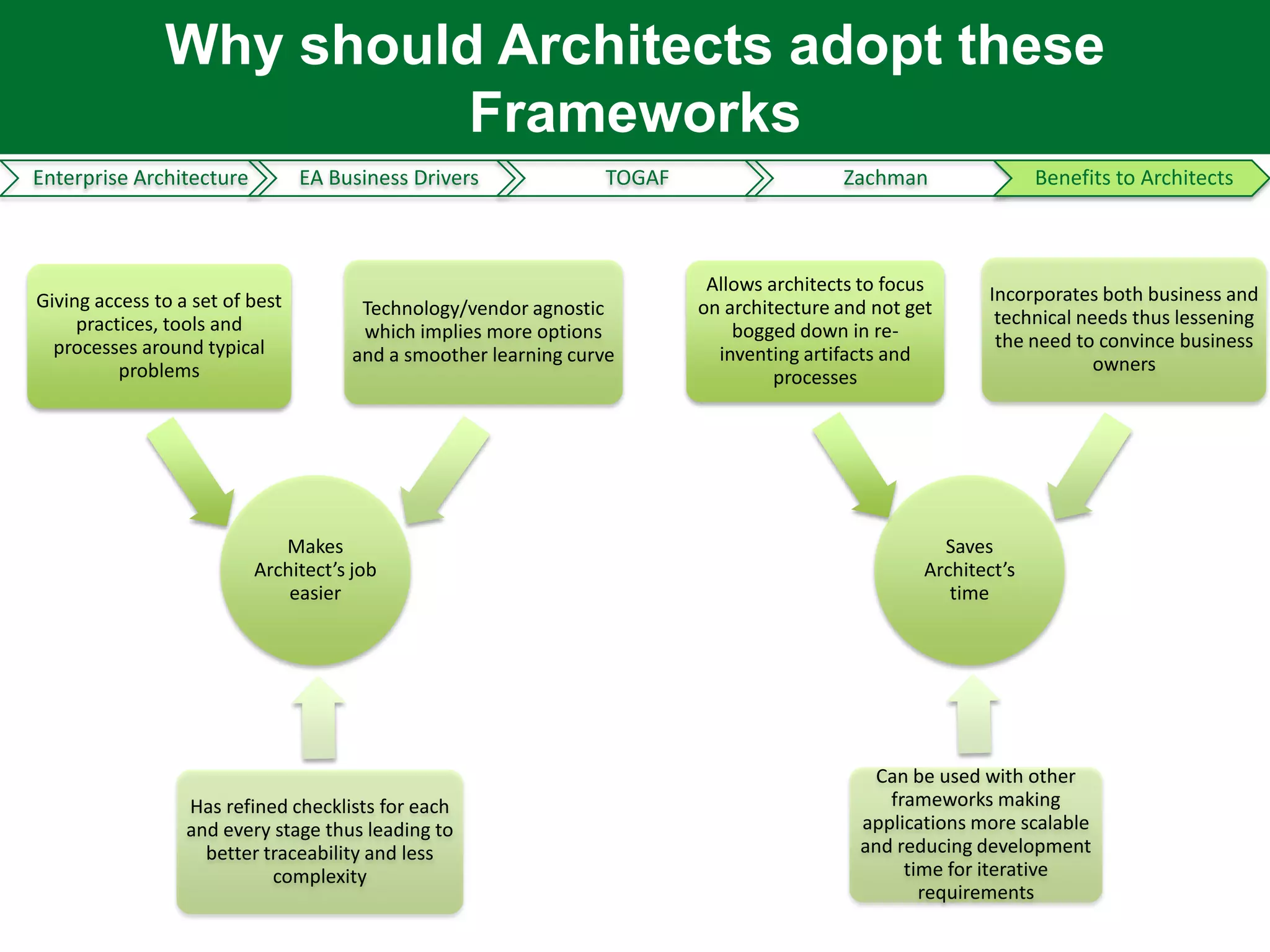
Why should Architects adopt these
                         Frameworks
Enterprise Architecture          EA Business Drivers              TOGAF                   Zachman                 Benefits to Architects


                                                                           Allows architects to focus      Incorporates both business and
Giving access to a set of best         Technology/vendor agnostic         on architecture and not get
     practices, tools and                                                                                   technical needs thus lessening
                                       which implies more options             bogged down in re-            the need to convince business
  processes around typical            and a smoother learning curve         inventing artifacts and
          problems                                                                                                      owners
                                                                                   processes


                             Makes                                                                    Saves
                          Architect’s job                                                           Architect’s
                              easier                                                                   time


                                                                                             Can be used with other
                  Has refined checklists for each                                              frameworks making
                  and every stage thus leading to                                           applications more scalable
                    better traceability and less                                            and reducing development
                            complexity                                                           time for iterative
                                                                                                   requirements
Appendix
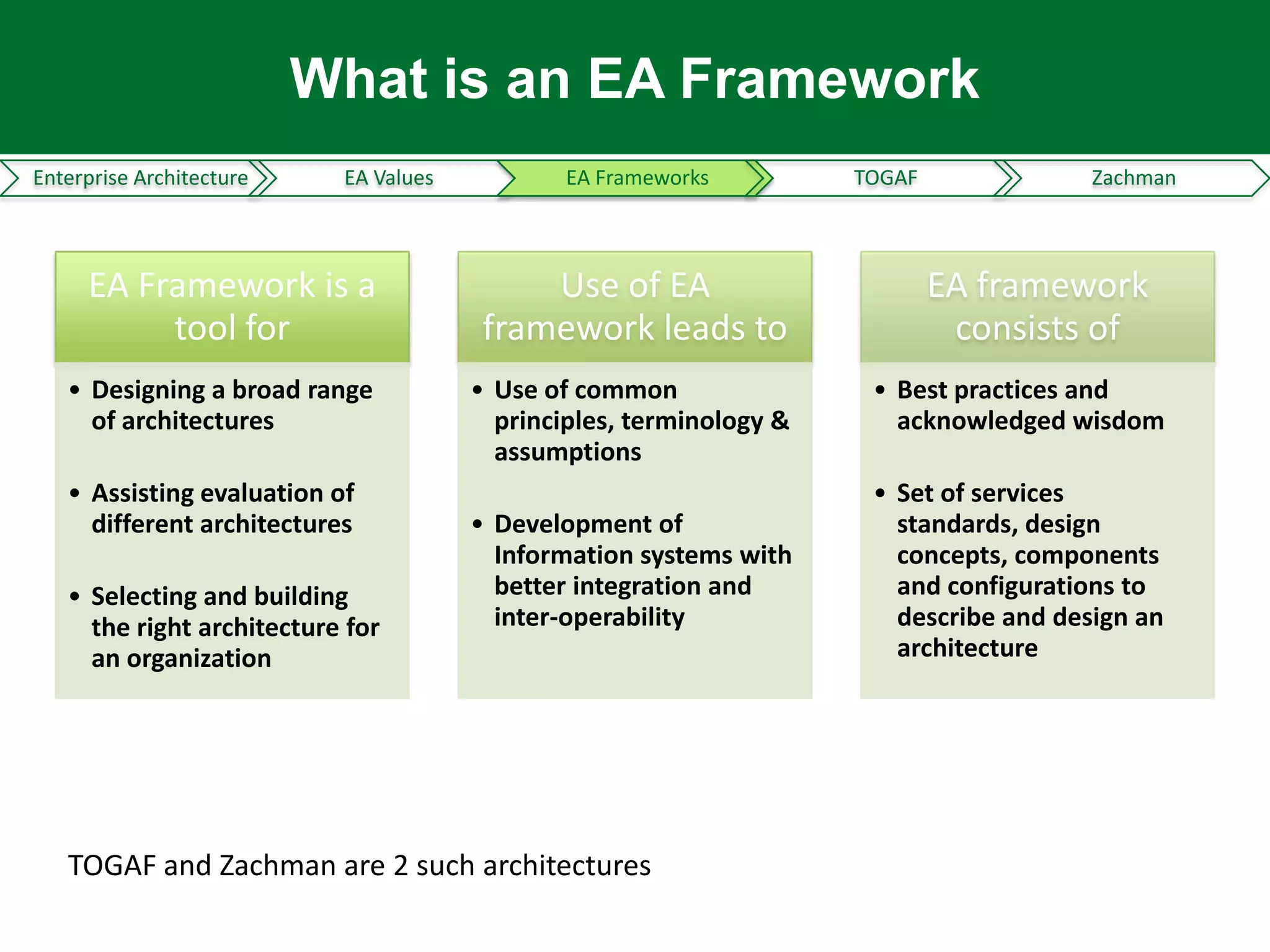
What is an EA Framework
Enterprise Architecture    EA Values           EA Frameworks         TOGAF              Zachman


     EA Framework is a                      Use of EA                        EA framework
          tool for                      framework leads to                    consists of
   • Designing a broad range           • Use of common                • Best practices and
     of architectures                    principles, terminology &      acknowledged wisdom
                                         assumptions
   • Assisting evaluation of                                          • Set of services
     different architectures           • Development of                 standards, design
                                         Information systems with       concepts, components
   • Selecting and building              better integration and         and configurations to
     the right architecture for          inter-operability              describe and design an
     an organization                                                    architecture


   TOGAF and Zachman are 2 such architectures
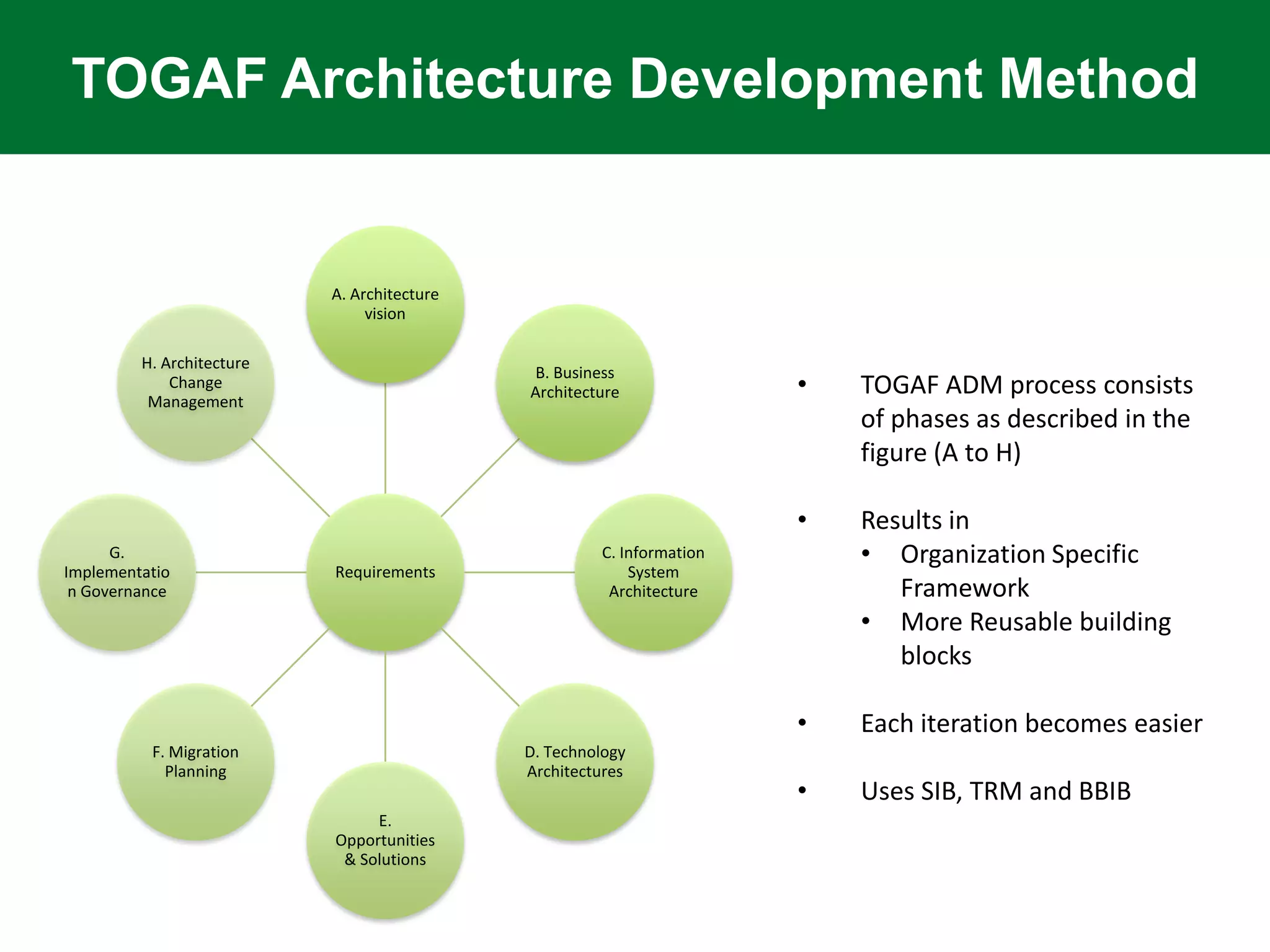
TOGAF Architecture Development Method


                           A. Architecture
                                vision

         H. Architecture
                                             B. Business
             Change
          Management
                                             Architecture              •   TOGAF ADM process consists
                                                                           of phases as described in the
                                                                           figure (A to H)

                                                                       •   Results in
      G.                                              C. Information       • Organization Specific
Implementatio              Requirements                   System
 n Governance                                          Architecture           Framework
                                                                           • More Reusable building
                                                                              blocks

                                                                       •   Each iteration becomes easier
          F. Migration                       D. Technology
            Planning                         Architectures
                                                                       •   Uses SIB, TRM and BBIB
                                E.
                           Opportunities
                            & Solutions
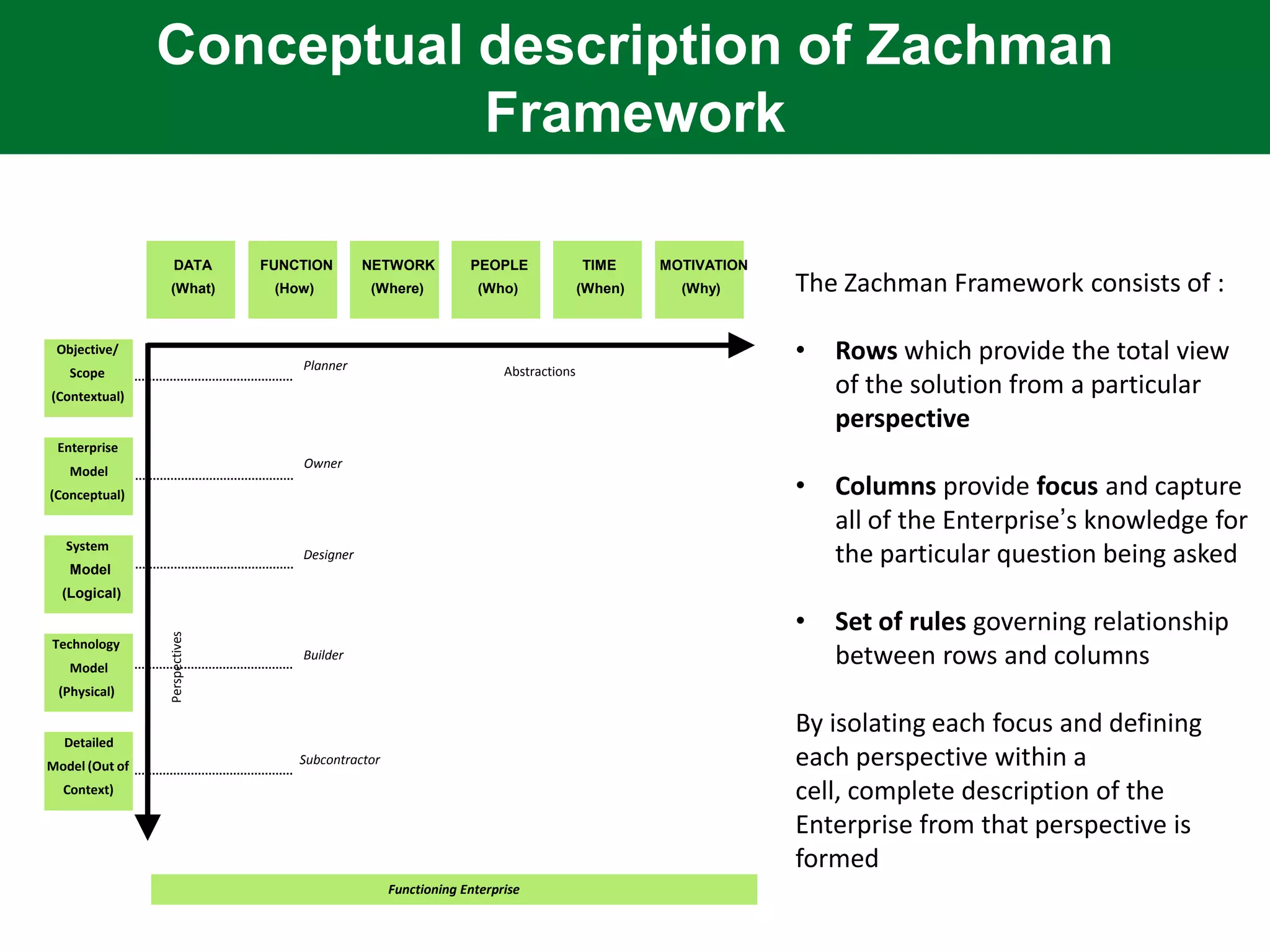
Conceptual description of Zachman
                           Framework

                  DATA         FUNCTION       NETWORK           PEOPLE               TIME     MOTIVATION
                (What)          (How)         (Where)            (Who)               (When)     (Why)      The Zachman Framework consists of :

 Objective/
                                   Planner
                                                                                                           •   Rows which provide the total view
   Scope                                                              Abstractions
(Contextual)
                                                                                                               of the solution from a particular
                                                                                                               perspective
 Enterprise
                                   Owner
   Model
(Conceptual)                                                                                               •   Columns provide focus and capture
                                                                                                               all of the Enterprise’s knowledge for
   System
   Model
                                   Designer                                                                    the particular question being asked
  (Logical)

                                                                                                           •   Set of rules governing relationship
                Perspectives


Technology
   Model
                                   Builder                                                                     between rows and columns
 (Physical)

                                                                                                           By isolating each focus and defining
  Detailed
Model (Out of                      Subcontractor                                                           each perspective within a
  Context)                                                                                                 cell, complete description of the
                                                                                                           Enterprise from that perspective is
                                                                                                           formed
                                                   Functioning Enterprise
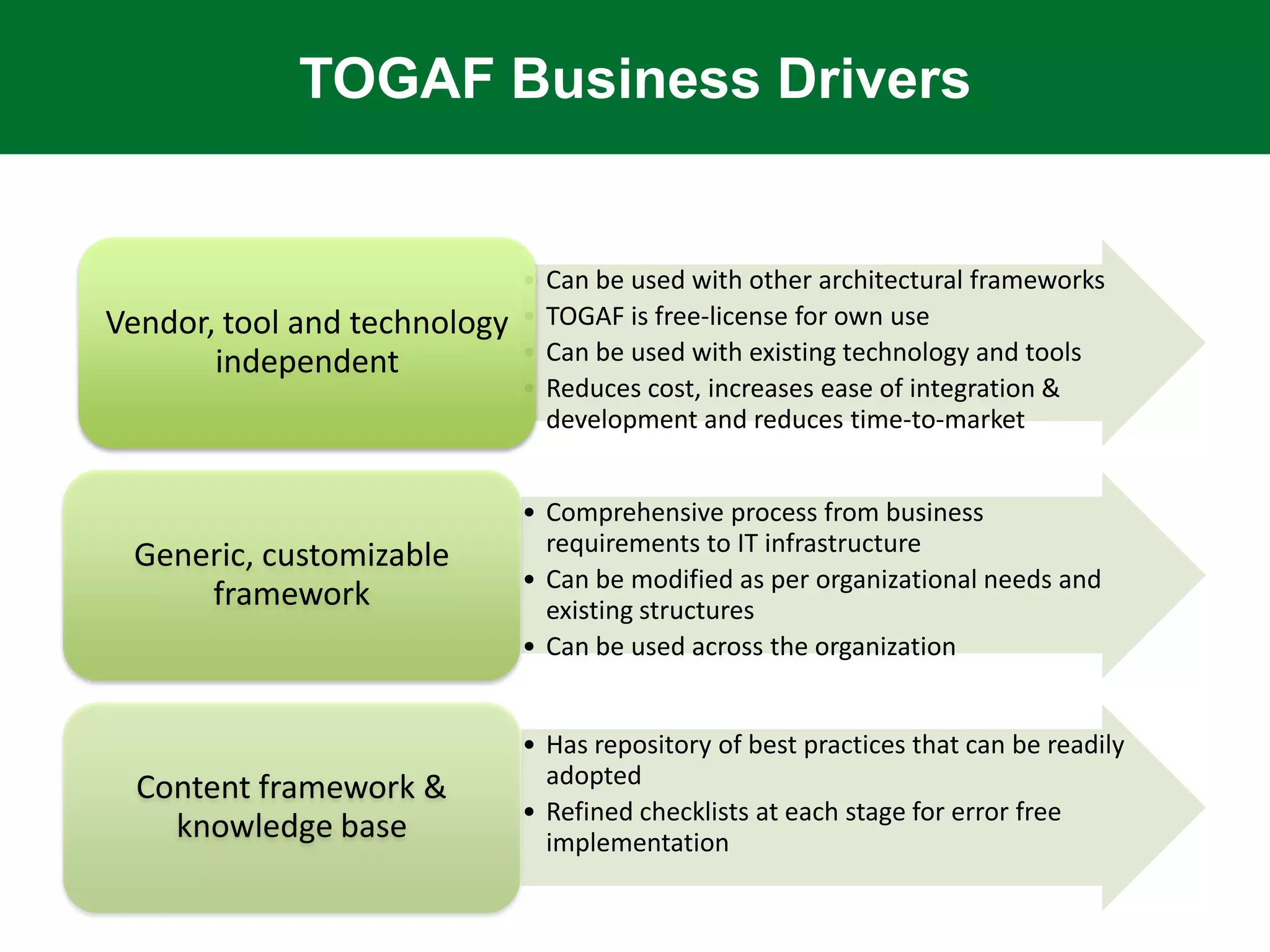
TOGAF Business Drivers


                              •   Can be used with other architectural frameworks
Vendor, tool and technology   •   TOGAF is free-license for own use
       independent            •   Can be used with existing technology and tools
                              •   Reduces cost, increases ease of integration &
                                  development and reduces time-to-market


                              • Comprehensive process from business
 Generic, customizable          requirements to IT infrastructure
                              • Can be modified as per organizational needs and
     framework                  existing structures
                              • Can be used across the organization


                              • Has repository of best practices that can be readily
  Content framework &           adopted
                              • Refined checklists at each stage for error free
    knowledge base              implementation
THANK YOU

Enterprise Architecture Frameworks

  • 1.
  • 2.
    Contents • What is EA ? Enterprise Architecture • What are it’s layers ? • Speedier decision making EA Business Drivers • Reduction in time-to-market • Reduction in costs TOGAF • TOGAF components Zachman • Zachman components • Makes job easier Benefits to Architects • Saves time
  • 3.
    What is anEnterprise Architecture (EA) Enterprise Architecture EA Business Drivers TOGAF Zachman Benefits to Architects Enterprise Architecture is a self-improvement business function that examines the structure and behavior of the socio-technical aspects of an 'enterprise' and focuses on opportunities to improve it. It can be thought of as layers (shown in figure below) Business Business requirements, Business rules, Organizational structure etc. Data Architecture, Master Data Management, Data Data Quality etc. Service Definition, Custom Application Application Development, Process Alignment etc. Database Technology Infrastructure, Hardware, Networks, Security, Storage etc.
  • 4.
    How does anEA delivers ‘Value’ Enterprise Architecture EA Business Drivers TOGAF Zachman Benefits to Architects Alignment between IT Availability & Business of reliable information Ensuring traceability and reducing risk of decisions Speedier Decision Making
  • 5.
    TOGAF framework components EnterpriseArchitecture EA Business Drivers TOGAF Zachman Benefits to Architects TOGAF Target Architecture Architecture Development Method (ADM) explains how to get from the Foundation Architecture to an organization specific one Technical Reference Standards Information Building Blocks Model (TRM) describes : Base (SIB) describes: Information Base (BBIB) 1. Terminology 1. list of standards on will : 2. Description of the information systems 1. Extend the range of Resource components and 2. Proven technology information recorded Base conceptual structure Supported by most of 2. Introduce interactive of an information the industry tools to facilitate the system use of information in 3. Visual representation selecting building of the model to aid blocks. understanding Business Requirements
  • 6.
    Zachman Framework Components EnterpriseArchitecture EA Business Drivers TOGAF Zachman Benefits to Architects The Zachman Framework : • Provides a schema for defining and viewing an enterprise • Takes into account the target audience and the issue being addressed • Consists of cells formed by intersection of 6 communication questions and 6 solution perspectives
  • 7.
    Why should Architectsadopt these Frameworks Enterprise Architecture EA Business Drivers TOGAF Zachman Benefits to Architects Allows architects to focus Incorporates both business and Giving access to a set of best Technology/vendor agnostic on architecture and not get practices, tools and technical needs thus lessening which implies more options bogged down in re- the need to convince business processes around typical and a smoother learning curve inventing artifacts and problems owners processes Makes Saves Architect’s job Architect’s easier time Can be used with other Has refined checklists for each frameworks making and every stage thus leading to applications more scalable better traceability and less and reducing development complexity time for iterative requirements
  • 8.
  • 9.
    What is anEA Framework Enterprise Architecture EA Values EA Frameworks TOGAF Zachman EA Framework is a Use of EA EA framework tool for framework leads to consists of • Designing a broad range • Use of common • Best practices and of architectures principles, terminology & acknowledged wisdom assumptions • Assisting evaluation of • Set of services different architectures • Development of standards, design Information systems with concepts, components • Selecting and building better integration and and configurations to the right architecture for inter-operability describe and design an an organization architecture TOGAF and Zachman are 2 such architectures
  • 10.
    TOGAF Architecture DevelopmentMethod A. Architecture vision H. Architecture B. Business Change Management Architecture • TOGAF ADM process consists of phases as described in the figure (A to H) • Results in G. C. Information • Organization Specific Implementatio Requirements System n Governance Architecture Framework • More Reusable building blocks • Each iteration becomes easier F. Migration D. Technology Planning Architectures • Uses SIB, TRM and BBIB E. Opportunities & Solutions
  • 11.
    Conceptual description ofZachman Framework DATA FUNCTION NETWORK PEOPLE TIME MOTIVATION (What) (How) (Where) (Who) (When) (Why) The Zachman Framework consists of : Objective/ Planner • Rows which provide the total view Scope Abstractions (Contextual) of the solution from a particular perspective Enterprise Owner Model (Conceptual) • Columns provide focus and capture all of the Enterprise’s knowledge for System Model Designer the particular question being asked (Logical) • Set of rules governing relationship Perspectives Technology Model Builder between rows and columns (Physical) By isolating each focus and defining Detailed Model (Out of Subcontractor each perspective within a Context) cell, complete description of the Enterprise from that perspective is formed Functioning Enterprise
  • 12.
    TOGAF Business Drivers • Can be used with other architectural frameworks Vendor, tool and technology • TOGAF is free-license for own use independent • Can be used with existing technology and tools • Reduces cost, increases ease of integration & development and reduces time-to-market • Comprehensive process from business Generic, customizable requirements to IT infrastructure • Can be modified as per organizational needs and framework existing structures • Can be used across the organization • Has repository of best practices that can be readily Content framework & adopted • Refined checklists at each stage for error free knowledge base implementation
  • 13.