

MULTI-WORD
VERBS
UNIT 6
ENTERTAINMENT
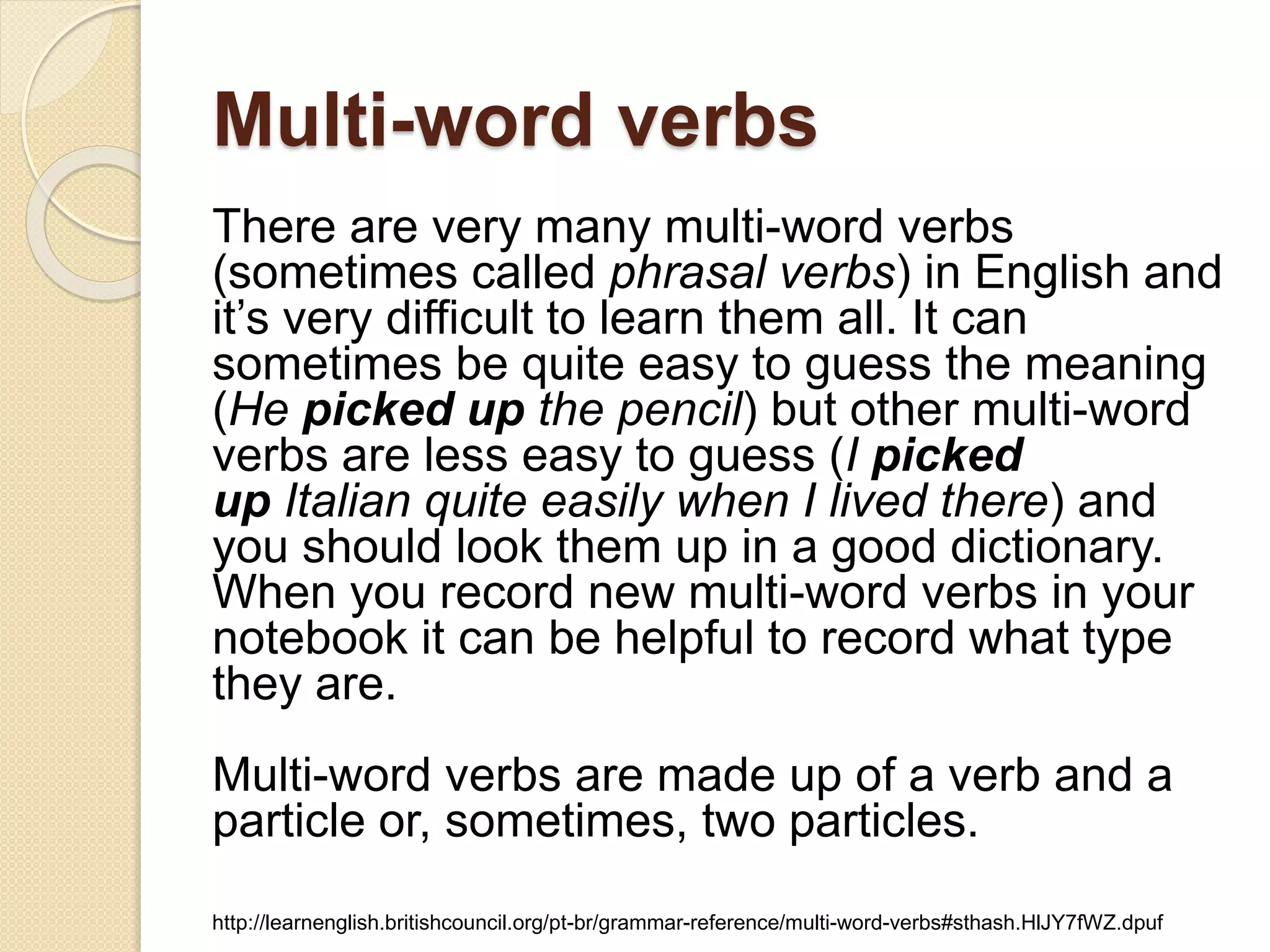
Multi-word verbs
There are very many multi-word verbs
(sometimes called phrasal verbs) in English and
it’s very difficult to learn them all. It can
sometimes be quite easy to guess the meaning
(He picked up the pencil) but other multi-word
verbs are less easy to guess (I picked
up Italian quite easily when I lived there) and
you should look them up in a good dictionary.
When you record new multi-word verbs in your
notebook it can be helpful to record what type
they are.
Multi-word verbs are made up of a verb and a
particle or, sometimes, two particles.
http://learnenglish.britishcouncil.org/pt-br/grammar-reference/multi-word-verbs#sthash.HlJY7fWZ.dpuf
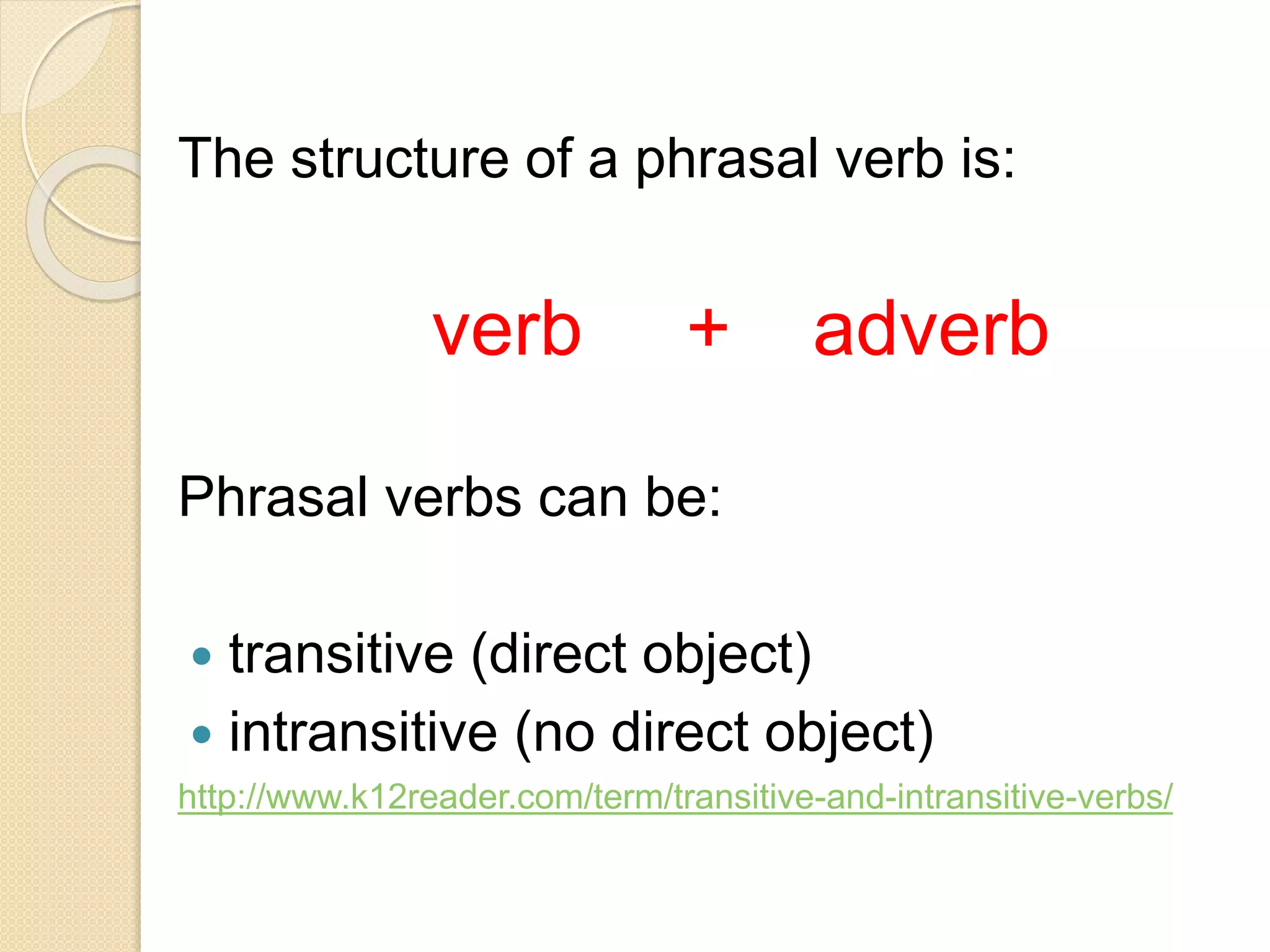
The structure of a phrasal verb is:
verb + adverb
Phrasal verbs can be:
 transitive (direct object)
 intransitive (no direct object)
http://www.k12reader.com/term/transitive-and-intransitive-verbs/
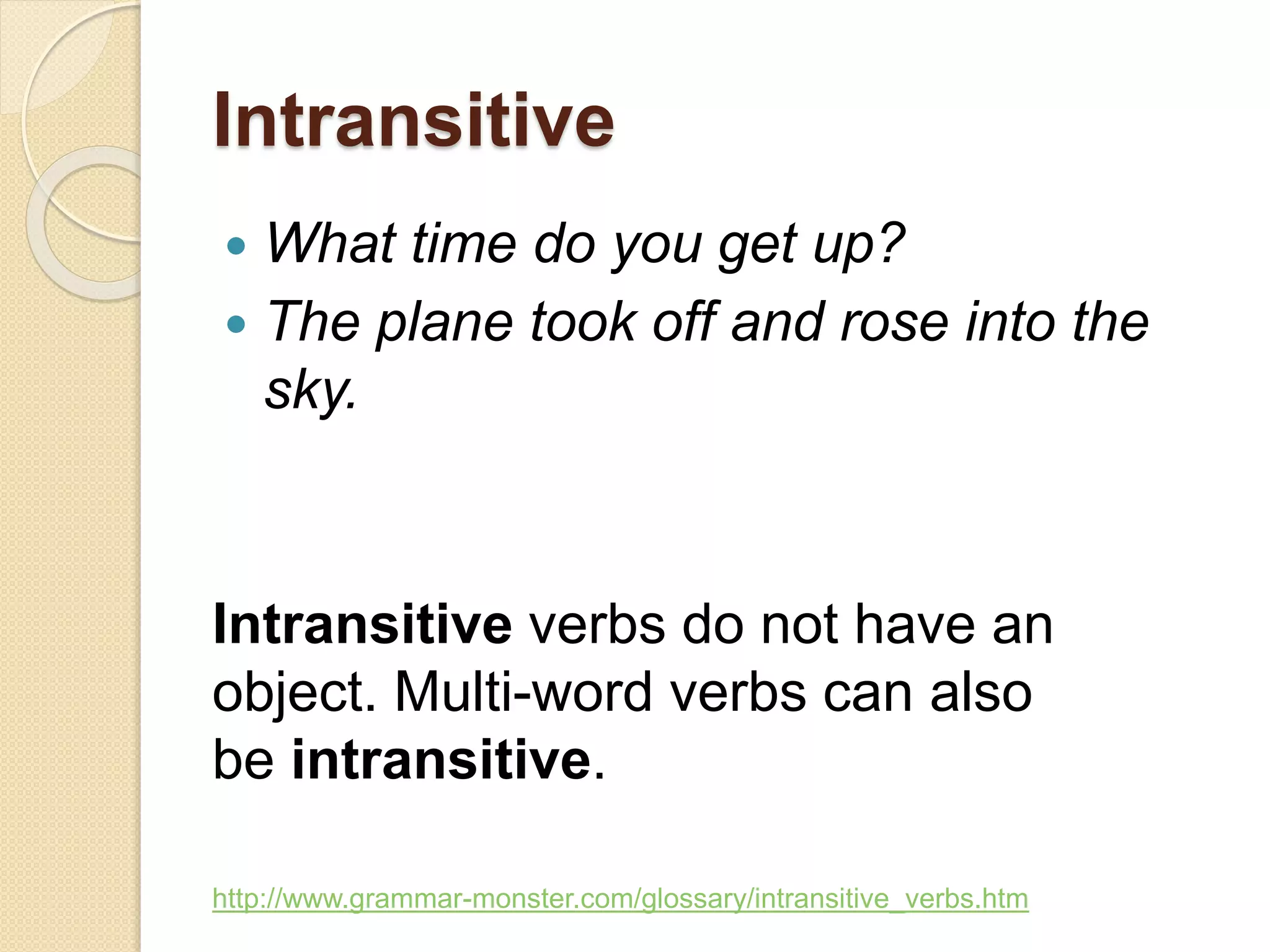
Intransitive
 What time do you get up?
 The plane took off and rose into the
sky.
Intransitive verbs do not have an
object. Multi-word verbs can also
be intransitive.
http://www.grammar-monster.com/glossary/intransitive_verbs.htm
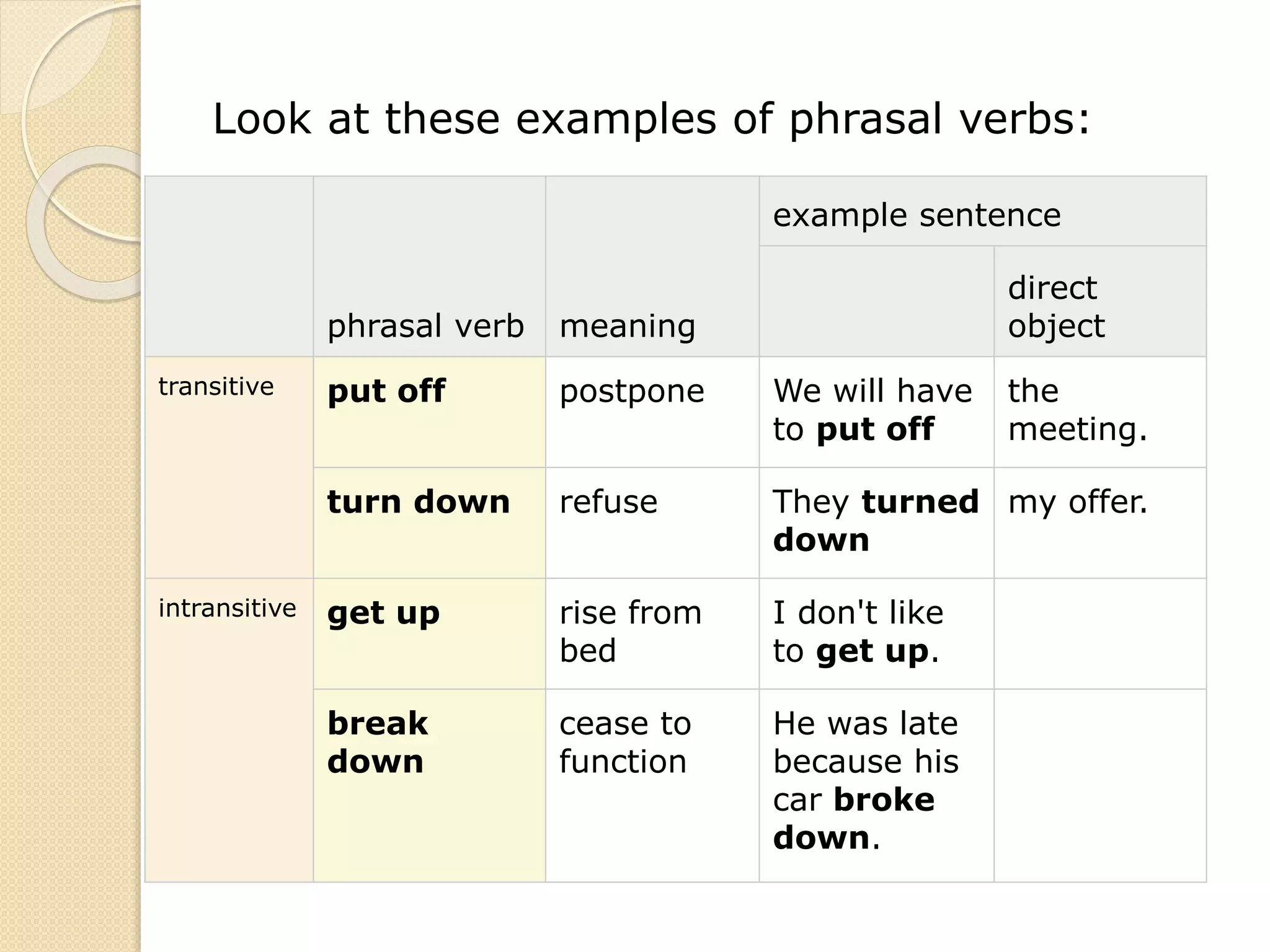
Look at these examples of phrasal verbs:
phrasal verb meaning
example sentence
direct
object
transitive put off postpone We will have
to put off
the
meeting.
turn down refuse They turned
down
my offer.
intransitive get up rise from
bed
I don't like
to get up.
break
down
cease to
function
He was late
because his
car broke
down.
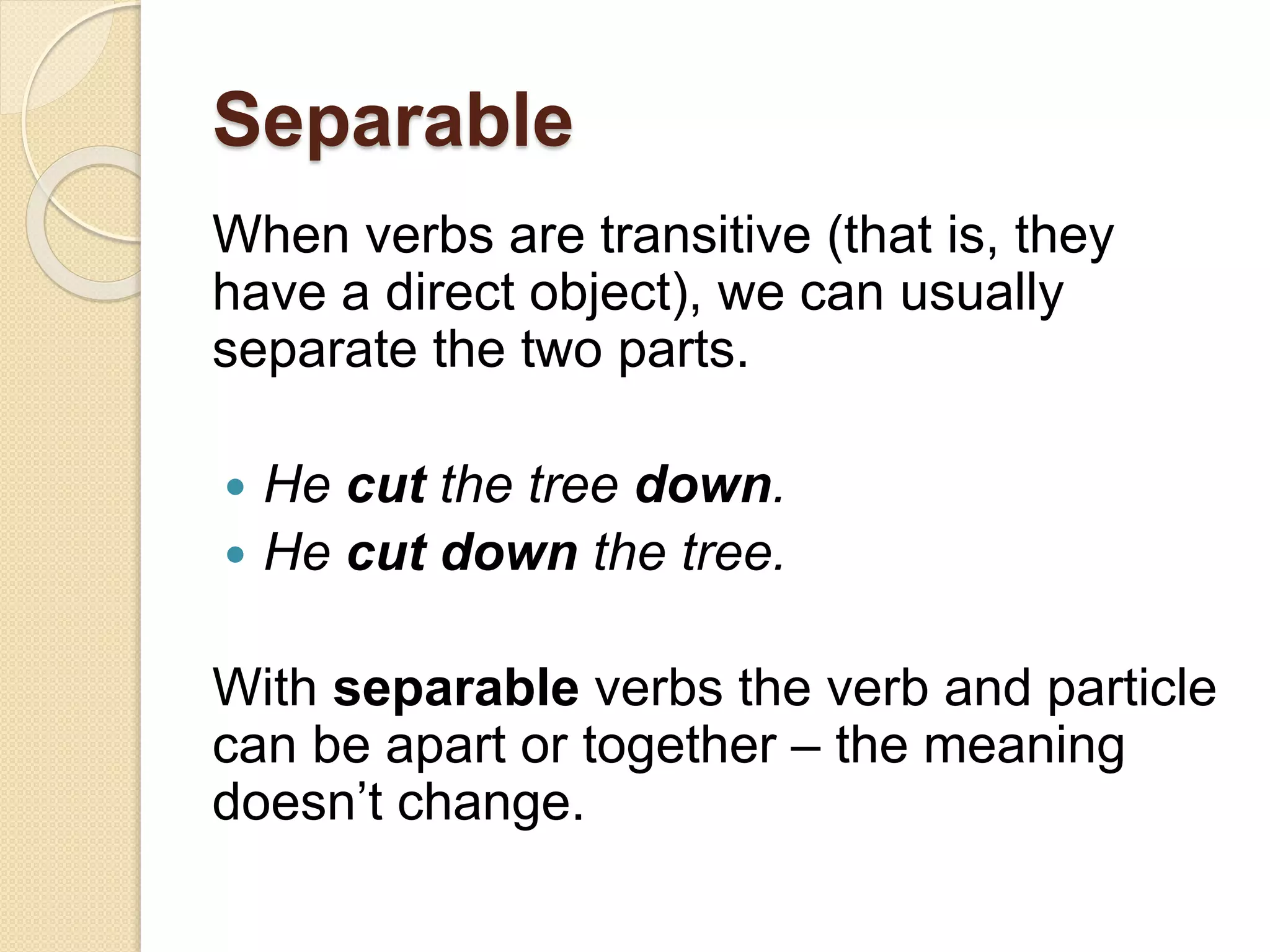
Separable
When verbs are transitive (that is, they
have a direct object), we can usually
separate the two parts.
 He cut the tree down.
 He cut down the tree.
With separable verbs the verb and particle
can be apart or together – the meaning
doesn’t change.
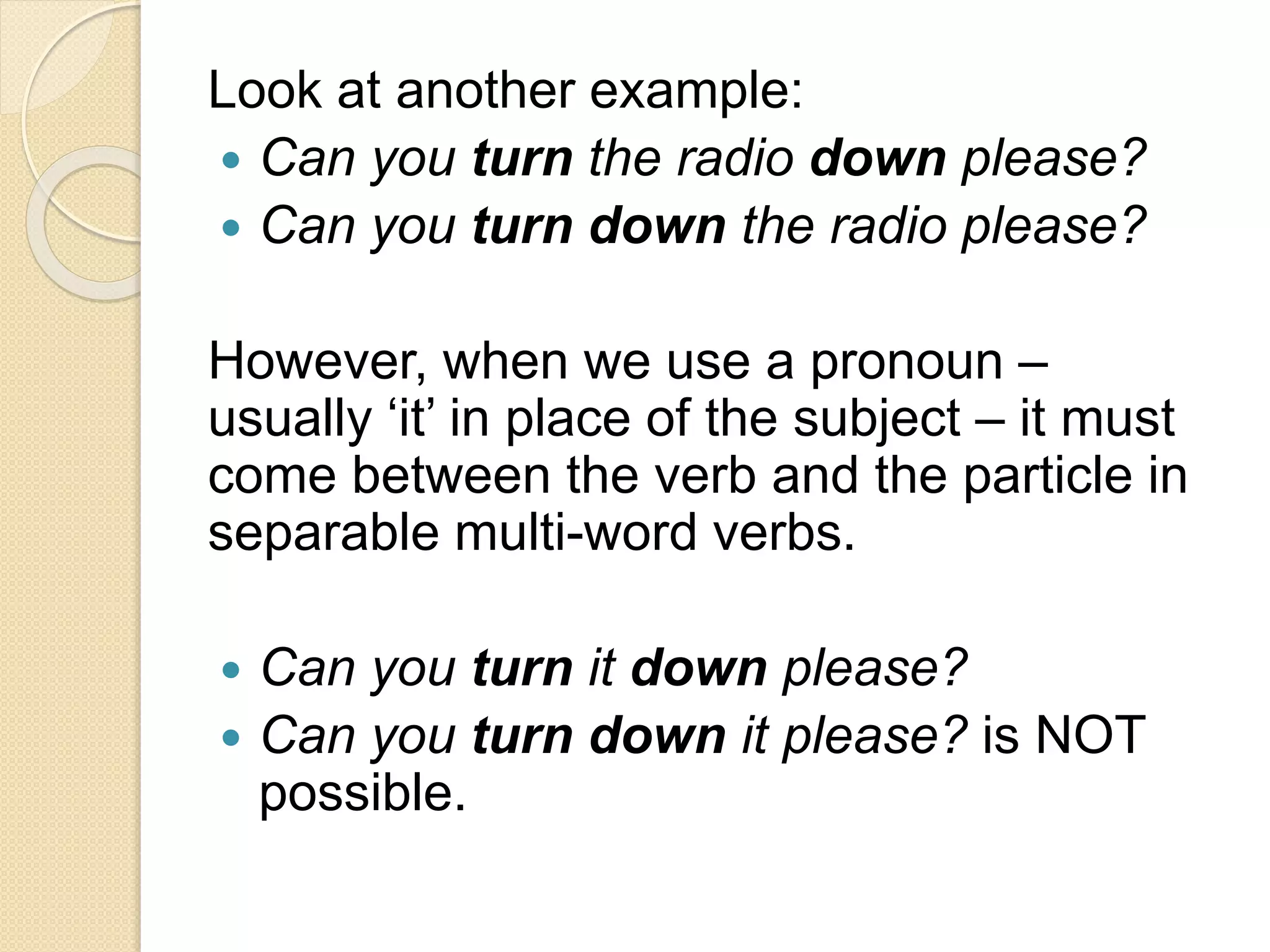
Look at another example:
 Can you turn the radio down please?
 Can you turn down the radio please?
However, when we use a pronoun –
usually ‘it’ in place of the subject – it must
come between the verb and the particle in
separable multi-word verbs.
 Can you turn it down please?
 Can you turn down it please? is NOT
possible.
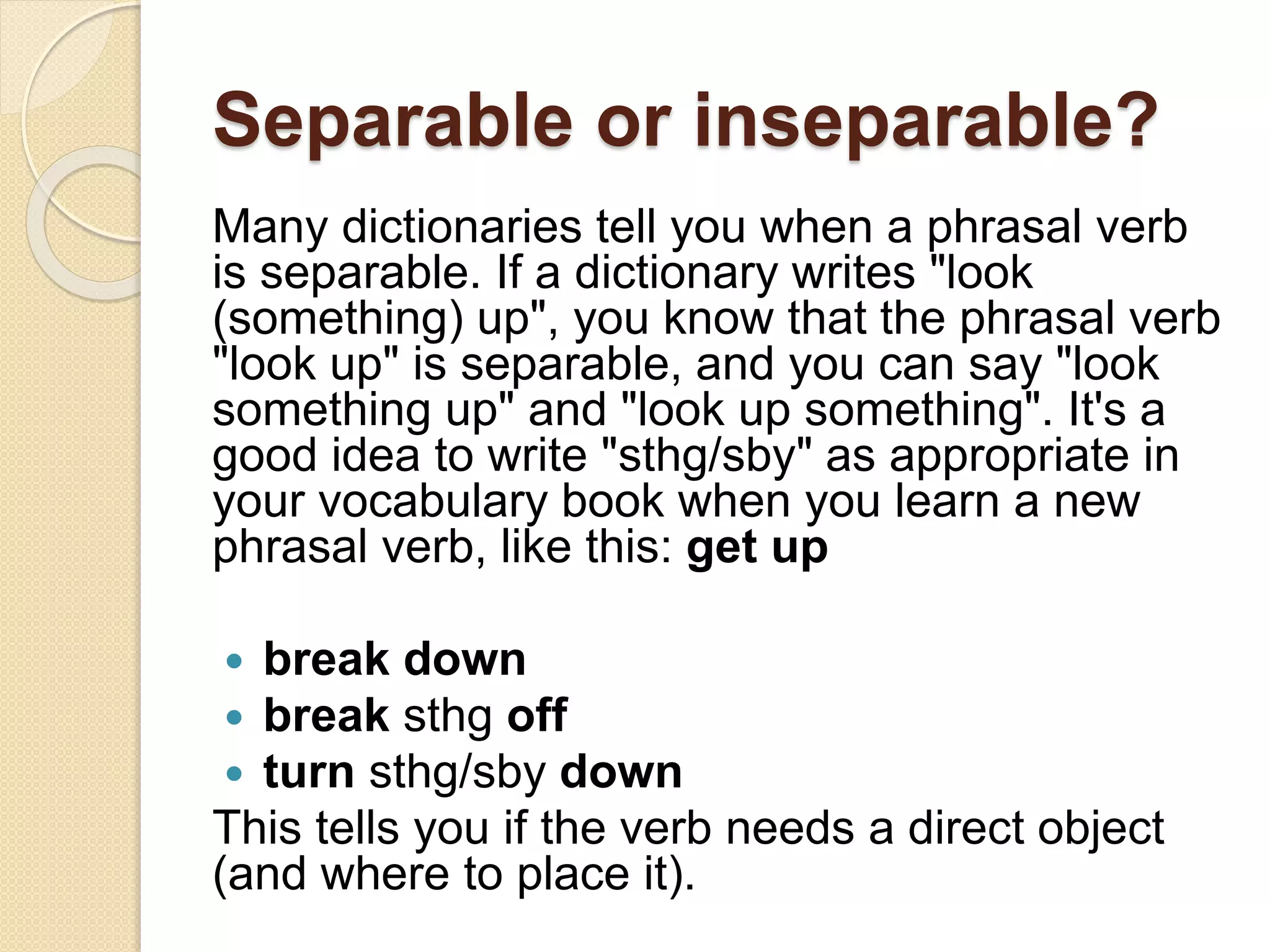
Separable or inseparable?
Many dictionaries tell you when a phrasal verb
is separable. If a dictionary writes "look
(something) up", you know that the phrasal verb
"look up" is separable, and you can say "look
something up" and "look up something". It's a
good idea to write "sthg/sby" as appropriate in
your vocabulary book when you learn a new
phrasal verb, like this: get up
 break down
 break sthg off
 turn sthg/sby down
This tells you if the verb needs a direct object
(and where to place it).
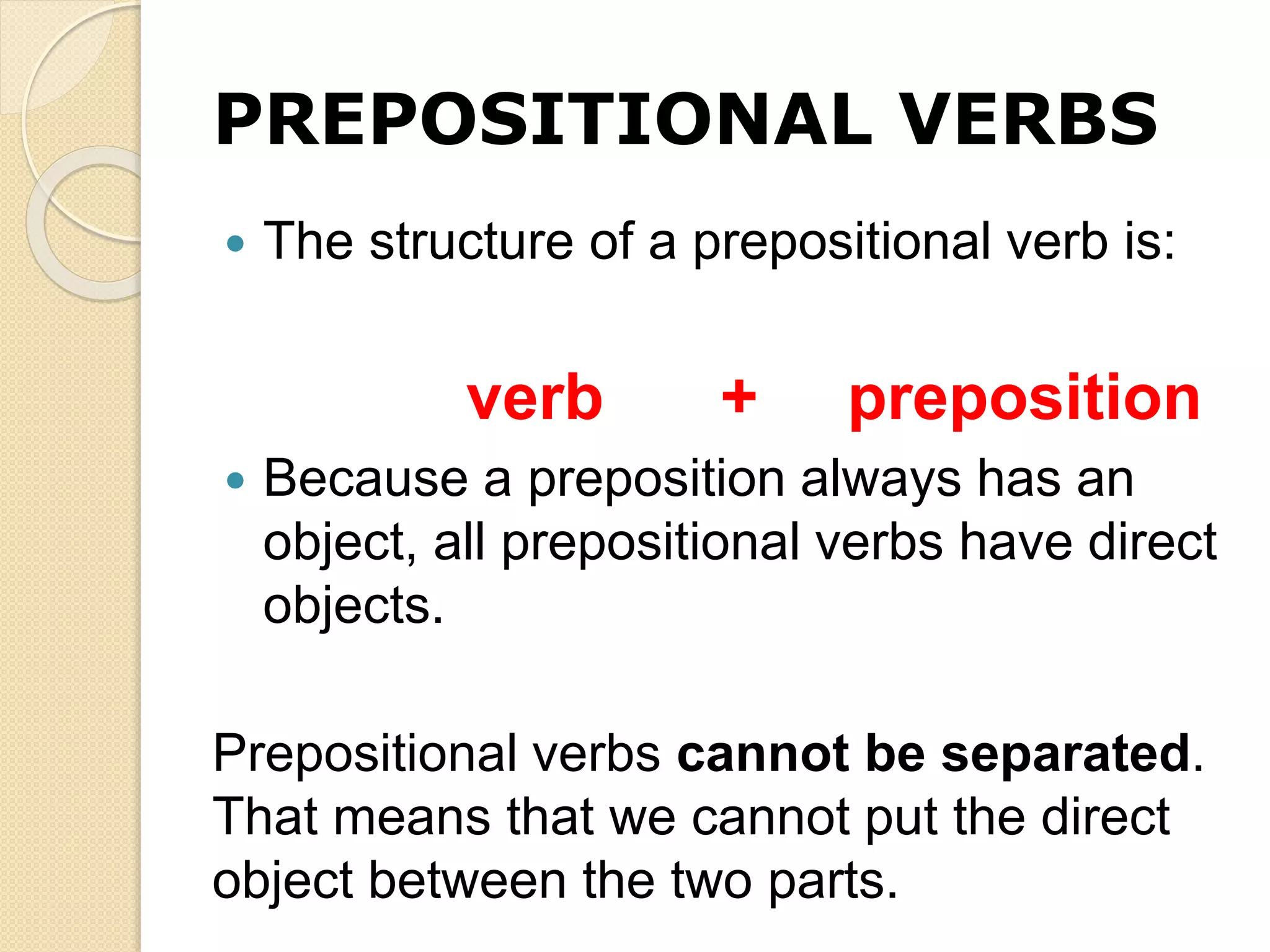
PREPOSITIONAL VERBS
 The structure of a prepositional verb is:
verb + preposition
 Because a preposition always has an
object, all prepositional verbs have direct
objects.
Prepositional verbs cannot be separated.
That means that we cannot put the direct
object between the two parts.
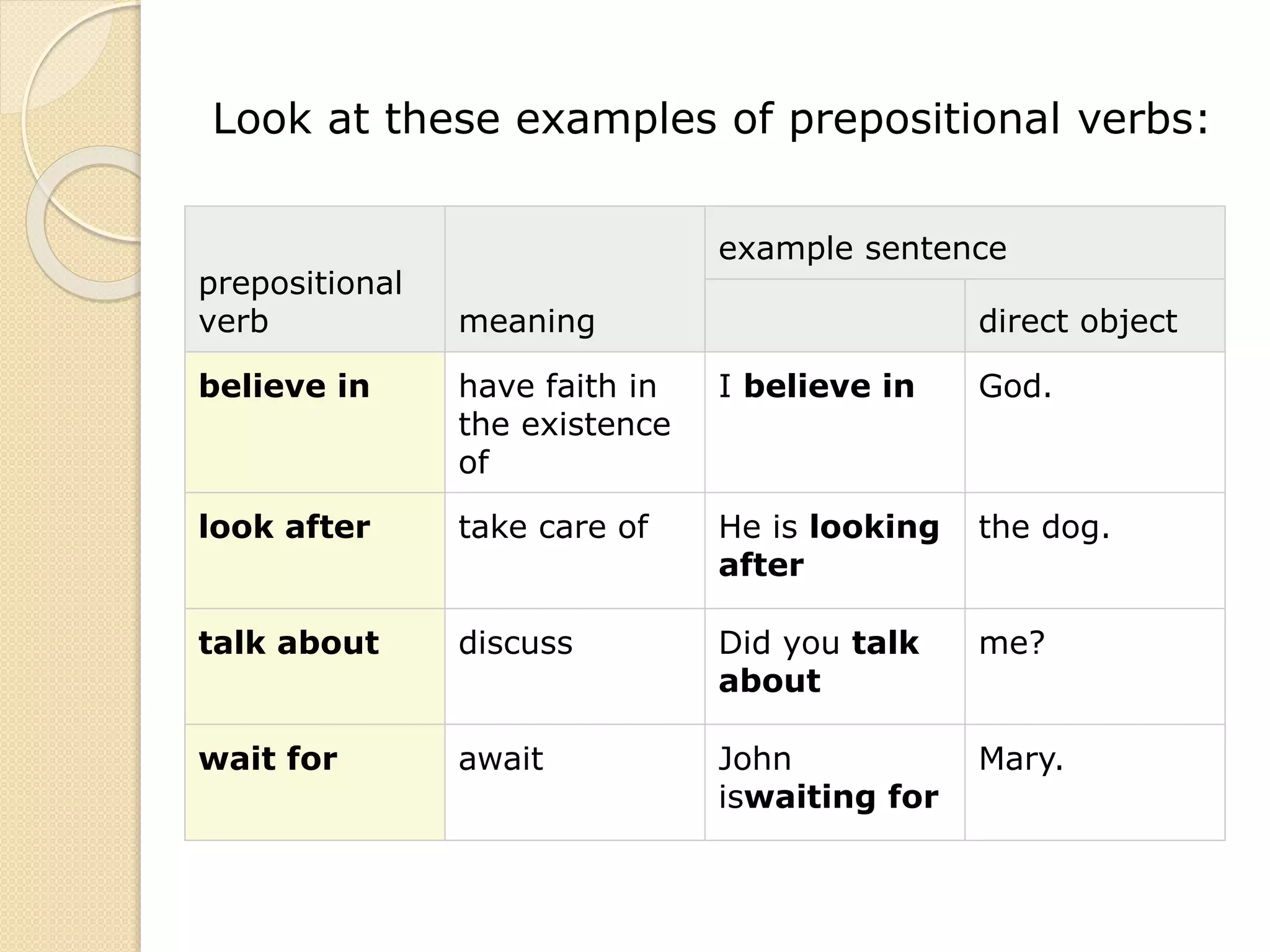
Look at these examples of prepositional verbs:
prepositional
verb meaning
example sentence
direct object
believe in have faith in
the existence
of
I believe in God.
look after take care of He is looking
after
the dog.
talk about discuss Did you talk
about
me?
wait for await John
iswaiting for
Mary.
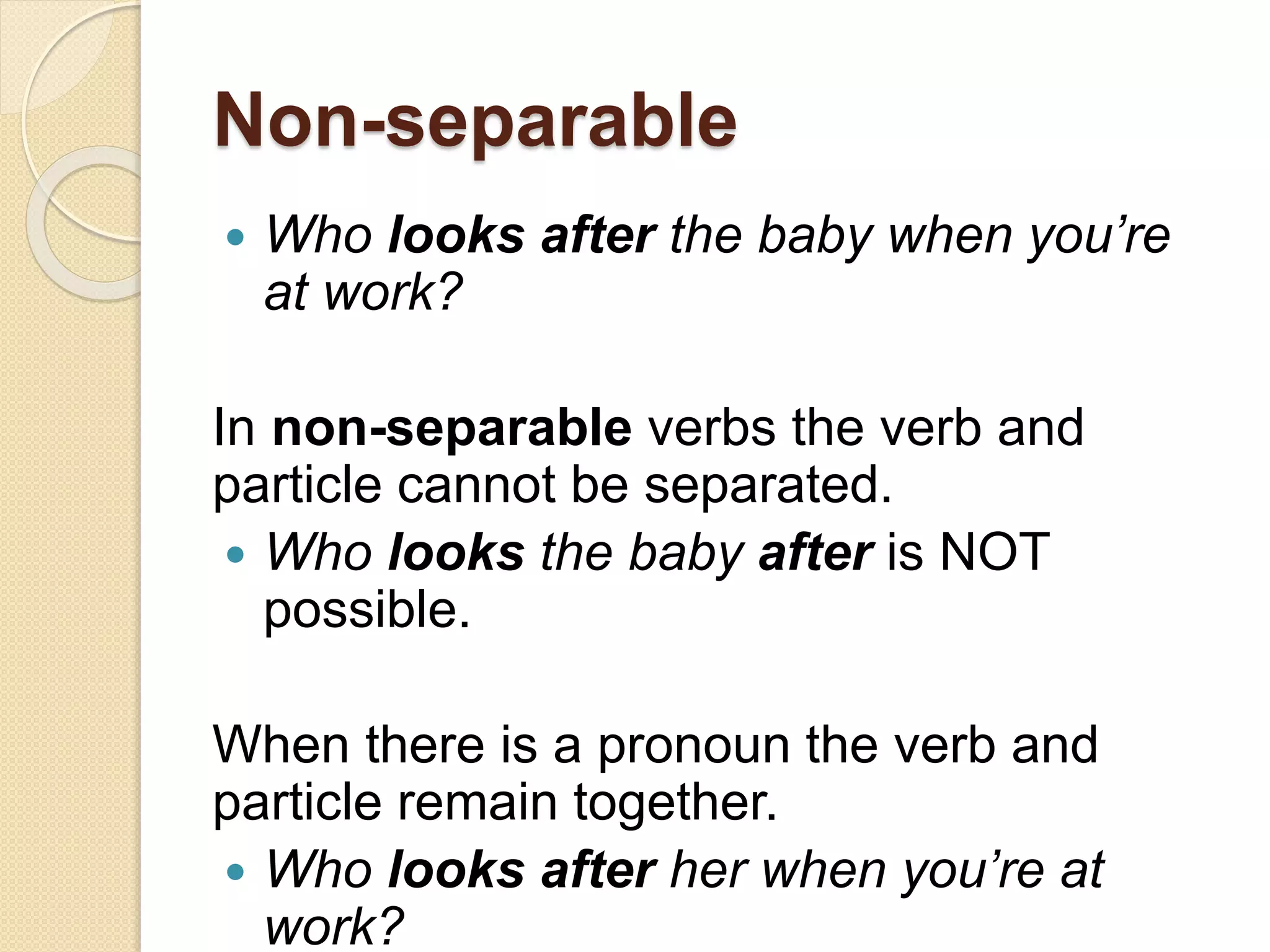
Non-separable
 Who looks after the baby when you’re
at work?
In non-separable verbs the verb and
particle cannot be separated.
 Who looks the baby after is NOT
possible.
When there is a pronoun the verb and
particle remain together.
 Who looks after her when you’re at
work?
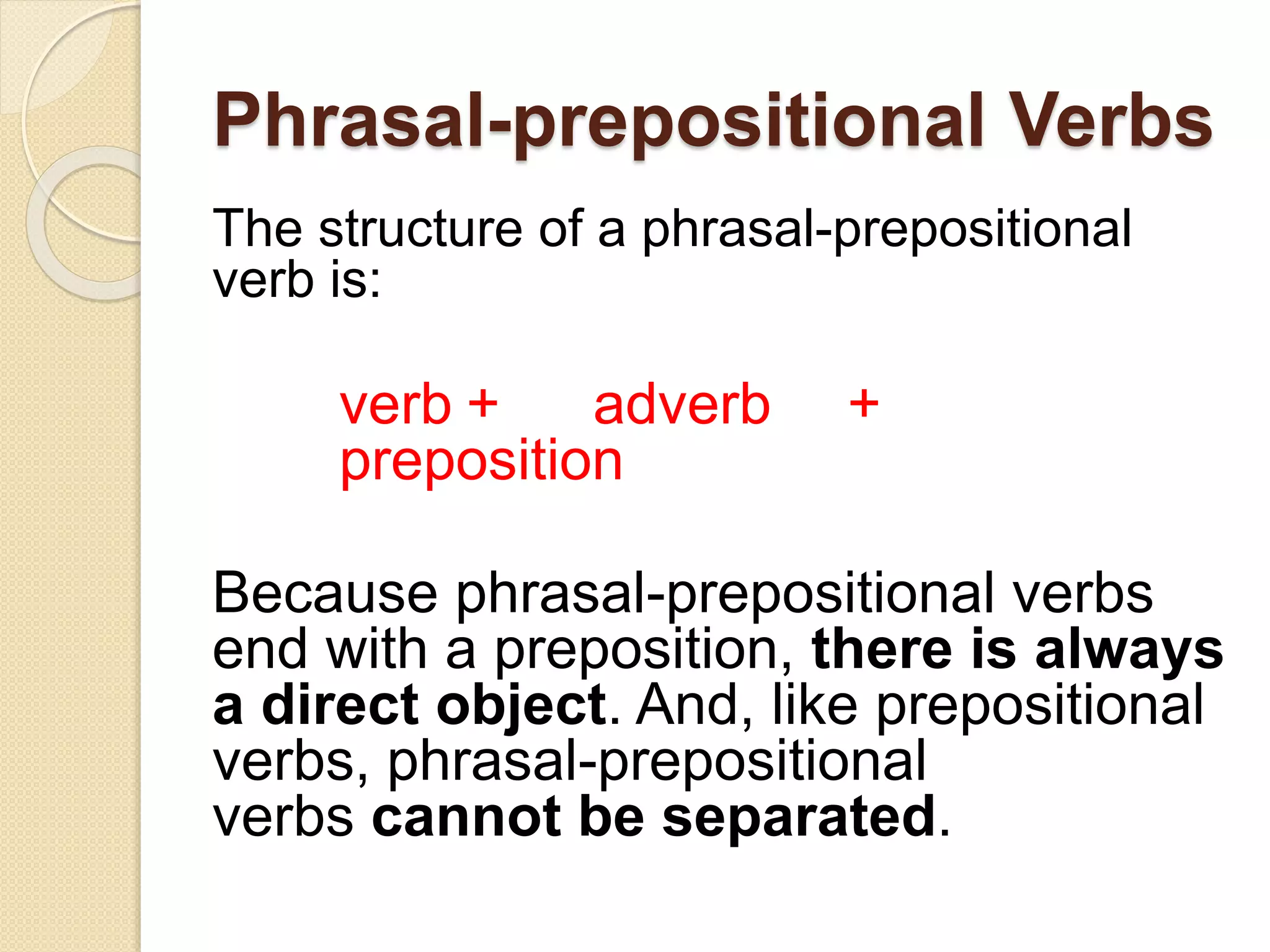
Phrasal-prepositional Verbs
The structure of a phrasal-prepositional
verb is:
verb + adverb +
preposition
Because phrasal-prepositional verbs
end with a preposition, there is always
a direct object. And, like prepositional
verbs, phrasal-prepositional
verbs cannot be separated.
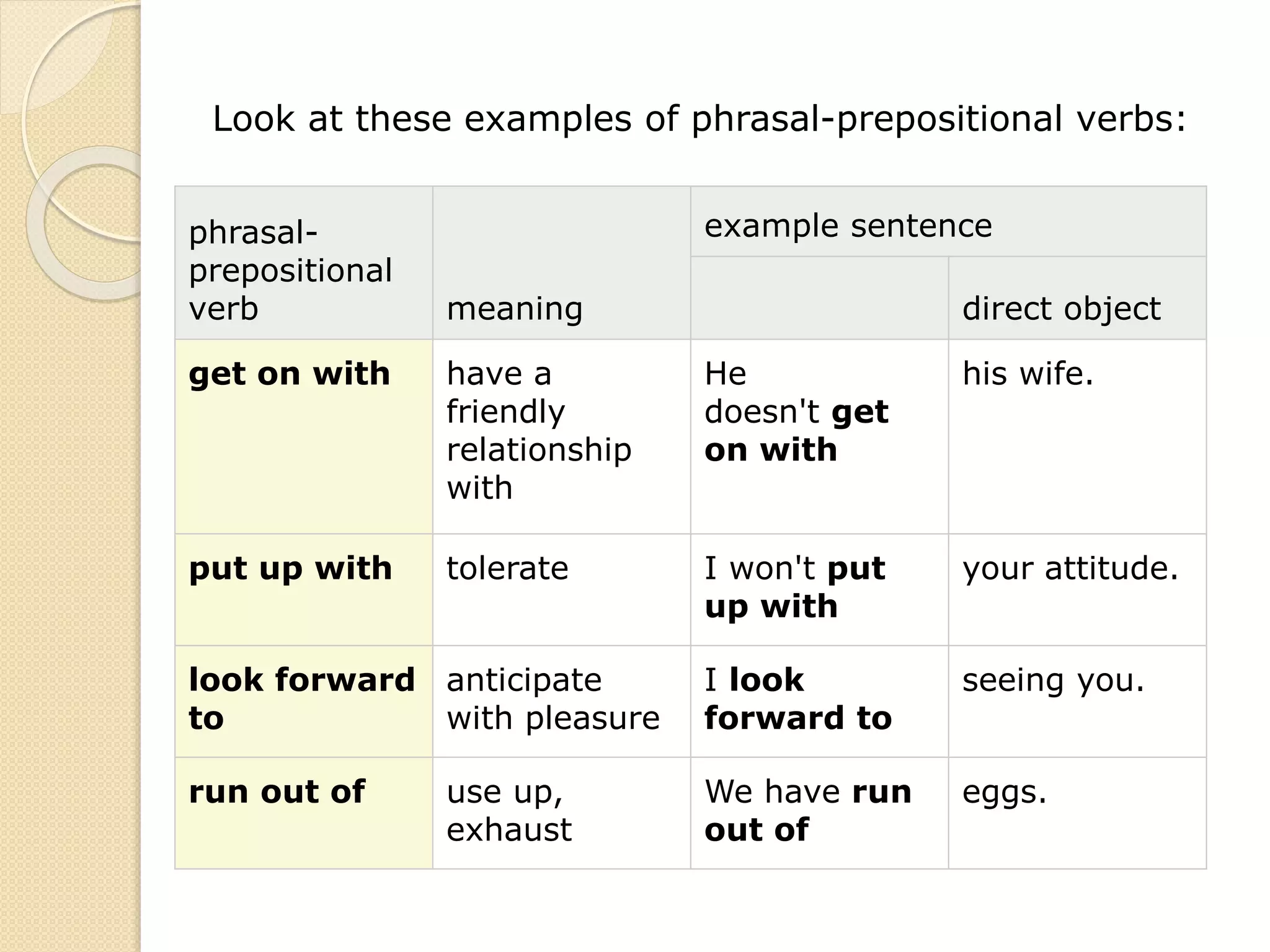
Look at these examples of phrasal-prepositional verbs:
phrasal-
prepositional
verb meaning
example sentence
direct object
get on with have a
friendly
relationship
with
He
doesn't get
on with
his wife.
put up with tolerate I won't put
up with
your attitude.
look forward
to
anticipate
with pleasure
I look
forward to
seeing you.
run out of use up,
exhaust
We have run
out of
eggs.
With two particles
 Who came up with that idea?
 I don’t know how you put up with it.
There are a few verbs with two particles
and they act like inseparable multi-word
verbs.
PRACTICE
 http://learnenglish.britishcouncil.org/pt-
br/grammar-reference/multi-word-
verbs
 https://www.englishclub.com/grammar/
verbs-phrasal-verbs_quiz.htm

E3 Unit 6 multi word verbs

  • 1.
  • 2.
    Multi-word verbs There arevery many multi-word verbs (sometimes called phrasal verbs) in English and it’s very difficult to learn them all. It can sometimes be quite easy to guess the meaning (He picked up the pencil) but other multi-word verbs are less easy to guess (I picked up Italian quite easily when I lived there) and you should look them up in a good dictionary. When you record new multi-word verbs in your notebook it can be helpful to record what type they are. Multi-word verbs are made up of a verb and a particle or, sometimes, two particles. http://learnenglish.britishcouncil.org/pt-br/grammar-reference/multi-word-verbs#sthash.HlJY7fWZ.dpuf
  • 3.
    The structure ofa phrasal verb is: verb + adverb Phrasal verbs can be:  transitive (direct object)  intransitive (no direct object) http://www.k12reader.com/term/transitive-and-intransitive-verbs/
  • 4.
    Intransitive  What timedo you get up?  The plane took off and rose into the sky. Intransitive verbs do not have an object. Multi-word verbs can also be intransitive. http://www.grammar-monster.com/glossary/intransitive_verbs.htm
  • 5.
    Look at theseexamples of phrasal verbs: phrasal verb meaning example sentence direct object transitive put off postpone We will have to put off the meeting. turn down refuse They turned down my offer. intransitive get up rise from bed I don't like to get up. break down cease to function He was late because his car broke down.
  • 6.
    Separable When verbs aretransitive (that is, they have a direct object), we can usually separate the two parts.  He cut the tree down.  He cut down the tree. With separable verbs the verb and particle can be apart or together – the meaning doesn’t change.
  • 7.
    Look at anotherexample:  Can you turn the radio down please?  Can you turn down the radio please? However, when we use a pronoun – usually ‘it’ in place of the subject – it must come between the verb and the particle in separable multi-word verbs.  Can you turn it down please?  Can you turn down it please? is NOT possible.
  • 8.
    Separable or inseparable? Manydictionaries tell you when a phrasal verb is separable. If a dictionary writes "look (something) up", you know that the phrasal verb "look up" is separable, and you can say "look something up" and "look up something". It's a good idea to write "sthg/sby" as appropriate in your vocabulary book when you learn a new phrasal verb, like this: get up  break down  break sthg off  turn sthg/sby down This tells you if the verb needs a direct object (and where to place it).
  • 9.
    PREPOSITIONAL VERBS  Thestructure of a prepositional verb is: verb + preposition  Because a preposition always has an object, all prepositional verbs have direct objects. Prepositional verbs cannot be separated. That means that we cannot put the direct object between the two parts.
  • 10.
    Look at theseexamples of prepositional verbs: prepositional verb meaning example sentence direct object believe in have faith in the existence of I believe in God. look after take care of He is looking after the dog. talk about discuss Did you talk about me? wait for await John iswaiting for Mary.
  • 11.
    Non-separable  Who looksafter the baby when you’re at work? In non-separable verbs the verb and particle cannot be separated.  Who looks the baby after is NOT possible. When there is a pronoun the verb and particle remain together.  Who looks after her when you’re at work?
  • 12.
    Phrasal-prepositional Verbs The structureof a phrasal-prepositional verb is: verb + adverb + preposition Because phrasal-prepositional verbs end with a preposition, there is always a direct object. And, like prepositional verbs, phrasal-prepositional verbs cannot be separated.
  • 13.
    Look at theseexamples of phrasal-prepositional verbs: phrasal- prepositional verb meaning example sentence direct object get on with have a friendly relationship with He doesn't get on with his wife. put up with tolerate I won't put up with your attitude. look forward to anticipate with pleasure I look forward to seeing you. run out of use up, exhaust We have run out of eggs.
  • 14.
    With two particles Who came up with that idea?  I don’t know how you put up with it. There are a few verbs with two particles and they act like inseparable multi-word verbs.
  • 15.