Phrasal Verbs 1
PHRASAL VERBS
DEFINITION, TYPES AND
EXAMPLES.
Phrasal Verbs 2
DEFINITION:
• Phrasal Verbs are verbs with more than
one word. (Normally the verb followed by
a preposition or/and an adverb).
• Examples: pick up, put down, turn on, turn
off
• Phrasal verbs are also called 'two-part
verbs' and 'three-part verbs.'
Phrasal Verbs 3
Types:
• There are two types of phrasal
verbs: separable and non separable
(that is the same as to say transitive or
intransitive).
►Non separable phrasal verbs are
sometimes called 'inseparable.'
Phrasal Verbs 4
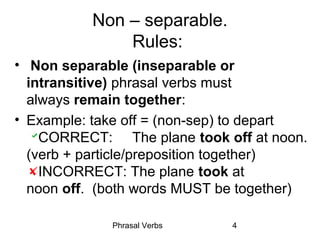
Non – separable.
Rules:
• Non separable (inseparable or
intransitive) phrasal verbs must
always remain together:
• Example: take off = (non-sep) to depart
CORRECT: The plane took off at noon.
(verb + particle/preposition together)
INCORRECT: The plane took at
noon off. (both words MUST be together)
Phrasal Verbs 5
Separable.
Rules:
• Separable (mainly transitive; the object is
involved) phrasal verbs can be written three
different ways:
• Example: take off (sep) = to remove clothing
CORRECT: Sara took off her jacket. (verb +
particle together)
CORRECT: Sara took her jacket off. (verb +
particle separated by noun)
CORRECT: Sara took it off. (verb + particle
separated with a pronoun)
INCORRECT: Sara took off it. (the pronoun
MUST be in the middle)
Phrasal Verbs 6
Phrasal Verbs vs. Prepositional
Verbs:
PREPOSITIONAL VERBS:
There are a very large number of combinations of verb+preposition.
Prepositions always have objects:
• Please look afterlook after the children.
• I've fallen forfallen for you in a big way.
In English, the preposition does not always come before its
object; in certain kinds of sentences, it can come at the end
of the clause:
• What are you talking aboutabout?
Prepositional verbs are those which accept the passive
and/or the pronominal question, but not the adverbial
question form.
Phrasal Verbs 7
IS THE VERB A PHRASAL/PREPOSITIONAL VERB OR NOT?
SEMANTIC CRITERIA FOR PHRASAL/PREPOSITIONAL VERBS.
• The semantic unity in phrasal and prepositional verbs
can often be manifested by substitution with a single-
word verbs, for example: visit for call on, summon for call
up, omit for leave out, see for look at, etc.
• Furthermore, phrasal and prepositional verbs often have
composite meanings which are not normally deducible
from their parts, for example, make out (understand),
take in (deceive),come by (obtain). The terms phrasal
and prepositional verbs are not, however, restricted to
such idiomatic combinations. We can distinguish three
subclasses
Phrasal Verbs 8
How to distinguish these types of
verbs:
Phrasal verbs.
We say that a verb is phrasal because the particle after it is or acts in the end
as an adverb (even though it is sometimes a preposition). They are different
to prepositional verbs because:
• 1. The accent is on the particle, not on the verb.
I'll put 'ON my trousers.
• 2. If the complement is a pronoun, it cannot be placed after the particle.
*I'll put on THEM.
• 3. An adverb can't be placed between the verb and the particle.
*I'll put CAREFULLY on my trousers.
• 4. The particle cannot be placed before the relative pronoun.
*The trousers ON which I put.
• 5. The object (substantive) can be placed between the verb and the particle.
I'll put MY TROUSERS on.
• 6. The pronoun (object) must be placed between the verb and the particle.
I'll put THEM on.
Phrasal Verbs 9
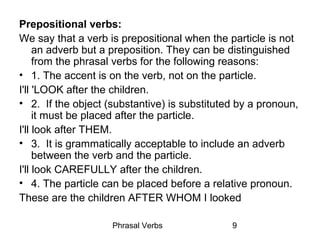
Prepositional verbs:
We say that a verb is prepositional when the particle is not
an adverb but a preposition. They can be distinguished
from the phrasal verbs for the following reasons:
• 1. The accent is on the verb, not on the particle.
I'll 'LOOK after the children.
• 2. If the object (substantive) is substituted by a pronoun,
it must be placed after the particle.
I'll look after THEM.
• 3. It is grammatically acceptable to include an adverb
between the verb and the particle.
I'll look CAREFULLY after the children.
• 4. The particle can be placed before a relative pronoun.
These are the children AFTER WHOM I looked
Phrasal Verbs 10
The end!
• Now, move on to your photocopies on
phrasal verbs, and prepositional verbs and
do the activities.
Phrasal Verbs 11
Activities.
Phrasal Verb Practice -Assorted Verbs.
• The concert was ___ because of the rain.
a. called off
b. blacked out
c. turned off
• How did he ___ their bad behavior.
a. come to
b. account for
c. jot down
• He must be about 90. He is really ___.
a. getting on
b. bringing up
c. bringing forward
• In the end everything ___ OK.
a. turned out
b. wore out
c. climb up
• Can you ___ all right or should I get a ladder?
a. fall through
b. climb down
c. barge in
• I am sorry that I am late. I got ___ in traffic.
a. lifted off
b. held down
c. caught up
• I was so angry that I ___ in protest.
a. gave up
b. walked out
c. ran over
• The man was ___ of jail early for good behaviour.
a. let out
b. bent down
c. sent down
• Even though he was tired, he ___ going.
a. kept on
b. brought out
c. fell over
• After the accident a lot of people ___.
a. turned out
b. set out
c. crowded around

Phrasal Verbs

  • 1.
    Phrasal Verbs 1 PHRASALVERBS DEFINITION, TYPES AND EXAMPLES.
  • 2.
    Phrasal Verbs 2 DEFINITION: •Phrasal Verbs are verbs with more than one word. (Normally the verb followed by a preposition or/and an adverb). • Examples: pick up, put down, turn on, turn off • Phrasal verbs are also called 'two-part verbs' and 'three-part verbs.'
  • 3.
    Phrasal Verbs 3 Types: •There are two types of phrasal verbs: separable and non separable (that is the same as to say transitive or intransitive). ►Non separable phrasal verbs are sometimes called 'inseparable.'
  • 4.
    Phrasal Verbs 4 Non– separable. Rules: • Non separable (inseparable or intransitive) phrasal verbs must always remain together: • Example: take off = (non-sep) to depart CORRECT: The plane took off at noon. (verb + particle/preposition together) INCORRECT: The plane took at noon off. (both words MUST be together)
  • 5.
    Phrasal Verbs 5 Separable. Rules: •Separable (mainly transitive; the object is involved) phrasal verbs can be written three different ways: • Example: take off (sep) = to remove clothing CORRECT: Sara took off her jacket. (verb + particle together) CORRECT: Sara took her jacket off. (verb + particle separated by noun) CORRECT: Sara took it off. (verb + particle separated with a pronoun) INCORRECT: Sara took off it. (the pronoun MUST be in the middle)
  • 6.
    Phrasal Verbs 6 PhrasalVerbs vs. Prepositional Verbs: PREPOSITIONAL VERBS: There are a very large number of combinations of verb+preposition. Prepositions always have objects: • Please look afterlook after the children. • I've fallen forfallen for you in a big way. In English, the preposition does not always come before its object; in certain kinds of sentences, it can come at the end of the clause: • What are you talking aboutabout? Prepositional verbs are those which accept the passive and/or the pronominal question, but not the adverbial question form.
  • 7.
    Phrasal Verbs 7 ISTHE VERB A PHRASAL/PREPOSITIONAL VERB OR NOT? SEMANTIC CRITERIA FOR PHRASAL/PREPOSITIONAL VERBS. • The semantic unity in phrasal and prepositional verbs can often be manifested by substitution with a single- word verbs, for example: visit for call on, summon for call up, omit for leave out, see for look at, etc. • Furthermore, phrasal and prepositional verbs often have composite meanings which are not normally deducible from their parts, for example, make out (understand), take in (deceive),come by (obtain). The terms phrasal and prepositional verbs are not, however, restricted to such idiomatic combinations. We can distinguish three subclasses
  • 8.
    Phrasal Verbs 8 Howto distinguish these types of verbs: Phrasal verbs. We say that a verb is phrasal because the particle after it is or acts in the end as an adverb (even though it is sometimes a preposition). They are different to prepositional verbs because: • 1. The accent is on the particle, not on the verb. I'll put 'ON my trousers. • 2. If the complement is a pronoun, it cannot be placed after the particle. *I'll put on THEM. • 3. An adverb can't be placed between the verb and the particle. *I'll put CAREFULLY on my trousers. • 4. The particle cannot be placed before the relative pronoun. *The trousers ON which I put. • 5. The object (substantive) can be placed between the verb and the particle. I'll put MY TROUSERS on. • 6. The pronoun (object) must be placed between the verb and the particle. I'll put THEM on.
  • 9.
    Phrasal Verbs 9 Prepositionalverbs: We say that a verb is prepositional when the particle is not an adverb but a preposition. They can be distinguished from the phrasal verbs for the following reasons: • 1. The accent is on the verb, not on the particle. I'll 'LOOK after the children. • 2. If the object (substantive) is substituted by a pronoun, it must be placed after the particle. I'll look after THEM. • 3. It is grammatically acceptable to include an adverb between the verb and the particle. I'll look CAREFULLY after the children. • 4. The particle can be placed before a relative pronoun. These are the children AFTER WHOM I looked
  • 10.
    Phrasal Verbs 10 Theend! • Now, move on to your photocopies on phrasal verbs, and prepositional verbs and do the activities.
  • 11.
    Phrasal Verbs 11 Activities. PhrasalVerb Practice -Assorted Verbs. • The concert was ___ because of the rain. a. called off b. blacked out c. turned off • How did he ___ their bad behavior. a. come to b. account for c. jot down • He must be about 90. He is really ___. a. getting on b. bringing up c. bringing forward • In the end everything ___ OK. a. turned out b. wore out c. climb up • Can you ___ all right or should I get a ladder? a. fall through b. climb down c. barge in • I am sorry that I am late. I got ___ in traffic. a. lifted off b. held down c. caught up • I was so angry that I ___ in protest. a. gave up b. walked out c. ran over • The man was ___ of jail early for good behaviour. a. let out b. bent down c. sent down • Even though he was tired, he ___ going. a. kept on b. brought out c. fell over • After the accident a lot of people ___. a. turned out b. set out c. crowded around