PHRASAL
VERBS
INSTRUCTIONS
1. PHRASAL VERBS – EXPLANATION
2. PHRASAL VERBS SEPARABLE AND
INSEPARABLE
THEN, ACTIVITIES TIME!
4
EXPLANATION
WHAT’S A PHRASAL VERB?
✘ They consist of a verb (put,take,show...) and one or two
particles (off,out,by,up...).
For example: I got along with my classmates
I woke up early
5
WHAT’S A PHRASAL VERB?
✘ In some cases, they create meaning different from the
original verb and many times it can be replaced by a
synonym, normally used in more formal situations.
For example:
Look: Look after my baby!
Look for = search / Make up: invent
6
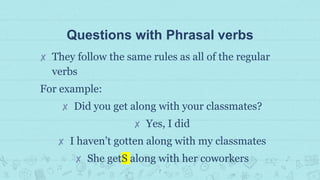
Questions with Phrasal verbs
✘ They follow the same rules as all of the regular
verbs
For example:
✘ Did you get along with your classmates?
✘ Yes, I did
✘ I haven’t gotten along with my classmates
✘ She getS along with her coworkers
7
ACTIVITIES
8
OBJECT PRONOUNS
✘ An object pronoun is not the subject of the sentence. It is
usually the object that is affected in some way by
the subject of the sentence.
1. She ate ice cream
Did she eat IT?
2. Andres: I wanted to call Maria
Ethan: Did you call HER?
9
OBJECT PRONOUNS
10
ACTIVITIES
Kahoot
11
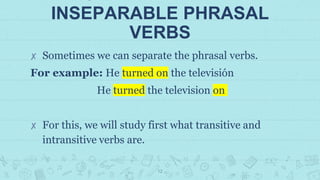
INSEPARABLE PHRASAL
VERBS
✘ Sometimes we can separate the phrasal verbs.
For example: He turned on the televisión
He turned the television on
✘ For this, we will study first what transitive and
intransitive verbs are.
12
INTRANSITIVE VERBS
✘ Intransitive phrasal verbs have no direct object.
Therefore, they are not separable.
✘ Examples of intransitive phrasal verbs:
• I woke up at 10:30 AM.
• You can come over to my house after school.
• Sit down!
• Shut up.
13
TRANSITIVE VERBS
✘ Transitive phrasal verbs have a direct object so they
have an object that receives the action. Examples of
transitive phrasal verbs are:
• You need to fill out this form to register for the
course.
• I’m going to cut down on fast food this year. (cut
down on = reduce)
• Check out that website – it’s really great!
• I’m looking for my books.14
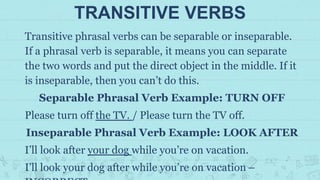
TRANSITIVE VERBS
Transitive phrasal verbs can be separable or inseparable.
If a phrasal verb is separable, it means you can separate
the two words and put the direct object in the middle. If it
is inseparable, then you can’t do this.
Separable Phrasal Verb Example: TURN OFF
Please turn off the TV. / Please turn the TV off.
Inseparable Phrasal Verb Example: LOOK AFTER
I’ll look after your dog while you’re on vacation.
I’ll look your dog after while you’re on vacation –
15
TRANSITIVE VERBS
✘ When the direct object is the specific name of a thing or
a person, it can be located after the phrasal verb or in
the middle:
I threw away the old pizza. = I threw the old pizza away.
✘ However, when the direct object is a pronoun (me, you,
him, her, us, them, it), then it MUST go in the middle:
I threw it away.
I threw away it. – INCORRECT
16
TRANSITIVE VERBS
✘ Here’s another example:
• They’ll pick up John from the airport
They’ll pick John up from the airport.
• They’ll pick him up from the airport.
They’ll pick up him from the airport. – INCORRECT
17
Are all the transitive verbs
separable?
✘ Transitive phrasal verbs will be separable
depending on the particle. A good dictionary
helps!
✘ When the particle is an adverb, phrasal verbs can
be separable. The object can be placed between
the verb and the adverb.
He took off his jacket
He took his jacket off
18
Are all the transitive verbs
separable?
✘ After is used in the following ways: as a preposition
(followed by a noun): I went for a
swim after breakfast. as an adverb (without a
following noun): He died on June 3rd and was buried
the day after. as a conjunction (connecting two
clauses): After you'd left, I got a phone call from
Stuart.
19
20
21
✘ Common verbs/Regular verbs: smile, Play, look,
speak (transitivos e intransitivos)
✘ Phrasal verbs: look for, come up with, wake up,
make up (transitivos e intransitivos).
ACTIVITIES
https://youtu.be/HH3SKpHW9qc
S-v-o
S-v-c
23
CONGRATULATIONS
!!!
NOW, LET’S CONTINUE WITH PART 2
GOOD JOB FRIEND, you have
finished this week activities!
26
THANKS!
Any questions?
You can find me at jeraldinballesteros@unicauca.edu.co
BIBLIOGRAPHY
✘ Woodwardenglish. (2016). Recuperado de:
https://www.grammar.cl/Notes/Some_Any_A_An
.htm
27

Phrasal verbs .pptx

  • 2.
  • 3.
    INSTRUCTIONS 1. PHRASAL VERBS– EXPLANATION 2. PHRASAL VERBS SEPARABLE AND INSEPARABLE THEN, ACTIVITIES TIME!
  • 4.
  • 5.
    WHAT’S A PHRASALVERB? ✘ They consist of a verb (put,take,show...) and one or two particles (off,out,by,up...). For example: I got along with my classmates I woke up early 5
  • 6.
    WHAT’S A PHRASALVERB? ✘ In some cases, they create meaning different from the original verb and many times it can be replaced by a synonym, normally used in more formal situations. For example: Look: Look after my baby! Look for = search / Make up: invent 6
  • 7.
    Questions with Phrasalverbs ✘ They follow the same rules as all of the regular verbs For example: ✘ Did you get along with your classmates? ✘ Yes, I did ✘ I haven’t gotten along with my classmates ✘ She getS along with her coworkers 7
  • 8.
  • 9.
    OBJECT PRONOUNS ✘ Anobject pronoun is not the subject of the sentence. It is usually the object that is affected in some way by the subject of the sentence. 1. She ate ice cream Did she eat IT? 2. Andres: I wanted to call Maria Ethan: Did you call HER? 9
  • 10.
  • 11.
  • 12.
    INSEPARABLE PHRASAL VERBS ✘ Sometimeswe can separate the phrasal verbs. For example: He turned on the televisión He turned the television on ✘ For this, we will study first what transitive and intransitive verbs are. 12
  • 13.
    INTRANSITIVE VERBS ✘ Intransitivephrasal verbs have no direct object. Therefore, they are not separable. ✘ Examples of intransitive phrasal verbs: • I woke up at 10:30 AM. • You can come over to my house after school. • Sit down! • Shut up. 13
  • 14.
    TRANSITIVE VERBS ✘ Transitivephrasal verbs have a direct object so they have an object that receives the action. Examples of transitive phrasal verbs are: • You need to fill out this form to register for the course. • I’m going to cut down on fast food this year. (cut down on = reduce) • Check out that website – it’s really great! • I’m looking for my books.14
  • 15.
    TRANSITIVE VERBS Transitive phrasalverbs can be separable or inseparable. If a phrasal verb is separable, it means you can separate the two words and put the direct object in the middle. If it is inseparable, then you can’t do this. Separable Phrasal Verb Example: TURN OFF Please turn off the TV. / Please turn the TV off. Inseparable Phrasal Verb Example: LOOK AFTER I’ll look after your dog while you’re on vacation. I’ll look your dog after while you’re on vacation – 15
  • 16.
    TRANSITIVE VERBS ✘ Whenthe direct object is the specific name of a thing or a person, it can be located after the phrasal verb or in the middle: I threw away the old pizza. = I threw the old pizza away. ✘ However, when the direct object is a pronoun (me, you, him, her, us, them, it), then it MUST go in the middle: I threw it away. I threw away it. – INCORRECT 16
  • 17.
    TRANSITIVE VERBS ✘ Here’sanother example: • They’ll pick up John from the airport They’ll pick John up from the airport. • They’ll pick him up from the airport. They’ll pick up him from the airport. – INCORRECT 17
  • 18.
    Are all thetransitive verbs separable? ✘ Transitive phrasal verbs will be separable depending on the particle. A good dictionary helps! ✘ When the particle is an adverb, phrasal verbs can be separable. The object can be placed between the verb and the adverb. He took off his jacket He took his jacket off 18
  • 19.
    Are all thetransitive verbs separable? ✘ After is used in the following ways: as a preposition (followed by a noun): I went for a swim after breakfast. as an adverb (without a following noun): He died on June 3rd and was buried the day after. as a conjunction (connecting two clauses): After you'd left, I got a phone call from Stuart. 19
  • 20.
  • 21.
  • 22.
    ✘ Common verbs/Regularverbs: smile, Play, look, speak (transitivos e intransitivos) ✘ Phrasal verbs: look for, come up with, wake up, make up (transitivos e intransitivos).
  • 23.
  • 24.
  • 25.
    GOOD JOB FRIEND,you have finished this week activities!
  • 26.
    26 THANKS! Any questions? You canfind me at jeraldinballesteros@unicauca.edu.co
  • 27.
    BIBLIOGRAPHY ✘ Woodwardenglish. (2016).Recuperado de: https://www.grammar.cl/Notes/Some_Any_A_An .htm 27