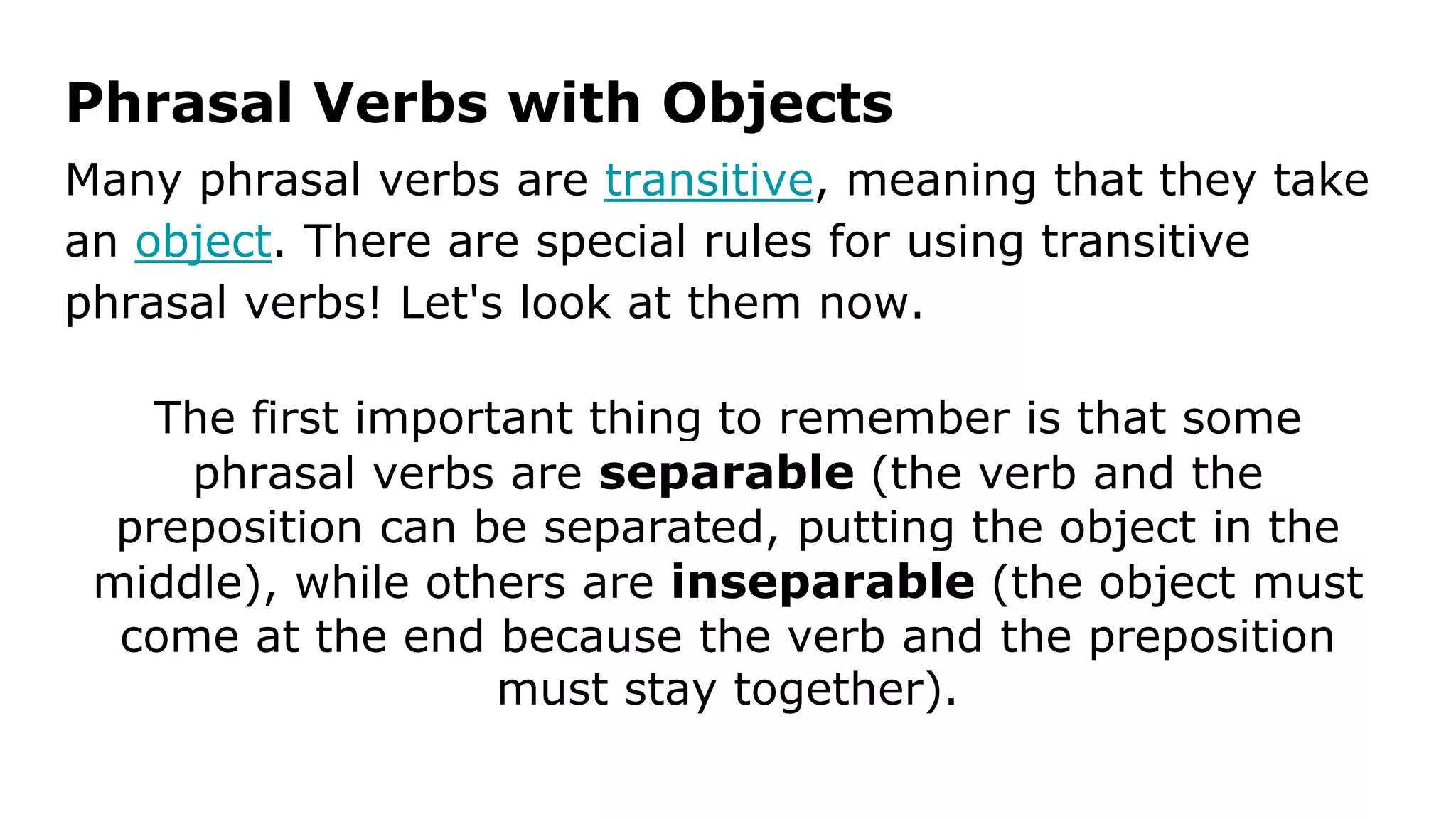
Phrasal Verbs with Objects
Many phrasal verbs are transitive, meaning that they take
an object. There are special rules for using transitive
phrasal verbs! Let's look at them now.
The first important thing to remember is that some
phrasal verbs are separable (the verb and the
preposition can be separated, putting the object in the
middle), while others are inseparable (the object must
come at the end because the verb and the preposition
must stay together).
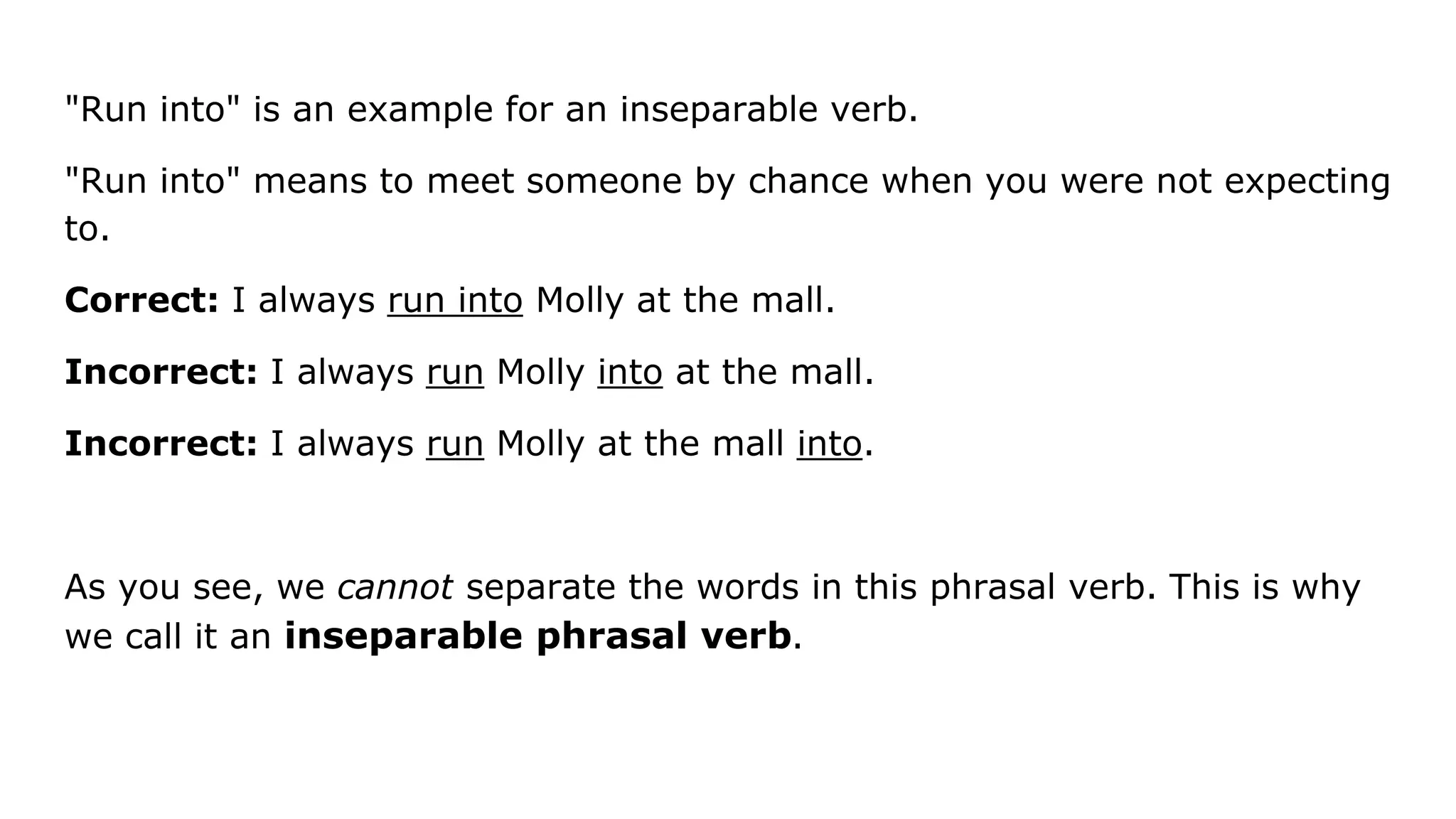
"Run into" is an example for an inseparable verb.
"Run into" means to meet someone by chance when you were not expecting
to.
Correct: I always run into Molly at the mall.
Incorrect: I always run Molly into at the mall.
Incorrect: I always run Molly at the mall into.
As you see, we cannot separate the words in this phrasal verb. This is why
we call it an inseparable phrasal verb.
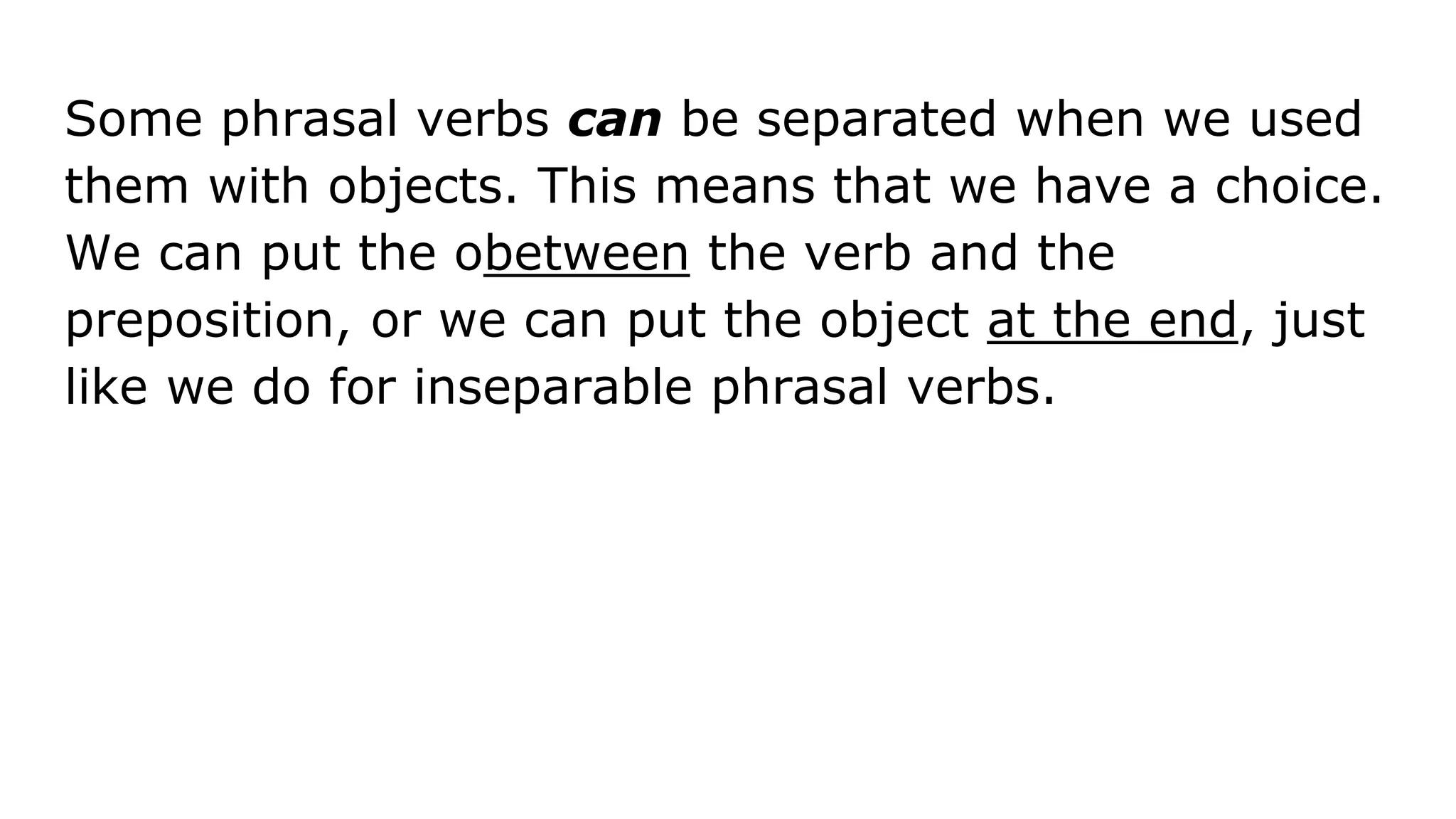
Some phrasal verbs can be separated when we used
them with objects. This means that we have a choice.
We can put the obetween the verb and the
preposition, or we can put the object at the end, just
like we do for inseparable phrasal verbs.
"Write down" is an example for a separable verb.
"Write down" means to make a note some information on
paper.
We can separate this phrasal verb if we want! Look at the
examples below to see how this construction works.
Correct: His students write down everything he says.
Correct: His students write everything he says down.
As you see, we can separate the words in this phrasal verb. This is
why we call it a separable phrasal verb.
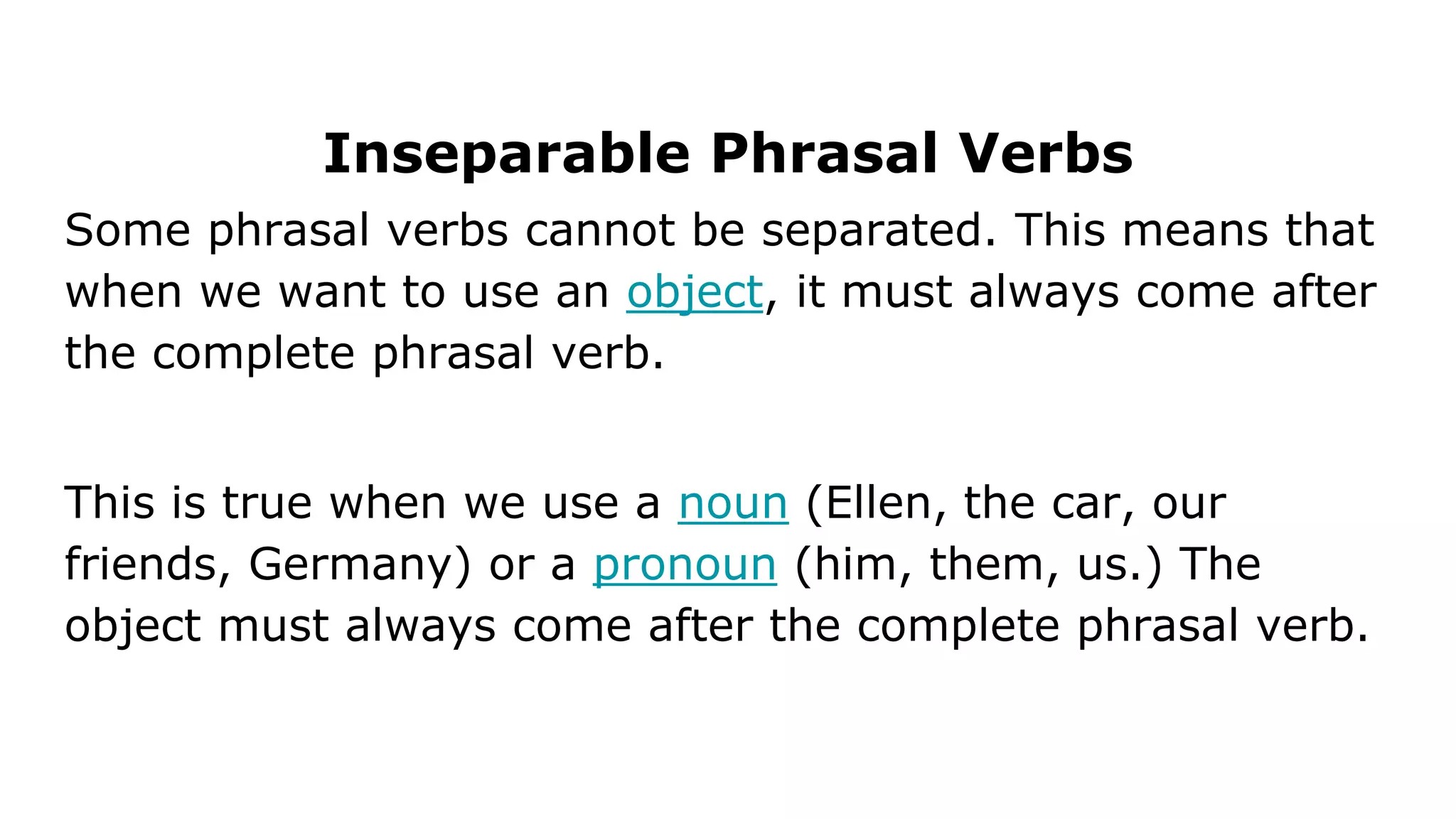
Inseparable Phrasal Verbs
Some phrasal verbs cannot be separated. This means that
when we want to use an object, it must always come after
the complete phrasal verb.
This is true when we use a noun (Ellen, the car, our
friends, Germany) or a pronoun (him, them, us.) The
object must always come after the complete phrasal verb.
1. Get on/off
The phrasal verbs get on/off talk about entering
or exiting a mode of transportation. These
phrasal verbs work for boats, airplanes, trains,
bicycles, and motorcycles. (If we are talking
about a car, we use get in/out.)
EXAMPLES:
● Everyone must get on the plane and fasten their seatbelts
before we can take off.
● Get off that motorcycle if you don't have a helmet! It's
dangerous to ride without one.
● I had to run to get on the train, but I made it!
● It was hard for him to get off the boat, because he was
feeling a little sick when they reached the dock!
2. Run into
This phrasal verb means to meet someone by chance when you were not
expecting to. The object (who we met) must always come at the end!
Examples:
● This is such a big city! I'm always amazed when I run into someone I
know on the street.
● Melanie said she ran into Mrs. Dawson last week. Do you remember
her? Our fifth grade English teacher!
● I hope I run into Dr. Borelli at the conference. It would be really
interesting to talk about his latest research.
3. Look after
This phrasal verb means to take care of. We often use it when we are talking about taking
care of children or animals. We don't use it for objects or projects.
The people or pets we are taking care of must come at the end of the phrasal verb.
Examples:
● Could you please look after my cat while I'm vacation? She's really no trouble.
● Karen loves looking after her nephew in the afternoon while his father is at work.
● Lisa and Matthew are going to look after the kids this weekend. They're going to have
lots of fun!
4. Run out of
We use this phrasal verb when we had something,
but we have used it all, and now it is all gone.
Remember that the item we no longer have must go
at the very end of this phrasal verb because it is
inseparable.
Examples:
● Oh no, it looks like we've run out of yogurt. What will I have
for breakfast now?
● We had to wait a whole hour with the new client until my
boss finally arrived. It was terrible! Eventually I ran out of
polite things to ask him.
● Chet was having a lovely afternoon drive until he ran out of
gas!
5. Put up with
This phrasal verb means to endure a person or situation
that we don't like. We have to accept the person or
situation although we don't enjoy it.
Again, the person or situation we find annoying or difficult
must come after the preposition in this inseparable phrasal
verb.
Examples:
● I am so tired of putting up with my roommate's sister!
She comes over every afternoon and plays loud music!
● Sometimes we have to put up with difficult situations at
work, but it's important not to get too stressed.
● Alfred smokes outside so that his co-workers don't have
to put up with the smell of his cigarettes.
Separable Phrasal Verbs
Some phrasal verbs can be separated when we used them with
objects. This means that we have a choice. We can put the object
between the verb and the preposition, or we can put the object at
the end, just like we do for inseparable phrasal verbs.
However, there is one important thing to remember! If we want to
use a pronoun (like him, her, them, us, or it), we must separate
the phrasal verb.
For example:
Correct: This is very important information. Please write it down.
Incorrect: This is very important information. Please write down it.
It's also important to remember that if the object is quite long, we usually
do not separate the phrasal verb.
It is not grammatically incorrect to separate the phrasal verbs in these
cases, but it is much clearer for the listener if we do not separate the
phrasal verb.
For example:
Clear: Can I use the car? I need to pick up a friend of mine from summer
camp at the airport.
Confusing: Can I use the car? I need to pick a friend of mine from
summer camp up at the airport.
five common
separable phrasal
verbs.
1. Write down
This phrasal verb means to make a note of something with a
pen and paper, for example. We do not use it for typing or
for a general meaning of writing, such as writing a book. We
use it when we are making a note of some information on
paper.
We can separate this phrasal verb if we want! Look at the
examples below to see how this construction works.
Examples:
● Dr. Watson is an excellent professor. Her students write down
everything she says.
● Yolanda hasn't got any paper, but she needs to write the
number down.
● Olivia has so many ideas! She wants to write them all down
before she forgets them!
2. Pick up
This phrasal verb means to go and get someone in your car. It can
also mean to lift something up with your hands.
In either case, the object can come in the middle of the phrasal
verb or at the end.
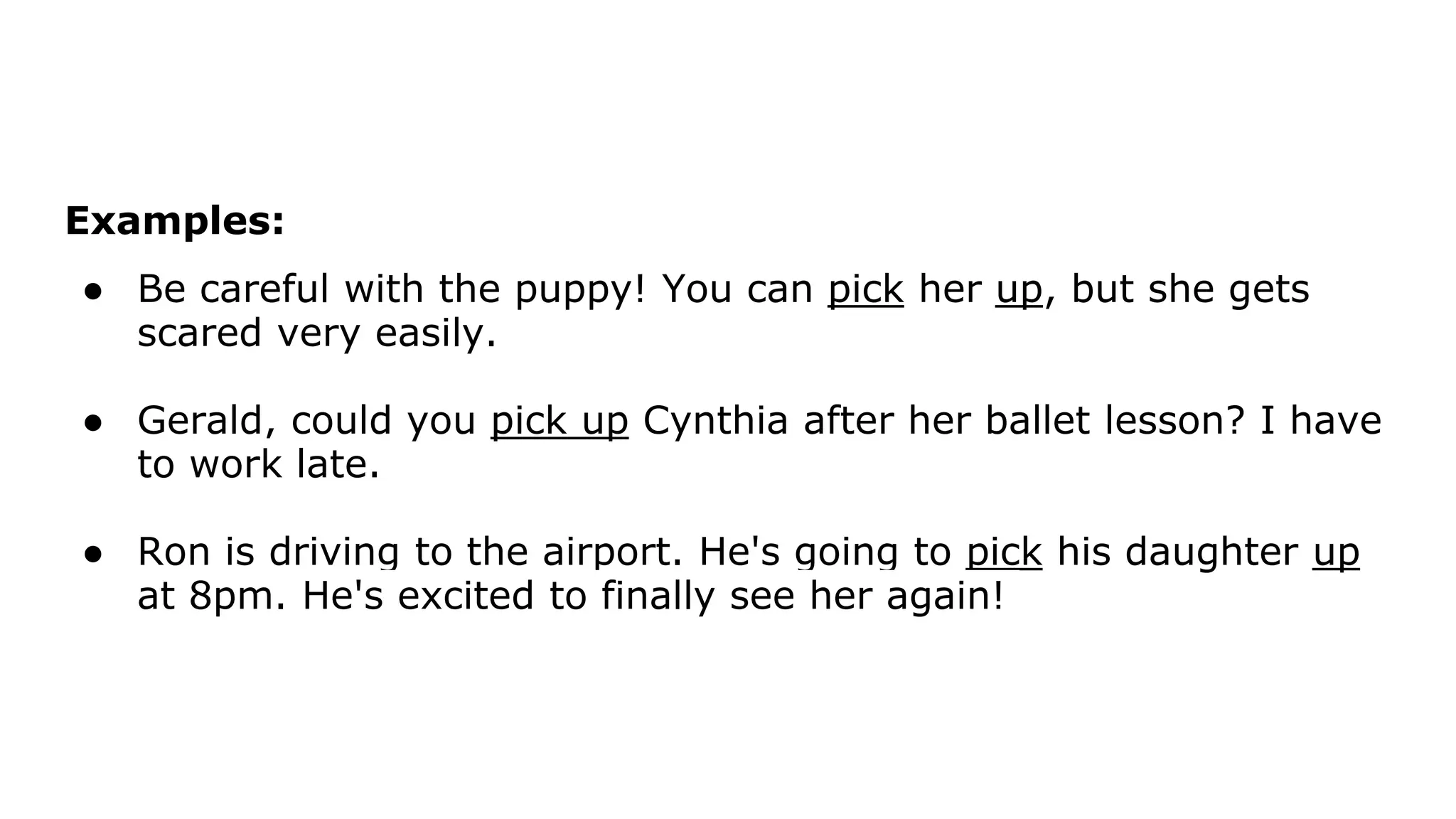
Examples:
● Be careful with the puppy! You can pick her up, but she gets
scared very easily.
● Gerald, could you pick up Cynthia after her ballet lesson? I have
to work late.
● Ron is driving to the airport. He's going to pick his daughter up
at 8pm. He's excited to finally see her again!
3. Put on
This phrasal verb is used for clothing. Once we have put
something on, we are now wearing it.
Since this verb is separable, the piece of clothing we are
putting on can come in the middle of the verb or at the end.
Examples:
● It's terribly cold out! Please put your coat on before you go out.
● Charlotte is such a clown! She put on a ridiculous red hat to go
to the party. Everyone thought it was very funny.
● Henry was in such a rush before work this morning that he left
without putting his jacket on!
4. Turn down
This phrasal verb means to refuse an offer.
The object of this phrasal verb can be the offer
itself or the person who has made the offer to us.
Examples:
● My supervisor told me they want to give me a promotion, but I
think I'm going to turn the new job down. I'm just too busy with
my kids to accept more work right now.
● Ursula won a free trip to the coast, but she turned it down because
her sister is getting married the same weekend.
● Doug proposed to Claire! He sure hopes she won't turn him down.
5. Make up
This phrasal verb means to invent a story or an excuse.
We use it when someone has invented a story that is not
true.
The story or excuse can come in the middle of the verb or
at the end since this phrasal verb is separable.
Examples:
● The children in my afternoon class make up the most wonderful
stories when we have story time! They are very creative.
● I just can't stand Wanda! She always has some excuse for arriving
late, but I think she makes them up.
● Talking to Susan is so much fun. Maybe she makes up half her
stories, but they're entertaining anyway.
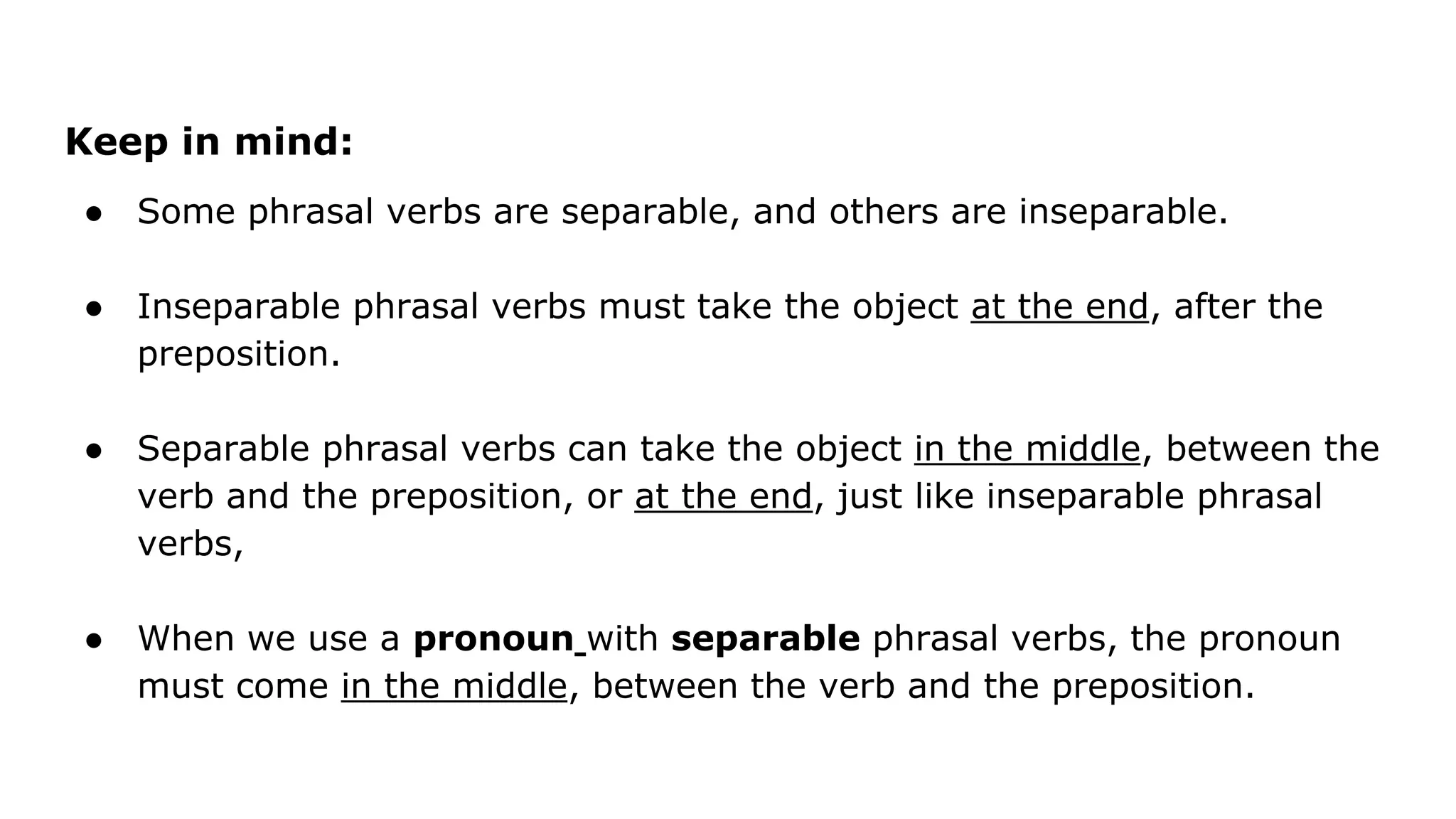
Keep in mind:
● Some phrasal verbs are separable, and others are inseparable.
● Inseparable phrasal verbs must take the object at the end, after the
preposition.
● Separable phrasal verbs can take the object in the middle, between the
verb and the preposition, or at the end, just like inseparable phrasal
verbs,
● When we use a pronoun with separable phrasal verbs, the pronoun
must come in the middle, between the verb and the preposition.

Seperable and nonseperable phrasal verbs (1).pptx

  • 1.
    Phrasal Verbs withObjects Many phrasal verbs are transitive, meaning that they take an object. There are special rules for using transitive phrasal verbs! Let's look at them now. The first important thing to remember is that some phrasal verbs are separable (the verb and the preposition can be separated, putting the object in the middle), while others are inseparable (the object must come at the end because the verb and the preposition must stay together).
  • 2.
    "Run into" isan example for an inseparable verb. "Run into" means to meet someone by chance when you were not expecting to. Correct: I always run into Molly at the mall. Incorrect: I always run Molly into at the mall. Incorrect: I always run Molly at the mall into. As you see, we cannot separate the words in this phrasal verb. This is why we call it an inseparable phrasal verb.
  • 3.
    Some phrasal verbscan be separated when we used them with objects. This means that we have a choice. We can put the obetween the verb and the preposition, or we can put the object at the end, just like we do for inseparable phrasal verbs.
  • 4.
    "Write down" isan example for a separable verb. "Write down" means to make a note some information on paper. We can separate this phrasal verb if we want! Look at the examples below to see how this construction works. Correct: His students write down everything he says. Correct: His students write everything he says down. As you see, we can separate the words in this phrasal verb. This is why we call it a separable phrasal verb.
  • 5.
    Inseparable Phrasal Verbs Somephrasal verbs cannot be separated. This means that when we want to use an object, it must always come after the complete phrasal verb. This is true when we use a noun (Ellen, the car, our friends, Germany) or a pronoun (him, them, us.) The object must always come after the complete phrasal verb.
  • 6.
    1. Get on/off Thephrasal verbs get on/off talk about entering or exiting a mode of transportation. These phrasal verbs work for boats, airplanes, trains, bicycles, and motorcycles. (If we are talking about a car, we use get in/out.)
  • 7.
    EXAMPLES: ● Everyone mustget on the plane and fasten their seatbelts before we can take off. ● Get off that motorcycle if you don't have a helmet! It's dangerous to ride without one. ● I had to run to get on the train, but I made it! ● It was hard for him to get off the boat, because he was feeling a little sick when they reached the dock!
  • 8.
    2. Run into Thisphrasal verb means to meet someone by chance when you were not expecting to. The object (who we met) must always come at the end! Examples: ● This is such a big city! I'm always amazed when I run into someone I know on the street. ● Melanie said she ran into Mrs. Dawson last week. Do you remember her? Our fifth grade English teacher! ● I hope I run into Dr. Borelli at the conference. It would be really interesting to talk about his latest research.
  • 9.
    3. Look after Thisphrasal verb means to take care of. We often use it when we are talking about taking care of children or animals. We don't use it for objects or projects. The people or pets we are taking care of must come at the end of the phrasal verb. Examples: ● Could you please look after my cat while I'm vacation? She's really no trouble. ● Karen loves looking after her nephew in the afternoon while his father is at work. ● Lisa and Matthew are going to look after the kids this weekend. They're going to have lots of fun!
  • 10.
    4. Run outof We use this phrasal verb when we had something, but we have used it all, and now it is all gone. Remember that the item we no longer have must go at the very end of this phrasal verb because it is inseparable.
  • 11.
    Examples: ● Oh no,it looks like we've run out of yogurt. What will I have for breakfast now? ● We had to wait a whole hour with the new client until my boss finally arrived. It was terrible! Eventually I ran out of polite things to ask him. ● Chet was having a lovely afternoon drive until he ran out of gas!
  • 12.
    5. Put upwith This phrasal verb means to endure a person or situation that we don't like. We have to accept the person or situation although we don't enjoy it. Again, the person or situation we find annoying or difficult must come after the preposition in this inseparable phrasal verb.
  • 13.
    Examples: ● I amso tired of putting up with my roommate's sister! She comes over every afternoon and plays loud music! ● Sometimes we have to put up with difficult situations at work, but it's important not to get too stressed. ● Alfred smokes outside so that his co-workers don't have to put up with the smell of his cigarettes.
  • 14.
    Separable Phrasal Verbs Somephrasal verbs can be separated when we used them with objects. This means that we have a choice. We can put the object between the verb and the preposition, or we can put the object at the end, just like we do for inseparable phrasal verbs. However, there is one important thing to remember! If we want to use a pronoun (like him, her, them, us, or it), we must separate the phrasal verb.
  • 15.
    For example: Correct: Thisis very important information. Please write it down. Incorrect: This is very important information. Please write down it. It's also important to remember that if the object is quite long, we usually do not separate the phrasal verb. It is not grammatically incorrect to separate the phrasal verbs in these cases, but it is much clearer for the listener if we do not separate the phrasal verb. For example: Clear: Can I use the car? I need to pick up a friend of mine from summer camp at the airport. Confusing: Can I use the car? I need to pick a friend of mine from summer camp up at the airport.
  • 16.
  • 17.
    1. Write down Thisphrasal verb means to make a note of something with a pen and paper, for example. We do not use it for typing or for a general meaning of writing, such as writing a book. We use it when we are making a note of some information on paper. We can separate this phrasal verb if we want! Look at the examples below to see how this construction works.
  • 18.
    Examples: ● Dr. Watsonis an excellent professor. Her students write down everything she says. ● Yolanda hasn't got any paper, but she needs to write the number down. ● Olivia has so many ideas! She wants to write them all down before she forgets them!
  • 19.
    2. Pick up Thisphrasal verb means to go and get someone in your car. It can also mean to lift something up with your hands. In either case, the object can come in the middle of the phrasal verb or at the end.
  • 20.
    Examples: ● Be carefulwith the puppy! You can pick her up, but she gets scared very easily. ● Gerald, could you pick up Cynthia after her ballet lesson? I have to work late. ● Ron is driving to the airport. He's going to pick his daughter up at 8pm. He's excited to finally see her again!
  • 21.
    3. Put on Thisphrasal verb is used for clothing. Once we have put something on, we are now wearing it. Since this verb is separable, the piece of clothing we are putting on can come in the middle of the verb or at the end.
  • 22.
    Examples: ● It's terriblycold out! Please put your coat on before you go out. ● Charlotte is such a clown! She put on a ridiculous red hat to go to the party. Everyone thought it was very funny. ● Henry was in such a rush before work this morning that he left without putting his jacket on!
  • 23.
    4. Turn down Thisphrasal verb means to refuse an offer. The object of this phrasal verb can be the offer itself or the person who has made the offer to us.
  • 24.
    Examples: ● My supervisortold me they want to give me a promotion, but I think I'm going to turn the new job down. I'm just too busy with my kids to accept more work right now. ● Ursula won a free trip to the coast, but she turned it down because her sister is getting married the same weekend. ● Doug proposed to Claire! He sure hopes she won't turn him down.
  • 25.
    5. Make up Thisphrasal verb means to invent a story or an excuse. We use it when someone has invented a story that is not true. The story or excuse can come in the middle of the verb or at the end since this phrasal verb is separable.
  • 26.
    Examples: ● The childrenin my afternoon class make up the most wonderful stories when we have story time! They are very creative. ● I just can't stand Wanda! She always has some excuse for arriving late, but I think she makes them up. ● Talking to Susan is so much fun. Maybe she makes up half her stories, but they're entertaining anyway.
  • 27.
    Keep in mind: ●Some phrasal verbs are separable, and others are inseparable. ● Inseparable phrasal verbs must take the object at the end, after the preposition. ● Separable phrasal verbs can take the object in the middle, between the verb and the preposition, or at the end, just like inseparable phrasal verbs, ● When we use a pronoun with separable phrasal verbs, the pronoun must come in the middle, between the verb and the preposition.