What are phrasal verbs?
A phrasal verb is a verb plus a preposition or
adverb which creates a meaning different from
the original verb.
An adverb in a literal phrasal verb modifies the
verb it is attached to, and a preposition links the
subject to the verb.
TRANSITIVE AND INTRANSITIVE
PHRASAL VERBS
 transitive phrasal verbs have a direct object*
 intransitive phrasal verbs do not have a direct
object.
*An object is a word or part of a sentence that is
affected by the action of a verb.
EXAMPLES OF INTRANSITIVE VERBS
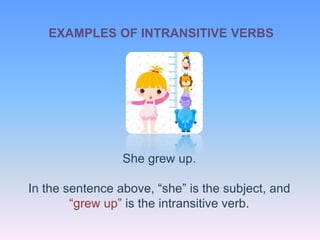
She grew up.
In the sentence above, “she” is the subject, and
“grew up” is the intransitive verb.
We will talk tomorrow.
Will talk: this verb is an intransitive verb.
It has no direct object.
The kids are jumping.
Jumping: this verb is an intransitive verb.
It has no direct object.
put off (postpone, move to a later time):
We’ve put off the meeting for a week.
(put off = phrasal verb, object = ‘the
meeting’)
EXAMPLES OF TRANSITIVE VERBS
Came across (find by accident)
I CAME ACROSS my old school reports
when I was clearing out my desk.
(came across = phrasal verb, object = old
school reports)
set up (organise, configure):
I’ve set up a filter in my email inbox.
(set up = phrasal verb, object = ‘my email’)
SEPARABLE OR INSEPARABLE
PHRASAL VERBS
A further way of considering phrasal verbs is
whether they are separable or inseparable.
 In inseparable verbs, the object comes after
the particle.
For example:
"She got on the bus .“
"On weekdays, we look after our grandchildren.“
Separable verbs have several ways of
separating verb, particle and object.
Usually, the object comes between verb
and particle.
For example:
"She looked up the word in her dictionary."
He put on the jacket.
phrasal verbs,

phrasal verbs,

  • 2.
    What are phrasalverbs? A phrasal verb is a verb plus a preposition or adverb which creates a meaning different from the original verb. An adverb in a literal phrasal verb modifies the verb it is attached to, and a preposition links the subject to the verb.
  • 4.
    TRANSITIVE AND INTRANSITIVE PHRASALVERBS  transitive phrasal verbs have a direct object*  intransitive phrasal verbs do not have a direct object. *An object is a word or part of a sentence that is affected by the action of a verb.
  • 5.
    EXAMPLES OF INTRANSITIVEVERBS She grew up. In the sentence above, “she” is the subject, and “grew up” is the intransitive verb.
  • 6.
    We will talktomorrow. Will talk: this verb is an intransitive verb. It has no direct object.
  • 7.
    The kids arejumping. Jumping: this verb is an intransitive verb. It has no direct object.
  • 8.
    put off (postpone,move to a later time): We’ve put off the meeting for a week. (put off = phrasal verb, object = ‘the meeting’) EXAMPLES OF TRANSITIVE VERBS
  • 9.
    Came across (findby accident) I CAME ACROSS my old school reports when I was clearing out my desk. (came across = phrasal verb, object = old school reports)
  • 10.
    set up (organise,configure): I’ve set up a filter in my email inbox. (set up = phrasal verb, object = ‘my email’)
  • 11.
    SEPARABLE OR INSEPARABLE PHRASALVERBS A further way of considering phrasal verbs is whether they are separable or inseparable.  In inseparable verbs, the object comes after the particle.
  • 12.
    For example: "She goton the bus .“ "On weekdays, we look after our grandchildren.“
  • 13.
    Separable verbs haveseveral ways of separating verb, particle and object. Usually, the object comes between verb and particle. For example: "She looked up the word in her dictionary."
  • 14.
    He put onthe jacket.