Wednesday, April 27, 2011Oral Language: More Voice WorkLiterature: Sound in Poetry
Housekeepingpink slipsExams will be given back next Wednesday
Voice WorkIn preparation for your oral presentations, we will continue with our voice work.diaphragmatic breathing articulationprojection expression
Warm-up – Facial StretchPinch your face inOpen up your faceRepeat several timesStick out your tongue out as far as you can and move it aroundSay the syllable “la” in as many ways as you can Repeat the last step, but change your face.  Massage the tension from your jaws, cheeks, and temples.
Warm-up - ProjectionDeep belly breaths with hand on bellyStage Whisper – see handout
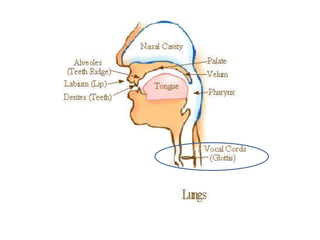
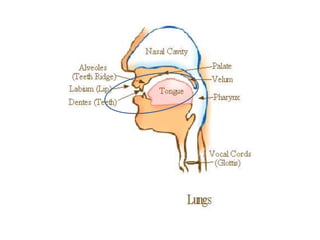
Making and Shaping Soundswhen we exhale, air moves our vocal chords in our throat and they vibrate, creating sound
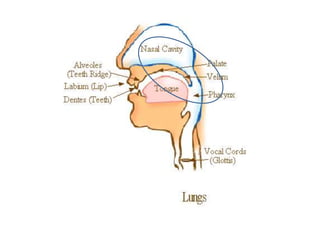
Making and Shaping Soundssound is also shaped in your mouth and throat
Making and Shaping SoundsResonance – vibration and audibility Vowels are open sustained sounds that make your voice audible, able to be heardFormed by roof of your mouth, back of your throat and your sinuses
Vowel Warm upSee handout
Making and Shaping SoundsArticulation – clear and precise pronunciation of wordsConsonants or “stopped” soundsShaped by your jaws, lips, tongue, teeth and far roof of your mouth
Consonant WarmupSee handout
Poetry Warm-upIn pairs, each student should read one of the poems aloud to his/her partner.  One student should read “Annabel Lee” and the other “Recuerdo.”Remember to speak from your belly!
BREAK
Sound in Poetry – Analysis QuestionsQuestions 1, 2, 3, 6, 7, 8, and 9 were assigned.At your table, discuss the question number that I assign you for 5-10 minutes.  Make note of any questions or disagreements.We will go over all the questions together now.
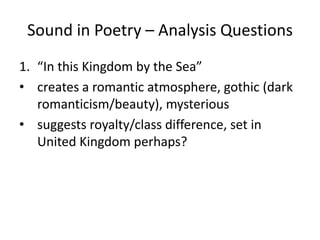
Sound in Poetry – Analysis Questions“In this Kingdom by the Sea” creates a romantic atmosphere, gothic (dark romanticism/beauty), mysterioussuggests royalty/class difference, set in United Kingdom perhaps?
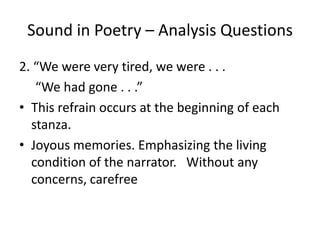
Sound in Poetry – Analysis Questions2. “We were very tired, we were . . .      “We had gone . . .” This refrain occurs at the beginning of each stanza.Joyous memories. Emphasizing the living condition of the narrator.   Without any concerns, carefree
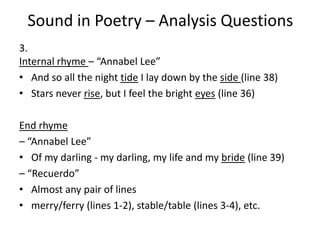
Sound in Poetry – Analysis Questions3. Internal rhyme – “Annabel Lee”And so all the night tide I lay down by the side (line 38)Stars never rise, but I feel the bright eyes (line 36)End rhyme – “Annabel Lee”Of my darling - my darling, my life and my bride (line 39)– “Recuerdo”Almost any pair of linesmerry/ferry (lines 1-2), stable/table (lines 3-4), etc.
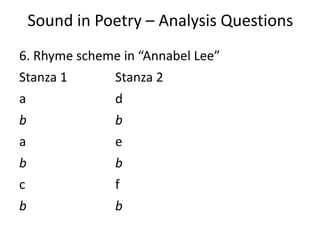
Sound in Poetry – Analysis Questions6. Rhyme scheme in “Annabel Lee”Stanza 1		Stanza 2a				db				ba				eb				bc				fb				b
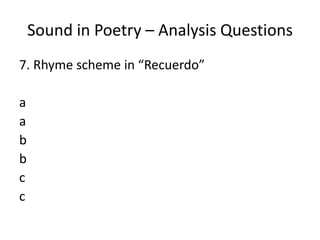
Sound in Poetry – Analysis Questions7. Rhyme scheme in “Recuerdo”aabbcc
Sound in Poetry“Annabel Lee,” by Edgar Allan Poehttp://www.freesound.org/samplesViewSingle.php?id=47235http://www.youtube.com/watch?v=cxWE5mVi4Sg&feature=related“Recuerdo,” by Edna St. Vincent Millayhttp://ia700201.us.archive.org/16/items/recuerdo_librivox/recuerdo_millay_apc_64kb.mp3
Sound in Poetry – Analysis Questions8. The rhythm in “Annabel Lee” is inconsistent, sometimes choppy and fast and at other times slower and smoother, like waves. The mood is sad, intense, mournful. 9. The rhythm in “Recuerdo” switches between shorter lines that seem to pause in the middle, and longer lines that don’t have as obvious a pause. This creates a mood that sometimes feels calm and relaxed and at others, lively and energetic.
In-class Poetry AssignmentWrite a clear, detailed response to question #2 on page 21 of your handout.
HomeworkNo homework!Bring your “English Skills” textbook on Monday. We will be doing in-class writing.

E10 apr27 2011

  • 1.
    Wednesday, April 27,2011Oral Language: More Voice WorkLiterature: Sound in Poetry
  • 2.
    Housekeepingpink slipsExams willbe given back next Wednesday
  • 3.
    Voice WorkIn preparationfor your oral presentations, we will continue with our voice work.diaphragmatic breathing articulationprojection expression
  • 4.
    Warm-up – FacialStretchPinch your face inOpen up your faceRepeat several timesStick out your tongue out as far as you can and move it aroundSay the syllable “la” in as many ways as you can Repeat the last step, but change your face.  Massage the tension from your jaws, cheeks, and temples.
  • 5.
    Warm-up - ProjectionDeepbelly breaths with hand on bellyStage Whisper – see handout
  • 6.
    Making and ShapingSoundswhen we exhale, air moves our vocal chords in our throat and they vibrate, creating sound
  • 8.
    Making and ShapingSoundssound is also shaped in your mouth and throat
  • 9.
    Making and ShapingSoundsResonance – vibration and audibility Vowels are open sustained sounds that make your voice audible, able to be heardFormed by roof of your mouth, back of your throat and your sinuses
  • 11.
  • 12.
    Making and ShapingSoundsArticulation – clear and precise pronunciation of wordsConsonants or “stopped” soundsShaped by your jaws, lips, tongue, teeth and far roof of your mouth
  • 14.
  • 15.
    Poetry Warm-upIn pairs,each student should read one of the poems aloud to his/her partner. One student should read “Annabel Lee” and the other “Recuerdo.”Remember to speak from your belly!
  • 16.
  • 17.
    Sound in Poetry– Analysis QuestionsQuestions 1, 2, 3, 6, 7, 8, and 9 were assigned.At your table, discuss the question number that I assign you for 5-10 minutes. Make note of any questions or disagreements.We will go over all the questions together now.
  • 18.
    Sound in Poetry– Analysis Questions“In this Kingdom by the Sea” creates a romantic atmosphere, gothic (dark romanticism/beauty), mysterioussuggests royalty/class difference, set in United Kingdom perhaps?
  • 19.
    Sound in Poetry– Analysis Questions2. “We were very tired, we were . . . “We had gone . . .” This refrain occurs at the beginning of each stanza.Joyous memories. Emphasizing the living condition of the narrator. Without any concerns, carefree
  • 20.
    Sound in Poetry– Analysis Questions3. Internal rhyme – “Annabel Lee”And so all the night tide I lay down by the side (line 38)Stars never rise, but I feel the bright eyes (line 36)End rhyme – “Annabel Lee”Of my darling - my darling, my life and my bride (line 39)– “Recuerdo”Almost any pair of linesmerry/ferry (lines 1-2), stable/table (lines 3-4), etc.
  • 21.
    Sound in Poetry– Analysis Questions6. Rhyme scheme in “Annabel Lee”Stanza 1 Stanza 2a db ba eb bc fb b
  • 22.
    Sound in Poetry– Analysis Questions7. Rhyme scheme in “Recuerdo”aabbcc
  • 23.
    Sound in Poetry“AnnabelLee,” by Edgar Allan Poehttp://www.freesound.org/samplesViewSingle.php?id=47235http://www.youtube.com/watch?v=cxWE5mVi4Sg&feature=related“Recuerdo,” by Edna St. Vincent Millayhttp://ia700201.us.archive.org/16/items/recuerdo_librivox/recuerdo_millay_apc_64kb.mp3
  • 24.
    Sound in Poetry– Analysis Questions8. The rhythm in “Annabel Lee” is inconsistent, sometimes choppy and fast and at other times slower and smoother, like waves. The mood is sad, intense, mournful. 9. The rhythm in “Recuerdo” switches between shorter lines that seem to pause in the middle, and longer lines that don’t have as obvious a pause. This creates a mood that sometimes feels calm and relaxed and at others, lively and energetic.
  • 25.
    In-class Poetry AssignmentWritea clear, detailed response to question #2 on page 21 of your handout.
  • 26.
    HomeworkNo homework!Bring your“English Skills” textbook on Monday. We will be doing in-class writing.

Editor's Notes