Creative Writing Poetry Mr. Jeremy Rinkel
Elements of Poetry Characterization Point of View Plot Setting Theme
Steps in Analyzing Poetry First, focus on the speaker. Who is speaking? What characterizes the speaker? To whom is he or she speaking? What is the speakers tone? What is the speakers emotional state? Why is he or she speaking?
Steps in Analyzing Poetry First, focus on the speaker…cont. What situation is being described? What are the conflicts or tensions in this situation? What ideas is the speaker communicating?
Diction The poets use of words. Examine the words in the poem for all their possible meanings How do the meanings combine to create the overall effect PAGE 100 William Wordsworth
Tips on Studying Diction Circle words you don’t know; look them up Underline words that seem important; Explain: Denotation- dictionary meaning Connotation- is the subjective, emotional association that a word has for one person or a group of people Explain how choice of words contributes to the speakers tone
Imagery Represents the descriptive passages of a poem. Sensuous imagery- pleasurable for its own sake, but it also provides concreteness and immediacy PAGE 102 John Keats poem (First Stanza)
Figurative Language Is the conscious departure from normal or conventional ways of saying things. Metaphors Analogy similes
Similies Uses like or as to claim similarities between things that are essentially different Shakespeare’s “Fair is My Love”  Page 103
Metaphors Claims a similarity between things that are essentially alike, but eliminates the comparative words like and as. Example “Love is a Sickness” by Samuel Daniel Page 103
Analogies Is a similarity between things that are basically different. Personification- a kind of analogy that gives a word the attributes of a person.
Tips on Studying  Descriptive Language Mark descriptive images.  Name the sense appealed to. Describe how the images create a sense of time. Explain how the descriptive images help create and atmosphere and mood.
Tips on Studying  Figurative Language Mark the similies in the poem.  (Circle words that signal comparisons Mark the metaphors.  Explain what they contribute to the poem. Poets use analogies to assist the reader in making an abstract words more concrete.
Assignment 1) Bring your favorite poem to class with you tomorrow This will be an “artifact” for your portfolio project 2) Write a poem using similes, metaphors, and analogies MUST BE at least  12  Lines long
Rhythm Meters- recognizable patterns or rhythm in poetry. Foot- unit of rhythm in a verse that determines the arrangement of a poem Examples: PAGE 108- 109
Tips on Studying  Rhythm Count the number of syllables per line Read poem aloud (draw a vertical line between each foot in the poem) Underline where the poet strays away from the metrical pattern
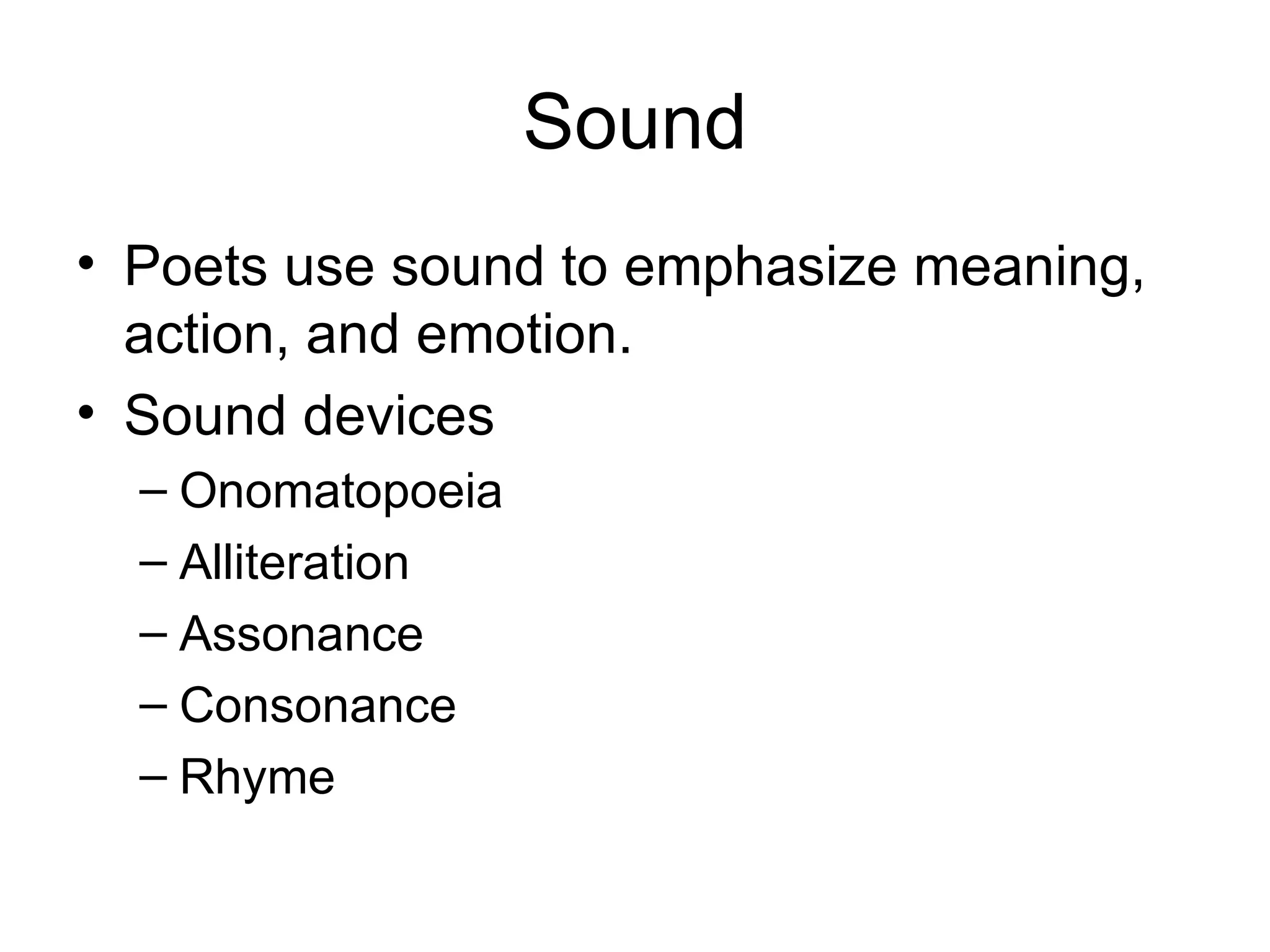
Sound Poets use sound to emphasize meaning, action, and emotion. Sound devices Onomatopoeia Alliteration Assonance  Consonance  Rhyme
Sound Onomatopoeia- the use of words that sound like what they mean (boom, buzz) Alliteration- the repetition of consonant sounds at the beginning of words or at the beginning of accented syllables “ P eter  P iper  p icked”
Sound Assonance- the repetition of vowel sounds followed by consonant sounds Consonance – “half rhyme” the repetition of final consonant sounds that are preceded by different vowel sounds “the bea st  climbed fa st  to the cre st
Sound  Rhyme- the repetition of accented vowels and the sounds that follow.  PAGE 113 Masculine rhyme- rhymed sounds have 1 syllable Feminine rhyme- rhymed sounds have 2 or more syllables Internal rhyme- the rhyme sounds are within a line End rhyme- the rhymed sounds are at the end of a line
Tips on Studying  Sound Underline examples of alliteration, assonance and consonance in the poem Circle the rhymed words (what similarities and contrasts do these words show the reader) Circle any words that have attractive or meaningful sound qualities
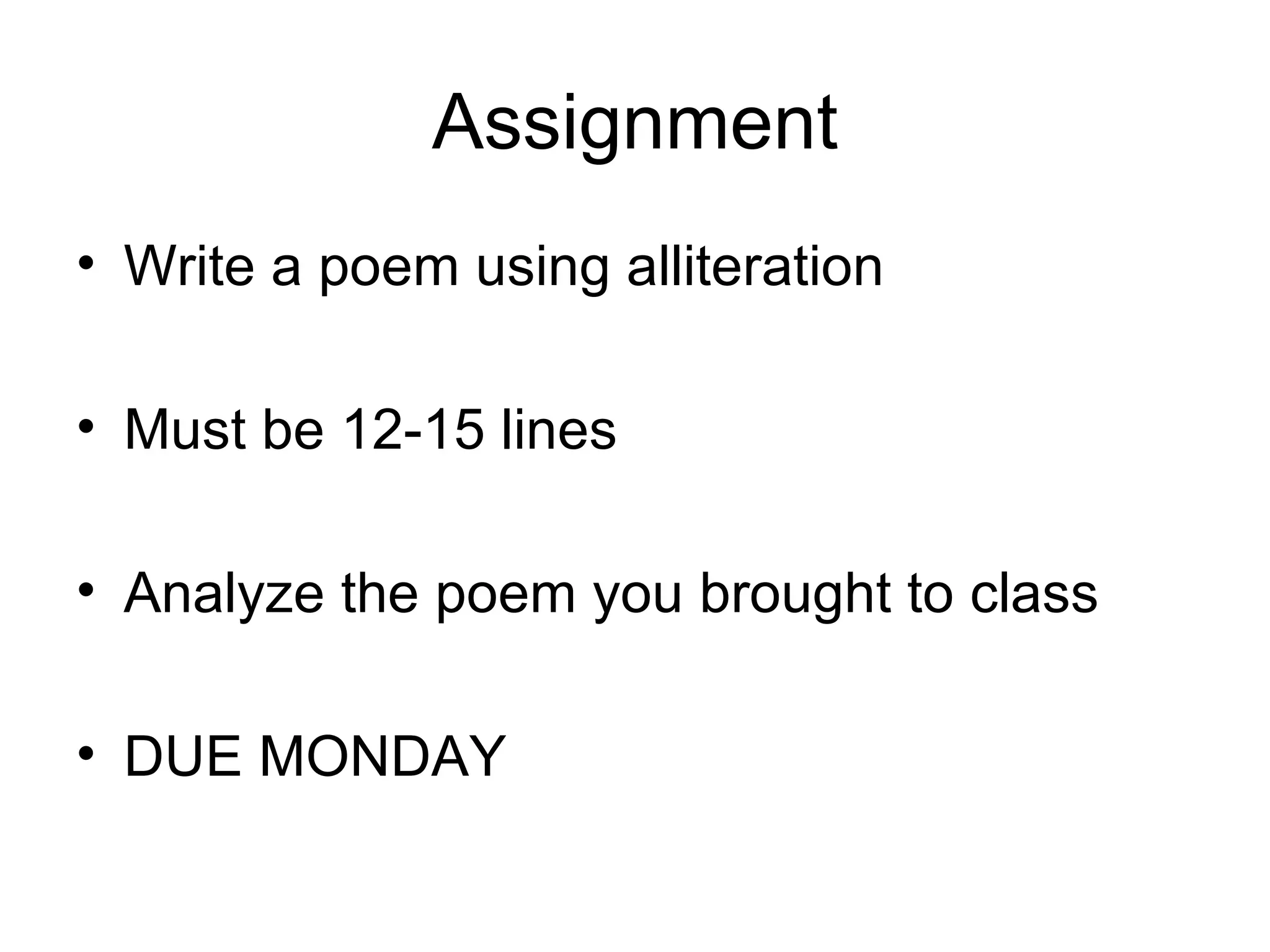
Assignment Write a poem using alliteration Must be 12-15 lines Analyze the poem you brought to class DUE MONDAY
Structure Rhyme scheme- any pattern of end rhyme Stanzas Usually represents one idea Usually have the same structure The same number of lines Length of lines Metrical patters Rhyme schemes
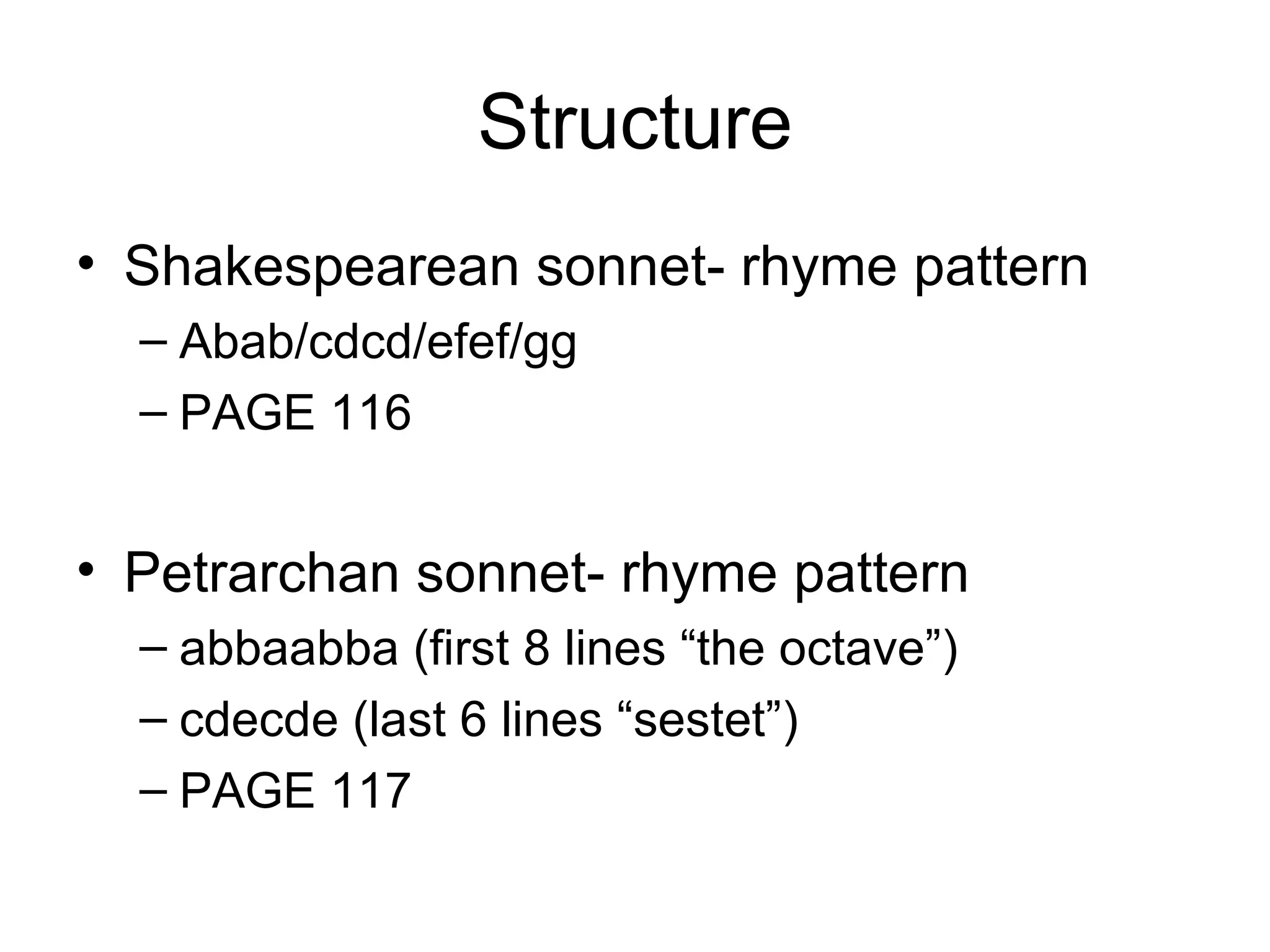
Structure Shakespearean sonnet- rhyme pattern Abab/cdcd/efef/gg PAGE 116 Petrarchan sonnet- rhyme pattern abbaabba (first 8 lines “the octave”) cdecde (last 6 lines “sestet”) PAGE 117
Other Fixed Forms Ballad Ode Heroic couplet Rhyme royal stanza
Tips on Studying Structure Mark the rhyme scheme  Divide the poem up (look at the examples on pages 116-117 Summarize the meaning of each section Look at the relationships of the end rhyme Look at the imagery presented within the poem
Free Verse Very difficult to see or find structural elements  It avoids metrical patterns and fixed line lengths It finds other ways to create rhythm and sound patterns PAGE 120 Walt Whitman’s Poem
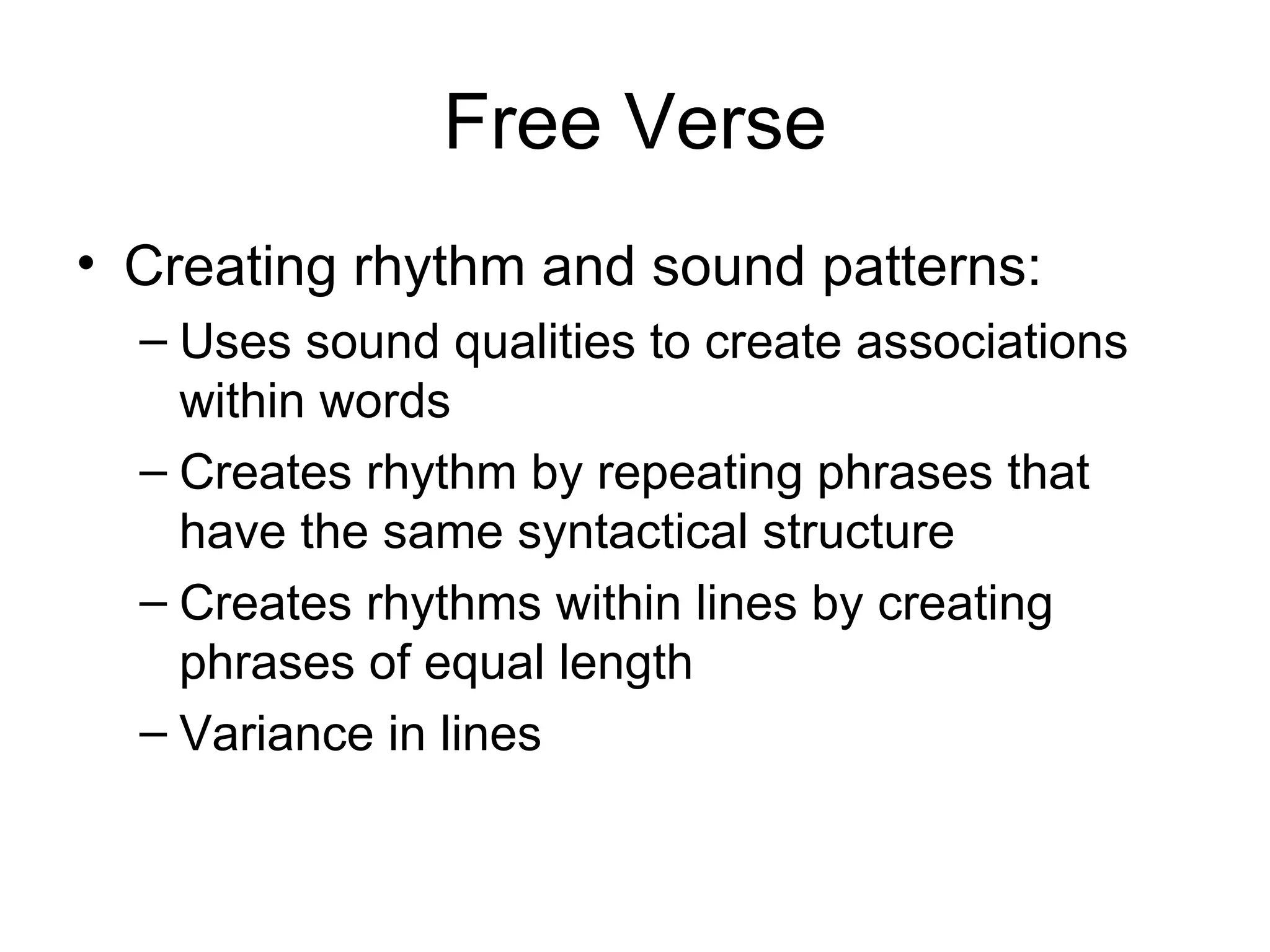
Free Verse Creating rhythm and sound patterns: Uses sound qualities to create associations within words Creates rhythm by repeating phrases that have the same syntactical structure Creates rhythms within lines by creating phrases of equal length Variance in lines
Tips on Studying  Free Verse Read the poem aloud Underline repeated phrases Explain why the lines end when they do Explain the relationship between the rhythm and the meaning and purpose Note the variation between short and long phrases
Assignment Write a poem using rhyme Must be at least 12 lines You may use any type of rhyme (internal, end, etc) Begin work on your portfolio  Vocabulary Quiz tomorrow
Symbolism Highly suggestive in a few words Symbol- physical object that represents an abstract idea or ideas Most powerful symbols do not specify the ideas they represent Examples: Psalms 23 The Sick Rose by William Blake
Tips for Studying Symbolism Be alert for symbols Circle the symbols in the poem List the meanings for each symbol Explain how each symbol contributes to the overall meaning of the poem
Assignment Write a poem using free verse Must be at least 15 lines Bring everything you need to work on your portfolio; we will be going to the lab to work on them.

Poetry Creative Writing

  • 1.
    Creative Writing PoetryMr. Jeremy Rinkel
  • 2.
    Elements of PoetryCharacterization Point of View Plot Setting Theme
  • 3.
    Steps in AnalyzingPoetry First, focus on the speaker. Who is speaking? What characterizes the speaker? To whom is he or she speaking? What is the speakers tone? What is the speakers emotional state? Why is he or she speaking?
  • 4.
    Steps in AnalyzingPoetry First, focus on the speaker…cont. What situation is being described? What are the conflicts or tensions in this situation? What ideas is the speaker communicating?
  • 5.
    Diction The poetsuse of words. Examine the words in the poem for all their possible meanings How do the meanings combine to create the overall effect PAGE 100 William Wordsworth
  • 6.
    Tips on StudyingDiction Circle words you don’t know; look them up Underline words that seem important; Explain: Denotation- dictionary meaning Connotation- is the subjective, emotional association that a word has for one person or a group of people Explain how choice of words contributes to the speakers tone
  • 7.
    Imagery Represents thedescriptive passages of a poem. Sensuous imagery- pleasurable for its own sake, but it also provides concreteness and immediacy PAGE 102 John Keats poem (First Stanza)
  • 8.
    Figurative Language Isthe conscious departure from normal or conventional ways of saying things. Metaphors Analogy similes
  • 9.
    Similies Uses likeor as to claim similarities between things that are essentially different Shakespeare’s “Fair is My Love” Page 103
  • 10.
    Metaphors Claims asimilarity between things that are essentially alike, but eliminates the comparative words like and as. Example “Love is a Sickness” by Samuel Daniel Page 103
  • 11.
    Analogies Is asimilarity between things that are basically different. Personification- a kind of analogy that gives a word the attributes of a person.
  • 12.
    Tips on Studying Descriptive Language Mark descriptive images. Name the sense appealed to. Describe how the images create a sense of time. Explain how the descriptive images help create and atmosphere and mood.
  • 13.
    Tips on Studying Figurative Language Mark the similies in the poem. (Circle words that signal comparisons Mark the metaphors. Explain what they contribute to the poem. Poets use analogies to assist the reader in making an abstract words more concrete.
  • 14.
    Assignment 1) Bringyour favorite poem to class with you tomorrow This will be an “artifact” for your portfolio project 2) Write a poem using similes, metaphors, and analogies MUST BE at least 12 Lines long
  • 15.
    Rhythm Meters- recognizablepatterns or rhythm in poetry. Foot- unit of rhythm in a verse that determines the arrangement of a poem Examples: PAGE 108- 109
  • 16.
    Tips on Studying Rhythm Count the number of syllables per line Read poem aloud (draw a vertical line between each foot in the poem) Underline where the poet strays away from the metrical pattern
  • 17.
    Sound Poets usesound to emphasize meaning, action, and emotion. Sound devices Onomatopoeia Alliteration Assonance Consonance Rhyme
  • 18.
    Sound Onomatopoeia- theuse of words that sound like what they mean (boom, buzz) Alliteration- the repetition of consonant sounds at the beginning of words or at the beginning of accented syllables “ P eter P iper p icked”
  • 19.
    Sound Assonance- therepetition of vowel sounds followed by consonant sounds Consonance – “half rhyme” the repetition of final consonant sounds that are preceded by different vowel sounds “the bea st climbed fa st to the cre st
  • 20.
    Sound Rhyme-the repetition of accented vowels and the sounds that follow. PAGE 113 Masculine rhyme- rhymed sounds have 1 syllable Feminine rhyme- rhymed sounds have 2 or more syllables Internal rhyme- the rhyme sounds are within a line End rhyme- the rhymed sounds are at the end of a line
  • 21.
    Tips on Studying Sound Underline examples of alliteration, assonance and consonance in the poem Circle the rhymed words (what similarities and contrasts do these words show the reader) Circle any words that have attractive or meaningful sound qualities
  • 22.
    Assignment Write apoem using alliteration Must be 12-15 lines Analyze the poem you brought to class DUE MONDAY
  • 23.
    Structure Rhyme scheme-any pattern of end rhyme Stanzas Usually represents one idea Usually have the same structure The same number of lines Length of lines Metrical patters Rhyme schemes
  • 24.
    Structure Shakespearean sonnet-rhyme pattern Abab/cdcd/efef/gg PAGE 116 Petrarchan sonnet- rhyme pattern abbaabba (first 8 lines “the octave”) cdecde (last 6 lines “sestet”) PAGE 117
  • 25.
    Other Fixed FormsBallad Ode Heroic couplet Rhyme royal stanza
  • 26.
    Tips on StudyingStructure Mark the rhyme scheme Divide the poem up (look at the examples on pages 116-117 Summarize the meaning of each section Look at the relationships of the end rhyme Look at the imagery presented within the poem
  • 27.
    Free Verse Verydifficult to see or find structural elements It avoids metrical patterns and fixed line lengths It finds other ways to create rhythm and sound patterns PAGE 120 Walt Whitman’s Poem
  • 28.
    Free Verse Creatingrhythm and sound patterns: Uses sound qualities to create associations within words Creates rhythm by repeating phrases that have the same syntactical structure Creates rhythms within lines by creating phrases of equal length Variance in lines
  • 29.
    Tips on Studying Free Verse Read the poem aloud Underline repeated phrases Explain why the lines end when they do Explain the relationship between the rhythm and the meaning and purpose Note the variation between short and long phrases
  • 30.
    Assignment Write apoem using rhyme Must be at least 12 lines You may use any type of rhyme (internal, end, etc) Begin work on your portfolio Vocabulary Quiz tomorrow
  • 31.
    Symbolism Highly suggestivein a few words Symbol- physical object that represents an abstract idea or ideas Most powerful symbols do not specify the ideas they represent Examples: Psalms 23 The Sick Rose by William Blake
  • 32.
    Tips for StudyingSymbolism Be alert for symbols Circle the symbols in the poem List the meanings for each symbol Explain how each symbol contributes to the overall meaning of the poem
  • 33.
    Assignment Write apoem using free verse Must be at least 15 lines Bring everything you need to work on your portfolio; we will be going to the lab to work on them.