Wednesday, November 2, 2011

   Literature: “The Tell-Tale Heart”
Housekeeping
• Green box
  – handouts
  – homework
• Short Story Exam
  – Wednesday, November 16th
  – Study Sheet available by next week
The Tell-Tale Heart

After Reading

Briefly: Think about the title again. How does it
relate to the story?

• Whose heart does it refer to?
• How does it reveal, give a signal, give a clue?
The Tell-Tale Heart - Activity
30 minutes - NO DICTIONARIES ALLOWED!
1. Refer to the story to complete the following questions
   on the handout:
  1. Understanding the Words in the Story (Multiple
     Choice) /5 (p. 144)
  2. Check-up (Multiple Choice) /5 (p.142)

We will go over the answers together. Each question is
worth half a mark (.5). The marks will not count – they
are For Your Information (FYI) only.
The Tell-Tale Heart
Understanding the Words in the Story (Multiple Choice)

1. acute (adj.)
b. sharp

2. conceived (v.)
a. imagined

3. thrust (v.)
b. poked (peeked, pushed)

4. vexed (v.)
b. irritated (annoyed)

5. profound (adj.)
b. highly intelligent
The Tell-Tale Heart
6. stifled (v.)
a. smothered

7. awe (n.)
c. wonder and fear

8. well up (v. – phrasal verb)
a. come OR c. rise

9. distracted (v.)
c. frightened

10. causeless (adj.)
b. unfounded (without foundation, reason or cause)
The Tell-Tale Heart
Check-up (Multiple Choice)

1. c. hearing
2. b. nervous
3. c. to get rid of an obsession
4. a. cleverness
5. b. fury
6. c. the beating of a human heart
7. a. the old man’s room
8. a. loud shriek
9. c. completely confident
10. c. hypocrisy
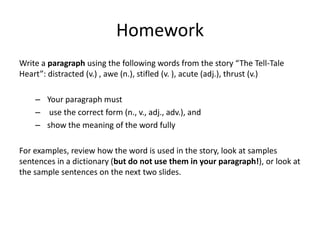
Homework
Write a paragraph using the following words from the story “The Tell-Tale
Heart”: distracted (v.) , awe (n.), stifled (v. ), acute (adj.), thrust (v.)

    – Your paragraph must
    – use the correct form (n., v., adj., adv.), and
    – show the meaning of the word fully

For examples, review how the word is used in the story, look at samples
sentences in a dictionary (but do not use them in your paragraph!), or look at
the sample sentences on the next two slides.
Sample Sentences
1. distracted (v.) (past tense of distract)
   (usually takes an object)
Ex: I tried to study but I was distracted by the students at
     the next table who were talking loudly.
     Please don’t distract me from what I am doing.
     I am very distracted right now.

2. awe (n.)
Ex: We were so in awe of the amazing sunset that we had to
     stay and watch until the sun was completely gone.
     They were filled with awe . . .
     I was full of awe . . .
Sample Sentences
3. stifled (v. ) (past tense of stifle) (usually takes a direct object)
Ex:     I was very tired, but I didn’t want to appear rude so I stifled a yawn.
        The dictatorship used violence to stifle dissent.
        Stifle your anger and focus on what you have to do.

4. acute (adj.)
Ex:   Her eyesight is acute; she can read highway signs when they are still
      far in the distance.
      He had an acute understanding of middle east issues.

5. thrust (v.) (usually takes an object)
Ex:    He thrust his foot into the aisle, tripping his classmate.
       She thrust her unwanted opinions on her friends.
       They were thrust into a new life without any preparation.
BREAK
“The Tell-Tale Heart”
         Literary Elements Activity
You will need:
• “The Tell Tale Heart” Story and Questions
• Handout: “Reviewing Story Elements”
• Handout: “Fiction Terms”
“The Tell-Tale Heart”
         Literary Elements Activity
Group Time: 30 minutes
• You should use this time to
   – Help each other understand the story
   – Discuss some of the literary elements you are still
     unsure about
Questions You Still Have
• What is the relationship between the narrator and the
  old man? What is the location?
A: We don’t have enough information to answer these
   questions . They may be roomates. They may live in a
   “boarding house” (Almost like a hotel for single men)
• How did he cut up the old man’s body without leaving
  a trace of blood?
A: He cut it up in the “tub” (bathtub)
• What type of story?
A: Horror, Suspense.
Groups
A: Chanel, Hossein
B: Grace, Maha
C: Ysaura, Omid
D: Shun, Raana, Dominic
E: Aiko, Estella, Manochehr
Class Review of Literary Elements
Point of View (POV )
• First person point of view
• The main character is telling us the story
• Easy to know the narrator’s thoughts and feelings
• He describes himself as clever and smart, etc. – we get to
  know his personality through his own description – but it
  could be biased
• We don’t know what he looks like or any background
  information about him
• We only know what the narrator wants us to know and we
  don’t really know if it is accurate
• He’s an unreliable narrator – he is insane
Class Review of Literary Elements
Setting
• Midnight, in a house, in the old man’s room
  (chamber)
• Probably North America in the late 19th or early
  20th century (lantern)
• It has to take place late at night, in a place where
  two men live in the same building -where the
  narrator has access to the old man’s room and
  the two characters see each other every day –
  the old man has to live alone and be vulnerable
Class Review (Cont’d.)
Character - is the narrator round or flat?

Round
• personality is complicated – by his description
• sometimes he is feeling crazy, sometimes confident, patient, strong, he loved the
   old man but he wants to kill him, he doesn’t like the man’s eye – it is difficult to
   understand his motivations
• he is not straightforward – he wants to kill the man but treated him more kindly
   leading up to the crime.
• in life, everyone is flat and round; if you see someone you don’t know walking
   down the street, they are flat to you; if you stopped to talk to them and get to
   know them, they become round to you. In a short story, it is up to the writer how
   much we learn about a character; if the writer shows/tells us a lot about a
   character, we can say the character is round (Shun’s comment)

Flat
- he is defined by his obsession
Class Review (Cont’d.)
Character - is the narrator dynamic or static?

Dynamic
– At the end of the story he admitted his crime because his
  heart was beating louder and louder . Did he confess jus to
  stop the beating? Or because he felt guilty about his crime?
  Only in the second case could we say he is dynamic.

Static
– When he begins telling the story, it has already happened.
   He is proud of what he had done, even after he has
   confessed; he has no regret – so he has not undergone a
   change in view, belief, or outlook.
Class Review (Cont’d.)
Conflict

Internal
Character vs. his feelings stand his guilt
Character vs. his feelings for the old man

External
Character vs. Character – narrator vs. old man’s eye
Character vs. Character – narrator vs. police

Foreshadowing
• The disease had sharpened my senses not dulled (p. 135) – suggests he is crazy
• I loved the old man, he had never wronged me . . . . (p. 135) – suggests conflict between them
• The first paragraph – his description of his hearing (heard all things in heaven and hell) tells us he is
  probably crazy and may do something unreasonable (p. 135)
• It is impossible to say how first the idea entered my brain. (p. 135)
• My blood ran cold . . . I made up my mind to take the life of the old man . . . (p. 136) (more direct
  statement than foreshadowing)
Class Review (Cont’d.)
Outcome
• Negative – he was caught
• Positive – he felt that he got rid of the sound of the beating
  heart

Theme
• If someone commits a crime, it will eventually be revealed
• A person with a mental illness is not capable of
  understanding they are committing a crime or feeling guilty
• One can lie to other people but cannot lie to themselves

(Other themes are possible, but they must be based on the
details and overall meaning of the story)
Homework
For Wednesday, Nov. 9th - “The Tell-Tale Heart”
1. Re-read the story as many times as you need to in
   order to fully understand it. Be prepared for in-class
   questions on this story.
2. Write a paragraph using the following words from
   the story “The Tell-Tale Heart”: distracted (v.) , awe
   (n.), stifled (v. ), acute (adj.), thrust (v.). Your
   paragraph must use the correct form
   (n., v., adj., adv.), and show the meaning of the word
   fully.

E10 nov2 2011

  • 1.
    Wednesday, November 2,2011 Literature: “The Tell-Tale Heart”
  • 2.
    Housekeeping • Green box – handouts – homework • Short Story Exam – Wednesday, November 16th – Study Sheet available by next week
  • 3.
    The Tell-Tale Heart AfterReading Briefly: Think about the title again. How does it relate to the story? • Whose heart does it refer to? • How does it reveal, give a signal, give a clue?
  • 4.
    The Tell-Tale Heart- Activity 30 minutes - NO DICTIONARIES ALLOWED! 1. Refer to the story to complete the following questions on the handout: 1. Understanding the Words in the Story (Multiple Choice) /5 (p. 144) 2. Check-up (Multiple Choice) /5 (p.142) We will go over the answers together. Each question is worth half a mark (.5). The marks will not count – they are For Your Information (FYI) only.
  • 5.
    The Tell-Tale Heart Understandingthe Words in the Story (Multiple Choice) 1. acute (adj.) b. sharp 2. conceived (v.) a. imagined 3. thrust (v.) b. poked (peeked, pushed) 4. vexed (v.) b. irritated (annoyed) 5. profound (adj.) b. highly intelligent
  • 6.
    The Tell-Tale Heart 6.stifled (v.) a. smothered 7. awe (n.) c. wonder and fear 8. well up (v. – phrasal verb) a. come OR c. rise 9. distracted (v.) c. frightened 10. causeless (adj.) b. unfounded (without foundation, reason or cause)
  • 7.
    The Tell-Tale Heart Check-up(Multiple Choice) 1. c. hearing 2. b. nervous 3. c. to get rid of an obsession 4. a. cleverness 5. b. fury 6. c. the beating of a human heart 7. a. the old man’s room 8. a. loud shriek 9. c. completely confident 10. c. hypocrisy
  • 8.
    Homework Write a paragraphusing the following words from the story “The Tell-Tale Heart”: distracted (v.) , awe (n.), stifled (v. ), acute (adj.), thrust (v.) – Your paragraph must – use the correct form (n., v., adj., adv.), and – show the meaning of the word fully For examples, review how the word is used in the story, look at samples sentences in a dictionary (but do not use them in your paragraph!), or look at the sample sentences on the next two slides.
  • 9.
    Sample Sentences 1. distracted(v.) (past tense of distract) (usually takes an object) Ex: I tried to study but I was distracted by the students at the next table who were talking loudly. Please don’t distract me from what I am doing. I am very distracted right now. 2. awe (n.) Ex: We were so in awe of the amazing sunset that we had to stay and watch until the sun was completely gone. They were filled with awe . . . I was full of awe . . .
  • 10.
    Sample Sentences 3. stifled(v. ) (past tense of stifle) (usually takes a direct object) Ex: I was very tired, but I didn’t want to appear rude so I stifled a yawn. The dictatorship used violence to stifle dissent. Stifle your anger and focus on what you have to do. 4. acute (adj.) Ex: Her eyesight is acute; she can read highway signs when they are still far in the distance. He had an acute understanding of middle east issues. 5. thrust (v.) (usually takes an object) Ex: He thrust his foot into the aisle, tripping his classmate. She thrust her unwanted opinions on her friends. They were thrust into a new life without any preparation.
  • 11.
  • 12.
    “The Tell-Tale Heart” Literary Elements Activity You will need: • “The Tell Tale Heart” Story and Questions • Handout: “Reviewing Story Elements” • Handout: “Fiction Terms”
  • 13.
    “The Tell-Tale Heart” Literary Elements Activity Group Time: 30 minutes • You should use this time to – Help each other understand the story – Discuss some of the literary elements you are still unsure about
  • 14.
    Questions You StillHave • What is the relationship between the narrator and the old man? What is the location? A: We don’t have enough information to answer these questions . They may be roomates. They may live in a “boarding house” (Almost like a hotel for single men) • How did he cut up the old man’s body without leaving a trace of blood? A: He cut it up in the “tub” (bathtub) • What type of story? A: Horror, Suspense.
  • 15.
    Groups A: Chanel, Hossein B:Grace, Maha C: Ysaura, Omid D: Shun, Raana, Dominic E: Aiko, Estella, Manochehr
  • 16.
    Class Review ofLiterary Elements Point of View (POV ) • First person point of view • The main character is telling us the story • Easy to know the narrator’s thoughts and feelings • He describes himself as clever and smart, etc. – we get to know his personality through his own description – but it could be biased • We don’t know what he looks like or any background information about him • We only know what the narrator wants us to know and we don’t really know if it is accurate • He’s an unreliable narrator – he is insane
  • 17.
    Class Review ofLiterary Elements Setting • Midnight, in a house, in the old man’s room (chamber) • Probably North America in the late 19th or early 20th century (lantern) • It has to take place late at night, in a place where two men live in the same building -where the narrator has access to the old man’s room and the two characters see each other every day – the old man has to live alone and be vulnerable
  • 18.
    Class Review (Cont’d.) Character- is the narrator round or flat? Round • personality is complicated – by his description • sometimes he is feeling crazy, sometimes confident, patient, strong, he loved the old man but he wants to kill him, he doesn’t like the man’s eye – it is difficult to understand his motivations • he is not straightforward – he wants to kill the man but treated him more kindly leading up to the crime. • in life, everyone is flat and round; if you see someone you don’t know walking down the street, they are flat to you; if you stopped to talk to them and get to know them, they become round to you. In a short story, it is up to the writer how much we learn about a character; if the writer shows/tells us a lot about a character, we can say the character is round (Shun’s comment) Flat - he is defined by his obsession
  • 19.
    Class Review (Cont’d.) Character- is the narrator dynamic or static? Dynamic – At the end of the story he admitted his crime because his heart was beating louder and louder . Did he confess jus to stop the beating? Or because he felt guilty about his crime? Only in the second case could we say he is dynamic. Static – When he begins telling the story, it has already happened. He is proud of what he had done, even after he has confessed; he has no regret – so he has not undergone a change in view, belief, or outlook.
  • 20.
    Class Review (Cont’d.) Conflict Internal Charactervs. his feelings stand his guilt Character vs. his feelings for the old man External Character vs. Character – narrator vs. old man’s eye Character vs. Character – narrator vs. police Foreshadowing • The disease had sharpened my senses not dulled (p. 135) – suggests he is crazy • I loved the old man, he had never wronged me . . . . (p. 135) – suggests conflict between them • The first paragraph – his description of his hearing (heard all things in heaven and hell) tells us he is probably crazy and may do something unreasonable (p. 135) • It is impossible to say how first the idea entered my brain. (p. 135) • My blood ran cold . . . I made up my mind to take the life of the old man . . . (p. 136) (more direct statement than foreshadowing)
  • 21.
    Class Review (Cont’d.) Outcome •Negative – he was caught • Positive – he felt that he got rid of the sound of the beating heart Theme • If someone commits a crime, it will eventually be revealed • A person with a mental illness is not capable of understanding they are committing a crime or feeling guilty • One can lie to other people but cannot lie to themselves (Other themes are possible, but they must be based on the details and overall meaning of the story)
  • 22.
    Homework For Wednesday, Nov.9th - “The Tell-Tale Heart” 1. Re-read the story as many times as you need to in order to fully understand it. Be prepared for in-class questions on this story. 2. Write a paragraph using the following words from the story “The Tell-Tale Heart”: distracted (v.) , awe (n.), stifled (v. ), acute (adj.), thrust (v.). Your paragraph must use the correct form (n., v., adj., adv.), and show the meaning of the word fully.