Poetic Devices
Taken from
Write Source 2000
Elements of Poetry
 Understanding the elements and devices
of poetry will help you better comprehend
the meanings of poems.
 Remember, often in poetry, the meaning
of the words isn’t literal. It’s figurative.
Understanding Internalizing
 As you already know, figurative language
and symbolism are very important to
poetry. However, there are other
elements that help create images,
rhythm, and meaning.
Alliteration
 The repeating of beginning consonant
sounds
 Ex: “creamy and crunchy”
 Ex: “nodded nearly napping”
–
“The Raven”
Assonance
 The repetition of vowel sounds
 Notice the repetition of the long “i” sound in the
following example
 Till the shining scythes went far and wide
And cut it down to dry.
- “The Hayloft” by R.L. Stevenson
Consonance
 The repetition of consonant sounds
(differs from alliteration because the
sounds can be anywhere within the word,
not just the beginning)
 The sailor sings of ropes and things
In ships upon the seas.
- “Singing”
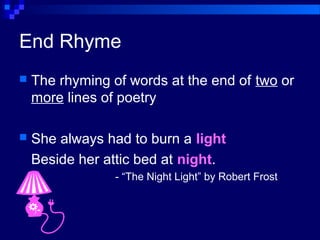
End Rhyme
 The rhyming of words at the end of two or
more lines of poetry
 She always had to burn a light
Beside her attic bed at night.
- “The Night Light” by Robert Frost
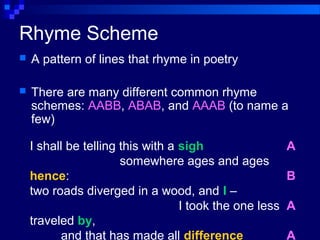
Rhyme Scheme
 A pattern of lines that rhyme in poetry
 There are many different common rhyme
schemes: AABB, ABAB, and AAAB (to name a
few)
I shall be telling this with a sigh
somewhere ages and ages hence:
two roads diverged in a wood, and I –
I took the one less traveled by,
and that has made all difference
- “The Road Not Taken” by Robert Frost
A
B
A
A
B
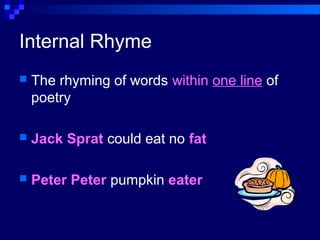
Internal Rhyme
 The rhyming of words within one line of
poetry
 Jack Sprat could eat no fat
 Peter Peter pumpkin eater
Onomatopoeia
 The use of a word that sounds like what it
means
 buzz, gunk, gush, swish, zigzag, zip
Repetition
 The repeating of a word or phrase to add
rhythm or to emphasize an idea
While I nodded, nearly napping, suddenly there came a tapping,
As of someone gently rapping, rapping at my chamber door –
- “The Raven” by E.A. Poe
Refrain
 Line, lines, or stanza repeated throughout
a poem (like a “chorus” in a song)
 Quoth the raven, “Never more.”
- “The Raven” by E.A. Poe
Stanza
 A group of lines within a poem that go
together
 Stanzas may consist of any number of lines,
even only a single line.
 Kindly remember that poems are written in
stanzas, not paragraphs and that they
consist of lines not sentences. *Occasionally
some poems do use sentences.
Quatrain
 A four-line stanza
 Common rhyme schemes in quatrains are
AABB, ABAB, and AAAB
 I wish I had no teachers.
That’s what I’d like to see.
I’d do whatever I wanted to,
And nobody’d yell at me.
Plus these, which are a review!
Simile
 Comparing two unrelated things using
“like” or “as”
 touching the ball like an ancient relic from
Africa . . .
– “The Ball The Rim and Him” by Al Letson
Metaphor
 Comparing two unrelated things without
using “like” or “as”
 . . . and then, with a little bit of reluctance he
lets go of this small circular piece of
Olympia, he lets go and falls back to us . . .
- “The Ball The Rim and Him” by Al Letson
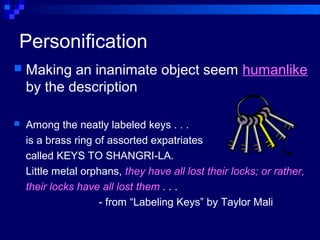
Personification
 Making an inanimate object seem humanlike
by the description
 Among the neatly labeled keys . . .
is a brass ring of assorted expatriates
called KEYS TO SHANGRI-LA.
Little metal orphans, they have all lost their locks; or rather,
their locks have all lost them . . .
- from “Labeling Keys” by Taylor Mali
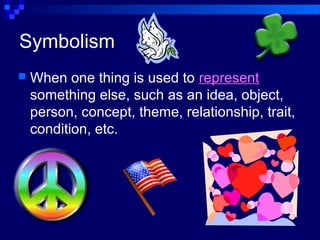
Symbolism
 When one thing is used to represent
something else, such as an idea, object,
person, concept, theme, relationship, trait,
condition, etc.

Poetic Devices

  • 1.
  • 2.
    Elements of Poetry Understanding the elements and devices of poetry will help you better comprehend the meanings of poems.  Remember, often in poetry, the meaning of the words isn’t literal. It’s figurative.
  • 3.
    Understanding Internalizing  Asyou already know, figurative language and symbolism are very important to poetry. However, there are other elements that help create images, rhythm, and meaning.
  • 4.
    Alliteration  The repeatingof beginning consonant sounds  Ex: “creamy and crunchy”  Ex: “nodded nearly napping” – “The Raven”
  • 5.
    Assonance  The repetitionof vowel sounds  Notice the repetition of the long “i” sound in the following example  Till the shining scythes went far and wide And cut it down to dry. - “The Hayloft” by R.L. Stevenson
  • 6.
    Consonance  The repetitionof consonant sounds (differs from alliteration because the sounds can be anywhere within the word, not just the beginning)  The sailor sings of ropes and things In ships upon the seas. - “Singing”
  • 7.
    End Rhyme  Therhyming of words at the end of two or more lines of poetry  She always had to burn a light Beside her attic bed at night. - “The Night Light” by Robert Frost
  • 8.
    Rhyme Scheme  Apattern of lines that rhyme in poetry  There are many different common rhyme schemes: AABB, ABAB, and AAAB (to name a few) I shall be telling this with a sigh somewhere ages and ages hence: two roads diverged in a wood, and I – I took the one less traveled by, and that has made all difference - “The Road Not Taken” by Robert Frost A B A A B
  • 9.
    Internal Rhyme  Therhyming of words within one line of poetry  Jack Sprat could eat no fat  Peter Peter pumpkin eater
  • 10.
    Onomatopoeia  The useof a word that sounds like what it means  buzz, gunk, gush, swish, zigzag, zip
  • 11.
    Repetition  The repeatingof a word or phrase to add rhythm or to emphasize an idea While I nodded, nearly napping, suddenly there came a tapping, As of someone gently rapping, rapping at my chamber door – - “The Raven” by E.A. Poe
  • 12.
    Refrain  Line, lines,or stanza repeated throughout a poem (like a “chorus” in a song)  Quoth the raven, “Never more.” - “The Raven” by E.A. Poe
  • 13.
    Stanza  A groupof lines within a poem that go together  Stanzas may consist of any number of lines, even only a single line.  Kindly remember that poems are written in stanzas, not paragraphs and that they consist of lines not sentences. *Occasionally some poems do use sentences.
  • 14.
    Quatrain  A four-linestanza  Common rhyme schemes in quatrains are AABB, ABAB, and AAAB  I wish I had no teachers. That’s what I’d like to see. I’d do whatever I wanted to, And nobody’d yell at me.
  • 15.
    Plus these, whichare a review!
  • 16.
    Simile  Comparing twounrelated things using “like” or “as”  touching the ball like an ancient relic from Africa . . . – “The Ball The Rim and Him” by Al Letson
  • 17.
    Metaphor  Comparing twounrelated things without using “like” or “as”  . . . and then, with a little bit of reluctance he lets go of this small circular piece of Olympia, he lets go and falls back to us . . . - “The Ball The Rim and Him” by Al Letson
  • 18.
    Personification  Making aninanimate object seem humanlike by the description  Among the neatly labeled keys . . . is a brass ring of assorted expatriates called KEYS TO SHANGRI-LA. Little metal orphans, they have all lost their locks; or rather, their locks have all lost them . . . - from “Labeling Keys” by Taylor Mali
  • 19.
    Symbolism  When onething is used to represent something else, such as an idea, object, person, concept, theme, relationship, trait, condition, etc.