Language and Culture III
Cut ure I I I
Prof . Li c. Gabri el a A.
Ll aneza
POETRY
A type of literature
that expresses ideas,
feelings, or tells a
story in a specific
form (usually using
lines and stanzas)
POINT OF VIEW IN POETRY
POET
 The poet is the author
of the poem.
SPEAKER
 The speaker of the
poem is the “narrator”
of the poem.
POETRY FORM
 FORM - the
appearance of the
words on the page
 LINE - a group of
words together on one
line of the poem
 STANZA - a group of
lines arranged together
A word is dead
When it is said,
Some say.
I say it just
Begins to live
That day.
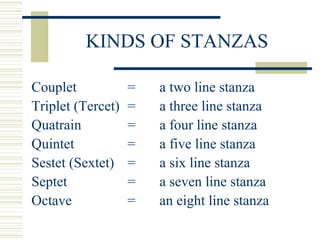
KINDS OF STANZAS
Couplet = a two line stanza
Triplet (Tercet) = a three line stanza
Quatrain = a four line stanza
Quintet = a five line stanza
Sestet (Sextet) = a six line stanza
Septet = a seven line stanza
Octave = an eight line stanza
SOUND EFFECTS
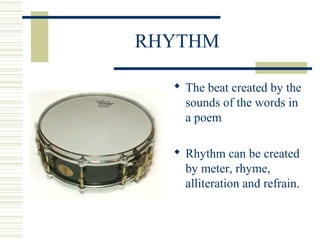
RHYTHM
 The beat created by the
sounds of the words in
a poem
 Rhythm can be created
by meter, rhyme,
alliteration and refrain.
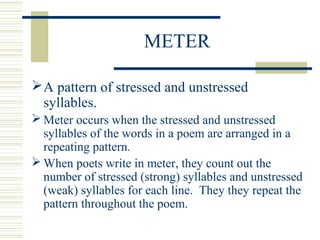
METER
A pattern of stressed and unstressed
syllables.
 Meter occurs when the stressed and unstressed
syllables of the words in a poem are arranged in a
repeating pattern.
 When poets write in meter, they count out the
number of stressed (strong) syllables and unstressed
(weak) syllables for each line. They they repeat the
pattern throughout the poem.
METER cont.
 FOOT - unit of meter.
 A foot can have two or
three syllables.
 Usually consists of one
stressed and one or
more unstressed
syllables.
 TYPES OF FEET
The types of feet are
determined by the
arrangement of stressed
and unstressed
syllables.
(cont.)
METER cont.
TYPES OF FEET (cont.)
Iambic - unstressed, stressed
Trochaic - stressed, unstressed
Anapestic - unstressed, unstressed, stressed
Dactylic - stressed, unstressed, unstressed
METER cont.
Kinds of Metrical Lines
 monometer = one foot on a line
 dimeter = two feet on a line
 trimeter = three feet on a line
 tetrameter = four feet on a line
 pentameter = five feet on a line
 hexameter = six feet on a line
 heptameter = seven feet on a line
 octometer = eight feet on a line
FREE VERSE POETRY
 Unlike metered poetry,
free verse poetry does
NOT have any
repeating patterns of
stressed and unstressed
syllables.
 Does NOT have
rhyme.
 Free verse poetry is
very conversational -
sounds like someone
talking with you.
 A more modern type of
poetry.
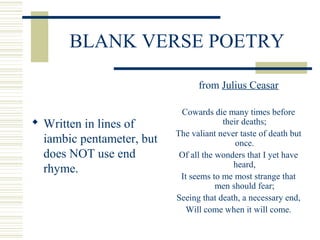
BLANK VERSE POETRY
 Written in lines of
iambic pentameter, but
does NOT use end
rhyme.
from Julius Ceasar
Cowards die many times before
their deaths;
The valiant never taste of death but
once.
Of all the wonders that I yet have
heard,
It seems to me most strange that
men should fear;
Seeing that death, a necessary end,
Will come when it will come.
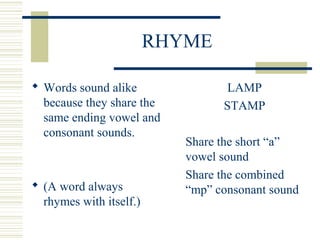
RHYME
 Words sound alike
because they share the
same ending vowel and
consonant sounds.
 (A word always
rhymes with itself.)
LAMP
STAMP
Share the short “a”
vowel sound
Share the combined
“mp” consonant sound
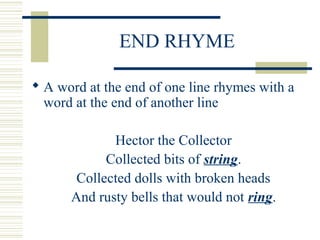
END RHYME
 A word at the end of one line rhymes with a
word at the end of another line
Hector the Collector
Collected bits of string.
Collected dolls with broken heads
And rusty bells that would not ring.
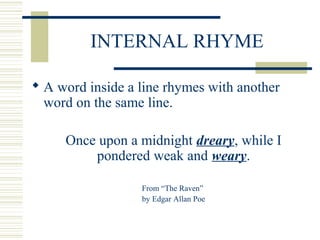
INTERNAL RHYME
 A word inside a line rhymes with another
word on the same line.
Once upon a midnight dreary, while I
pondered weak and weary.
From “The Raven”
by Edgar Allan Poe
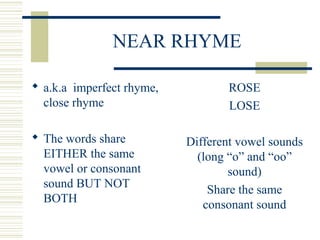
NEAR RHYME
 a.k.a imperfect rhyme,
close rhyme
 The words share
EITHER the same
vowel or consonant
sound BUT NOT
BOTH
ROSE
LOSE
Different vowel sounds
(long “o” and “oo”
sound)
Share the same
consonant sound
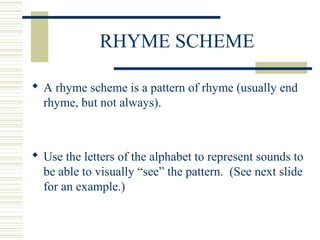
RHYME SCHEME
 A rhyme scheme is a pattern of rhyme (usually end
rhyme, but not always).
 Use the letters of the alphabet to represent sounds to
be able to visually “see” the pattern. (See next slide
for an example.)
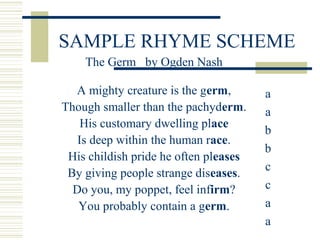
SAMPLE RHYME SCHEME
The Germ by Ogden Nash
A mighty creature is the germ,
Though smaller than the pachyderm.
His customary dwelling place
Is deep within the human race.
His childish pride he often pleases
By giving people strange diseases.
Do you, my poppet, feel infirm?
You probably contain a germ.
a
a
b
b
c
c
a
a
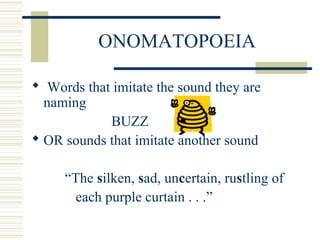
ONOMATOPOEIA
 Words that imitate the sound they are
naming
BUZZ
 OR sounds that imitate another sound
“The silken, sad, uncertain, rustling of
each purple curtain . . .”
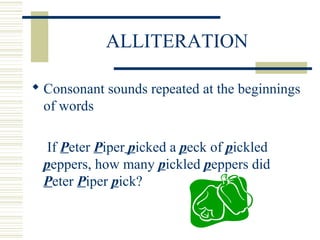
ALLITERATION
 Consonant sounds repeated at the beginnings
of words
If Peter Piper picked a peck of pickled
peppers, how many pickled peppers did
Peter Piper pick?
CONSONANCE
 Similar to alliteration EXCEPT . . .
 The repeated consonant sounds can be
anywhere in the words
“silken, sad, uncertain, rustling . . “
ASSONANCE
 Repeated VOWEL sounds in a line or lines
of poetry.
(Often creates near rhyme.)
Lake Fate Base Fade
(All share the long “a” sound.)
ASSONANCE cont.
Examples of ASSONANCE:
“Slow the low gradual moan came in the
snowing.”
- John Masefield
“Shall ever medicine thee to that sweet sleep.”
- William Shakespeare
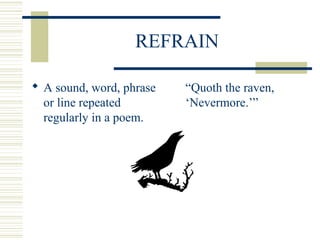
REFRAIN
 A sound, word, phrase
or line repeated
regularly in a poem.
“Quoth the raven,
‘Nevermore.’”
SOME TYPES OF POETRY
WE WILL BE STUDYING
LYRIC
 A short poem
 Usually written in first person point of view
 Expresses an emotion or an idea or describes
a scene
 Do not tell a story and are often musical
 (Many of the poems we read will be lyrics.)
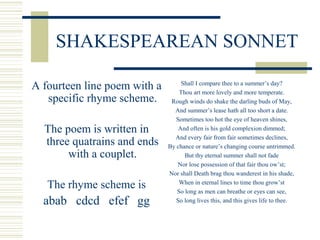
SHAKESPEAREAN SONNET
A fourteen line poem with a
specific rhyme scheme.
The poem is written in
three quatrains and ends
with a couplet.
The rhyme scheme is
abab cdcd efef gg
Shall I compare thee to a summer’s day?
Thou art more lovely and more temperate.
Rough winds do shake the darling buds of May,
And summer’s lease hath all too short a date.
Sometimes too hot the eye of heaven shines,
And often is his gold complexion dimmed;
And every fair from fair sometimes declines,
By chance or nature’s changing course untrimmed.
But thy eternal summer shall not fade
Nor lose possession of that fair thou ow’st;
Nor shall Death brag thou wanderest in his shade,
When in eternal lines to time thou grow’st
So long as men can breathe or eyes can see,
So long lives this, and this gives life to thee.
NARRATIVE POEMS
 A poem that tells a
story.
 Generally longer than
the lyric styles of
poetry b/c the poet
needs to establish
characters and a plot.
Examples of Narrative
Poems
“The Raven”
“The Highwayman”
“Casey at the Bat”
“The Walrus and the
Carpenter”
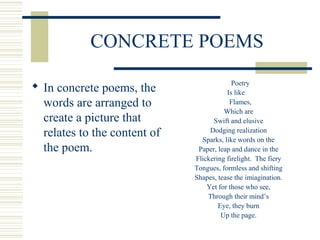
CONCRETE POEMS
 In concrete poems, the
words are arranged to
create a picture that
relates to the content of
the poem.
Poetry
Is like
Flames,
Which are
Swift and elusive
Dodging realization
Sparks, like words on the
Paper, leap and dance in the
Flickering firelight. The fiery
Tongues, formless and shifting
Shapes, tease the imiagination.
Yet for those who see,
Through their mind’s
Eye, they burn
Up the page.
FIGURATIVE
LANGUAGE
SIMILE
 A comparison of two things using “like, as
than,” or “resembles.”
 “She is as beautiful as a sunrise.”
METAPHOR
 A direct comparison of two unlike things
 “All the world’s a stage, and we are merely
players.”
- William Shakespeare
EXTENDED METAPHOR
 A metaphor that goes several lines or
possible the entire length of a work.
IMPLIED METAPHOR
 The comparison is hinted at but not clearly stated.
 “The poison sacs of the town began to manufacture
venom, and the town swelled and puffed with the
pressure of it.”
- from The Pearl
- by John Steinbeck
Hyperbole
 Exaggeration often used for emphasis.
Litotes
 Understatement - basically the opposite of
hyperbole. Often it is ironic.
 Ex. Calling a slow moving person “Speedy”
Idiom
 An expression where the literal meaning of
the words is not the meaning of the
expression. It means something other than
what it actually says.
 Ex. It’s raining cats and dogs.
PERSONIFICATION
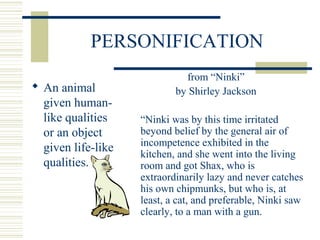
 An animal
given human-
like qualities
or an object
given life-like
qualities.
from “Ninki”
by Shirley Jackson
“Ninki was by this time irritated
beyond belief by the general air of
incompetence exhibited in the
kitchen, and she went into the living
room and got Shax, who is
extraordinarily lazy and never catches
his own chipmunks, but who is, at
least, a cat, and preferable, Ninki saw
clearly, to a man with a gun.
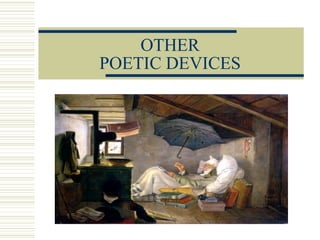
OTHER
POETIC DEVICES
SYMBOLISM
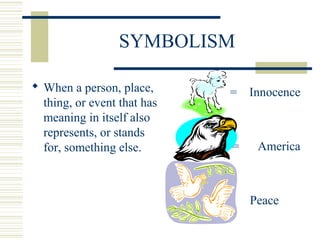
 When a person, place,
thing, or event that has
meaning in itself also
represents, or stands
for, something else.
= Innocence
= America
= Peace
Allusion
 Allusion comes from
the verb “allude”
which means “to refer
to”
 An allusion is a
reference to something
famous.
A tunnel walled and overlaid
With dazzling crystal: we
had read
Of rare Aladdin’s wondrous
cave,
And to our own his name we
gave.
From “Snowbound”
John Greenleaf Whittier
IMAGERY
 Language that appeals to the senses.
 Most images are visual, but they can also
appeal to the senses of sound, touch, taste, or
smell.
then with cracked hands that ached
from labor in the weekday weather . . .
from “Those Winter Sundays”

Poetry (1)

  • 1.
    Language and CultureIII Cut ure I I I Prof . Li c. Gabri el a A. Ll aneza
  • 2.
    POETRY A type ofliterature that expresses ideas, feelings, or tells a story in a specific form (usually using lines and stanzas)
  • 3.
    POINT OF VIEWIN POETRY POET  The poet is the author of the poem. SPEAKER  The speaker of the poem is the “narrator” of the poem.
  • 4.
    POETRY FORM  FORM- the appearance of the words on the page  LINE - a group of words together on one line of the poem  STANZA - a group of lines arranged together A word is dead When it is said, Some say. I say it just Begins to live That day.
  • 5.
    KINDS OF STANZAS Couplet= a two line stanza Triplet (Tercet) = a three line stanza Quatrain = a four line stanza Quintet = a five line stanza Sestet (Sextet) = a six line stanza Septet = a seven line stanza Octave = an eight line stanza
  • 6.
  • 7.
    RHYTHM  The beatcreated by the sounds of the words in a poem  Rhythm can be created by meter, rhyme, alliteration and refrain.
  • 8.
    METER A pattern ofstressed and unstressed syllables.  Meter occurs when the stressed and unstressed syllables of the words in a poem are arranged in a repeating pattern.  When poets write in meter, they count out the number of stressed (strong) syllables and unstressed (weak) syllables for each line. They they repeat the pattern throughout the poem.
  • 9.
    METER cont.  FOOT- unit of meter.  A foot can have two or three syllables.  Usually consists of one stressed and one or more unstressed syllables.  TYPES OF FEET The types of feet are determined by the arrangement of stressed and unstressed syllables. (cont.)
  • 10.
    METER cont. TYPES OFFEET (cont.) Iambic - unstressed, stressed Trochaic - stressed, unstressed Anapestic - unstressed, unstressed, stressed Dactylic - stressed, unstressed, unstressed
  • 11.
    METER cont. Kinds ofMetrical Lines  monometer = one foot on a line  dimeter = two feet on a line  trimeter = three feet on a line  tetrameter = four feet on a line  pentameter = five feet on a line  hexameter = six feet on a line  heptameter = seven feet on a line  octometer = eight feet on a line
  • 12.
    FREE VERSE POETRY Unlike metered poetry, free verse poetry does NOT have any repeating patterns of stressed and unstressed syllables.  Does NOT have rhyme.  Free verse poetry is very conversational - sounds like someone talking with you.  A more modern type of poetry.
  • 13.
    BLANK VERSE POETRY Written in lines of iambic pentameter, but does NOT use end rhyme. from Julius Ceasar Cowards die many times before their deaths; The valiant never taste of death but once. Of all the wonders that I yet have heard, It seems to me most strange that men should fear; Seeing that death, a necessary end, Will come when it will come.
  • 14.
    RHYME  Words soundalike because they share the same ending vowel and consonant sounds.  (A word always rhymes with itself.) LAMP STAMP Share the short “a” vowel sound Share the combined “mp” consonant sound
  • 15.
    END RHYME  Aword at the end of one line rhymes with a word at the end of another line Hector the Collector Collected bits of string. Collected dolls with broken heads And rusty bells that would not ring.
  • 16.
    INTERNAL RHYME  Aword inside a line rhymes with another word on the same line. Once upon a midnight dreary, while I pondered weak and weary. From “The Raven” by Edgar Allan Poe
  • 17.
    NEAR RHYME  a.k.aimperfect rhyme, close rhyme  The words share EITHER the same vowel or consonant sound BUT NOT BOTH ROSE LOSE Different vowel sounds (long “o” and “oo” sound) Share the same consonant sound
  • 18.
    RHYME SCHEME  Arhyme scheme is a pattern of rhyme (usually end rhyme, but not always).  Use the letters of the alphabet to represent sounds to be able to visually “see” the pattern. (See next slide for an example.)
  • 19.
    SAMPLE RHYME SCHEME TheGerm by Ogden Nash A mighty creature is the germ, Though smaller than the pachyderm. His customary dwelling place Is deep within the human race. His childish pride he often pleases By giving people strange diseases. Do you, my poppet, feel infirm? You probably contain a germ. a a b b c c a a
  • 20.
    ONOMATOPOEIA  Words thatimitate the sound they are naming BUZZ  OR sounds that imitate another sound “The silken, sad, uncertain, rustling of each purple curtain . . .”
  • 21.
    ALLITERATION  Consonant soundsrepeated at the beginnings of words If Peter Piper picked a peck of pickled peppers, how many pickled peppers did Peter Piper pick?
  • 22.
    CONSONANCE  Similar toalliteration EXCEPT . . .  The repeated consonant sounds can be anywhere in the words “silken, sad, uncertain, rustling . . “
  • 23.
    ASSONANCE  Repeated VOWELsounds in a line or lines of poetry. (Often creates near rhyme.) Lake Fate Base Fade (All share the long “a” sound.)
  • 24.
    ASSONANCE cont. Examples ofASSONANCE: “Slow the low gradual moan came in the snowing.” - John Masefield “Shall ever medicine thee to that sweet sleep.” - William Shakespeare
  • 25.
    REFRAIN  A sound,word, phrase or line repeated regularly in a poem. “Quoth the raven, ‘Nevermore.’”
  • 26.
    SOME TYPES OFPOETRY WE WILL BE STUDYING
  • 27.
    LYRIC  A shortpoem  Usually written in first person point of view  Expresses an emotion or an idea or describes a scene  Do not tell a story and are often musical  (Many of the poems we read will be lyrics.)
  • 28.
    SHAKESPEAREAN SONNET A fourteenline poem with a specific rhyme scheme. The poem is written in three quatrains and ends with a couplet. The rhyme scheme is abab cdcd efef gg Shall I compare thee to a summer’s day? Thou art more lovely and more temperate. Rough winds do shake the darling buds of May, And summer’s lease hath all too short a date. Sometimes too hot the eye of heaven shines, And often is his gold complexion dimmed; And every fair from fair sometimes declines, By chance or nature’s changing course untrimmed. But thy eternal summer shall not fade Nor lose possession of that fair thou ow’st; Nor shall Death brag thou wanderest in his shade, When in eternal lines to time thou grow’st So long as men can breathe or eyes can see, So long lives this, and this gives life to thee.
  • 29.
    NARRATIVE POEMS  Apoem that tells a story.  Generally longer than the lyric styles of poetry b/c the poet needs to establish characters and a plot. Examples of Narrative Poems “The Raven” “The Highwayman” “Casey at the Bat” “The Walrus and the Carpenter”
  • 30.
    CONCRETE POEMS  Inconcrete poems, the words are arranged to create a picture that relates to the content of the poem. Poetry Is like Flames, Which are Swift and elusive Dodging realization Sparks, like words on the Paper, leap and dance in the Flickering firelight. The fiery Tongues, formless and shifting Shapes, tease the imiagination. Yet for those who see, Through their mind’s Eye, they burn Up the page.
  • 31.
  • 32.
    SIMILE  A comparisonof two things using “like, as than,” or “resembles.”  “She is as beautiful as a sunrise.”
  • 33.
    METAPHOR  A directcomparison of two unlike things  “All the world’s a stage, and we are merely players.” - William Shakespeare
  • 34.
    EXTENDED METAPHOR  Ametaphor that goes several lines or possible the entire length of a work.
  • 35.
    IMPLIED METAPHOR  Thecomparison is hinted at but not clearly stated.  “The poison sacs of the town began to manufacture venom, and the town swelled and puffed with the pressure of it.” - from The Pearl - by John Steinbeck
  • 36.
  • 37.
    Litotes  Understatement -basically the opposite of hyperbole. Often it is ironic.  Ex. Calling a slow moving person “Speedy”
  • 38.
    Idiom  An expressionwhere the literal meaning of the words is not the meaning of the expression. It means something other than what it actually says.  Ex. It’s raining cats and dogs.
  • 39.
    PERSONIFICATION  An animal givenhuman- like qualities or an object given life-like qualities. from “Ninki” by Shirley Jackson “Ninki was by this time irritated beyond belief by the general air of incompetence exhibited in the kitchen, and she went into the living room and got Shax, who is extraordinarily lazy and never catches his own chipmunks, but who is, at least, a cat, and preferable, Ninki saw clearly, to a man with a gun.
  • 40.
  • 41.
    SYMBOLISM  When aperson, place, thing, or event that has meaning in itself also represents, or stands for, something else. = Innocence = America = Peace
  • 42.
    Allusion  Allusion comesfrom the verb “allude” which means “to refer to”  An allusion is a reference to something famous. A tunnel walled and overlaid With dazzling crystal: we had read Of rare Aladdin’s wondrous cave, And to our own his name we gave. From “Snowbound” John Greenleaf Whittier
  • 43.
    IMAGERY  Language thatappeals to the senses.  Most images are visual, but they can also appeal to the senses of sound, touch, taste, or smell. then with cracked hands that ached from labor in the weekday weather . . . from “Those Winter Sundays”

Editor's Notes

  • #15 Activity: Rhyme group game
  • #19 Activity: Rhyme Scheme group game
  • #22 Activity: Alliteration group game