Gerald BarryPiano Quartet No. 1Sections E, F, G, H
Section ESection E is a retrograde of section DA retrograde is a piece of music played backwardsThough a retrograde uses old material it sounds as though it is completely new materialThe retrograde starts with the F in bar 357. It’s as if the music begins to rewind at this point
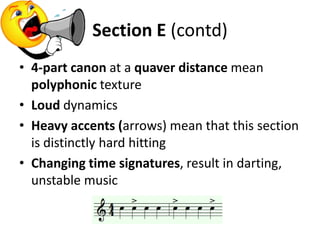
Section E (contd)4-part canon at a quaver distance mean polyphonic textureLoud dynamicsHeavy accents (arrows)mean that this section is distinctly hard hittingChanging time signatures, result in darting, unstable music
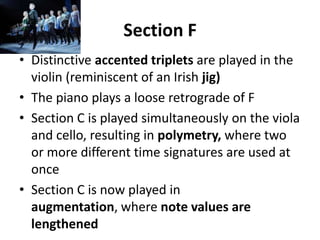
Section FDistinctive accented triplets are played in the violin (reminiscent of an Irish jig)The piano plays a loose retrograde of FSection C is played simultaneously on the viola and cello, resulting in polymetry, where two or more different time signatures are used at onceSection C is now played in augmentation, where note values are lengthened
Section GThis is the shortest section in the whole pieceBarry uses telescoping here, by taking small sections of each previous sectionThough the music is recycled it sounds completely newHomophonic textureLoud dynamics, sudden (subito) fast tempo, accents and changing time signatures all result in a confused and violent sound.
Section HThe last section is based on the Irish tune, Lord Mayo’s Delight2part canon on viola and cello at a crotchet’s distance, followed by a 3 part canon at the unison at a crotchet’s distanceInstruments play flautando (bow over the fingerboard) which results in a quiet, wispy, flute-like soundLow register is used. This means that some notes are missing from the violin part as they don’t exist on the violinLeft-hand piano returns for the last note only. It results in an unfinished and open sound at the ending

Barry e h

  • 1.
    Gerald BarryPiano QuartetNo. 1Sections E, F, G, H
  • 2.
    Section ESection Eis a retrograde of section DA retrograde is a piece of music played backwardsThough a retrograde uses old material it sounds as though it is completely new materialThe retrograde starts with the F in bar 357. It’s as if the music begins to rewind at this point
  • 3.
    Section E (contd)4-partcanon at a quaver distance mean polyphonic textureLoud dynamicsHeavy accents (arrows)mean that this section is distinctly hard hittingChanging time signatures, result in darting, unstable music
  • 4.
    Section FDistinctive accentedtriplets are played in the violin (reminiscent of an Irish jig)The piano plays a loose retrograde of FSection C is played simultaneously on the viola and cello, resulting in polymetry, where two or more different time signatures are used at onceSection C is now played in augmentation, where note values are lengthened
  • 5.
    Section GThis isthe shortest section in the whole pieceBarry uses telescoping here, by taking small sections of each previous sectionThough the music is recycled it sounds completely newHomophonic textureLoud dynamics, sudden (subito) fast tempo, accents and changing time signatures all result in a confused and violent sound.
  • 6.
    Section HThe lastsection is based on the Irish tune, Lord Mayo’s Delight2part canon on viola and cello at a crotchet’s distance, followed by a 3 part canon at the unison at a crotchet’s distanceInstruments play flautando (bow over the fingerboard) which results in a quiet, wispy, flute-like soundLow register is used. This means that some notes are missing from the violin part as they don’t exist on the violinLeft-hand piano returns for the last note only. It results in an unfinished and open sound at the ending