Presented by Mrs. S. Dianne Black
Types of
                      Poems
 Haiku—Japanese fixed-form poem
     structured in 3 lines of 17 syllable;
     captures a moment in time or aspect of
     nature
  Sestina—French form of six six-line
     stanzas followed by a tercet called an
     envoy to =39 lines; set of six words is
     repeated in varying patterns at the ends of
     the lines of each of the six-line stanzas;
     the six words also in the envoy, two in
     each line of the tercet
2/9/2013                                        2
…types of poems
 • Sonnet—14 lines of iambic pentameter;
     can be Shakespearean/English (3
     quatrains followed by a couplet) or
     Petrarchan/Italian (octave followed by 2
     tercets)
 • Villanelle—fixed-form of 19 lines
     composed of 5 tercets (rhyme
     scheme:aba) and a concluding quatrain
     (rhyme scheme:abaa); lines one & three of
     the 1st tercet serve as refrains
2/9/2013                                      3
…continued

• Ballad—short poem in song format that
  tells a story
• Elegy—subject is death of aperson
• Epic—long, adventurous tale with a hero
• Lyric—expresses love, inner emotions
  tends to be personal; usually written in 1st
  person
2/9/2013                                         4
...continued
• Narrative—the poet tells a story with
   characters and a plot
• Ode—originally a Greek form, odes are
   serious lyric poems; English Romantic
   poets reinvigorated the form
• Prose poem—looks like a
   paragraph, even having a jagged right
   margin; may read like a paragraph, but
   retains poetic elements such as
   imagery, figurative language, and concise
 2/9/2013                                      5
   language.
Theme
Purpose of the poem
What the poet needed to say
Expresses the unity of human
    experience
See that we are more alike as a human
    race than different
Tells us what is true about us
Expresses the poet’s vision about the
    truth of the world
2/9/2013                                 6
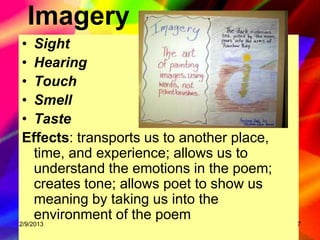
Imagery
• Sight
• Hearing
• Touch
• Smell
• Taste
Effects: transports us to another place,
  time, and experience; allows us to
  understand the emotions in the poem;
  creates tone; allows poet to show us
  meaning by taking us into the
  environment of the poem
2/9/2013                                   7
Diction
How does a poet choose the exact word?
• Sound: how does the word sound? Does
  it contribute to the meaning, to the overall
  sound scheme, or does it interrupt or
  interfere?
• Denotation: What is the exact meaning of
  the word?
• Connotation: What is the suggested
  meaning? What is the emotive quality?
 Every word matters . Never skim over any word in a poem.
2/9/2013
                                                            8
Sound
• Rhyme                     •   Alliteration
• Exact Rhyme               •   Assonance
• Slant Rhyme/Approximate   •   Cacophony
  Rhyme                     •   Euphony
• Internal Rhyme vs. End    •   Meter
  Rhyme


2/9/2013                                       9
…sound continued
Definitions and Examples:
Rhyme: words that sound either exactly
 alike or merely similar
Exact Rhyme:
Cat, hat, flat, mat: masculine rhyme (one
 syllable rhymes
Falling, calling, stalling: feminine rhyme
 (two or more syllables)
2/9/2013                                      10
…sound continued
Slant rhyme/approximate rhyme:
The words sound close but are not exact
  rhymes
Mirror, steer, dear or book, crack, stick
  (consonance is used most often for slant
  rhymes)


2/9/2013                                     11
…sound continued
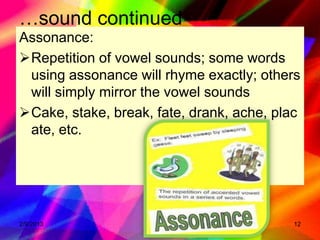
Assonance:
Repetition of vowel sounds; some words
 using assonance will rhyme exactly; others
 will simply mirror the vowel sounds
Cake, stake, break, fate, drank, ache, plac
 ate, etc.


2/9/2013                                  12
…sound continued
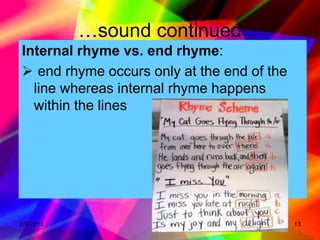
Internal rhyme vs. end rhyme:
 end rhyme occurs only at the end of the
  line whereas internal rhyme happens
  within the lines


2/9/2013                                    13
…sound continued
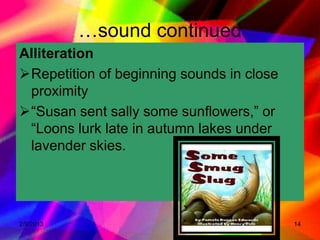
Alliteration
Repetition of beginning sounds in close
 proximity
“Susan sent sally some sunflowers,” or
 “Loons lurk late in autumn lakes under
 lavender skies.


2/9/2013                                   14
…sound continued
Cacophony
Harsh , discordant, or unpleasing sounds


2/9/2013                                    15
…sound continued
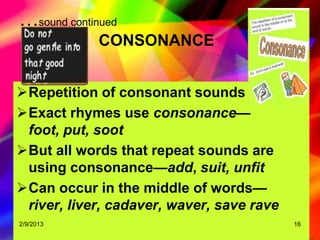
             CONSONANCE


Repetition of consonant sounds
Exact rhymes use consonance—
 foot, put, soot
But all words that repeat sounds are
 using consonance—add, suit, unfit
Can occur in the middle of words—
 river, liver, cadaver, waver, save rave
2/9/2013                                   16
…sound continued
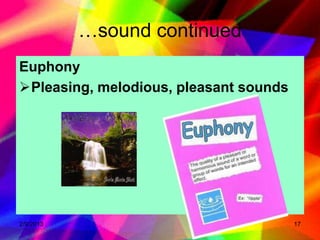
Euphony
Pleasing, melodious, pleasant sounds


2/9/2013                                17
…sound continued
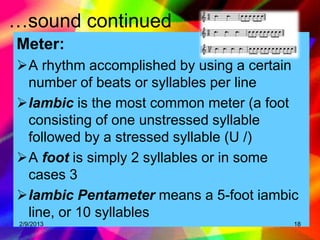
Meter:
A rhythm accomplished by using a certain
 number of beats or syllables per line
Iambic is the most common meter (a foot
 consisting of one unstressed syllable
 followed by a stressed syllable (U /)
A foot is simply 2 syllables or in some
 cases 3
Iambic Pentameter means a 5-foot iambic
 line, or 10 syllables
 2/9/2013                               18
Final Points about Sound
Sound is not as important as the idea or
 meaning of the poem.
Sound simply extends the meaning of the
 poem and enhances ideas.
Sound not likely to be a significant factor in
 meaning in older fixed form poems.
Sound in free verse poems are more
 experimental

2/9/2013                                     19
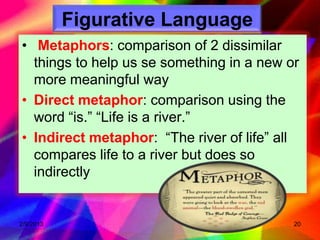
Figurative Language
• Metaphors: comparison of 2 dissimilar
  things to help us se something in a new or
  more meaningful way
• Direct metaphor: comparison using the
  word “is.” “Life is a river.”
• Indirect metaphor: “The river of life” all
  compares life to a river but does so
  indirectly


2/9/2013                                   20
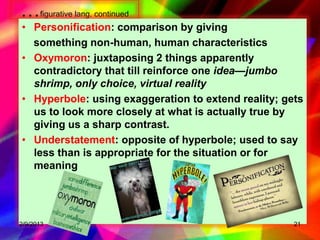
…figurative lang. continued
• Personification: comparison by giving
  something non-human, human characteristics
• Oxymoron: juxtaposing 2 things apparently
  contradictory that till reinforce one idea—jumbo
  shrimp, only choice, virtual reality
• Hyperbole: using exaggeration to extend reality; gets
  us to look more closely at what is actually true by
  giving us a sharp contrast.
• Understatement: opposite of hyperbole; used to say
  less than is appropriate for the situation or for
  meaning


2/9/2013                                             21
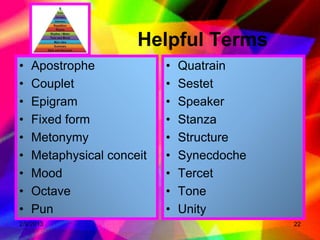
Helpful Terms
•   Apostrophe             •   Quatrain
•   Couplet                •   Sestet
•   Epigram                •   Speaker
•   Fixed form             •   Stanza
•   Metonymy               •   Structure
•   Metaphysical conceit   •   Synecdoche
•   Mood                   •   Tercet
•   Octave                 •   Tone
•   Pun                    •   Unity
2/9/2013                                    22

Poetry ppt

  • 1.
    Presented by Mrs.S. Dianne Black
  • 2.
    Types of Poems  Haiku—Japanese fixed-form poem structured in 3 lines of 17 syllable; captures a moment in time or aspect of nature  Sestina—French form of six six-line stanzas followed by a tercet called an envoy to =39 lines; set of six words is repeated in varying patterns at the ends of the lines of each of the six-line stanzas; the six words also in the envoy, two in each line of the tercet 2/9/2013 2
  • 3.
    …types of poems • Sonnet—14 lines of iambic pentameter; can be Shakespearean/English (3 quatrains followed by a couplet) or Petrarchan/Italian (octave followed by 2 tercets) • Villanelle—fixed-form of 19 lines composed of 5 tercets (rhyme scheme:aba) and a concluding quatrain (rhyme scheme:abaa); lines one & three of the 1st tercet serve as refrains 2/9/2013 3
  • 4.
    …continued • Ballad—short poemin song format that tells a story • Elegy—subject is death of aperson • Epic—long, adventurous tale with a hero • Lyric—expresses love, inner emotions tends to be personal; usually written in 1st person 2/9/2013 4
  • 5.
    ...continued • Narrative—the poettells a story with characters and a plot • Ode—originally a Greek form, odes are serious lyric poems; English Romantic poets reinvigorated the form • Prose poem—looks like a paragraph, even having a jagged right margin; may read like a paragraph, but retains poetic elements such as imagery, figurative language, and concise 2/9/2013 5 language.
  • 6.
    Theme Purpose of thepoem What the poet needed to say Expresses the unity of human experience See that we are more alike as a human race than different Tells us what is true about us Expresses the poet’s vision about the truth of the world 2/9/2013 6
  • 7.
    Imagery • Sight • Hearing •Touch • Smell • Taste Effects: transports us to another place, time, and experience; allows us to understand the emotions in the poem; creates tone; allows poet to show us meaning by taking us into the environment of the poem 2/9/2013 7
  • 8.
    Diction How does apoet choose the exact word? • Sound: how does the word sound? Does it contribute to the meaning, to the overall sound scheme, or does it interrupt or interfere? • Denotation: What is the exact meaning of the word? • Connotation: What is the suggested meaning? What is the emotive quality? Every word matters . Never skim over any word in a poem. 2/9/2013 8
  • 9.
    Sound • Rhyme • Alliteration • Exact Rhyme • Assonance • Slant Rhyme/Approximate • Cacophony Rhyme • Euphony • Internal Rhyme vs. End • Meter Rhyme 2/9/2013 9
  • 10.
    …sound continued Definitions andExamples: Rhyme: words that sound either exactly alike or merely similar Exact Rhyme: Cat, hat, flat, mat: masculine rhyme (one syllable rhymes Falling, calling, stalling: feminine rhyme (two or more syllables) 2/9/2013 10
  • 11.
    …sound continued Slant rhyme/approximaterhyme: The words sound close but are not exact rhymes Mirror, steer, dear or book, crack, stick (consonance is used most often for slant rhymes) 2/9/2013 11
  • 12.
    …sound continued Assonance: Repetition ofvowel sounds; some words using assonance will rhyme exactly; others will simply mirror the vowel sounds Cake, stake, break, fate, drank, ache, plac ate, etc. 2/9/2013 12
  • 13.
    …sound continued Internal rhymevs. end rhyme:  end rhyme occurs only at the end of the line whereas internal rhyme happens within the lines 2/9/2013 13
  • 14.
    …sound continued Alliteration Repetition ofbeginning sounds in close proximity “Susan sent sally some sunflowers,” or “Loons lurk late in autumn lakes under lavender skies. 2/9/2013 14
  • 15.
    …sound continued Cacophony Harsh ,discordant, or unpleasing sounds 2/9/2013 15
  • 16.
    …sound continued CONSONANCE Repetition of consonant sounds Exact rhymes use consonance— foot, put, soot But all words that repeat sounds are using consonance—add, suit, unfit Can occur in the middle of words— river, liver, cadaver, waver, save rave 2/9/2013 16
  • 17.
  • 18.
    …sound continued Meter: A rhythmaccomplished by using a certain number of beats or syllables per line Iambic is the most common meter (a foot consisting of one unstressed syllable followed by a stressed syllable (U /) A foot is simply 2 syllables or in some cases 3 Iambic Pentameter means a 5-foot iambic line, or 10 syllables 2/9/2013 18
  • 19.
    Final Points aboutSound Sound is not as important as the idea or meaning of the poem. Sound simply extends the meaning of the poem and enhances ideas. Sound not likely to be a significant factor in meaning in older fixed form poems. Sound in free verse poems are more experimental 2/9/2013 19
  • 20.
    Figurative Language • Metaphors:comparison of 2 dissimilar things to help us se something in a new or more meaningful way • Direct metaphor: comparison using the word “is.” “Life is a river.” • Indirect metaphor: “The river of life” all compares life to a river but does so indirectly 2/9/2013 20
  • 21.
    …figurative lang. continued •Personification: comparison by giving something non-human, human characteristics • Oxymoron: juxtaposing 2 things apparently contradictory that till reinforce one idea—jumbo shrimp, only choice, virtual reality • Hyperbole: using exaggeration to extend reality; gets us to look more closely at what is actually true by giving us a sharp contrast. • Understatement: opposite of hyperbole; used to say less than is appropriate for the situation or for meaning 2/9/2013 21
  • 22.
    Helpful Terms • Apostrophe • Quatrain • Couplet • Sestet • Epigram • Speaker • Fixed form • Stanza • Metonymy • Structure • Metaphysical conceit • Synecdoche • Mood • Tercet • Octave • Tone • Pun • Unity 2/9/2013 22