IOSR Journal of Mechanical and Civil Engineering (IOSR-JMCE)
e-ISSN: 2278-1684,p-ISSN: 2320-334X, Volume 7, Issue 6 (Jul. - Aug. 2013), PP 33-36
www.iosrjournals.org
www.iosrjournals.org 33 | Page
Enhancement of Specific Power Output of a Gas Turbine Using
Filtered Chilled Air
S. Suneetha and A. V. Satyanarayana
Dept., of Mechanical Engineering G. Pulla Reddy Engineering College. Kurnool-518007
Abstract: Conventionally the specific power output of the gas turbine can be increased using reheating and
intercooling. The thermal efficiency can be improved by adding a regenerating at lower pressure ratios. In the
present work the emphasis is given to enhance the specific power output by other means like reduction in the air
temperature at the inlet duct. The power output of the gas turbine has been estimated by allowing air at reduced
temperatures, step wise. The experiment is conducted till STP conditions are attained. The chiller coils are used
for inlet air cooling. The variation of power output with respect to temperature is also studied.
Keywords: Gas turbine, Inlet air cooling, cooling coil arrangement.
I. Introduction
Gas Turbine Cycle with Cooling System
The gas turbine is an internal combustion engine that uses air as the working fluid. The engine extracts
chemical energy from fuel and converts it to mechanical energy using the gaseous energy of the working fluid
(air) to drive the engine and propeller, which, in turn, propel the airplane. The basic principle of the airplane
turbine engine is identical to any and all engines that extract energy from chemical fuel. In the case of a
piston engine, such as the engine in a car or reciprocating airplane engine, the intake, compression, combustion,
and exhaust steps occur in the same place (cylinder head) at different times as the piston goes up and down. In
the turbine engine, however, these same four steps occur at the same time but in different places. As a result of
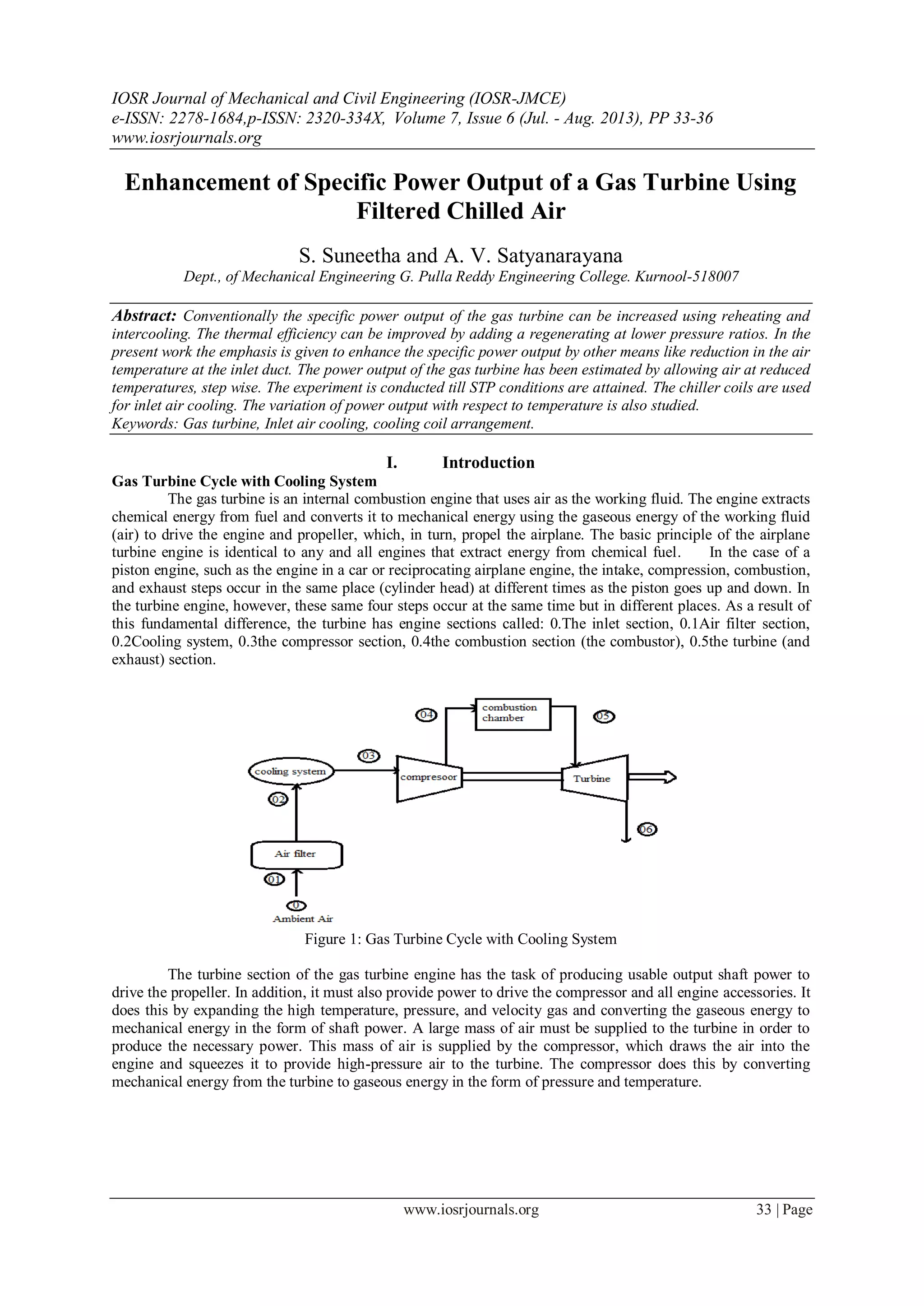
this fundamental difference, the turbine has engine sections called: 0.The inlet section, 0.1Air filter section,
0.2Cooling system, 0.3the compressor section, 0.4the combustion section (the combustor), 0.5the turbine (and
exhaust) section.
Figure 1: Gas Turbine Cycle with Cooling System
The turbine section of the gas turbine engine has the task of producing usable output shaft power to
drive the propeller. In addition, it must also provide power to drive the compressor and all engine accessories. It
does this by expanding the high temperature, pressure, and velocity gas and converting the gaseous energy to
mechanical energy in the form of shaft power. A large mass of air must be supplied to the turbine in order to
produce the necessary power. This mass of air is supplied by the compressor, which draws the air into the
engine and squeezes it to provide high-pressure air to the turbine. The compressor does this by converting
mechanical energy from the turbine to gaseous energy in the form of pressure and temperature.
Enhancement Of Specific Power Output Of A Gas Turbine Using Filtered Chilled Air
www.iosrjournals.org 34 | Page
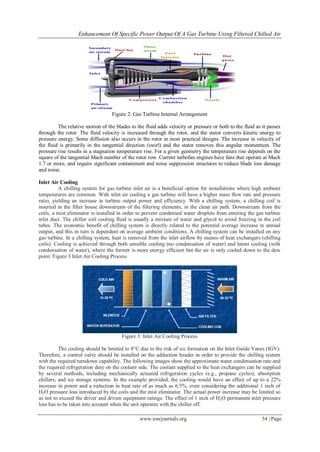
Figure 2: Gas Turbine Internal Arrangement
The relative motion of the blades to the fluid adds velocity or pressure or both to the fluid as it passes
through the rotor. The fluid velocity is increased through the rotor, and the stator converts kinetic energy to
pressure energy. Some diffusion also occurs in the rotor in most practical designs. The increase in velocity of
the fluid is primarily in the tangential direction (swirl) and the stator removes this angular momentum. The
pressure rise results in a stagnation temperature rise. For a given geometry the temperature rise depends on the
square of the tangential Mach number of the rotor row. Current turbofan engines have fans that operate at Mach
1.7 or more, and require significant containment and noise suppression structures to reduce blade loss damage
and noise.
Inlet Air Cooling
A chilling system for gas turbine inlet air is a beneficial option for installations where high ambient
temperatures are common. With inlet air cooling a gas turbine will have a higher mass flow rate and pressure
ratio, yielding an increase in turbine output power and efficiency. With a chilling system, a chilling coil is
inserted in the filter house downstream of the filtering elements, in the clean air path. Downstream from the
coils, a mist eliminator is installed in order to prevent condensed water droplets from entering the gas turbine
inlet duct. The chiller coil cooling fluid is usually a mixture of water and glycol to avoid freezing in the coil
tubes. The economic benefit of chilling system is directly related to the potential average increase in annual
output, and this in turn is dependent on average ambient conditions. A chilling system can be installed on any
gas turbine. In a chilling system, heat is removed from the inlet airflow by means of heat exchangers (chilling
coils). Cooling is achieved through both sensible cooling (no condensation of water) and latent cooling (with
condensation of water), where the former is more energy efficient but the air is only cooled down to the dew
point. Figure 3 Inlet Air Cooling Process
Figure 3: Inlet Air Cooling Process
The cooling should be limited to 8°C due to the risk of ice formation on the Inlet Guide Vanes (IGV).
Therefore, a control valve should be installed on the adduction header in order to provide the chilling system
with the required turndown capability. The following images show the approximate water condensation rate and
the required refrigeration duty on the coolant side. The coolant supplied to the heat exchangers can be supplied
by several methods, including mechanically actuated refrigeration cycles (e.g., propane cycles), absorption
chillers, and ice storage systems. In the example provided, the cooling would have an effect of up to a 22%
increase in power and a reduction in heat rate of as much as 6.5%, even considering the additional 1 inch of
H2O pressure loss introduced by the coils and the mist eliminator. The actual power increase may be limited so
as not to exceed the driver and driven equipment ratings. The effect of 1 inch of H2O permanent inlet pressure
loss has to be taken into account when the unit operates with the chiller off.
Enhancement Of Specific Power Output Of A Gas Turbine Using Filtered Chilled Air
www.iosrjournals.org 35 | Page
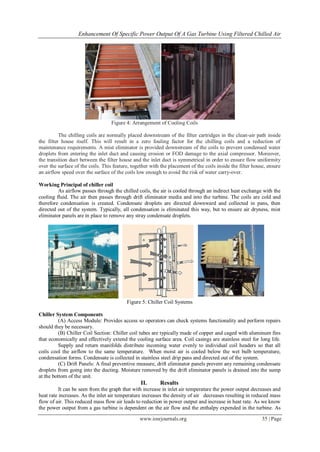
Figure 4: Arrangement of Cooling Coils
The chilling coils are normally placed downstream of the filter cartridges in the clean-air path inside
the filter house itself. This will result in a zero fouling factor for the chilling coils and a reduction of
maintenance requirements. A mist eliminator is provided downstream of the coils to prevent condensed water
droplets from entering the inlet duct and causing erosion or FOD damage to the axial compressor. Moreover,
the transition duct between the filter house and the inlet duct is symmetrical in order to ensure flow uniformity
over the surface of the coils. This feature, together with the placement of the coils inside the filter house, ensure
an airflow speed over the surface of the coils low enough to avoid the risk of water carry-over.
Working Principal of chiller coil
As airflow passes through the chilled coils, the air is cooled through an indirect heat exchange with the
cooling fluid. The air then passes through drift eliminator media and into the turbine. The coils are cold and
therefore condensation is created. Condensate droplets are directed downward and collected in pans, then
directed out of the system. Typically, all condensation is eliminated this way, but to ensure air dryness, mist
eliminator panels are in place to remove any stray condensate droplets.
Figure 5: Chiller Coil Systems
Chiller System Components
(A) Access Module: Provides access so operators can check systems functionality and perform repairs
should they be necessary.
(B) Chiller Coil Section: Chiller coil tubes are typically made of copper and caged with aluminum fins
that economically and effectively extend the cooling surface area. Coil casings are stainless steel for long life.
Supply and return manifolds distribute incoming water evenly to individual coil headers so that all
coils cool the airflow to the same temperature. When moist air is cooled below the wet bulb temperature,
condensation forms. Condensate is collected in stainless steel drip pans and directed out of the system.
(C) Drift Panels: A final preventive measure, drift eliminator panels prevent any remaining condensate
droplets from going into the ducting. Moisture removed by the drift eliminator panels is drained into the sump
at the bottom of the unit.
II. Results
It can be seen from the graph that with increase in inlet air temperature the power output decreases and
heat rate increases. As the inlet air temperature increases the density of air decreases resulting in reduced mass
flow of air. This reduced mass flow air leads to reduction in power output and increase in heat rate. As we know
the power output from a gas turbine is dependent on the air flow and the enthalpy expended in the turbine. As
Enhancement Of Specific Power Output Of A Gas Turbine Using Filtered Chilled Air
www.iosrjournals.org 36 | Page
the mass flow of air in the turbine reduces the capacity of the gas turbine to consume fuel also decreases, since
the firing temperature is fixed. The reduction in the fuel also leads to reduced
Figure 6: Effect of Inlet Air Temperature on Gas Turbine Power Output
Table 1: Calculations for Chiller Capacity
Temperature in ˚C Chiller Capacity in TR Gas Turbine Power
Output in MW
Approximate cost @
0.45 lakhs/Ton
33 102.19
25 643.3352 107.9 290
22 1558.041 110.04 701
20 2835.147 111.47 1,276
18 3621.67 112.8 1,630
15 4717.452 114.94 2,123
III. Conclusions
 Using air at atmosphere pressure and temperature gas turbine produces power of 102.19MW. But when
cold air at STP is used the turbine output increases to 114.94 MW.
 Hence percentage increases in turbine is 12.47%.
 Air is cooled from 33˚C to 15˚C using chiller. Under this condition chiller capacity is 4717.45TR.
Bibliography
[1] Farzaneh-Gord, M.; Deymi-Dashtebayaz, M. Effect of various inlet air cooling methods on gas turbine performance. Energy, 36,
1196–1205, 2011.
[2] ASHRAE. ASHRAE Handbook – HVAC Systems and equipment (SI). Atlanta, 2008.
[3] Al-Ibrahim A. M.; Varnham, A. A review of inlet air-cooling technologies for enhancing the performance of combustion turbines in
Saudi Arabia. Applied Thermal Engineering, 30, 1879–1888, 2010.
[4] Amell, A. A.; Cadavid, F. J. Influence of the Relative Humidity on the Air Cooling Thermal Load in Gas Turbine Power Plant.
Applied Thermal Engineering, 22, 1529–1533, 2002.
[5] Ibrahim, T. K.; Rahman M. M.; Abdalla A. N. Improvement of gas turbine performance based on inlet air cooling systems: A
technical review. International Journal of Physical Sciences, 6 (4), 620-627, 2011.
[6] Jaber, Q. M. Jaber, J. O.; Khawaldah, M. A. Assessment of power augmentation from gas turbine power plants using different inlet
air cooling systems. Jordan Journal of Mechanical and industrial Engineering, 1(1), 7–15, 2007.
[7] Alhazmy, M. M.; Najjar, Y. S. H. Augmentation of gas turbine performance using air coolers. Applied Thermal Engineering,
24,415– 429, 2004.
[8] Nasser, A. E. M.; El-Kalay, M. A. A heat-recovery cooling system to conserve energy in gas-turbine power stations in the Arabian
Gulf. Applied Energy, 38 (2), 133–142, 1991.
[9] Dawoud, B.; Zurigat Y. H.; Bortmany, J. Thermodynamic assessment of power requirements and impact of different gas-turbine
inlet air cooling techniques at two different locations in Oman. Applied Thermal Engineering, 25, 1579–1598, 2005.
[10] Hosseini, R.; Beshkani, A.; Soltani, M. Performance improvement of gas turbines of Fars (Iran) combined cycle power plant by
intake air cooling using a media evaporative cooler. Energy Conversion and Management, 48, 1055-1064, 2007.
[11] Brooks, F. J. GE Gas turbine performance characteristics. GE Power Systems. Schenectady, NY. GER-3567H.
[12] Mahmoudi SM, Zare V, Ranjbar F, Farshi L (2009). Energy and exergy analysis of simple and regenerative gas turbines inlet air
cooling using absorption refrigeration. J. Appl. Sci., 9(13): 2399-2407.
108
110
112
114
116
288 291 293 295 298
GasTurbineOutputin
MW
Temperature in K

Enhancement of Specific Power Output of a Gas Turbine Using Filtered Chilled Air

  • 1.
    IOSR Journal ofMechanical and Civil Engineering (IOSR-JMCE) e-ISSN: 2278-1684,p-ISSN: 2320-334X, Volume 7, Issue 6 (Jul. - Aug. 2013), PP 33-36 www.iosrjournals.org www.iosrjournals.org 33 | Page Enhancement of Specific Power Output of a Gas Turbine Using Filtered Chilled Air S. Suneetha and A. V. Satyanarayana Dept., of Mechanical Engineering G. Pulla Reddy Engineering College. Kurnool-518007 Abstract: Conventionally the specific power output of the gas turbine can be increased using reheating and intercooling. The thermal efficiency can be improved by adding a regenerating at lower pressure ratios. In the present work the emphasis is given to enhance the specific power output by other means like reduction in the air temperature at the inlet duct. The power output of the gas turbine has been estimated by allowing air at reduced temperatures, step wise. The experiment is conducted till STP conditions are attained. The chiller coils are used for inlet air cooling. The variation of power output with respect to temperature is also studied. Keywords: Gas turbine, Inlet air cooling, cooling coil arrangement. I. Introduction Gas Turbine Cycle with Cooling System The gas turbine is an internal combustion engine that uses air as the working fluid. The engine extracts chemical energy from fuel and converts it to mechanical energy using the gaseous energy of the working fluid (air) to drive the engine and propeller, which, in turn, propel the airplane. The basic principle of the airplane turbine engine is identical to any and all engines that extract energy from chemical fuel. In the case of a piston engine, such as the engine in a car or reciprocating airplane engine, the intake, compression, combustion, and exhaust steps occur in the same place (cylinder head) at different times as the piston goes up and down. In the turbine engine, however, these same four steps occur at the same time but in different places. As a result of this fundamental difference, the turbine has engine sections called: 0.The inlet section, 0.1Air filter section, 0.2Cooling system, 0.3the compressor section, 0.4the combustion section (the combustor), 0.5the turbine (and exhaust) section. Figure 1: Gas Turbine Cycle with Cooling System The turbine section of the gas turbine engine has the task of producing usable output shaft power to drive the propeller. In addition, it must also provide power to drive the compressor and all engine accessories. It does this by expanding the high temperature, pressure, and velocity gas and converting the gaseous energy to mechanical energy in the form of shaft power. A large mass of air must be supplied to the turbine in order to produce the necessary power. This mass of air is supplied by the compressor, which draws the air into the engine and squeezes it to provide high-pressure air to the turbine. The compressor does this by converting mechanical energy from the turbine to gaseous energy in the form of pressure and temperature.
  • 2.
    Enhancement Of SpecificPower Output Of A Gas Turbine Using Filtered Chilled Air www.iosrjournals.org 34 | Page Figure 2: Gas Turbine Internal Arrangement The relative motion of the blades to the fluid adds velocity or pressure or both to the fluid as it passes through the rotor. The fluid velocity is increased through the rotor, and the stator converts kinetic energy to pressure energy. Some diffusion also occurs in the rotor in most practical designs. The increase in velocity of the fluid is primarily in the tangential direction (swirl) and the stator removes this angular momentum. The pressure rise results in a stagnation temperature rise. For a given geometry the temperature rise depends on the square of the tangential Mach number of the rotor row. Current turbofan engines have fans that operate at Mach 1.7 or more, and require significant containment and noise suppression structures to reduce blade loss damage and noise. Inlet Air Cooling A chilling system for gas turbine inlet air is a beneficial option for installations where high ambient temperatures are common. With inlet air cooling a gas turbine will have a higher mass flow rate and pressure ratio, yielding an increase in turbine output power and efficiency. With a chilling system, a chilling coil is inserted in the filter house downstream of the filtering elements, in the clean air path. Downstream from the coils, a mist eliminator is installed in order to prevent condensed water droplets from entering the gas turbine inlet duct. The chiller coil cooling fluid is usually a mixture of water and glycol to avoid freezing in the coil tubes. The economic benefit of chilling system is directly related to the potential average increase in annual output, and this in turn is dependent on average ambient conditions. A chilling system can be installed on any gas turbine. In a chilling system, heat is removed from the inlet airflow by means of heat exchangers (chilling coils). Cooling is achieved through both sensible cooling (no condensation of water) and latent cooling (with condensation of water), where the former is more energy efficient but the air is only cooled down to the dew point. Figure 3 Inlet Air Cooling Process Figure 3: Inlet Air Cooling Process The cooling should be limited to 8°C due to the risk of ice formation on the Inlet Guide Vanes (IGV). Therefore, a control valve should be installed on the adduction header in order to provide the chilling system with the required turndown capability. The following images show the approximate water condensation rate and the required refrigeration duty on the coolant side. The coolant supplied to the heat exchangers can be supplied by several methods, including mechanically actuated refrigeration cycles (e.g., propane cycles), absorption chillers, and ice storage systems. In the example provided, the cooling would have an effect of up to a 22% increase in power and a reduction in heat rate of as much as 6.5%, even considering the additional 1 inch of H2O pressure loss introduced by the coils and the mist eliminator. The actual power increase may be limited so as not to exceed the driver and driven equipment ratings. The effect of 1 inch of H2O permanent inlet pressure loss has to be taken into account when the unit operates with the chiller off.
  • 3.
    Enhancement Of SpecificPower Output Of A Gas Turbine Using Filtered Chilled Air www.iosrjournals.org 35 | Page Figure 4: Arrangement of Cooling Coils The chilling coils are normally placed downstream of the filter cartridges in the clean-air path inside the filter house itself. This will result in a zero fouling factor for the chilling coils and a reduction of maintenance requirements. A mist eliminator is provided downstream of the coils to prevent condensed water droplets from entering the inlet duct and causing erosion or FOD damage to the axial compressor. Moreover, the transition duct between the filter house and the inlet duct is symmetrical in order to ensure flow uniformity over the surface of the coils. This feature, together with the placement of the coils inside the filter house, ensure an airflow speed over the surface of the coils low enough to avoid the risk of water carry-over. Working Principal of chiller coil As airflow passes through the chilled coils, the air is cooled through an indirect heat exchange with the cooling fluid. The air then passes through drift eliminator media and into the turbine. The coils are cold and therefore condensation is created. Condensate droplets are directed downward and collected in pans, then directed out of the system. Typically, all condensation is eliminated this way, but to ensure air dryness, mist eliminator panels are in place to remove any stray condensate droplets. Figure 5: Chiller Coil Systems Chiller System Components (A) Access Module: Provides access so operators can check systems functionality and perform repairs should they be necessary. (B) Chiller Coil Section: Chiller coil tubes are typically made of copper and caged with aluminum fins that economically and effectively extend the cooling surface area. Coil casings are stainless steel for long life. Supply and return manifolds distribute incoming water evenly to individual coil headers so that all coils cool the airflow to the same temperature. When moist air is cooled below the wet bulb temperature, condensation forms. Condensate is collected in stainless steel drip pans and directed out of the system. (C) Drift Panels: A final preventive measure, drift eliminator panels prevent any remaining condensate droplets from going into the ducting. Moisture removed by the drift eliminator panels is drained into the sump at the bottom of the unit. II. Results It can be seen from the graph that with increase in inlet air temperature the power output decreases and heat rate increases. As the inlet air temperature increases the density of air decreases resulting in reduced mass flow of air. This reduced mass flow air leads to reduction in power output and increase in heat rate. As we know the power output from a gas turbine is dependent on the air flow and the enthalpy expended in the turbine. As
  • 4.
    Enhancement Of SpecificPower Output Of A Gas Turbine Using Filtered Chilled Air www.iosrjournals.org 36 | Page the mass flow of air in the turbine reduces the capacity of the gas turbine to consume fuel also decreases, since the firing temperature is fixed. The reduction in the fuel also leads to reduced Figure 6: Effect of Inlet Air Temperature on Gas Turbine Power Output Table 1: Calculations for Chiller Capacity Temperature in ˚C Chiller Capacity in TR Gas Turbine Power Output in MW Approximate cost @ 0.45 lakhs/Ton 33 102.19 25 643.3352 107.9 290 22 1558.041 110.04 701 20 2835.147 111.47 1,276 18 3621.67 112.8 1,630 15 4717.452 114.94 2,123 III. Conclusions  Using air at atmosphere pressure and temperature gas turbine produces power of 102.19MW. But when cold air at STP is used the turbine output increases to 114.94 MW.  Hence percentage increases in turbine is 12.47%.  Air is cooled from 33˚C to 15˚C using chiller. Under this condition chiller capacity is 4717.45TR. Bibliography [1] Farzaneh-Gord, M.; Deymi-Dashtebayaz, M. Effect of various inlet air cooling methods on gas turbine performance. Energy, 36, 1196–1205, 2011. [2] ASHRAE. ASHRAE Handbook – HVAC Systems and equipment (SI). Atlanta, 2008. [3] Al-Ibrahim A. M.; Varnham, A. A review of inlet air-cooling technologies for enhancing the performance of combustion turbines in Saudi Arabia. Applied Thermal Engineering, 30, 1879–1888, 2010. [4] Amell, A. A.; Cadavid, F. J. Influence of the Relative Humidity on the Air Cooling Thermal Load in Gas Turbine Power Plant. Applied Thermal Engineering, 22, 1529–1533, 2002. [5] Ibrahim, T. K.; Rahman M. M.; Abdalla A. N. Improvement of gas turbine performance based on inlet air cooling systems: A technical review. International Journal of Physical Sciences, 6 (4), 620-627, 2011. [6] Jaber, Q. M. Jaber, J. O.; Khawaldah, M. A. Assessment of power augmentation from gas turbine power plants using different inlet air cooling systems. Jordan Journal of Mechanical and industrial Engineering, 1(1), 7–15, 2007. [7] Alhazmy, M. M.; Najjar, Y. S. H. Augmentation of gas turbine performance using air coolers. Applied Thermal Engineering, 24,415– 429, 2004. [8] Nasser, A. E. M.; El-Kalay, M. A. A heat-recovery cooling system to conserve energy in gas-turbine power stations in the Arabian Gulf. Applied Energy, 38 (2), 133–142, 1991. [9] Dawoud, B.; Zurigat Y. H.; Bortmany, J. Thermodynamic assessment of power requirements and impact of different gas-turbine inlet air cooling techniques at two different locations in Oman. Applied Thermal Engineering, 25, 1579–1598, 2005. [10] Hosseini, R.; Beshkani, A.; Soltani, M. Performance improvement of gas turbines of Fars (Iran) combined cycle power plant by intake air cooling using a media evaporative cooler. Energy Conversion and Management, 48, 1055-1064, 2007. [11] Brooks, F. J. GE Gas turbine performance characteristics. GE Power Systems. Schenectady, NY. GER-3567H. [12] Mahmoudi SM, Zare V, Ranjbar F, Farshi L (2009). Energy and exergy analysis of simple and regenerative gas turbines inlet air cooling using absorption refrigeration. J. Appl. Sci., 9(13): 2399-2407. 108 110 112 114 116 288 291 293 295 298 GasTurbineOutputin MW Temperature in K