Proceedings of the 2nd International Conference on Current Trends in Engineering and Management ICCTEM -2014 
INTERNATIONAL JOURNAL OF MECHANICAL ENGINEERING 
17 – 19, July 2014, Mysore, Karnataka, India 
AND TECHNOLOGY (IJMET) 
ISSN 0976 – 6340 (Print) 
ISSN 0976 – 6359 (Online) 
Volume 5, Issue 9, September (2014), pp. 22-30 
© IAEME: www.iaeme.com/IJMET.asp 
Journal Impact Factor (2014): 7.5377 (Calculated by GISI) 
www.jifactor.com 
22 
 
IJMET 
© I A E M E 
PERFORMANCE EVALUATION AND OPTIMIZATION OF AIR 
PREHEATER IN THERMAL POWER PLANT 
G.Shruti1, Ravinarayan Bhat2, Gangadhar Sheri3 
1(Department of Mechanical Engineering, Srinivas Institute of Technology, Mangalore, 574143, Karnataka, India) 
2 (Associate professor , Department of Mechanical Engineering, Srinivas Institute of Technology, Mangalore, 574143, 
Karnataka, India) 
3(AGM Performance, LANCO-UPCL Nagarjuna Thermal Power Plant, Padubidri, Udupi, 574113 Karnataka, India) 
ABSTRACT 
This paper presents a performance evaluation and optimization method of an air preheater based on routine 
operation data measured onsite at LANCO-UPCL, Nagarjuna thermal power plant Padubidri, Karnataka, India. The work 
focuses on the performance of Regenerative type air pre heater (model LAP 13494/2200). The performances were 
evaluated before and after radial sector plate clearance adjustments with air preheater tests, and improvement is seen 
along with air preheater optimization. 
Keywords: Air pre heater, Air leakage, Gas side efficiency, Seals, X-ratio. 
1. INTRODUCTION 
Modern high capacity boilers are always provided with an air preheater. Air pre-heater is an important boiler 
auxiliary which primarily preheats the combustion air for rapid and efficient combustion in the furnace Serving as the last 
heat trap for the boiler system, a regenerative air preheater typically accounts for over 10% of a plants thermal efficiency 
on a typical steam generator. Considering this, when evaluating the performance of an air preheater one should take into 
account all of the process variables [10]. 
A very good method to improve the overall efficiency of a thermal power plant is to preheat the air. If the 
incoming air for combustion is not preheated, then some energy must be supplied to heat the air to a temperature required 
to facilitate combustion. As a result, more fuel will be consumed which increases the overall cost and decreases the 
efficiency. There are many factors, which contribute to the deterioration of air preheater performance like high seal 
leakage, deterioration of heat absorption characteristics of basket elements due to fouling or plugging. Close monitoring 
of air pre heater performance and proper instrumentation would enable timely detection of performance degradation. The 
combustion air preheater for the large fuel-burning furnaces used to generate steam in thermal power plants [5]. 
2. LJUNGSTROM AIR PREHEATER (LAP 13494/2200) 
The Ljungstrom air preheater is more widely used than any other type of combustion air preheater in the power 
industry, because of its compact design proven performance and reliability, and its fuel flexibility. The model LAP 
13494/2200 means a Ljungstrom air preheater with rotor diameter of 13494mm is used in UPCL power plant. The 
heights of heating elements of 4 sections are respectively 300mm, 800mm, 800mm and 300mm from top to bottom of the 
rotor. The cold end heating elements of 300mm height are made of carbon plate while the hot end heating elements are
Proceedings of the 2nd International Conference on Current Trends in Engineering and Management ICCTEM 
17 – 19, July 2014, Mysore, Karnataka, India 
made of common carbon steel. The metal weight of one air preheater is approximately 620 tons, including 465 tons for 
the rotor assembly (about 75 percent of the total weight). The air preheater is tri 
The model LAP 13494/2200 tri-sector rotary air preheater as shown in Fig 
exchanger. Specially corrugated heating elements are tightly placed in the sector compartment of the rotor. The rotor 
turns at a speed of 0.99 rpm and is divided into gas channels and air channels. The air side is mad 
channels and secondary air channels. When gas flows through the rotor, it releases heat and delivers it to the heating 
elements and then the gas temperature drops; when the heated elements turn to the air side, the air passing through them 
is heated and its temperature is increased. By continuing maintaining such a circulation, the heat exchange is achieved 
between gas and air. 
Fig. 1: Trisector rotary air preheater and its important 
2.1 Heating Elements 
Heating elements are made of carbon steel sheets with special corrugations formed by pressing; the hot end 
heating assemblies are profiled in accordance with shapes and sizes of individual sub 
by alternately piling up notched undulation sheets with vertical undulations and inclined turbulent corrugations and 
sheets only with the same inclined corrugations one by one as shown in Fig 2. All the assemblies of both hot and cold 
end heating elements are fastened by welding flat b 
23 
tri-sector type [10]. 
Fig. 1 is a counter flow regenerative heat 
parts [10] 
sub-modules. Each assembly is formed 
ed bars and angle steels together [3]. 
-2014 
 
made of primary air
Proceedings of the 2nd International Conference on Current Trends in Engineering and Management ICCTEM 
2.2 Sealing System 
17 – 19, July 2014, Mysore, Karnataka, India 
Fig. 2: Heating Elements 
Usually air leaks in to the gas in the air preheater due to pressure differences. This leakage air decreases the 
flue gas temperature without extracting the heat. 
requirement that the rotating parts should have some working clearance between the static parts to avoid any 
interference between them. Here, in air preheaters, rotors are constructed to have high 
thermal expansion and these gaps are close with the flexible seal leaves. Major types of seals used in power plant. 
• Radial seals 
• Axial seals 
• Bypass seals 
• Circumferential seals 
To reduce the air leakage seals are provided. It is an implied 
The main purpose of these seals is to reduce the 
the Air pre heater.[6] 
3. EXPERIMENTAL SET-UP AND PROCEDURE 
3.1 Principle of Operation 
Air preheater performance test is conducted on rotary regenerative 
air preheaters. Various performance indices like air preheater leakage, gas side efficiency, X 
this test. A single carbon steel tube with portable gas analyzer and digital thermomete 
evaluation. 
3.2 Test Procedure 
The Instruments used are: Gas analyzer, Digital thermometer, static probe. 
3.2.1 Test Set Up – Operating Conditions of Test Runs 
Test runs are conducted at an easily repeatable level at 
number of mills in service and same total air levels as previous tests. The operating conditions for each test run are as 
follows. 
a. No furnace or air heater soot blowing is done during the test. 
b. Unit operation is kept steady for at least 60 minutes prior to the test. 
24 
higher clearance to take care of 
leakage between the gas and air. Fig 3. Shows sealing system of 
Fig. 3: Sealing System 
air preheater to improve the efficiency of the 
X-ratio are determined using 
thermometer is used for performance 
defined baseline conditions at full load with same 
ion -2014 
 
er r
Proceedings of the 2nd International Conference on Current Trends in Engineering and Management ICCTEM -2014 
17 – 19, July 2014, Mysore, Karnataka, India 
25 
 
c. Steam coil Air heaters (SCAPH) steam supply is kept isolated and gas recirculation dampers if any, are tightly 
shut. 
d. No mill change over is done during the test. 
The test run duration will be the time required to complete two traverses for temperature and gas analysis. Two 
separate test crews should sample the gas inlet and outlet ducts simultaneously. 
3.2.2 Traverse locations – Gas side 
a. The gas inlet traverse plane should be located as close as possible to the air heater inlet. This is done to ensure 
that any air ingress from the intervening duct/ expansion joints is not included in air heater performance 
assessment. 
b. The gas outlet traverse plane should be located at a suitable distance downstream the air heater to allow mixing 
of the flow to reduce temperature and o2 stratification. However, it should not be located downstream of other 
equipment or access ways that might contribute to air ingress. 
3.2.3 Traverse locations – Airside 
a. The air inlet traverse plane should be located after any air heating coils and as close as possible to the air heater 
inlet. Since the entering air temperature is usually uniform, a single probe with 2 or 3 temperature measurement 
points is adequate. 
b. The air outlet traverse plane should be located at a suitable distance downstream the air heater to allow mixing 
of the flow to reduce the gas stratification as shown in Fig 4. 
Fig. 4: Traverse location- airside [10] 
3.2.4 Ports and Probes 
Typical test port and probe used for the test is shown in Fig 5. 
Fig. 5: Ports and Probes [10]
Proceedings of the 2nd International Conference on Current Trends in Engineering and Management ICCTEM -2014 
17 – 19, July 2014, Mysore, Karnataka, India 
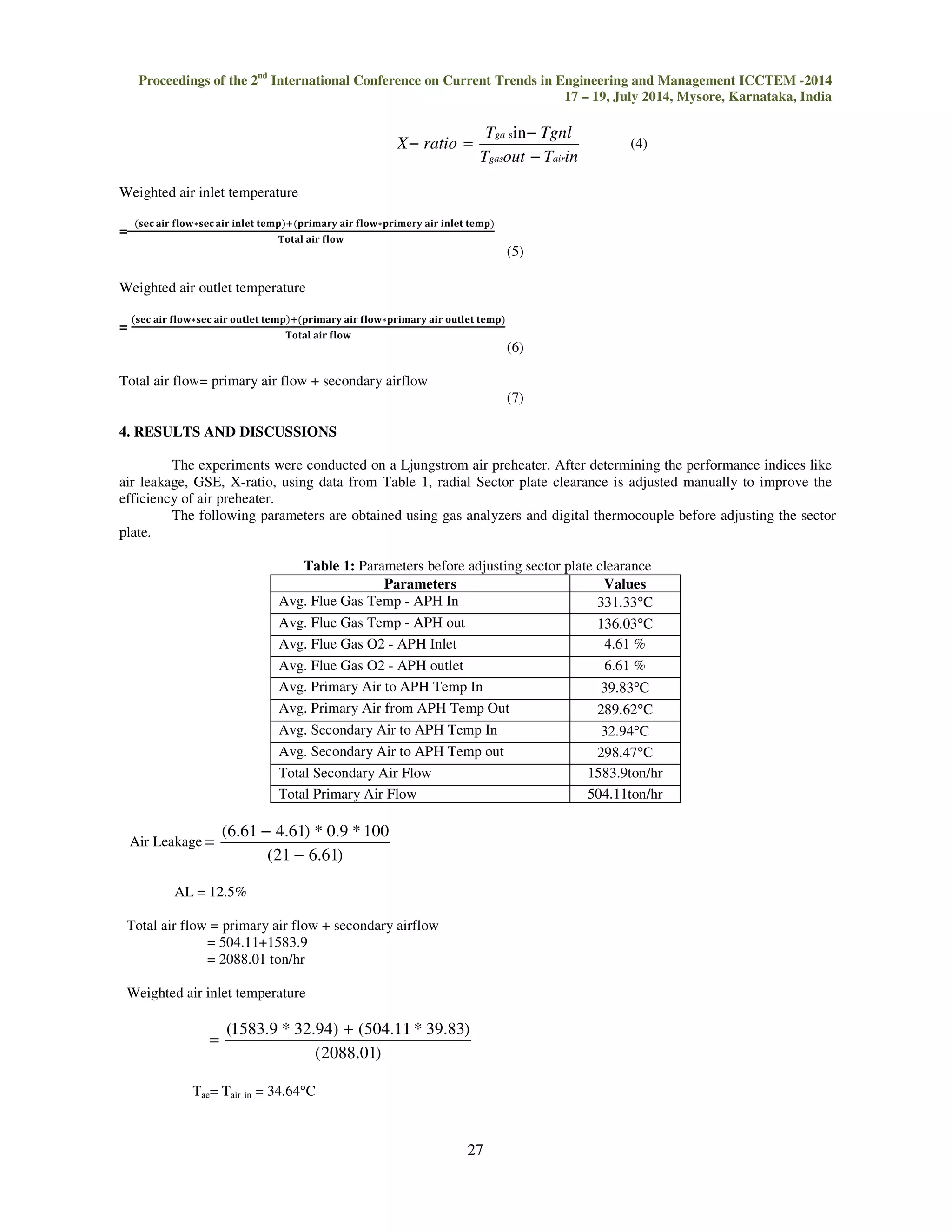
( O gl O ge 
) * 0.9 * 100 
* ( − 
) 
AL Tgl Tae 
( Tge − 
Tgnl 
) 
Tge Tae 
= (3) 
26 
 
Tubes numbered 1,2, 3 are carbon steel 3/8” OD tubes and tube no. 4 is carbon steel 12-15 mm OD. Tubes 
numbered 1, 2 3 are for gas sampling while tube no. 4 is for carrying thermocouple wires for temperature measurement. 
d is the flue gas duct width at the test cross-section. 
3.2.5 Flue Gas Composition  Temperature 
A representative value of flue gas composition (O2 / CO2/ CO) is obtained by grid sampling of the flue gas at 
multiple points in a plane perpendicular to the flow at air heater inlet and outlet using a portable gas analyzer. Two 
complete sets of data are collected for each traverse plane during each test run to ensure data repeatability. 
A typical cross section of the flue gas duct with an 18- point grid is shown in Fig 6. Along with a typical probe. 
Each dot indicates a sampling point for measurement of gas composition and temperature. 
Fig. 6: Cross section of Flue gas duct [10] 
Flue gas samples are drawn by a vacuum pump from the test grid probes and sent to a portable gas analyzer 
through a gas conditioning system. Similarly, a representative value of temperature is obtained by grid measurement of 
flue gas temperature at multiple points in a plane perpendicular to the flow at air heater inlet and outlet using multi point 
probes. 
A single tube probe with portable analyzer can also be used for traversing duct cross section. Marking / etching 
is done on the sampling tube at d/6, d/2  5d/6, if d is the duct depth. The probe is inserted in each port  samples are 
drawn at different depths as per markings. Temperatures of flue gas are also measured at the same locations using a 
similar single tube temperature probe. 
Fig. 7: Gas Analyzer 
Fig 7 shows typical gas analyzer used in the test to measure oxygen percentage in the flue gas. After completing 
the testing of all the ports of a air preheater, calculations can be done as per the following formulae. 
Air leakage 
(21 2 
) 
2 2 
O gl 
− 
− 
= (1) 
+ 
= 
Tgnl Tgl 
100 
(2) 
Gas side Efficiency GSE = (Temp drop/ Temp head)*100 
*100 
( ) 
GSE 
− 
W out 
air 
W 
ga sin 
X− ratio =
Proceedings of the 2nd International Conference on Current Trends in Engineering and Management ICCTEM -2014 
17 – 19, July 2014, Mysore, Karnataka, India 
− 
T Tgnl
(1583.9 * 32.94) + (504.11 * 39.83) 
27 
 
ga 
− 
iT out T n 
X ratio 
gas air 
− = 
sin 
(4) 
Weighted air inlet temperature 
=
(5) 
 
Weighted air outlet temperature 
=
(6) 
Total air flow= primary air flow + secondary airflow 
(7) 
4. RESULTS AND DISCUSSIONS 
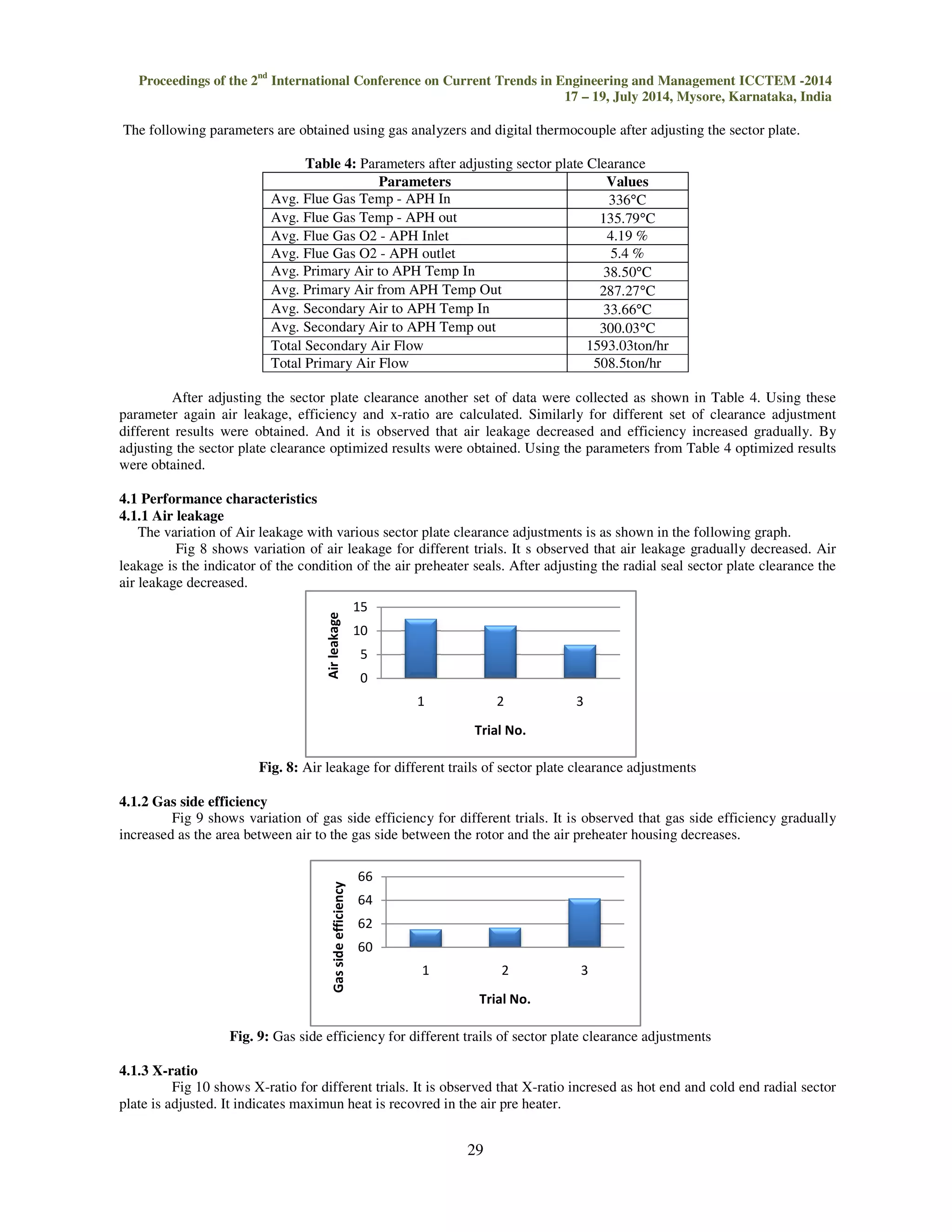
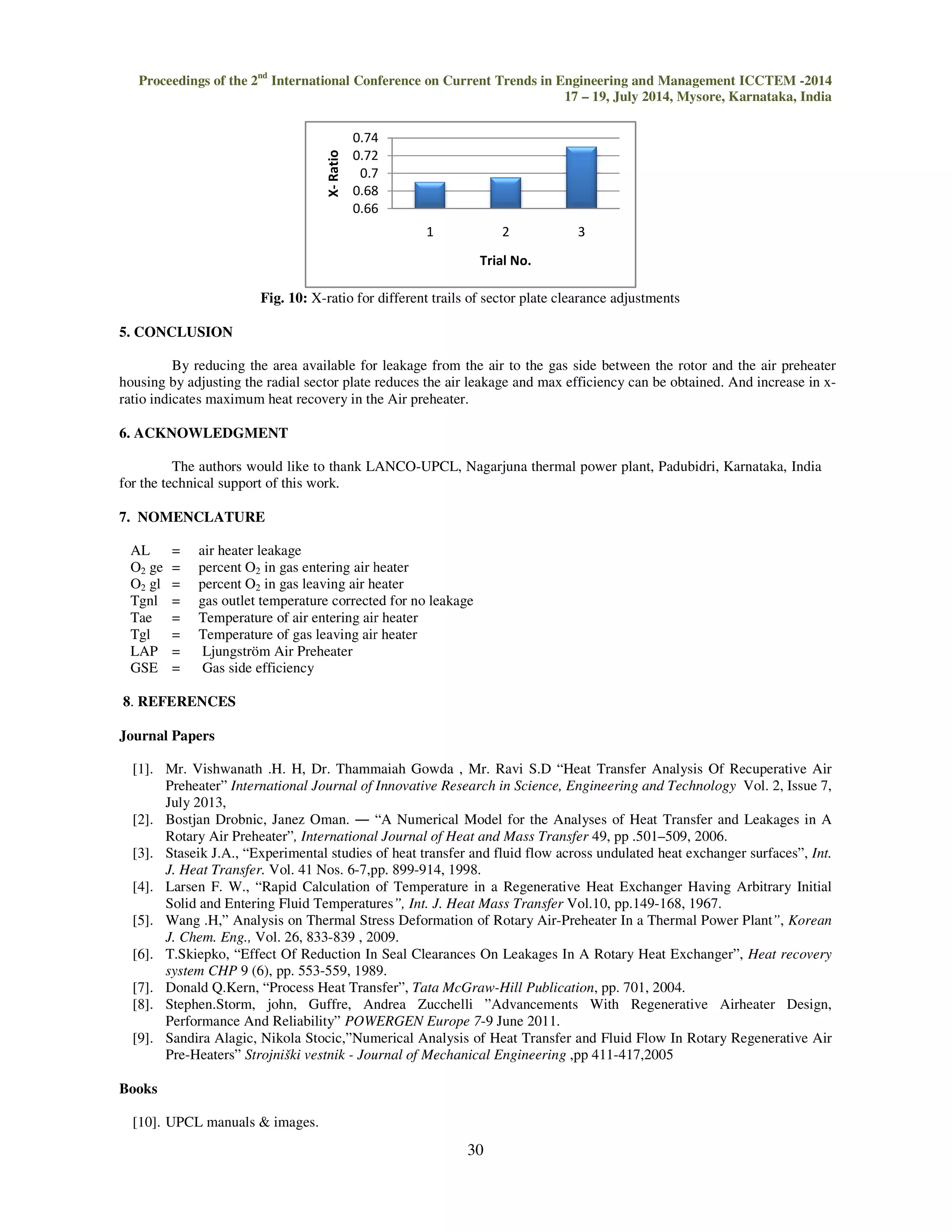
The experiments were conducted on a Ljungstrom air preheater. After determining the performance indices like 
air leakage, GSE, X-ratio, using data from Table 1, radial Sector plate clearance is adjusted manually to improve the 
efficiency of air preheater. 
The following parameters are obtained using gas analyzers and digital thermocouple before adjusting the sector 
plate. 
Table 1: Parameters before adjusting sector plate clearance 
Parameters Values 
Avg. Flue Gas Temp - APH In 331.33°C 
Avg. Flue Gas Temp - APH out 136.03°C 
Avg. Flue Gas O2 - APH Inlet 4.61 % 
Avg. Flue Gas O2 - APH outlet 6.61 % 
Avg. Primary Air to APH Temp In 39.83°C 
Avg. Primary Air from APH Temp Out 289.62°C 
Avg. Secondary Air to APH Temp In 32.94°C 
Avg. Secondary Air to APH Temp out 298.47°C 
Total Secondary Air Flow 1583.9ton/hr 
Total Primary Air Flow 504.11ton/hr 
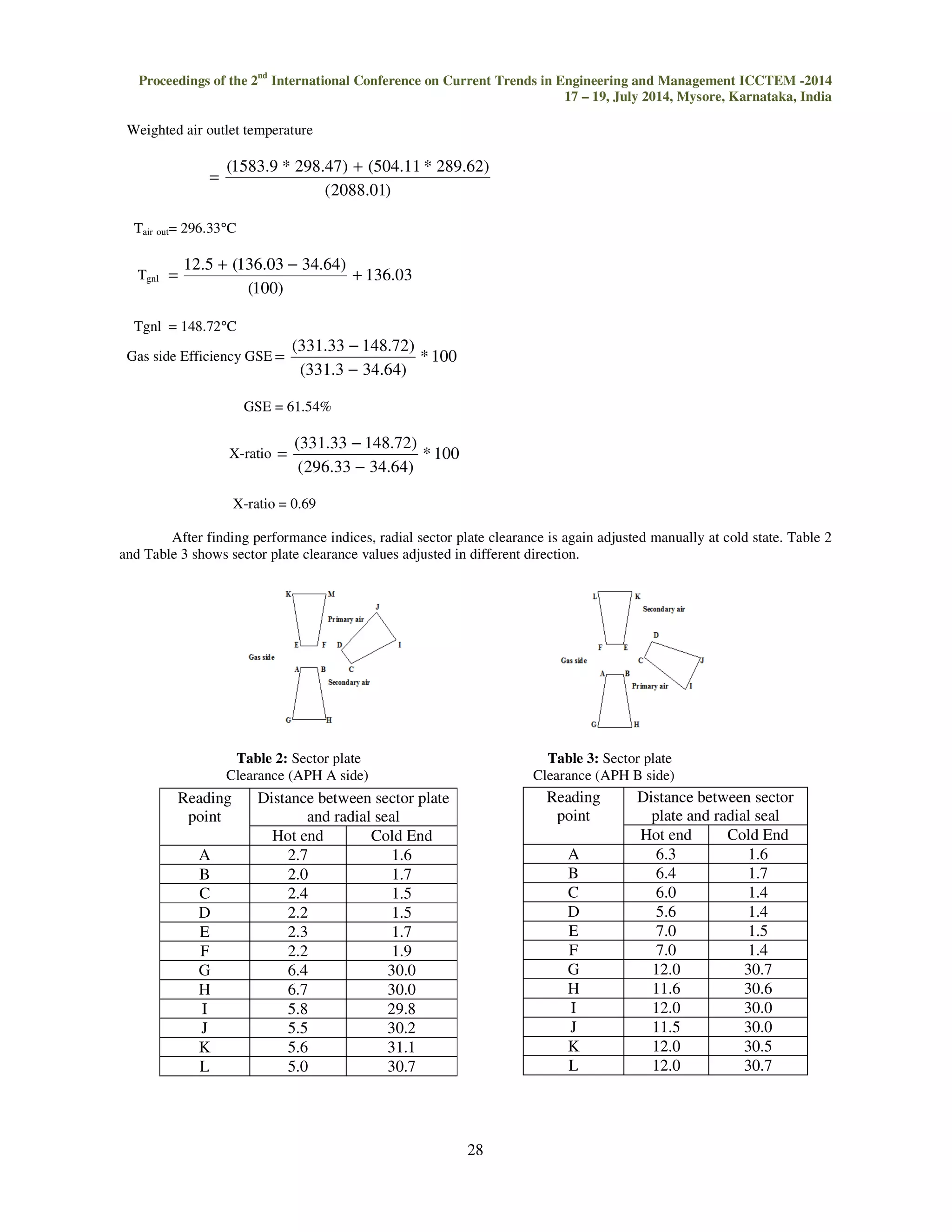
Air Leakage 
(6.61 4.61) * 0.9 * 100 
(21 − 
6.61) 
− 
= 
AL = 12.5% 
Total air flow = primary air flow + secondary airflow 
= 504.11+1583.9 
= 2088.01 ton/hr 
Weighted air inlet temperature 
(2088.01) 
= 
Tae= Tair in = 34.64°C

Performance evaluation and optimization of air preheater in thermal power plant

  • 1.
    Proceedings of the2nd International Conference on Current Trends in Engineering and Management ICCTEM -2014 INTERNATIONAL JOURNAL OF MECHANICAL ENGINEERING 17 – 19, July 2014, Mysore, Karnataka, India AND TECHNOLOGY (IJMET) ISSN 0976 – 6340 (Print) ISSN 0976 – 6359 (Online) Volume 5, Issue 9, September (2014), pp. 22-30 © IAEME: www.iaeme.com/IJMET.asp Journal Impact Factor (2014): 7.5377 (Calculated by GISI) www.jifactor.com 22 IJMET © I A E M E PERFORMANCE EVALUATION AND OPTIMIZATION OF AIR PREHEATER IN THERMAL POWER PLANT G.Shruti1, Ravinarayan Bhat2, Gangadhar Sheri3 1(Department of Mechanical Engineering, Srinivas Institute of Technology, Mangalore, 574143, Karnataka, India) 2 (Associate professor , Department of Mechanical Engineering, Srinivas Institute of Technology, Mangalore, 574143, Karnataka, India) 3(AGM Performance, LANCO-UPCL Nagarjuna Thermal Power Plant, Padubidri, Udupi, 574113 Karnataka, India) ABSTRACT This paper presents a performance evaluation and optimization method of an air preheater based on routine operation data measured onsite at LANCO-UPCL, Nagarjuna thermal power plant Padubidri, Karnataka, India. The work focuses on the performance of Regenerative type air pre heater (model LAP 13494/2200). The performances were evaluated before and after radial sector plate clearance adjustments with air preheater tests, and improvement is seen along with air preheater optimization. Keywords: Air pre heater, Air leakage, Gas side efficiency, Seals, X-ratio. 1. INTRODUCTION Modern high capacity boilers are always provided with an air preheater. Air pre-heater is an important boiler auxiliary which primarily preheats the combustion air for rapid and efficient combustion in the furnace Serving as the last heat trap for the boiler system, a regenerative air preheater typically accounts for over 10% of a plants thermal efficiency on a typical steam generator. Considering this, when evaluating the performance of an air preheater one should take into account all of the process variables [10]. A very good method to improve the overall efficiency of a thermal power plant is to preheat the air. If the incoming air for combustion is not preheated, then some energy must be supplied to heat the air to a temperature required to facilitate combustion. As a result, more fuel will be consumed which increases the overall cost and decreases the efficiency. There are many factors, which contribute to the deterioration of air preheater performance like high seal leakage, deterioration of heat absorption characteristics of basket elements due to fouling or plugging. Close monitoring of air pre heater performance and proper instrumentation would enable timely detection of performance degradation. The combustion air preheater for the large fuel-burning furnaces used to generate steam in thermal power plants [5]. 2. LJUNGSTROM AIR PREHEATER (LAP 13494/2200) The Ljungstrom air preheater is more widely used than any other type of combustion air preheater in the power industry, because of its compact design proven performance and reliability, and its fuel flexibility. The model LAP 13494/2200 means a Ljungstrom air preheater with rotor diameter of 13494mm is used in UPCL power plant. The heights of heating elements of 4 sections are respectively 300mm, 800mm, 800mm and 300mm from top to bottom of the rotor. The cold end heating elements of 300mm height are made of carbon plate while the hot end heating elements are
  • 2.
    Proceedings of the2nd International Conference on Current Trends in Engineering and Management ICCTEM 17 – 19, July 2014, Mysore, Karnataka, India made of common carbon steel. The metal weight of one air preheater is approximately 620 tons, including 465 tons for the rotor assembly (about 75 percent of the total weight). The air preheater is tri The model LAP 13494/2200 tri-sector rotary air preheater as shown in Fig exchanger. Specially corrugated heating elements are tightly placed in the sector compartment of the rotor. The rotor turns at a speed of 0.99 rpm and is divided into gas channels and air channels. The air side is mad channels and secondary air channels. When gas flows through the rotor, it releases heat and delivers it to the heating elements and then the gas temperature drops; when the heated elements turn to the air side, the air passing through them is heated and its temperature is increased. By continuing maintaining such a circulation, the heat exchange is achieved between gas and air. Fig. 1: Trisector rotary air preheater and its important 2.1 Heating Elements Heating elements are made of carbon steel sheets with special corrugations formed by pressing; the hot end heating assemblies are profiled in accordance with shapes and sizes of individual sub by alternately piling up notched undulation sheets with vertical undulations and inclined turbulent corrugations and sheets only with the same inclined corrugations one by one as shown in Fig 2. All the assemblies of both hot and cold end heating elements are fastened by welding flat b 23 tri-sector type [10]. Fig. 1 is a counter flow regenerative heat parts [10] sub-modules. Each assembly is formed ed bars and angle steels together [3]. -2014 made of primary air
  • 3.
    Proceedings of the2nd International Conference on Current Trends in Engineering and Management ICCTEM 2.2 Sealing System 17 – 19, July 2014, Mysore, Karnataka, India Fig. 2: Heating Elements Usually air leaks in to the gas in the air preheater due to pressure differences. This leakage air decreases the flue gas temperature without extracting the heat. requirement that the rotating parts should have some working clearance between the static parts to avoid any interference between them. Here, in air preheaters, rotors are constructed to have high thermal expansion and these gaps are close with the flexible seal leaves. Major types of seals used in power plant. • Radial seals • Axial seals • Bypass seals • Circumferential seals To reduce the air leakage seals are provided. It is an implied The main purpose of these seals is to reduce the the Air pre heater.[6] 3. EXPERIMENTAL SET-UP AND PROCEDURE 3.1 Principle of Operation Air preheater performance test is conducted on rotary regenerative air preheaters. Various performance indices like air preheater leakage, gas side efficiency, X this test. A single carbon steel tube with portable gas analyzer and digital thermomete evaluation. 3.2 Test Procedure The Instruments used are: Gas analyzer, Digital thermometer, static probe. 3.2.1 Test Set Up – Operating Conditions of Test Runs Test runs are conducted at an easily repeatable level at number of mills in service and same total air levels as previous tests. The operating conditions for each test run are as follows. a. No furnace or air heater soot blowing is done during the test. b. Unit operation is kept steady for at least 60 minutes prior to the test. 24 higher clearance to take care of leakage between the gas and air. Fig 3. Shows sealing system of Fig. 3: Sealing System air preheater to improve the efficiency of the X-ratio are determined using thermometer is used for performance defined baseline conditions at full load with same ion -2014 er r
  • 4.
    Proceedings of the2nd International Conference on Current Trends in Engineering and Management ICCTEM -2014 17 – 19, July 2014, Mysore, Karnataka, India 25 c. Steam coil Air heaters (SCAPH) steam supply is kept isolated and gas recirculation dampers if any, are tightly shut. d. No mill change over is done during the test. The test run duration will be the time required to complete two traverses for temperature and gas analysis. Two separate test crews should sample the gas inlet and outlet ducts simultaneously. 3.2.2 Traverse locations – Gas side a. The gas inlet traverse plane should be located as close as possible to the air heater inlet. This is done to ensure that any air ingress from the intervening duct/ expansion joints is not included in air heater performance assessment. b. The gas outlet traverse plane should be located at a suitable distance downstream the air heater to allow mixing of the flow to reduce temperature and o2 stratification. However, it should not be located downstream of other equipment or access ways that might contribute to air ingress. 3.2.3 Traverse locations – Airside a. The air inlet traverse plane should be located after any air heating coils and as close as possible to the air heater inlet. Since the entering air temperature is usually uniform, a single probe with 2 or 3 temperature measurement points is adequate. b. The air outlet traverse plane should be located at a suitable distance downstream the air heater to allow mixing of the flow to reduce the gas stratification as shown in Fig 4. Fig. 4: Traverse location- airside [10] 3.2.4 Ports and Probes Typical test port and probe used for the test is shown in Fig 5. Fig. 5: Ports and Probes [10]
  • 5.
    Proceedings of the2nd International Conference on Current Trends in Engineering and Management ICCTEM -2014 17 – 19, July 2014, Mysore, Karnataka, India ( O gl O ge ) * 0.9 * 100 * ( − ) AL Tgl Tae ( Tge − Tgnl ) Tge Tae = (3) 26 Tubes numbered 1,2, 3 are carbon steel 3/8” OD tubes and tube no. 4 is carbon steel 12-15 mm OD. Tubes numbered 1, 2 3 are for gas sampling while tube no. 4 is for carrying thermocouple wires for temperature measurement. d is the flue gas duct width at the test cross-section. 3.2.5 Flue Gas Composition Temperature A representative value of flue gas composition (O2 / CO2/ CO) is obtained by grid sampling of the flue gas at multiple points in a plane perpendicular to the flow at air heater inlet and outlet using a portable gas analyzer. Two complete sets of data are collected for each traverse plane during each test run to ensure data repeatability. A typical cross section of the flue gas duct with an 18- point grid is shown in Fig 6. Along with a typical probe. Each dot indicates a sampling point for measurement of gas composition and temperature. Fig. 6: Cross section of Flue gas duct [10] Flue gas samples are drawn by a vacuum pump from the test grid probes and sent to a portable gas analyzer through a gas conditioning system. Similarly, a representative value of temperature is obtained by grid measurement of flue gas temperature at multiple points in a plane perpendicular to the flow at air heater inlet and outlet using multi point probes. A single tube probe with portable analyzer can also be used for traversing duct cross section. Marking / etching is done on the sampling tube at d/6, d/2 5d/6, if d is the duct depth. The probe is inserted in each port samples are drawn at different depths as per markings. Temperatures of flue gas are also measured at the same locations using a similar single tube temperature probe. Fig. 7: Gas Analyzer Fig 7 shows typical gas analyzer used in the test to measure oxygen percentage in the flue gas. After completing the testing of all the ports of a air preheater, calculations can be done as per the following formulae. Air leakage (21 2 ) 2 2 O gl − − = (1) + = Tgnl Tgl 100 (2) Gas side Efficiency GSE = (Temp drop/ Temp head)*100 *100 ( ) GSE − W out air W ga sin X− ratio =
  • 6.
    Proceedings of the2nd International Conference on Current Trends in Engineering and Management ICCTEM -2014 17 – 19, July 2014, Mysore, Karnataka, India − T Tgnl
  • 7.
    (1583.9 * 32.94)+ (504.11 * 39.83) 27 ga − iT out T n X ratio gas air − = sin (4) Weighted air inlet temperature =
  • 8.
    (5) Weightedair outlet temperature =
  • 9.
    (6) Total airflow= primary air flow + secondary airflow (7) 4. RESULTS AND DISCUSSIONS The experiments were conducted on a Ljungstrom air preheater. After determining the performance indices like air leakage, GSE, X-ratio, using data from Table 1, radial Sector plate clearance is adjusted manually to improve the efficiency of air preheater. The following parameters are obtained using gas analyzers and digital thermocouple before adjusting the sector plate. Table 1: Parameters before adjusting sector plate clearance Parameters Values Avg. Flue Gas Temp - APH In 331.33°C Avg. Flue Gas Temp - APH out 136.03°C Avg. Flue Gas O2 - APH Inlet 4.61 % Avg. Flue Gas O2 - APH outlet 6.61 % Avg. Primary Air to APH Temp In 39.83°C Avg. Primary Air from APH Temp Out 289.62°C Avg. Secondary Air to APH Temp In 32.94°C Avg. Secondary Air to APH Temp out 298.47°C Total Secondary Air Flow 1583.9ton/hr Total Primary Air Flow 504.11ton/hr Air Leakage (6.61 4.61) * 0.9 * 100 (21 − 6.61) − = AL = 12.5% Total air flow = primary air flow + secondary airflow = 504.11+1583.9 = 2088.01 ton/hr Weighted air inlet temperature (2088.01) = Tae= Tair in = 34.64°C
  • 10.
    Proceedings of the2nd International Conference on Current Trends in Engineering and Management ICCTEM Weighted air outlet temperature (1583.9 * 298.47) + (504 504.11 * 289.62) 0(2088. 1 = Tair out= 296.33°C 12.5 (136.03 34.64) Tgnl 136 (100) + + − = Tgnl = 148.72°C Gas side Efficiency GSE (331.33 − 148 148.72) (331.3 − 34 = GSE = 61.54% X-ratio (331.33 − 148 148.72) (296.33 − 34 = X-ratio = 0.69 After finding performance indices, radial sector plate clearance is again adjusted manually and Table 3 shows sector plate clearance values adjusted in different direction. Table 2: Sector plate Clearance (APH A side) Reading point Distance between and radial seal Hot end Cold End A 2.7 B 2.0 C 2.4 D 2.2 E 2.3 F 2.2 G 6.4 H 6.7 I 5.8 J 5.5 K 5.6 L 5.0 17 – 19, July 2014, Mysore, Karnataka, India 28 01) 136.03 * 100 34.64) * 100 34.64) at cold state. Table 3: Sector plate Clearance (APH B side) sector plate 1.6 1.7 1.5 1.5 1.7 1.9 30.0 30.0 29.8 30.2 31.1 30.7 Reading point Distance between sector plate and radial seal Hot end A 6.3 B 6.4 C 6.0 D 5.6 E 7.0 F 7.0 G 12.0 H 11.6 I 12.0 J 11.5 K 12.0 L 12.0 -2014 Table 2 earance Cold End 1.6 1.7 1.4 1.4 1.5 1.4 30.7 30.6 30.0 30.0 30.5 30.7
  • 11.
    Proceedings of the2nd International Conference on Current Trends in Engineering and Management ICCTEM The following parameters are obtained using gas analyzers and digital Table 4: Parameters after adjusting sector plate Clearance Avg. Flue Gas Temp Avg. Flue Gas Temp Avg. Flue Gas O2 Avg. Flue Gas O2 Avg. Primary Air to APH Temp In Avg. Primary Air from APH Temp Out Avg. Secondary Air to APH Temp In Avg. Secondary Air to APH Temp out Total Secondary Air Flow Total Primary Air Flow -2014 After adjusting the sector plate clearance another set of data were collected as shown in Table 4. Using these parameter again air leakage, efficiency and x different results were obtained. And it is observed that air leakage decreased and efficiency increased gradually. By adjusting the sector plate clearance optimized results were obtained. Using the parameters from Table 4 optimized results were obtained. 4.1 Performance characteristics 4.1.1 Air leakage The variation of Air leakage with various sector plate clearance adjustments is as shown in the following graph. Fig 8 shows variation of air leakage for different trials. It s observed that leakage is the indicator of the condition of the air preheater seals. After adjusting the radial seal sector plate clearance air leakage decreased. Fig. 8: Air leakage for different trails of sector plate clearance adjustments 4.1.2 Gas side efficiency the Fig 9 shows variation of gas side efficiency for different trials. It is observed that gas side efficiency gradually increased as the area between air to the gas side between the rotor and the air preheater housing decreases.
  • 12.
    Fig. 9: Gasside efficiency for different trails of sector plate clearance adjustments 4.1.3 X-ratio Fig 10 shows X-ratio for different trials. It is observed that plate is adjusted. It indicates maximun heat is recovred in the air pre heater. 17 – 19, July 2014, Mysore, Karnataka, India 29 thermocouple after adjusting the sector plate. Parameters Values - APH In 336°C - APH out 135.79°C - APH Inlet 4.19 % - APH outlet 5.4 % 38.50°C 287.27°C 33.66°C 300.03°C 1593.03ton/hr 508.5ton/hr x-ratio are calculated. Similarly for different set of clearance adjustment air leakage gradually decreased. Air X-ratio incresed as hot end and cold end radial sector
  • 13.
    Proceedings of the2nd International Conference on Current Trends in Engineering and Management ICCTEM Fig. 10: X-ratio for different trails of sector plate clearance adjustments 5. CONCLUSION By reducing the area available for leakage from the air to the gas side between the rotor and the air preheater housing by adjusting the radial sector plate reduces the air leakage and max efficiency can be obtained. And increase in x ratio indicates maximum heat recovery in the Air preheater. 6. ACKNOWLEDGMENT The authors would like to thank LANCO for the technical support of this work. 7. NOMENCLATURE AL = air heater leakage O2 ge = percent O2 in gas entering air heater O2 gl = percent O2 in gas leaving air heater Tgnl = gas outlet temperature corrected for no Tae = Temperature of air entering air heater Tgl = Temperature of gas leaving air heater LAP = Ljungström Air Preheater GSE = Gas side efficiency 8. REFERENCES Journal Papers [1]. Mr. Vishwanath .H. H, Dr. Thammaiah Gowda , Mr. Ravi S.D “ Preheater” International Journal of Innovative Research in Science, Engineering and Technology July 2013, [2]. Bostjan Drobnic, Janez Oman. “A Numerical Model Rotary Air Preheater”, International Journal of Heat and Mass Transfer [3]. Staseik J.A., “Experimental studies of heat transfer and fluid flow across undulated heat exchanger surfaces”, J. Heat Transfer. Vol. 41 Nos. 6-7,pp. 899 [4]. Larsen F. W., “Rapid Calculation of Temperature in a Regenerative Heat Exchanger Having Arbitrary Initial Solid and Entering Fluid Temperatures [5]. Wang .H,” Analysis on Thermal Stress Deformation of J. Chem. Eng., Vol. 26, 833-839 , 2009. [6]. T.Skiepko, “Effect Of Reduction In Seal Clearances On Leakages In A Rotary Heat Exchanger system CHP 9 (6), pp. 553-559, 1989. [7]. Donald Q.Kern, “Process Heat Transfer [8]. Stephen.Storm, john, Guffre, Andrea Zucchelli ” Performance And Reliability” POWERGEN Europe 7 [9]. Sandira Alagic, Nikola Stocic,”Numerical Analysis Pre-Heaters” Strojniški vestnik - Journal of Mechanical Engineering Books [10]. UPCL manuals images. 17 – 19, July 2014, Mysore, Karnataka, India 30 overy LANCO-UPCL, Nagarjuna thermal power plant, Padubidri, Karnataka, India leakage Heat Transfer Analysis Of Recuperative Air for the Analyses of Heat Transfer , 49, pp .501–509, 2006. 899-914, 1998. Temperatures”, Int. J. Heat Mass Transfer Vol.10, pp.149-168, 1967. Rotary Air-Preheater In a Thermal Power Plant Transfer”, Tata McGraw-Hill Publication, pp. 701, 2004. Advancements With Regenerative Airheater Design, 7-9 June 2011. of Heat Transfer and Fluid Flow In Rotary Regenerative Air ,pp 411-417,2005 -2014 x- Vol. 2, Issue 7, and Leakages in A Int. Plant”, Korean Exchanger”, Heat recovery