1
Chapter 1
INTRODUCTION
The automotive industry is continuously involved in a strong competitive career to
obtain the best automobile design in multiple aspects (performance, fuel consumption,
aesthetics, safety, etc.). The air-cooled heat exchangers found in a vehicle (radiator,
AC condenser and evaporator, charge air cooler, etc.) have an important role in its
weight and also in the design of its front-end module, which also has a strong impact
on the car aerodynamic behaviour. Looking at these challenges, an optimisation
process is mandatory to obtain the best design compromise between performance,
size/shape and weight. This optimisation objective demands advanced design tools
that can indicate not only the better solution but also the fundamental reason of a
performance improvement. Some previous references were found with experimental
analysis of the thermal and fluid-dynamic behaviour of automotive radiators. Lin et al.
presented an interesting study of specific dissipation (SD) sensibility to radiator
boundary conditions (air and coolant inlet temperatures and mass flows). Their
conclusions were assessed by numerical and experimental work. Juger and Crook
reported an experimental testing on two radiators of the same flow area but with the
tubes in vertical or horizontal position, therefore studying the influence of tube length
vs. number of parallel tubes. They carried out this analysis for three different coolant
fluids. experimentally compared the performance of five commercial radiators
working with water and five aqueous glycol mixtures. experimentally analysed a
sample radiator.
2
Chapter 2
LITERATURE REVIEW
Several literature related to this topic above has been referred.
1. C. Oliet et.al [1] Parametric studies performed on automotive radiators by
means of a detailed rating and design heat exchanger model. A first part of the
analysis focuses on the influence of working conditions on both fluids (mass
flows, inlet temperatures) and the impact of the selected coolant fluid.
Following these studies, the influence of some geometrical parameters is
analysed (fin pitch, louver angle) as well as the importance of coolant flow
lay-out on the radiator global performance. This work provides an overall
behaviour report of automobile radiators working at usual range of operating
conditions.
2. Sudhi Uppuluri et.al [2] streamlined approach for characterizing the heat
flows from the combustion chamber to the engine coolant, engine oil circuit
and the ambient. The approach in this paper uses a built-in flow and heat
transfer solver in the CAD model of the engine to derive heat transfer
coefficients for the coolant-block interface, oil-block interface and the block-
ambient interface. These coefficients take into account the changing boundary
conditions of flow rate, temperatures, and combustion heat to help characterize
the complex thermal interactions between each of these subsystems during the
warm-up process.
3. Wei Liu et.al [3] The hydraulic retarder is the most stabilized auxiliary
braking system of heavy-duty vehicles. When the hydraulic retarder is
working during auxiliary braking, all of the braking energy is transferred into
the thermal energy of the transmission medium of the working wheel.
Theoretically, the residual heat-sinking capability of the engine could be used
to cool down the transmission medium of the hydraulic retarder, in order to
ensure the proper functioning of the hydraulic retarder. Never the less, the
hydraulic retarder is always placed at the tailing head of the gearbox, far from
the engine, long cooling circuits, which increases the risky leakage risk of the
transmission medium.
3
4. Pallavi Annabattula et.al [4] Determining coolant flow distribution in a
topologically complex flow path for efficient heat rejection from the critical
regions of the engine is a challenge. However, with the established
computational methodology, thermal response of an engine (via conjugate heat
transfer) can be accurately predicted and improved upon via Design of
Experiment (DOE) study in a relatively short timeframe.
4
Chapter 3
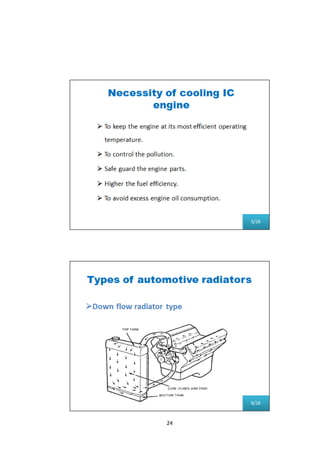
NECESSITY OF COOLING
To get the work done from internal combustion engine, we have to burn air-fuel
mixture inside the cylinder. When the combustion of air-fuel mixture takes place in
the engine cylinder, a temperature as high as 2500 degree centigrade is reached. To
withstand such a high temperature we have to use very high melting point material for
construction of engine. Practically it is less possible because, "Platinum" a metal
which has one of the highest melting point, melts at above 1800 degree centigrade.
It has been practically found that out of total heat generated by internal combustion
engine due to combustion of fuel, only 30% of heat is converted in useful work, out
of remaining 70% about 40 % is carried by exhaust gases into the atmosphere during
exhaust stroke. The rest of 30% must be passed to atmosphere by some suitable
arrangement.
Here we find the necessity of cooling. In addition to overheating, large temperature
differences may lead to distortion of the engine components due to set up of thermal
stresses. If the cooling system is not provided to internal combustion engine, the
lubricating oil film would break down and the lubricating oil will decompose to give
gummy and carbon deposits.
In lack of Cooling system, a complete seizure of the piston, bearing and other
important parts will occur. Due to this, there will be more frequent replacement of the
components are required. It will also increase the repairing cost and breakdown
period. The engine life will be reduced considerably.
It should also be noted that higher temperatures lower the volumetric efficiency of the
engine, promote pre-ignition and tendency of the engine to detonate. The object of
cooling is achieved by any of the two methods,
01)Air Cooling
02)Water Cooling
5
Properties of an efficient cooling system:-
The following are the two main properties desired of an efficient cooling system,
01)It must be capable of removing only about 30% of the heat generated in the
combustion chamber. Too much heat removal will lower the thermal efficiency of the
engine. It should remove heat at a fast rate when engine is hot. It is also required to be
very slow cooling at the starting of the engine, so that the different working parts of
the internal combustion engine reach their operating temperature in a short time
period. If you are using Water cooled engine, then are little chances of freezing of
water in cold weather conditions, if we keep engine without use for very long time.
To overcome this problem, we have to mix anti freezers in cooling water.
6
Chapter 4
TYPES OF RADIATOR
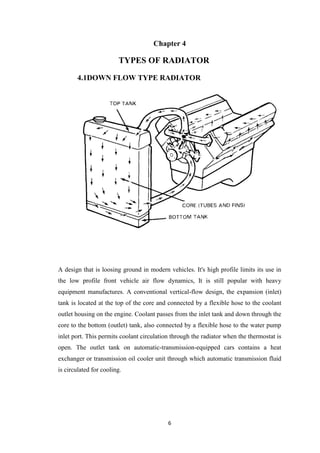
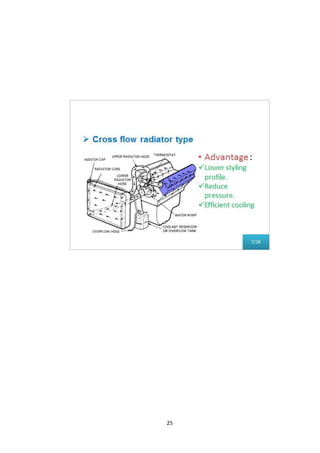
4.1DOWN FLOW TYPE RADIATOR
A design that is loosing ground in modern vehicles. It's high profile limits its use in
the low profile front vehicle air flow dynamics, It is still popular with heavy
equipment manufactures. A conventional vertical-flow design, the expansion (inlet)
tank is located at the top of the core and connected by a flexible hose to the coolant
outlet housing on the engine. Coolant passes from the inlet tank and down through the
core to the bottom (outlet) tank, also connected by a flexible hose to the water pump
inlet port. This permits coolant circulation through the radiator when the thermostat is
open. The outlet tank on automatic-transmission-equipped cars contains a heat
exchanger or transmission oil cooler unit through which automatic transmission fluid
is circulated for cooling.
7
4.2 CROSS FLOW TYPE RADIATOR
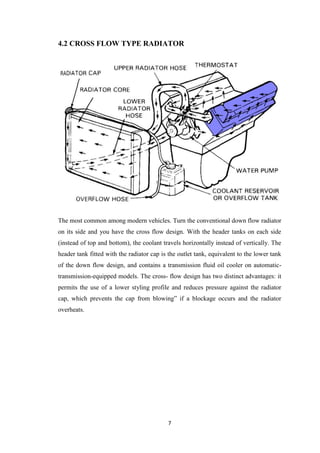
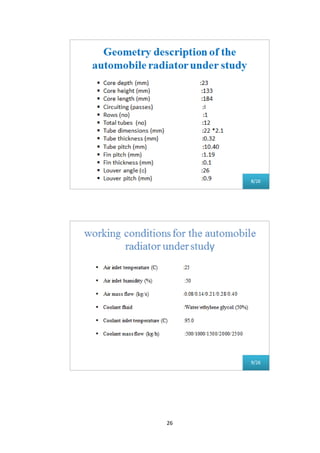
The most common among modern vehicles. Turn the conventional down flow radiator
on its side and you have the cross flow design. With the header tanks on each side
(instead of top and bottom), the coolant travels horizontally instead of vertically. The
header tank fitted with the radiator cap is the outlet tank, equivalent to the lower tank
of the down flow design, and contains a transmission fluid oil cooler on automatic-
transmission-equipped models. The cross- flow design has two distinct advantages: it
permits the use of a lower styling profile and reduces pressure against the radiator
cap, which prevents the cap from blowing” if a blockage occurs and the radiator
overheats.
8
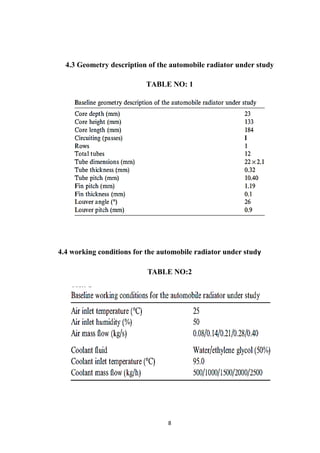
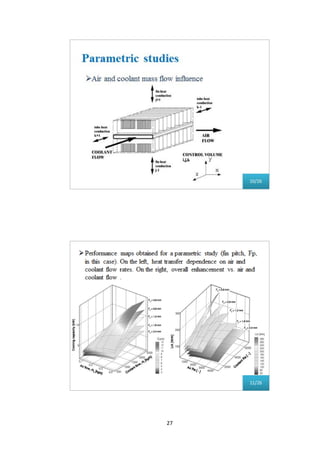
4.3 Geometry description of the automobile radiator under study
TABLE NO: 1
4.4 working conditions for the automobile radiator under study
TABLE NO:2
9
Chapter 5
PARAMETRIC STUDIES
The first part of these studies focuses on the influence of working conditions on both
fluids (mass flows, inlet temperatures, coolant fluid). After that, the influence of some
geometrical parameters is analysed (fin pitch, louver angle) as well as the importance
of coolant flow lay-out on the radiator performance. Significant knowledge-based
design conclusions have been reported. Where appropriate, the results are presented
using non-dimensional flow parameters (Reynolds numbers) and overall heat
exchanger parameters (overall heat transfer coefficient) to show general
trends independent of the particular testing condition.
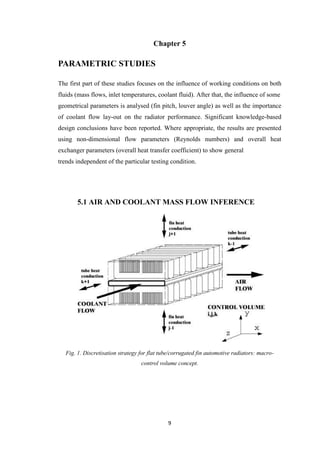
5.1 AIR AND COOLANT MASS FLOW INFERENCE
Fig. 1. Discretisation strategy for flat tube/corrugated fin automotive radiators: macro-
control volume concept.
10
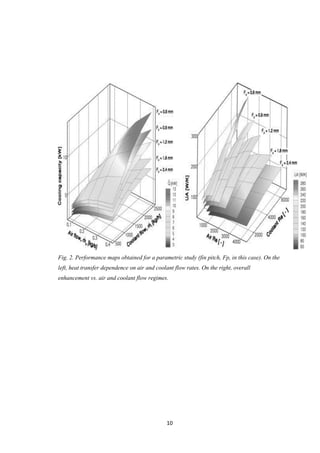
Fig. 2. Performance maps obtained for a parametric study (fin pitch, Fp, in this case). On the
left, heat transfer dependence on air and coolant flow rates. On the right, overall
enhancement vs. air and coolant flow regimes.
11
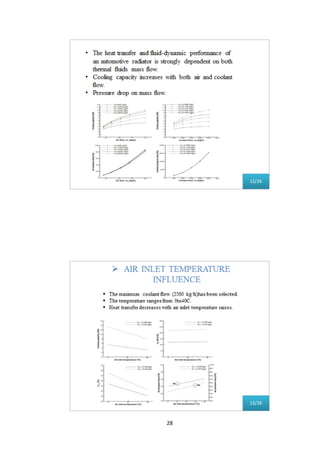
Fig. 3. Air and coolant mass flow influence on the thermal and fluid-dynamic performance of
the automotive radiator.
The heat transfer and fluid-dynamic performance of an automotive radiator is strongly
dependent on both thermal fluids mass flow. This study shows the behaviour of the
selected radiator over a wide flow range, while maintaining the geometry and the
temperature levels at the baseline situation. Fig. 3 shows how the cooling capacity
increases with both air and coolant flow, although its derivative decreases
monotonically. The curves show typically a stronger dependency on air mass flow
because air has usually the highest thermal resistance. The same figure introduces the
air and coolant pressure drop dependency on mass flow, reflecting the expected
quadratic behaviour.
12
5.2 AIR INLET TEMPERATURE INFLUENCE
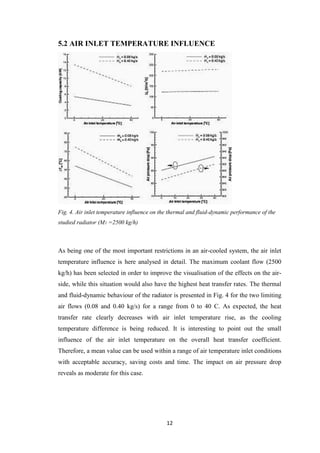
Fig. 4. Air inlet temperature influence on the thermal and fluid-dynamic performance of the
studied radiator (M1 =2500 kg/h)
As being one of the most important restrictions in an air-cooled system, the air inlet
temperature influence is here analysed in detail. The maximum coolant flow (2500
kg/h) has been selected in order to improve the visualisation of the effects on the air-
side, while this situation would also have the highest heat transfer rates. The thermal
and fluid-dynamic behaviour of the radiator is presented in Fig. 4 for the two limiting
air flows (0.08 and 0.40 kg/s) for a range from 0 to 40 C. As expected, the heat
transfer rate clearly decreases with air inlet temperature rise, as the cooling
temperature difference is being reduced. It is interesting to point out the small
influence of the air inlet temperature on the overall heat transfer coefficient.
Therefore, a mean value can be used within a range of air temperature inlet conditions
with acceptable accuracy, saving costs and time. The impact on air pressure drop
reveals as moderate for this case.
13
5.3 COOLANT FLUID INFLUENCE
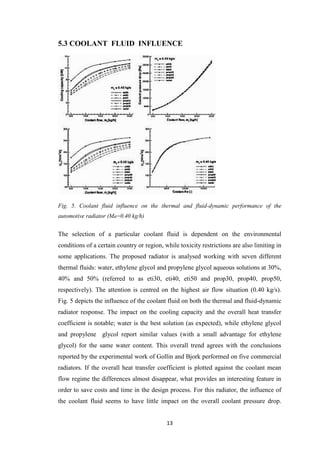
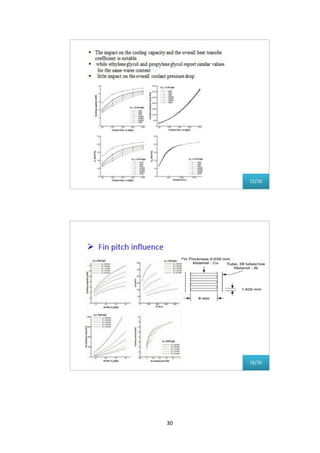
Fig. 5. Coolant fluid influence on the thermal and fluid-dynamic performance of the
automotive radiator (Ma=0.40 kg/h)
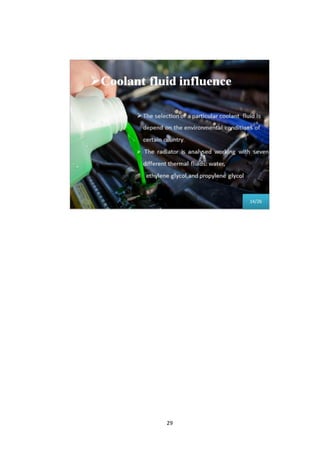
The selection of a particular coolant fluid is dependent on the environmental
conditions of a certain country or region, while toxicity restrictions are also limiting in
some applications. The proposed radiator is analysed working with seven different
thermal fluids: water, ethylene glycol and propylene glycol aqueous solutions at 30%,
40% and 50% (referred to as eti30, eti40, eti50 and prop30, prop40, prop50,
respectively). The attention is centred on the highest air flow situation (0.40 kg/s).
Fig. 5 depicts the influence of the coolant fluid on both the thermal and fluid-dynamic
radiator response. The impact on the cooling capacity and the overall heat transfer
coefficient is notable; water is the best solution (as expected), while ethylene glycol
and propylene glycol report similar values (with a small advantage for ethylene
glycol) for the same water content. This overall trend agrees with the conclusions
reported by the experimental work of Gollin and Bjork performed on five commercial
radiators. If the overall heat transfer coefficient is plotted against the coolant mean
flow regime the differences almost disappear, what provides an interesting feature in
order to save costs and time in the design process. For this radiator, the influence of
the coolant fluid seems to have little impact on the overall coolant pressure drop.
14
After investigation of this result, the conclusion is that the relative influence of the
manifolds and specially of the inlet/outlet nozzles overshadows the pressure drop
differences observed in the radiator core. A detailed observation of the local in-tube
results has outlined the better hydraulic behaviour of water, while the propylene
glycol mixture shows slightly higher pressure drop than its ethylene glycol
counterpart. These overall trends again coincide with the conclusions reported by
Gollin and Bjork.
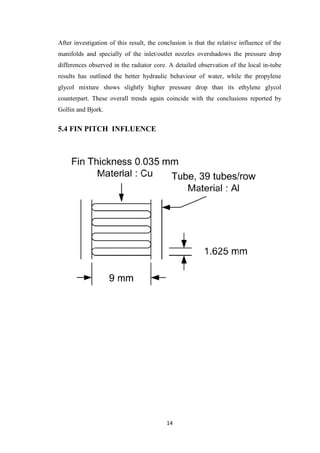
5.4 FIN PITCH INFLUENCE
15
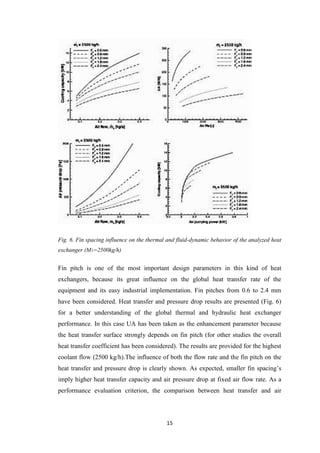
Fig. 6. Fin spacing influence on the thermal and fluid-dynamic behavior of the analyzed heat
exchanger (M1=2500kg/h)
Fin pitch is one of the most important design parameters in this kind of heat
exchangers, because its great influence on the global heat transfer rate of the
equipment and its easy industrial implementation. Fin pitches from 0.6 to 2.4 mm
have been considered. Heat transfer and pressure drop results are presented (Fig. 6)
for a better understanding of the global thermal and hydraulic heat exchanger
performance. In this case UA has been taken as the enhancement parameter because
the heat transfer surface strongly depends on fin pitch (for other studies the overall
heat transfer coefficient has been considered). The results are provided for the highest
coolant flow (2500 kg/h).The influence of both the flow rate and the fin pitch on the
heat transfer and pressure drop is clearly shown. As expected, smaller fin spacing’s
imply higher heat transfer capacity and air pressure drop at fixed air flow rate. As a
performance evaluation criterion, the comparison between heat transfer and air
16
pumping power indicates that the best design solution could depend on the needed
compactness or the available pumping power/flow area.
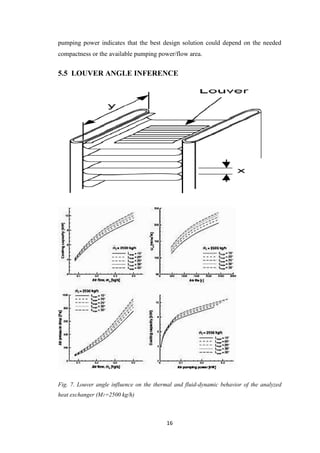
5.5 LOUVER ANGLE INFERENCE
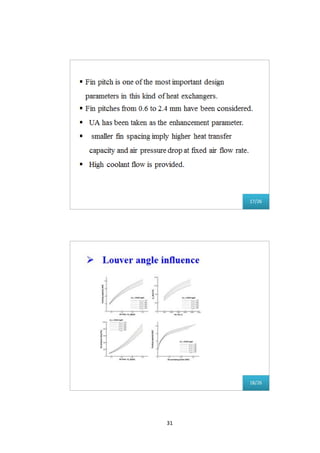
Fig. 7. Louver angle influence on the thermal and fluid-dynamic behavior of the analyzed
heat exchanger (M1=2500 kg/h)
17
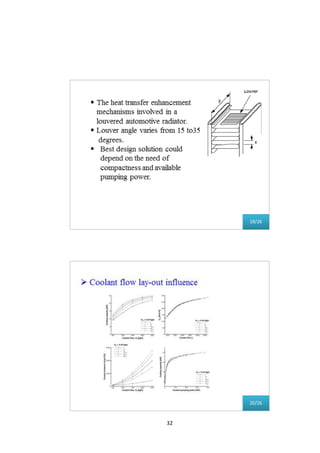
The louver angle has also been selected as a relevant parameter on the enhancement
mechanisms involved in a louvered automotive radiator. Values from 15 to 35 have
been considered. The heat transfer and pressure drop dependence on this parameter is
shown in Fig. 7. The higher the louver angle is, the higher heat transfer rate and
pressure drop. As a performance evaluation criterion, the comparison between heat
transfer and air pumping power indicates that the best design solution could depend
on the needed compactness or the available pumping power/flow area.
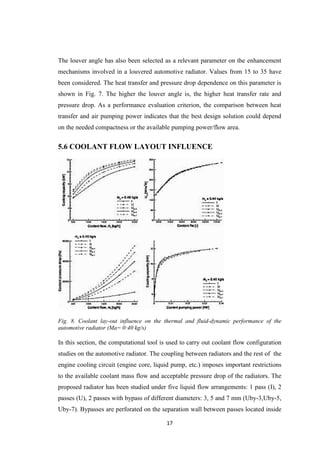
5.6 COOLANT FLOW LAYOUT INFLUENCE
Fig. 8. Coolant lay-out influence on the thermal and fluid-dynamic performance of the
automotive radiator (Ma= 0:40 kg/s)
In this section, the computational tool is used to carry out coolant flow configuration
studies on the automotive radiator. The coupling between radiators and the rest of the
engine cooling circuit (engine core, liquid pump, etc.) imposes important restrictions
to the available coolant mass flow and acceptable pressure drop of the radiators. The
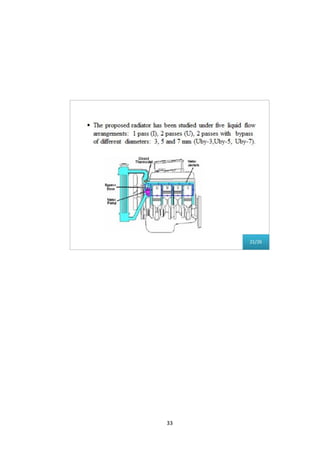
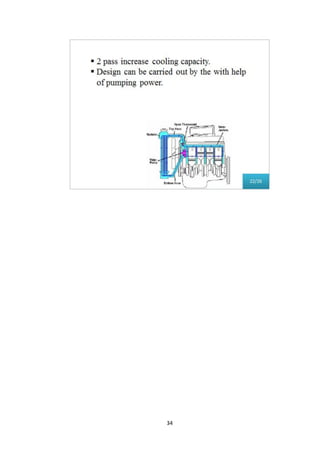
proposed radiator has been studied under five liquid flow arrangements: 1 pass (I), 2
passes (U), 2 passes with bypass of different diameters: 3, 5 and 7 mm (Uby-3,Uby-5,
Uby-7). Bypasses are perforated on the separation wall between passes located inside
18
the inlet/outlet manifold and have been used in the automotive industry in order to
find U configurations with lower coolant pressure drop values. The nozzles pressure
drop has been minimised because they should be adapted to each case to get
reasonable coolant velocities, thus determining the tube diameters
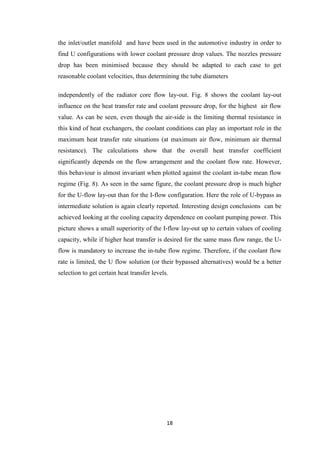
independently of the radiator core flow lay-out. Fig. 8 shows the coolant lay-out
influence on the heat transfer rate and coolant pressure drop, for the highest air flow
value. As can be seen, even though the air-side is the limiting thermal resistance in
this kind of heat exchangers, the coolant conditions can play an important role in the
maximum heat transfer rate situations (at maximum air flow, minimum air thermal
resistance). The calculations show that the overall heat transfer coefficient
significantly depends on the flow arrangement and the coolant flow rate. However,
this behaviour is almost invariant when plotted against the coolant in-tube mean flow
regime (Fig. 8). As seen in the same figure, the coolant pressure drop is much higher
for the U-flow lay-out than for the I-flow configuration. Here the role of U-bypass as
intermediate solution is again clearly reported. Interesting design conclusions can be
achieved looking at the cooling capacity dependence on coolant pumping power. This
picture shows a small superiority of the I-flow lay-out up to certain values of cooling
capacity, while if higher heat transfer is desired for the same mass flow range, the U-
flow is mandatory to increase the in-tube flow regime. Therefore, if the coolant flow
rate is limited, the U flow solution (or their bypassed alternatives) would be a better
selection to get certain heat transfer levels.
19
Chapter 6
CONCLUSIONS
Parametric studies has been focused on the influence of working conditions on both
fluids (mass flows, inlet temperatures) and the impact of the selected coolant fluid.
Following these studies, the influence of some geometrical parameters has been
analysed (fin spacing, louver angle) as well as the importance of coolant flow lay-out
on the radiator global performance. This work provides a detailed example of the
overall behaviour report of an automobile radiator working at usual range of operating
conditions. Significant knowledge-based design conclusions have also been reported:
1) The overall heat transfer coefficient reveals almost independent of the air inlet
temperature.
2) The overall heat transfer coefficient essentially depends on the coolant flow
regime (Re number) when coolant fluid or coolant flow arrangement are
varied.
3) Nozzles pressure drop can overshadow the impact of a parameter on the core
coolant pressure drop.
4) The cooling capacity vs. the pumping power reveals as a powerful comparison
criterion for this kind of studies.
5) The I-flow coolant arrangement is generally better than U-flow, if the
achieved flow regime is considered acceptable.
20
REFERENCES
1. C. Oliet, A. Oliva *, J. Castro, C.D. Pe´rez-Segarra, Parametric studies on
automotive radiators, Applied Thermal Engineering 27 (2007) 2033–2043,
Centre Tecnolo` gic de Transfere`ncia de Calor (CTTC), Universitat
Polite`cnica de Catalunya (UPC), ETSEIAT,Colom 11, 08222 Terrassa
(Barcelona), Spain.
2. C. Lin, J. Saunders, S. Watkins, The effect of changes in ambient and coolant
radiator inlet temperatures and coolant flowrate on specific dissipation, SAE
Technical Paper Series (2000-01-0579), 2000, pp.1–12.
3. J.J. Juger, R.F. Crook, Heat transfer performance of propylene glycol versus
ethylene glycol coolant solutions in laboratory testing, SAE Technical Paper
Series SP-1456, 1999-01-0129, 1999, pp. 23–33.
4. M. Gollin, D. Bjork, Comparative performance of ethylene glycol/water and
propylene glycol/water coolants in automobile radiators, SAE Technical Paper
Series SP-1175, 960372, 1996, pp. 115–123
21
ANNEXURE
22
23
24
25
26
27
28
29
30
31
32
33
34
35
36
37

SEMINAR REPORT

  • 1.
    1 Chapter 1 INTRODUCTION The automotiveindustry is continuously involved in a strong competitive career to obtain the best automobile design in multiple aspects (performance, fuel consumption, aesthetics, safety, etc.). The air-cooled heat exchangers found in a vehicle (radiator, AC condenser and evaporator, charge air cooler, etc.) have an important role in its weight and also in the design of its front-end module, which also has a strong impact on the car aerodynamic behaviour. Looking at these challenges, an optimisation process is mandatory to obtain the best design compromise between performance, size/shape and weight. This optimisation objective demands advanced design tools that can indicate not only the better solution but also the fundamental reason of a performance improvement. Some previous references were found with experimental analysis of the thermal and fluid-dynamic behaviour of automotive radiators. Lin et al. presented an interesting study of specific dissipation (SD) sensibility to radiator boundary conditions (air and coolant inlet temperatures and mass flows). Their conclusions were assessed by numerical and experimental work. Juger and Crook reported an experimental testing on two radiators of the same flow area but with the tubes in vertical or horizontal position, therefore studying the influence of tube length vs. number of parallel tubes. They carried out this analysis for three different coolant fluids. experimentally compared the performance of five commercial radiators working with water and five aqueous glycol mixtures. experimentally analysed a sample radiator.
  • 2.
    2 Chapter 2 LITERATURE REVIEW Severalliterature related to this topic above has been referred. 1. C. Oliet et.al [1] Parametric studies performed on automotive radiators by means of a detailed rating and design heat exchanger model. A first part of the analysis focuses on the influence of working conditions on both fluids (mass flows, inlet temperatures) and the impact of the selected coolant fluid. Following these studies, the influence of some geometrical parameters is analysed (fin pitch, louver angle) as well as the importance of coolant flow lay-out on the radiator global performance. This work provides an overall behaviour report of automobile radiators working at usual range of operating conditions. 2. Sudhi Uppuluri et.al [2] streamlined approach for characterizing the heat flows from the combustion chamber to the engine coolant, engine oil circuit and the ambient. The approach in this paper uses a built-in flow and heat transfer solver in the CAD model of the engine to derive heat transfer coefficients for the coolant-block interface, oil-block interface and the block- ambient interface. These coefficients take into account the changing boundary conditions of flow rate, temperatures, and combustion heat to help characterize the complex thermal interactions between each of these subsystems during the warm-up process. 3. Wei Liu et.al [3] The hydraulic retarder is the most stabilized auxiliary braking system of heavy-duty vehicles. When the hydraulic retarder is working during auxiliary braking, all of the braking energy is transferred into the thermal energy of the transmission medium of the working wheel. Theoretically, the residual heat-sinking capability of the engine could be used to cool down the transmission medium of the hydraulic retarder, in order to ensure the proper functioning of the hydraulic retarder. Never the less, the hydraulic retarder is always placed at the tailing head of the gearbox, far from the engine, long cooling circuits, which increases the risky leakage risk of the transmission medium.
  • 3.
    3 4. Pallavi Annabattulaet.al [4] Determining coolant flow distribution in a topologically complex flow path for efficient heat rejection from the critical regions of the engine is a challenge. However, with the established computational methodology, thermal response of an engine (via conjugate heat transfer) can be accurately predicted and improved upon via Design of Experiment (DOE) study in a relatively short timeframe.
  • 4.
    4 Chapter 3 NECESSITY OFCOOLING To get the work done from internal combustion engine, we have to burn air-fuel mixture inside the cylinder. When the combustion of air-fuel mixture takes place in the engine cylinder, a temperature as high as 2500 degree centigrade is reached. To withstand such a high temperature we have to use very high melting point material for construction of engine. Practically it is less possible because, "Platinum" a metal which has one of the highest melting point, melts at above 1800 degree centigrade. It has been practically found that out of total heat generated by internal combustion engine due to combustion of fuel, only 30% of heat is converted in useful work, out of remaining 70% about 40 % is carried by exhaust gases into the atmosphere during exhaust stroke. The rest of 30% must be passed to atmosphere by some suitable arrangement. Here we find the necessity of cooling. In addition to overheating, large temperature differences may lead to distortion of the engine components due to set up of thermal stresses. If the cooling system is not provided to internal combustion engine, the lubricating oil film would break down and the lubricating oil will decompose to give gummy and carbon deposits. In lack of Cooling system, a complete seizure of the piston, bearing and other important parts will occur. Due to this, there will be more frequent replacement of the components are required. It will also increase the repairing cost and breakdown period. The engine life will be reduced considerably. It should also be noted that higher temperatures lower the volumetric efficiency of the engine, promote pre-ignition and tendency of the engine to detonate. The object of cooling is achieved by any of the two methods, 01)Air Cooling 02)Water Cooling
  • 5.
    5 Properties of anefficient cooling system:- The following are the two main properties desired of an efficient cooling system, 01)It must be capable of removing only about 30% of the heat generated in the combustion chamber. Too much heat removal will lower the thermal efficiency of the engine. It should remove heat at a fast rate when engine is hot. It is also required to be very slow cooling at the starting of the engine, so that the different working parts of the internal combustion engine reach their operating temperature in a short time period. If you are using Water cooled engine, then are little chances of freezing of water in cold weather conditions, if we keep engine without use for very long time. To overcome this problem, we have to mix anti freezers in cooling water.
  • 6.
    6 Chapter 4 TYPES OFRADIATOR 4.1DOWN FLOW TYPE RADIATOR A design that is loosing ground in modern vehicles. It's high profile limits its use in the low profile front vehicle air flow dynamics, It is still popular with heavy equipment manufactures. A conventional vertical-flow design, the expansion (inlet) tank is located at the top of the core and connected by a flexible hose to the coolant outlet housing on the engine. Coolant passes from the inlet tank and down through the core to the bottom (outlet) tank, also connected by a flexible hose to the water pump inlet port. This permits coolant circulation through the radiator when the thermostat is open. The outlet tank on automatic-transmission-equipped cars contains a heat exchanger or transmission oil cooler unit through which automatic transmission fluid is circulated for cooling.
  • 7.
    7 4.2 CROSS FLOWTYPE RADIATOR The most common among modern vehicles. Turn the conventional down flow radiator on its side and you have the cross flow design. With the header tanks on each side (instead of top and bottom), the coolant travels horizontally instead of vertically. The header tank fitted with the radiator cap is the outlet tank, equivalent to the lower tank of the down flow design, and contains a transmission fluid oil cooler on automatic- transmission-equipped models. The cross- flow design has two distinct advantages: it permits the use of a lower styling profile and reduces pressure against the radiator cap, which prevents the cap from blowing” if a blockage occurs and the radiator overheats.
  • 8.
    8 4.3 Geometry descriptionof the automobile radiator under study TABLE NO: 1 4.4 working conditions for the automobile radiator under study TABLE NO:2
  • 9.
    9 Chapter 5 PARAMETRIC STUDIES Thefirst part of these studies focuses on the influence of working conditions on both fluids (mass flows, inlet temperatures, coolant fluid). After that, the influence of some geometrical parameters is analysed (fin pitch, louver angle) as well as the importance of coolant flow lay-out on the radiator performance. Significant knowledge-based design conclusions have been reported. Where appropriate, the results are presented using non-dimensional flow parameters (Reynolds numbers) and overall heat exchanger parameters (overall heat transfer coefficient) to show general trends independent of the particular testing condition. 5.1 AIR AND COOLANT MASS FLOW INFERENCE Fig. 1. Discretisation strategy for flat tube/corrugated fin automotive radiators: macro- control volume concept.
  • 10.
    10 Fig. 2. Performancemaps obtained for a parametric study (fin pitch, Fp, in this case). On the left, heat transfer dependence on air and coolant flow rates. On the right, overall enhancement vs. air and coolant flow regimes.
  • 11.
    11 Fig. 3. Airand coolant mass flow influence on the thermal and fluid-dynamic performance of the automotive radiator. The heat transfer and fluid-dynamic performance of an automotive radiator is strongly dependent on both thermal fluids mass flow. This study shows the behaviour of the selected radiator over a wide flow range, while maintaining the geometry and the temperature levels at the baseline situation. Fig. 3 shows how the cooling capacity increases with both air and coolant flow, although its derivative decreases monotonically. The curves show typically a stronger dependency on air mass flow because air has usually the highest thermal resistance. The same figure introduces the air and coolant pressure drop dependency on mass flow, reflecting the expected quadratic behaviour.
  • 12.
    12 5.2 AIR INLETTEMPERATURE INFLUENCE Fig. 4. Air inlet temperature influence on the thermal and fluid-dynamic performance of the studied radiator (M1 =2500 kg/h) As being one of the most important restrictions in an air-cooled system, the air inlet temperature influence is here analysed in detail. The maximum coolant flow (2500 kg/h) has been selected in order to improve the visualisation of the effects on the air- side, while this situation would also have the highest heat transfer rates. The thermal and fluid-dynamic behaviour of the radiator is presented in Fig. 4 for the two limiting air flows (0.08 and 0.40 kg/s) for a range from 0 to 40 C. As expected, the heat transfer rate clearly decreases with air inlet temperature rise, as the cooling temperature difference is being reduced. It is interesting to point out the small influence of the air inlet temperature on the overall heat transfer coefficient. Therefore, a mean value can be used within a range of air temperature inlet conditions with acceptable accuracy, saving costs and time. The impact on air pressure drop reveals as moderate for this case.
  • 13.
    13 5.3 COOLANT FLUIDINFLUENCE Fig. 5. Coolant fluid influence on the thermal and fluid-dynamic performance of the automotive radiator (Ma=0.40 kg/h) The selection of a particular coolant fluid is dependent on the environmental conditions of a certain country or region, while toxicity restrictions are also limiting in some applications. The proposed radiator is analysed working with seven different thermal fluids: water, ethylene glycol and propylene glycol aqueous solutions at 30%, 40% and 50% (referred to as eti30, eti40, eti50 and prop30, prop40, prop50, respectively). The attention is centred on the highest air flow situation (0.40 kg/s). Fig. 5 depicts the influence of the coolant fluid on both the thermal and fluid-dynamic radiator response. The impact on the cooling capacity and the overall heat transfer coefficient is notable; water is the best solution (as expected), while ethylene glycol and propylene glycol report similar values (with a small advantage for ethylene glycol) for the same water content. This overall trend agrees with the conclusions reported by the experimental work of Gollin and Bjork performed on five commercial radiators. If the overall heat transfer coefficient is plotted against the coolant mean flow regime the differences almost disappear, what provides an interesting feature in order to save costs and time in the design process. For this radiator, the influence of the coolant fluid seems to have little impact on the overall coolant pressure drop.
  • 14.
    14 After investigation ofthis result, the conclusion is that the relative influence of the manifolds and specially of the inlet/outlet nozzles overshadows the pressure drop differences observed in the radiator core. A detailed observation of the local in-tube results has outlined the better hydraulic behaviour of water, while the propylene glycol mixture shows slightly higher pressure drop than its ethylene glycol counterpart. These overall trends again coincide with the conclusions reported by Gollin and Bjork. 5.4 FIN PITCH INFLUENCE
  • 15.
    15 Fig. 6. Finspacing influence on the thermal and fluid-dynamic behavior of the analyzed heat exchanger (M1=2500kg/h) Fin pitch is one of the most important design parameters in this kind of heat exchangers, because its great influence on the global heat transfer rate of the equipment and its easy industrial implementation. Fin pitches from 0.6 to 2.4 mm have been considered. Heat transfer and pressure drop results are presented (Fig. 6) for a better understanding of the global thermal and hydraulic heat exchanger performance. In this case UA has been taken as the enhancement parameter because the heat transfer surface strongly depends on fin pitch (for other studies the overall heat transfer coefficient has been considered). The results are provided for the highest coolant flow (2500 kg/h).The influence of both the flow rate and the fin pitch on the heat transfer and pressure drop is clearly shown. As expected, smaller fin spacing’s imply higher heat transfer capacity and air pressure drop at fixed air flow rate. As a performance evaluation criterion, the comparison between heat transfer and air
  • 16.
    16 pumping power indicatesthat the best design solution could depend on the needed compactness or the available pumping power/flow area. 5.5 LOUVER ANGLE INFERENCE Fig. 7. Louver angle influence on the thermal and fluid-dynamic behavior of the analyzed heat exchanger (M1=2500 kg/h)
  • 17.
    17 The louver anglehas also been selected as a relevant parameter on the enhancement mechanisms involved in a louvered automotive radiator. Values from 15 to 35 have been considered. The heat transfer and pressure drop dependence on this parameter is shown in Fig. 7. The higher the louver angle is, the higher heat transfer rate and pressure drop. As a performance evaluation criterion, the comparison between heat transfer and air pumping power indicates that the best design solution could depend on the needed compactness or the available pumping power/flow area. 5.6 COOLANT FLOW LAYOUT INFLUENCE Fig. 8. Coolant lay-out influence on the thermal and fluid-dynamic performance of the automotive radiator (Ma= 0:40 kg/s) In this section, the computational tool is used to carry out coolant flow configuration studies on the automotive radiator. The coupling between radiators and the rest of the engine cooling circuit (engine core, liquid pump, etc.) imposes important restrictions to the available coolant mass flow and acceptable pressure drop of the radiators. The proposed radiator has been studied under five liquid flow arrangements: 1 pass (I), 2 passes (U), 2 passes with bypass of different diameters: 3, 5 and 7 mm (Uby-3,Uby-5, Uby-7). Bypasses are perforated on the separation wall between passes located inside
  • 18.
    18 the inlet/outlet manifoldand have been used in the automotive industry in order to find U configurations with lower coolant pressure drop values. The nozzles pressure drop has been minimised because they should be adapted to each case to get reasonable coolant velocities, thus determining the tube diameters independently of the radiator core flow lay-out. Fig. 8 shows the coolant lay-out influence on the heat transfer rate and coolant pressure drop, for the highest air flow value. As can be seen, even though the air-side is the limiting thermal resistance in this kind of heat exchangers, the coolant conditions can play an important role in the maximum heat transfer rate situations (at maximum air flow, minimum air thermal resistance). The calculations show that the overall heat transfer coefficient significantly depends on the flow arrangement and the coolant flow rate. However, this behaviour is almost invariant when plotted against the coolant in-tube mean flow regime (Fig. 8). As seen in the same figure, the coolant pressure drop is much higher for the U-flow lay-out than for the I-flow configuration. Here the role of U-bypass as intermediate solution is again clearly reported. Interesting design conclusions can be achieved looking at the cooling capacity dependence on coolant pumping power. This picture shows a small superiority of the I-flow lay-out up to certain values of cooling capacity, while if higher heat transfer is desired for the same mass flow range, the U- flow is mandatory to increase the in-tube flow regime. Therefore, if the coolant flow rate is limited, the U flow solution (or their bypassed alternatives) would be a better selection to get certain heat transfer levels.
  • 19.
    19 Chapter 6 CONCLUSIONS Parametric studieshas been focused on the influence of working conditions on both fluids (mass flows, inlet temperatures) and the impact of the selected coolant fluid. Following these studies, the influence of some geometrical parameters has been analysed (fin spacing, louver angle) as well as the importance of coolant flow lay-out on the radiator global performance. This work provides a detailed example of the overall behaviour report of an automobile radiator working at usual range of operating conditions. Significant knowledge-based design conclusions have also been reported: 1) The overall heat transfer coefficient reveals almost independent of the air inlet temperature. 2) The overall heat transfer coefficient essentially depends on the coolant flow regime (Re number) when coolant fluid or coolant flow arrangement are varied. 3) Nozzles pressure drop can overshadow the impact of a parameter on the core coolant pressure drop. 4) The cooling capacity vs. the pumping power reveals as a powerful comparison criterion for this kind of studies. 5) The I-flow coolant arrangement is generally better than U-flow, if the achieved flow regime is considered acceptable.
  • 20.
    20 REFERENCES 1. C. Oliet,A. Oliva *, J. Castro, C.D. Pe´rez-Segarra, Parametric studies on automotive radiators, Applied Thermal Engineering 27 (2007) 2033–2043, Centre Tecnolo` gic de Transfere`ncia de Calor (CTTC), Universitat Polite`cnica de Catalunya (UPC), ETSEIAT,Colom 11, 08222 Terrassa (Barcelona), Spain. 2. C. Lin, J. Saunders, S. Watkins, The effect of changes in ambient and coolant radiator inlet temperatures and coolant flowrate on specific dissipation, SAE Technical Paper Series (2000-01-0579), 2000, pp.1–12. 3. J.J. Juger, R.F. Crook, Heat transfer performance of propylene glycol versus ethylene glycol coolant solutions in laboratory testing, SAE Technical Paper Series SP-1456, 1999-01-0129, 1999, pp. 23–33. 4. M. Gollin, D. Bjork, Comparative performance of ethylene glycol/water and propylene glycol/water coolants in automobile radiators, SAE Technical Paper Series SP-1175, 960372, 1996, pp. 115–123
  • 21.
  • 22.
  • 23.
  • 24.
  • 25.
  • 26.
  • 27.
  • 28.
  • 29.
  • 30.
  • 31.
  • 32.
  • 33.
  • 34.
  • 35.
  • 36.
  • 37.