Agenda
 What is Cloud Computing?
 Milestone of Cloud Computing
 Common Attributes of Cloud Computing
 Cloud Service Layers
 Cloud Implementation Types
 Cloud Computing – Trend
 Applications of Cloud Computing
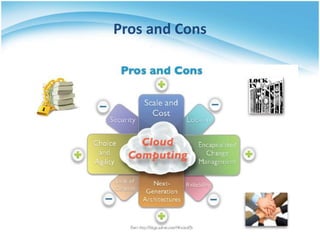
 Pros and Cons
if you only need milk , would you buy a cow ?
What is Cloud Computing ?
What is Cloud Computing
“Cloud computing is a style of computing where
massively scalable IT-related capabilities are
provided as a service across the Internet to multiple
external customers”
“Cloud computing: A pool of abstracted, highly
scalable, and managed infrastructure capable of
hosting end-customer applications and billed by
consumption”
“Cloud computing is Web-based processing,
whereby shared resources, software, and
information are provided to computers and other
devices (such as smart phones) on demand over
the Internet.”
What is Cloud Computing
“Cloud computing is a style of computing where
massively scalable IT-related capabilities are provided
as a service across the Internet to multiple external
customers”
“Cloud computing: A pool of abstracted, highly
scalable, and managed infrastructure capable of
hosting end-customer applications and billed by
consumption”
“Cloud computing is Web-based processing,
whereby shared resources, software, and
information are provided to computers and other
devices (such as smart phones) on demand over
the Internet.”
What is Cloud Computing
“Cloud computing is a style of computing where
massively scalable IT-related capabilities are provided
as a service across the Internet to multiple external
customers”
“Cloud computing: A pool of abstracted, highly
scalable, and managed infrastructure capable of
hosting end-customer applications and billed by
consumption”
“Cloud computing is Web-based processing,
whereby shared resources, software, and
information are provided to computers and
other devices (such as smart phones) on demand
over the Internet.”
Why we should know about it ?
Gartner top 10 Strategic Technologies for 2010-2011
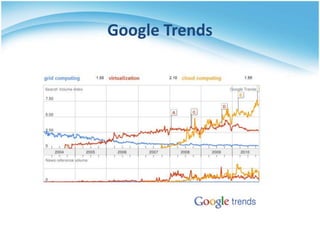
Google Trends
Why we call “Cloud Computing” ?
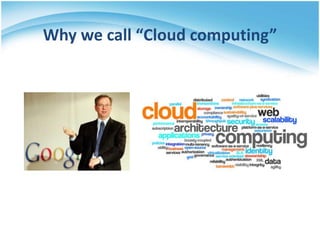
Why we call “Cloud computing”
Cloud
Why we call “Cloud computing”
Common Attributes of Cloud Computing
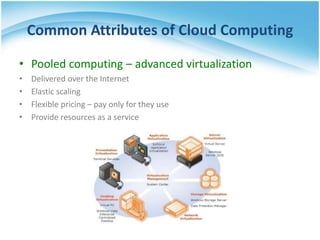
• Pooled computing – advanced virtualization
• Delivered over the Internet
• Elastic scaling
• Flexible pricing – pay only for they use
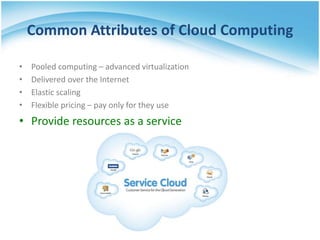
• Provide resources as a service
Common Attributes of Cloud Computing
• Pooled computing – advanced virtualization
• Delivered over the Network
• Elastic scaling
• Flexible pricing – pay only for they use
• Provide resources as a service
Common Attributes of Cloud Computing
• Pooled computing – advanced virtualization
• Delivered over the Internet
• Elastic scaling
• Flexible pricing – pay only for they use
• Provide resources as a service
Common Attributes of Cloud Computing
• Pooled computing – advanced virtualization
• Delivered over the Internet
• Elastic scaling
• Flexible pricing – pay only for they use
• Provide resources as a service
Common Attributes of Cloud Computing
• Pooled computing – advanced virtualization
• Delivered over the Internet
• Elastic scaling
• Flexible pricing – pay only for they use
• Provide resources as a service
Milestone of Cloud Computing
S3 Launches/EC2
Launch of Amazon web services
The arrival of Salesforce.com
Supercomputers/Mainframe
2006
2002
1990
1960
Google App / Azure
2008 - 2009
The first milestone for Cloud Computing
Launches of Google App
Engine/Windows Azure Beta
Type of Cloud Computing
Cloud Service Layers - Characteristics
• Sometimes free; easy to use; good consumer
adoption; proven business models
• You can only use the application as far as what it is
designed for
Software as a
Service (SaaS)
• Developers can upload a configured applications and it
“runs” within the platform’s framework;
• Restricted to the platform’s ability only; sometimes
dependant on Cloud Infrastructure provider
Platform as a
Service (PaaS)
• Offers full control of a company’s infrastructure; not
confined to applications or restrictive instances
• Sometimes comes with a price premium; can be
complex to build, manage and maintain
Infrastructure as
a Service (IaaS)
Cloud Service Layers - Containing
Software as a
Service (SaaS)
Platform as a
Service (PaaS)
Infrastructure as
a Service (IaaS)
Collaboration Business Processes
Industry Applications CRM/ERP/HR
Middleware
Database
Web 2.0 Application Runtime
Java RuntimeDevelopment Tooling
Shared virtualized, dynamic provisioning
Servers Networking Data Center FabricStorage
Cloud Service Layers - Example
Software as a
Service (SaaS)
Platform as a
Service (PaaS)
Infrastructure as
a Service (IaaS)
Cloud Implementation Type
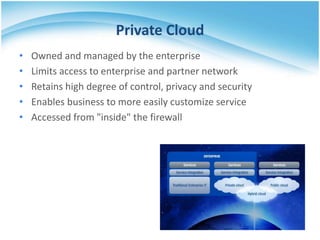
Private Cloud
• Owned and managed by the enterprise
• Limits access to enterprise and partner network
• Retains high degree of control, privacy and security
• Enables business to more easily customize service
• Accessed from "inside" the firewall
Public Cloud
• Owned and managed by service provider
• Delivers select set business process, application or
infrastructure services on a “pay per use” basis
• Highly standardized
• Limited customization options
• Accessed from "outside" the firewall
Hybrid Cloud
A hybrid infrastructure takes advantage of both public and
private clouds:
 Services provided over the Internet—the public cloud
 Services provided by the enterprise data center—the private
cloud
Product of Cloud Computing
Google App Engine
Amazon EC2 & S3
Windows Azure
Google App
Panda Cloud
Amazon Web Service
 Amazon is one of the foremost and most reputed
Cloud Computing service-provider
 Product Offerings include:
Simple Storage Service (S3)
Elastic Compute Cloud (EC2)
SimpleDB
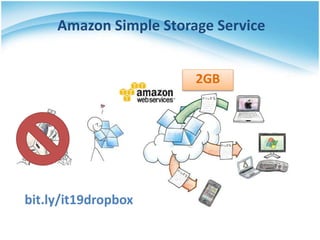
Amazon Simple Storage Service
bit.ly/it19dropbox
2GB
Windows Azure
“ Windows Azure is an integrated cloud solution, utilizing
Microsoft products already familiar with IT professionals ”
Windows Azure
Windows Azure
Windows Azure
Google App Engine
Google App Engine (GAE) is a service,
offered by Google, that allows
developers to build applications that
can run on Google’s infrastructure.
It is a form of Cloud Computing.
Google App Engine
Google App & Microsoft live
Panda Cloud Antivirus
 Desktop Application use
cloud service
 Small size
 Virus DB on Provider
server
 Send file to scan in cloud
 No need update
Normal Antivirus
Virus DB
Panda Antivirus
Send file to Scan in Cloud Server
Panda Cloud Server
JoliCloud
“netbook power by cloud”
Cloud Computing - Trend
• Large enterprises are building
their own private clouds
• Cloud computing will shift the skills
needed by IT workers
• IT departments will shrink as users go
directly to the cloud for IT resources
• Professional services will be bundled
with commodity cloud services
Cloud Computing - Trend
• Large enterprises are building their
own private clouds
• Cloud computing will shift
the skills needed by IT
workers
• IT departments will shrink as users go
directly to the cloud for IT resources
• Professional services will be bundled
with commodity cloud services
Cloud Computing - Trend
• Large enterprises are building their
own private clouds
• Cloud computing will shift the skills
needed by IT workers
• IT departments will shrink as
users go directly to the cloud
for IT resources
• Professional services will be bundled
with commodity cloud services
Cloud Computing - Trend
• Large enterprises are building their
own private clouds
• Cloud computing will shift the skills
needed by IT workers
• IT departments will shrink as users go
directly to the cloud for IT resources
• Professional services will be
bundled with commodity
cloud services
Cloud Computing - Trend
• Cloud-computing resources
will become more
customizable
• Large enterprises will become part-
time cloud-computing vendors
• Cloud computing will unleash
innovation
• The browser will be all the desktop
software you need
Cloud Computing - Trend
• Cloud-computing resources will
become more customizable
• Large enterprises will
become part-time cloud-
computing vendors
• Cloud computing will unleash
innovation
• The browser will be all the desktop
software you need
Cloud Computing - Trend
• Cloud-computing resources will
become more customizable
• Large enterprises will become part-
time cloud-computing vendors
• Cloud computing will
unleash innovation
• The browser will be all the desktop
software you need
Cloud Computing - Trend
• Cloud-computing resources will
become more customizable
• Large enterprises will become part-
time cloud-computing vendors
• Cloud computing will unleash
innovation
• The browser will be all the
desktop software you need
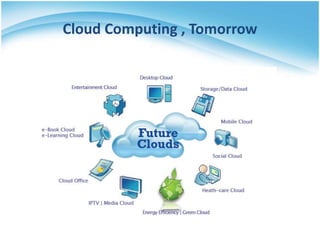
Cloud Computing , Tomorrow
Pros and Cons
Thank you
Resource
 http://en.wikipedia.org/wiki/Cloud_computing
 http://www.focus.com/articles/hosting-
bandwidth/top-10-cloud-computing-trends/
 http://architects.dzone.com/news/5-key-events-
history-cloud
Share
 http://bit.ly/itexec-cloud
Q & A
Thank you

Cloud Computing

  • 2.
    Agenda  What isCloud Computing?  Milestone of Cloud Computing  Common Attributes of Cloud Computing  Cloud Service Layers  Cloud Implementation Types  Cloud Computing – Trend  Applications of Cloud Computing  Pros and Cons if you only need milk , would you buy a cow ?
  • 3.
    What is CloudComputing ?
  • 4.
    What is CloudComputing “Cloud computing is a style of computing where massively scalable IT-related capabilities are provided as a service across the Internet to multiple external customers” “Cloud computing: A pool of abstracted, highly scalable, and managed infrastructure capable of hosting end-customer applications and billed by consumption” “Cloud computing is Web-based processing, whereby shared resources, software, and information are provided to computers and other devices (such as smart phones) on demand over the Internet.”
  • 5.
    What is CloudComputing “Cloud computing is a style of computing where massively scalable IT-related capabilities are provided as a service across the Internet to multiple external customers” “Cloud computing: A pool of abstracted, highly scalable, and managed infrastructure capable of hosting end-customer applications and billed by consumption” “Cloud computing is Web-based processing, whereby shared resources, software, and information are provided to computers and other devices (such as smart phones) on demand over the Internet.”
  • 6.
    What is CloudComputing “Cloud computing is a style of computing where massively scalable IT-related capabilities are provided as a service across the Internet to multiple external customers” “Cloud computing: A pool of abstracted, highly scalable, and managed infrastructure capable of hosting end-customer applications and billed by consumption” “Cloud computing is Web-based processing, whereby shared resources, software, and information are provided to computers and other devices (such as smart phones) on demand over the Internet.”
  • 7.
    Why we shouldknow about it ?
  • 8.
    Gartner top 10Strategic Technologies for 2010-2011
  • 9.
  • 10.
    Why we call“Cloud Computing” ?
  • 11.
    Why we call“Cloud computing” Cloud
  • 12.
    Why we call“Cloud computing”
  • 13.
    Common Attributes ofCloud Computing
  • 14.
    Common Attributes ofCloud Computing • Pooled computing – advanced virtualization • Delivered over the Internet • Elastic scaling • Flexible pricing – pay only for they use • Provide resources as a service
  • 15.
    Common Attributes ofCloud Computing • Pooled computing – advanced virtualization • Delivered over the Network • Elastic scaling • Flexible pricing – pay only for they use • Provide resources as a service
  • 16.
    Common Attributes ofCloud Computing • Pooled computing – advanced virtualization • Delivered over the Internet • Elastic scaling • Flexible pricing – pay only for they use • Provide resources as a service
  • 17.
    Common Attributes ofCloud Computing • Pooled computing – advanced virtualization • Delivered over the Internet • Elastic scaling • Flexible pricing – pay only for they use • Provide resources as a service
  • 18.
    Common Attributes ofCloud Computing • Pooled computing – advanced virtualization • Delivered over the Internet • Elastic scaling • Flexible pricing – pay only for they use • Provide resources as a service
  • 19.
    Milestone of CloudComputing S3 Launches/EC2 Launch of Amazon web services The arrival of Salesforce.com Supercomputers/Mainframe 2006 2002 1990 1960 Google App / Azure 2008 - 2009 The first milestone for Cloud Computing Launches of Google App Engine/Windows Azure Beta
  • 20.
    Type of CloudComputing
  • 21.
    Cloud Service Layers- Characteristics • Sometimes free; easy to use; good consumer adoption; proven business models • You can only use the application as far as what it is designed for Software as a Service (SaaS) • Developers can upload a configured applications and it “runs” within the platform’s framework; • Restricted to the platform’s ability only; sometimes dependant on Cloud Infrastructure provider Platform as a Service (PaaS) • Offers full control of a company’s infrastructure; not confined to applications or restrictive instances • Sometimes comes with a price premium; can be complex to build, manage and maintain Infrastructure as a Service (IaaS)
  • 22.
    Cloud Service Layers- Containing Software as a Service (SaaS) Platform as a Service (PaaS) Infrastructure as a Service (IaaS) Collaboration Business Processes Industry Applications CRM/ERP/HR Middleware Database Web 2.0 Application Runtime Java RuntimeDevelopment Tooling Shared virtualized, dynamic provisioning Servers Networking Data Center FabricStorage
  • 23.
    Cloud Service Layers- Example Software as a Service (SaaS) Platform as a Service (PaaS) Infrastructure as a Service (IaaS)
  • 24.
  • 25.
    Private Cloud • Ownedand managed by the enterprise • Limits access to enterprise and partner network • Retains high degree of control, privacy and security • Enables business to more easily customize service • Accessed from "inside" the firewall
  • 26.
    Public Cloud • Ownedand managed by service provider • Delivers select set business process, application or infrastructure services on a “pay per use” basis • Highly standardized • Limited customization options • Accessed from "outside" the firewall
  • 27.
    Hybrid Cloud A hybridinfrastructure takes advantage of both public and private clouds:  Services provided over the Internet—the public cloud  Services provided by the enterprise data center—the private cloud
  • 28.
    Product of CloudComputing Google App Engine Amazon EC2 & S3 Windows Azure Google App Panda Cloud
  • 29.
    Amazon Web Service Amazon is one of the foremost and most reputed Cloud Computing service-provider  Product Offerings include: Simple Storage Service (S3) Elastic Compute Cloud (EC2) SimpleDB
  • 30.
  • 31.
  • 32.
    Amazon Simple StorageService bit.ly/it19dropbox 2GB
  • 33.
    Windows Azure “ WindowsAzure is an integrated cloud solution, utilizing Microsoft products already familiar with IT professionals ”
  • 34.
  • 35.
  • 36.
  • 37.
    Google App Engine GoogleApp Engine (GAE) is a service, offered by Google, that allows developers to build applications that can run on Google’s infrastructure. It is a form of Cloud Computing.
  • 38.
  • 39.
    Google App &Microsoft live
  • 40.
    Panda Cloud Antivirus Desktop Application use cloud service  Small size  Virus DB on Provider server  Send file to scan in cloud  No need update
  • 41.
  • 42.
    Panda Antivirus Send fileto Scan in Cloud Server Panda Cloud Server
  • 43.
  • 44.
    Cloud Computing -Trend • Large enterprises are building their own private clouds • Cloud computing will shift the skills needed by IT workers • IT departments will shrink as users go directly to the cloud for IT resources • Professional services will be bundled with commodity cloud services
  • 45.
    Cloud Computing -Trend • Large enterprises are building their own private clouds • Cloud computing will shift the skills needed by IT workers • IT departments will shrink as users go directly to the cloud for IT resources • Professional services will be bundled with commodity cloud services
  • 46.
    Cloud Computing -Trend • Large enterprises are building their own private clouds • Cloud computing will shift the skills needed by IT workers • IT departments will shrink as users go directly to the cloud for IT resources • Professional services will be bundled with commodity cloud services
  • 47.
    Cloud Computing -Trend • Large enterprises are building their own private clouds • Cloud computing will shift the skills needed by IT workers • IT departments will shrink as users go directly to the cloud for IT resources • Professional services will be bundled with commodity cloud services
  • 48.
    Cloud Computing -Trend • Cloud-computing resources will become more customizable • Large enterprises will become part- time cloud-computing vendors • Cloud computing will unleash innovation • The browser will be all the desktop software you need
  • 49.
    Cloud Computing -Trend • Cloud-computing resources will become more customizable • Large enterprises will become part-time cloud- computing vendors • Cloud computing will unleash innovation • The browser will be all the desktop software you need
  • 50.
    Cloud Computing -Trend • Cloud-computing resources will become more customizable • Large enterprises will become part- time cloud-computing vendors • Cloud computing will unleash innovation • The browser will be all the desktop software you need
  • 51.
    Cloud Computing -Trend • Cloud-computing resources will become more customizable • Large enterprises will become part- time cloud-computing vendors • Cloud computing will unleash innovation • The browser will be all the desktop software you need
  • 52.
  • 53.
  • 54.
    Thank you Resource  http://en.wikipedia.org/wiki/Cloud_computing http://www.focus.com/articles/hosting- bandwidth/top-10-cloud-computing-trends/  http://architects.dzone.com/news/5-key-events- history-cloud Share  http://bit.ly/itexec-cloud
  • 55.

Editor's Notes

  • #15 ทำงานร่วมกัน
  • #16 ทำงานบนเครือข่าย
  • #17 ยืดหยุด spec ได้
  • #18 คิดค่าใช้จ่ายตามจริง
  • #19 ให้บริการเป็น service
  • #20 1960 :- Supercomputers and Mainframe (massive computing was done through utility of supercomputers. The problem with this set-up arises from the cost needed to create a supercomputer or mainframe to the cost of maintaining it in optimal condition. As a result, leading to the idea of an “intergalactic computer network” by J.C.R. Licklider, who was responsible for enabling the development of ARPANET (Advanced Research Projects Agency Network) in 1969. His vision was for everyone on the globe to be interconnected and accessing programs and data at any site, from anywhere. Afterwards, John McCarthy who proposed the idea of computation being delivered as a public utility, similar to the service bureaus.1990 :- The first milestones for cloud computing (The arrival of Salesforce.com, which pioneered the concept of delivering enterprise applications via a simple website.July 2002 :- Launch of Amazon web services (making information available through a web service focused as a retailer, provided a suite of cloud-based services including storage, computation and human intelligence.March 2006 and August 2006 :- S3 and EC2 (Elastic Compute Cloud) - infrastructure-as-a-service provider - making core computing infrastructure service (Cloud infrastructure) - pricing model ‘pay-per-use’ - shift of Amazon from being just a retailer to a strong player in the technology space - EC2 as a commercial web service that allows small companies and individuals to rent computers on which to run their own computer applications.April 2008 :- Launch of Google App Engine - first pure play technology company into the cloud computing market (browser-based enterprise applications) - a developer tool enables you to run your web applications on Google’s infrastructure. - Google App’s features - Dynamic web serving, persistent storage, automatic scaling and load balancing, Google API’s for authentication users and sending emailNovember 2009 :- Launch of Windows Azure Beta belonged to Microsoft (the same concept as Google App)2010 :- Concerns about the security of their corporate data in the cloud. Security, data privacy, network performance are likely to lead to a mix of cloud computing centers both within company firewall and outside of it.Learn how to secure, manage and monitor the growing range of external resources residing in the cloud including the improvement of faster processors and connections.**Amazon Launches EC2 Transaction Based Web Hosting Platform
  • #53 ข้อดี1.ลด ต้นทุนค่าดูแลบำรุงรักษาเนื่องจากค่าบริการได้รวมค่าใช้จ่ายตามที่ใช้งาน จริง เช่น ค่าจ้างพนักงาน ค่าซ่อมแซม ค่าลิขสิทธิ์ ค่าไฟฟ้า ค่าน้ำ ค่าน้ำมันเชื้อเพลิง ค่าอัพเกรด และค่าเช่าคู่สาย เป็นต้น2.ลดความเสี่ยงจากการเริ่มต้นหรือทดลองโครงการ3.มีความยืดหยุ่นในการเพิ่มหรือลดระบบตามความต้องการ4.ได้เครื่องแม่ข่ายที่มีประสิทธิภาพ มีระบบสำรองข้อมูลที่ดี มีเครือข่ายความเร็วสูง5.มีผู้เชี่ยวชาญดูแลระบบและพร้อมให้บริการช่วยเหลือ 24 ชั่วโมงข้อเสีย1.เนื่อง จากเป็นการใช้ทรัพยากรที่มาจากหลายที่หลายแห่งทำให้อาจมีปัญหาในเรื่องของ ความต่อเนื่องและความเร็วในการเข้าทรัพยากรมากกว่าการใช้บริการ Host ที่ Local หรืออยู่ภายในองค์การของเราเอง2.ยังไม่มีการรับประกันในการทำงานอย่างต่อเนื่องของระบบและความปลอดภัยของข้อมูล3.ความไม่มีมาตรฐานของแพลทฟอร์ม ทำให้ลูกค้ามีข้อจำกัดสำหรับตัวเลือกในการพัฒนาหรือติดตั้งระบบ