DevLearn 2008: Immersive Learning Simulations with Jeff Johannigman, People Type Consulting
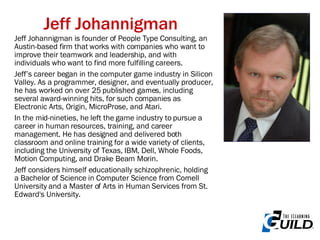
Jeff Johannigman Jeff Johannigman is founder of People Type Consulting, an Austin-based firm that works with companies who want to improve their teamwork and leadership, and with individuals who want to find more fulfilling careers.  Jeff’s career began in the computer game industry in Silicon Valley. As a programmer, designer, and eventually producer, he has worked on over 25 published games, including several award-winning hits, for such companies as Electronic Arts, Origin, MicroProse, and Atari.  In the mid-nineties, he left the game industry to pursue a career in human resources, training, and career management. He has designed and delivered both classroom and online training for a wide variety of clients, including the University of Texas, IBM, Dell, Whole Foods, Motion Computing, and Drake Beam Morin.  Jeff considers himself educationally schizophrenic, holding a Bachelor of Science in Computer Science from Cornell University and a Master of Arts in Human Services from St. Edward's University.
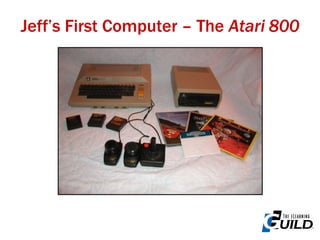
Jeff’s First Computer – The  Atari 800
I’ve worked on over 25 games from…


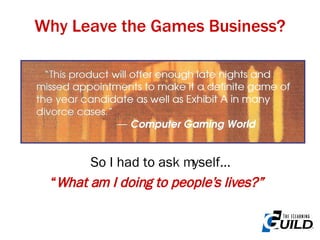
So I had to ask myself… “ What am I doing to people’s lives?”   Why Leave the Games Business?
“ Anyone who makes a distinction between games and learning clearly does not know the first thing about either one.” - Marshall McLuhan “ Game designers have a better take on the nature of learning than curriculum designers.” - Seymour Papert, MIT Can I make games that teach something useful?
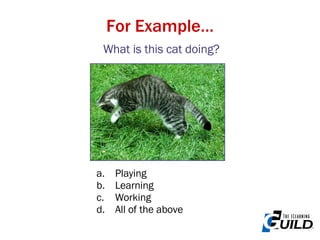
What is this cat doing? Playing Learning Working All of the above For Example…
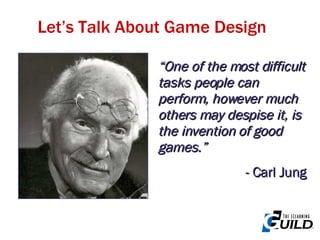
Let’s Talk About Game Design “ One of the most difficult tasks people can perform, however much others may despise it, is the invention of good games.” - Carl Jung
Define – What is “Fun”? “ Fun arises out of mastery. It arises out of comprehension. It is the act of solving puzzles that makes games fun. In other words, with games, learning is the drug. … That’s what games are, in the end. Teachers. Fun is just another word for learning.” - Raph Koster,  from “ A Theory of Fun for Game Design” “ Fun is the emotional response to learning.” - Chris Crawford author of  Chris Crawford on Game Design
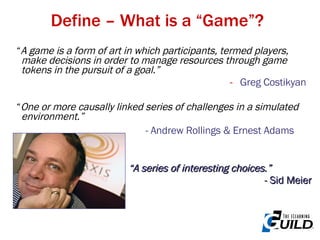
Define – What is a “Game”? “ A game is a form of art in which participants, termed players, make decisions in order to manage resources through game tokens in the pursuit of a goal.” Greg Costikyan “ One or more causally linked series of challenges in a simulated environment.” -   Andrew Rollings & Ernest Adams   “ A series of interesting choices.” - Sid Meier
A game is not… A game is not a  TOY Toys are free-form and open-ended. Games have structure, rules, and goals. A game is not a  PUZZLE Puzzles are static and have one solution. Games are dynamic and require strategies.  A game is not a  STORY Stories are linear and passive. Games are non-linear and interactive.
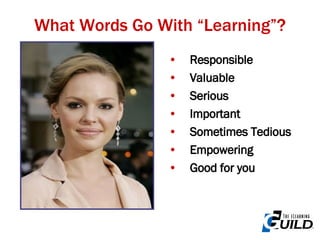
Responsible Valuable Serious Important Sometimes Tedious Empowering Good for you What Words Go With “Learning”?
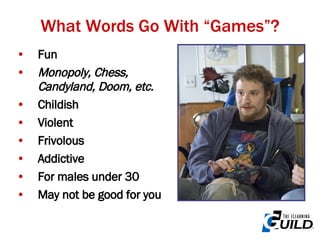
Fun Monopoly, Chess, Candyland, Doom, etc. Childish Violent Frivolous Addictive For males under 30 May not be good for you What Words Go With “Games”?
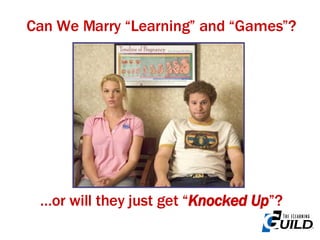
Can We Marry “Learning” and “Games”? … or will they just get “ Knocked Up ”?
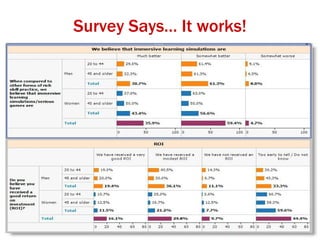
Survey Says… It works!
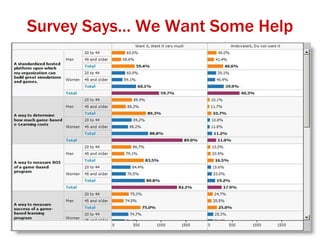
Survey Says… We Want Some Help
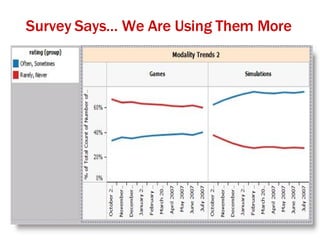
Survey Says… We Are Using Them More
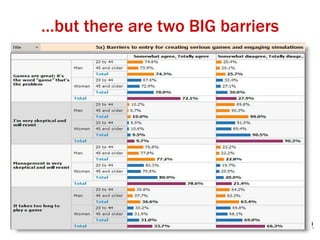
… but there are two BIG barriers
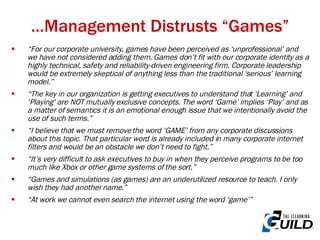
“ For our corporate university, games have been perceived as ‘unprofessional’ and we have not considered adding them. Games don’t fit with our corporate identity as a highly technical, safety and reliability-driven engineering firm. Corporate leadership would be extremely skeptical of anything less than the traditional ‘serious’ learning model.” “ The key in our organization is getting executives to understand that ‘Learning’ and ‘Playing’ are NOT mutually exclusive concepts. The word ‘Game’ implies ‘Play’ and as a matter of semantics it is an emotional enough issue that we intentionally avoid the use of such terms.” “ I believe that we must remove the word ‘GAME’ from any corporate discussions about this topic. That particular word is already included in many corporate internet filters and would be an obstacle we don’t need to fight.” “ It’s very difficult to ask executives to buy in when they perceive programs to be too much like Xbox or other game systems of the sort.” “ Games and simulations (as games) are an underutilized resource to teach. I only wish they had another name.” “ At work we cannot even search the internet using the word ‘game’” … Management Distrusts “Games”
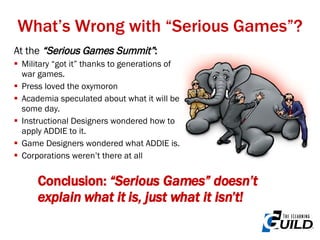
At the  “Serious Games Summit” : Military “got it” thanks to generations of war games. Press loved the oxymoron Academia speculated about what it will be some day. Instructional Designers wondered how to apply ADDIE to it. Game Designers wondered what ADDIE is. Corporations weren’t there at all What’s Wrong with “Serious Games”? Conclusion:  “Serious Games” doesn’t explain what it is, just what it isn’t!
They are  engaging , even addictive. People enjoy using them. They can  simulate  real-world systems and interactions. They  immerse  you in the game environment. They  actively  involve the learner, instead of passively transferring information. They are  effective , particularly in developing decision-making and problem-solving skills. What Do We Want from Games?
Interactive Learning G-Learning Training Simulations Experiential Learning Recursive Learning Goal Guided Training Immersive Learning Other Alternatives?
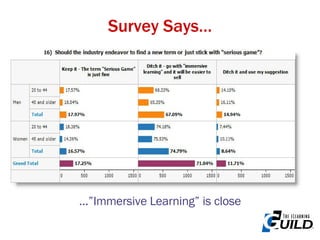
Survey Says… …” Immersive Learning” is close
What does it take to get buy in from IBM, GM, GE, P&G, NCR, KPMG, KFC, AMD, AT&T, 3M, EDS, USAA, EMC, and HEB? We need a TLA!  We need   ILS –  Immersive Learning Simulations! How Do We Sell It? “ A rose by any other name would still smell as sweet, but would a game by some other name sell to the executive suite?” - Jeff Johannigman
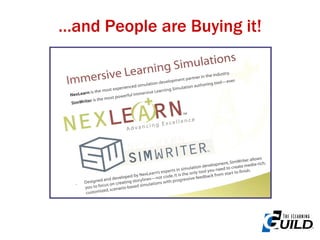
… and People are Buying it!
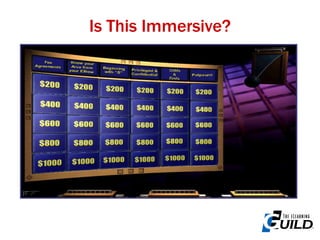
Immersive Learning Simulation … Describes what it IS in three specific words Puts the focus on the positive qualities we want Discards the baggage we don’t need Is NOT synonymous with all forms of game-based learning Does not include  Jeopardy, Hangman,  quiz games, and other Learning Reinforcement Activities ( LRA ’s?) NB: It’s  not  about millennials! Why ILS?
eLearning Linear Good for Knowledge Transfer Mostly Passive Information Presented Test Afterwards Failure is Bad ILS Cyclical Good for Problem-Solving and Decision Making Skills Mostly Interactive Principles Discovered Challenge Beforehand Failure (with feedback) is Good  Traditional eLearning vs. ILS
“ The cognitive process of acquiring skill or knowledge” Should be at the center of what we’re doing Still start development by defining specific learning objectives, particularly performance-based ones.  Ensure that the decisions the player makes in the ILS are directly tied to the learning objectives. ILS Dissected:  Learning
“ a model to describe a situation, event, program, or phenomenon. An interactive simulation allows people to manipulate variables that change the state of the model.”  (the eLearning Guild 360 Study) “ an imitation of some real thing, state of affairs, or process. The act of simulating something generally entails representing certain key characteristics or behaviors of a selected physical or abstract system”  (wikipedia)  ILS Dissected:  Simulation
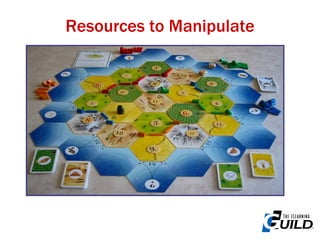
Resources to Manipulate
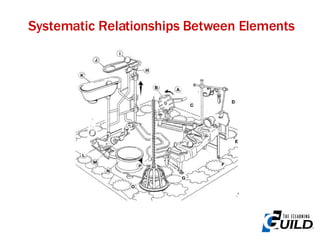
Systematic Relationships Between Elements
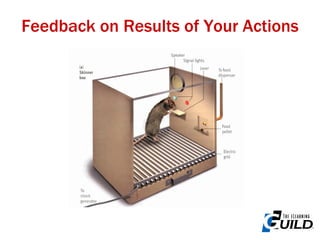
Feedback on Results of Your Actions
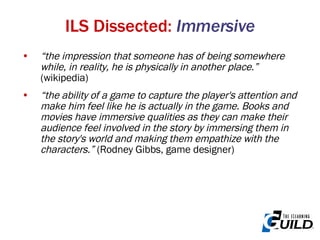
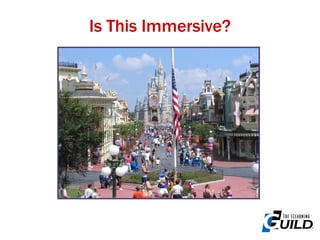
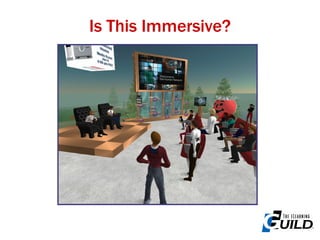
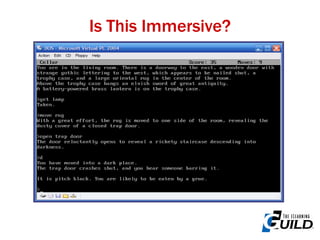
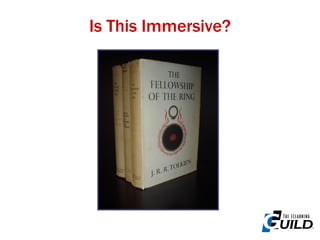
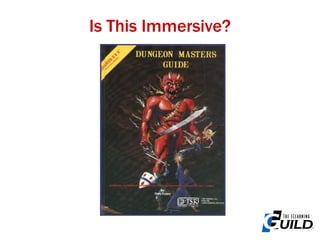
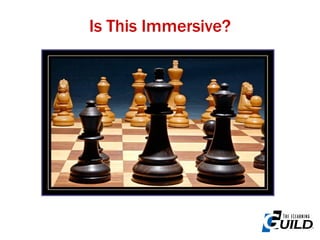
ILS Dissected:  Immersive “ the impression that someone has of being somewhere while, in reality, he is physically in another place.”  (wikipedia) “ the ability of a game to capture the player's attention and make him feel like he is actually in the game. Books and movies have immersive qualities as they can make their audience feel involved in the story by immersing them in the story's world and making them empathize with the characters.”  (Rodney Gibbs, game designer)
Is This Immersive?
Is This Immersive?
Is This Immersive?
Is This Immersive?
Is This Immersive?
Is This Immersive?
Is This Immersive?
Your First Step to  Becoming a Game Designer: PLAY! “ When your only tool is a hammer,  every problem begins to resemble a nail.” Abraham Maslow So, play everything you can –  board games, card games, computer games,  role-playing games, word games, party games, etc.
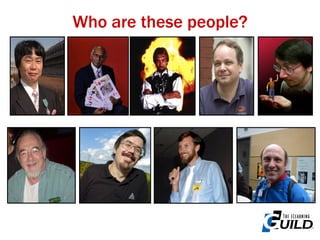
Who are these people?
Your Next Steps to  Becoming a Game Designer: Learn something about: Programming (even a simple language) Algebra & Geometry Probability & Statistics, maybe even Game Theory Psychology Story-telling – verbal and visual ( Understanding Comics) Literature and Mythology (esp Joseph Campbell) Theatre, Film, and Television production Art and Animation
The Wide, Wide World of Games Sports   –  Baseball, Basketball, Golf, Soccer Paper & Pencil  –  Hangman, Tic-tac-toe Quiz / TV show  –  Jeopardy, Family Feud, Trivial Pursuit Card  –  Poker, Fluxx, Magic: The Gathering, Pokemon Board  –  Chess, Monopoly, Risk, Go, Acquire, Scrabble   RPG & LARP   –  D & D, Murder Mystery, Vampire Wargames / Miniatures  –  Axis & Allies, Heroscape, Warhammer ,  Squad Leader
…and Computer / Video Games Action  –  Doom, Halo, Grand Theft Auto, Half-Life Sports   –  Madden NFL, Tiger Woods PGA Golf Story / RPG  –  Star Wars: KOTOR, Baldur’s Gate, Pirates Multiplayer  –  Second Life, World of Warcraft, Everquest   Vehicle Sim  –  MS Flight Sim, Need for Speed, Falcon Simulations  –  The Sims, Roller Coaster Tycoon, SimCity   Strategy  –  Civilization, Starcraft, Age of Empires Puzzle / Other  –  Tetris, Hoyle, You Don’t Know Jack
Types of Learning Games ? For now, we’ll stick with two basic types: Learning Reinforcement Activities (LRA’s)  Frame game structure independent of content. Easy to repurpose. Good for assessing and reinforcing fact-based learning. Immersive Learning Simulations (ILS’s) Game structure integral to learning content. Customized game mechanics and setting. Good for strategic thinking and problem-solving.
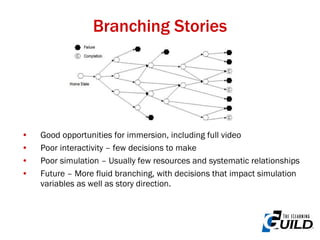
Branching Stories Good opportunities for immersion, including full video Poor interactivity – few decisions to make Poor simulation – Usually few resources and systematic relationships Future – More fluid branching, with decisions that impact simulation variables as well as story direction.
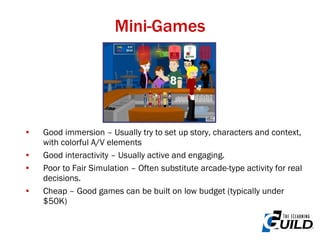
Mini-Games Good immersion – Usually try to set up story, characters and context, with colorful A/V elements Good interactivity – Usually active and engaging. Poor to Fair Simulation – Often substitute arcade-type activity for real decisions. Cheap – Good games can be built on low budget (typically under $50K)
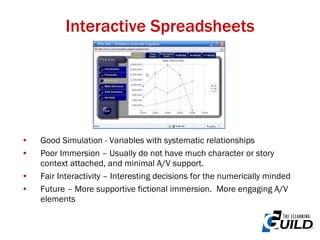
Interactive Spreadsheets Good Simulation - Variables with systematic relationships Poor Immersion – Usually do not have much character or story context attached, and minimal A/V support. Fair Interactivity – Interesting decisions for the numerically minded Future – More supportive fictional immersion.  More engaging A/V elements
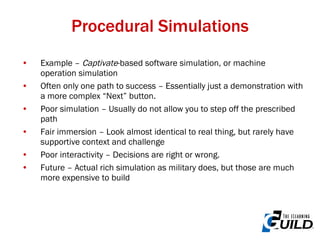
Procedural Simulations Example –  Captivate -based software simulation, or machine operation simulation Often only one path to success – Essentially just a demonstration with a more complex “Next” button. Poor simulation – Usually do not allow you to step off the prescribed path Fair immersion – Look almost identical to real thing, but rarely have supportive context and challenge Poor interactivity – Decisions are right or wrong. Future – Actual rich simulation as military does, but those are much more expensive to build
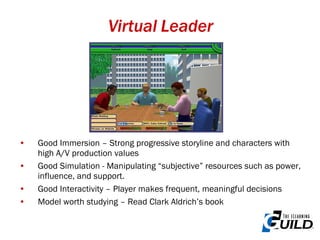
Virtual Leader Good Immersion – Strong progressive storyline and characters with high A/V production values Good Simulation - Manipulating “subjective” resources such as power, influence, and support. Good Interactivity – Player makes frequent, meaningful decisions Model worth studying – Read Clark Aldrich’s book
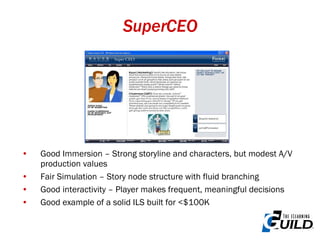
SuperCEO Good Immersion – Strong storyline and characters, but modest A/V production values Fair Simulation – Story node structure with fluid branching Good interactivity – Player makes frequent, meaningful decisions Good example of a solid ILS built for <$100K
The Ingredients of a Great Game
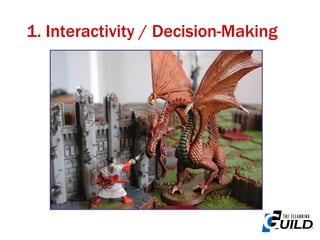
1. Interactivity / Decision-Making
1. Interactivity / Decision-Making Interactivity is like a conversation : You say something (take an action) The computer thinks about what you said and responds (changes the game state and gives you feedback) You think about what the computer said and respond (take another action) Repeat as needed More Interactivity = Better Game  (it’s just that simple) May be many quick decisions or fewer complex ones Players should always be : Thinking about their next decision Making the decision Evaluating the effectiveness of their last decision
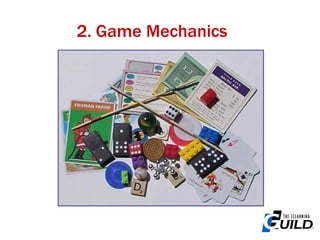
2. Game Mechanics
2. Game Mechanics Mechanics are the metaphors that translate abstract real world concepts to game objects that can be manipulated. Example game objects: Monopoly spaces and property cards Chess pieces D&D character sheets Objects can have both static and dynamic values: Properties Behaviors Relationships A Game Mechanic defines how your actions interact with the game objects. Good designers have a large toolbox of game mechanics.
3. Balanced Levels of Challenge
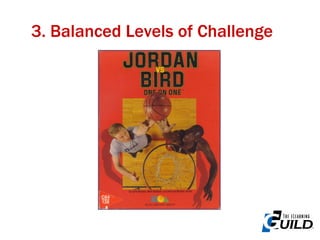
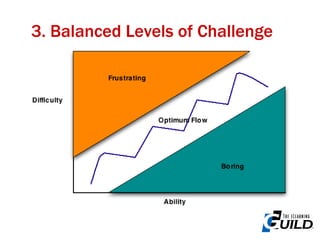
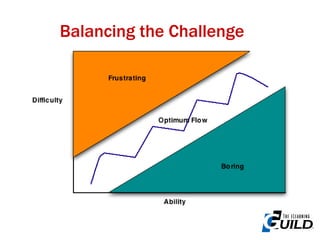
3. Balanced Levels of Challenge Would you become a great basketball player by playing against: A 5 year old child Michael Jordan A series of players, each slightly better than you at the time Learning comes from facing challenges just slightly better than you are, and devising ways to overcome them Challenge can come from: Competition Active conflict Limited resources Other limitations Tuning the progression of challenge is one of the most important aspects of the playtest phase.
3. Balanced Levels of Challenge
4. Feedback in Game Context
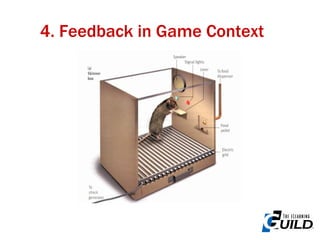
4. Feedback in Game Context Skinner was right. Feedback motivates players - period. “ I could get players to happily spend all day chopping down trees with large fish, if I gave them the right feedback and rewards”  – Game designer George MacDonald  Feedback can be: Visual, auditory, text Compliments or criticisms from game characters Rewards that increase player options Just a shiny badge Feedback should almost always fit the game fiction. Feedback does not always need to be immediate.
5. Goals and Subgoals
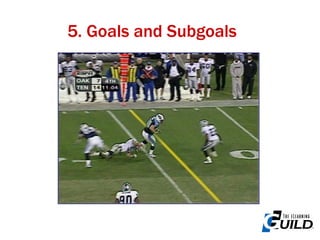
5. Goals and Subgoals Football’s main goal – Outscore your opponent Subgoal – Score a touchdown or a field goal with every possession Subgoal – Advance 10 yards within 4 plays Subgoal – Advance the ball with each play Conflicting subgoals can create effective tradeoffs and game tension: Your business needs to increase revenue, improve customer satisfaction, and decrease operating costs. Your Sim wants a big house, lots of friends, and a rewarding career. Progressions of interlinked subgoals give players feelings of accomplishment, but hook them to play “just a little more.”
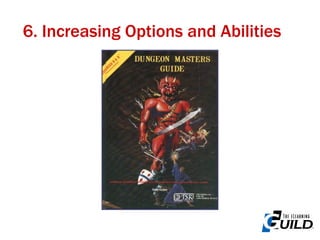
6. Increasing Options and Abilities
6. Increasing Options and Abilities Examples: “Power-Ups” in video games Bigger weapons in FPS games Character level advances in RPG’s. The most effective way to simultaneously set a goal, reward players for achieving it, and increase their challenge moving forward.
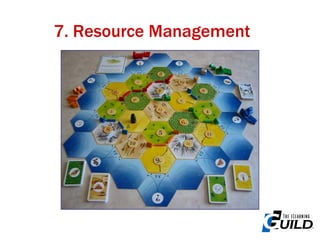
7. Resource Management
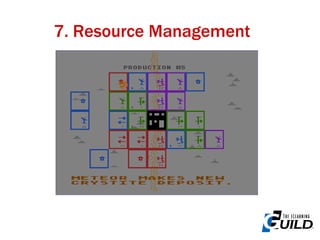
7. Resource Management Most games have both tangible and intangible resources: Tangible  - Money, People, Weapons, Ammo, Items Semi-tangible  – Time, Health / Hit Points Intangible  – Power, Influence, Reputation Classic 1980’s PC game  MULE  – settle a planet by producing Food  – needed to give you game time to take your turn Energy  – needed to run your MULEs Smithore  – needed to build more MULEs Crystite  – the cash commodity that you sell offworld Rich game options come from varying which resources produce which results: Option A – Lots of money, few people, moderate time Option B – Little time, moderate money, lots of people Option C – Little money, moderate people, long time
7. Resource Management
8. Personalization / Identification
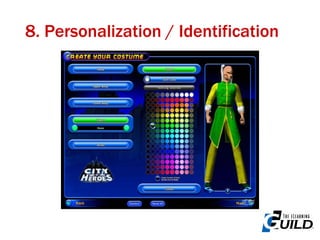
8. Personalization / Identification Do you have a favorite  Monopoly  piece? Why? Increases a player’s emotional investment in the game. Might have NO impact on game play at all. Could be as simple as: Naming your character Choosing a specific icon for yourself Selecting a color Picking a face that looks like you
9. Story Elements
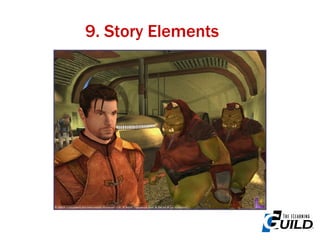
9. Story Elements Three basic elements of story: Setting – Fairly easy to do Character – Somewhat harder to do Plot – Should let the player do “ Stock” characters can still be effective in game settings Important character roles: Mentors Antagonist(s) Resource providers (Shopkeepers) Information providers (Messengers) Friends / sidekicks
10. Social Interaction
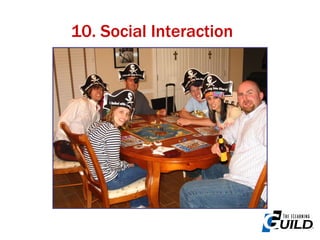
10. Social Interaction Not part of every game, but will usually make a game more satisfying. Can be used for competition and/or cooperation. Even artificial opponents can add fun. Are most players involved throughout, or do they have to wait their turn? Can create interaction outside of game context through high scores, discussion boards, chat, etc.
11. Exploration & Discovery
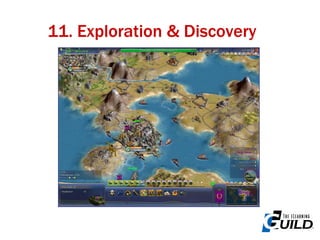
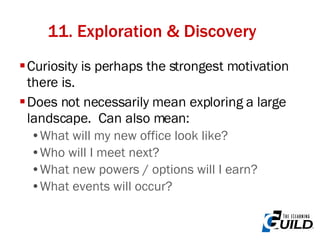
11. Exploration & Discovery Curiosity is perhaps the strongest motivation there is. Does not necessarily mean exploring a large landscape.  Can also mean: What will my new office look like? Who will I meet next? What new powers / options will I earn? What events will occur?
12. Predictable Risks
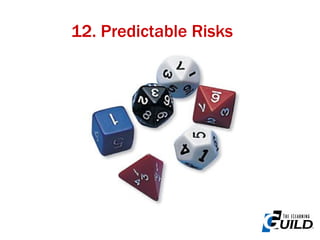
12. Predictable Risks Unpredictable events increase replayability Can simulate environmental factors like weather and the stock market  Managing risk is an important skill  Can help balance those ahead / behind Apply randomness carefully – The more randomness you have, the less players feel in control. Use it like a spice to “kick it up a notch”
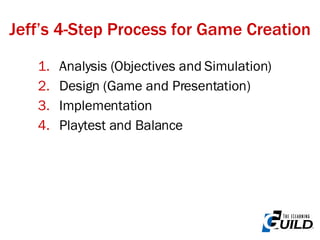
Jeff’s 4-Step Process for Game Creation Analysis (Objectives and Simulation) Design (Game and Presentation) Implementation Playtest and Balance
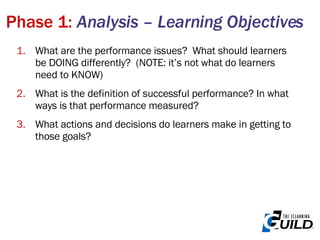
Phase 1:  Analysis – Learning Objectives What are the performance issues?  What should learners be DOING differently?  (NOTE: it’s not what do learners need to KNOW) What is the definition of successful performance? In what ways is that performance measured? What actions and decisions do learners make in getting to those goals?
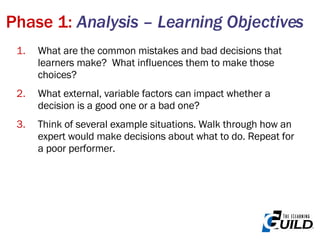
Phase 1:  Analysis – Learning Objectives What are the common mistakes and bad decisions that learners make?  What influences them to make those choices? What external, variable factors can impact whether a decision is a good one or a bad one? Think of several example situations. Walk through how an expert would make decisions about what to do. Repeat for a poor performer.
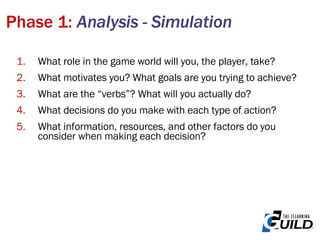
Phase 1:  Analysis - Simulation What role in the game world will you, the player, take? What motivates you? What goals are you trying to achieve? What are the “verbs”? What will you actually do?  What decisions do you make with each type of action? What information, resources, and other factors do you consider when making each decision?
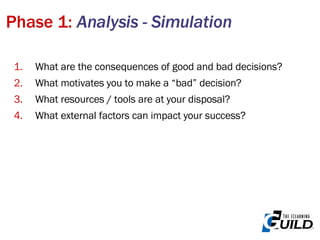
Phase 1:  Analysis - Simulation What are the consequences of good and bad decisions? What motivates you to make a “bad” decision? What resources / tools are at your disposal? What external factors can impact your success?
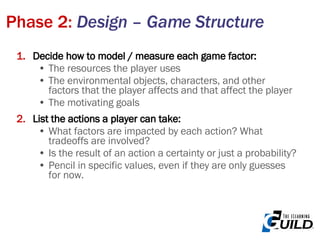
Phase 2:  Design – Game Structure Decide how to model / measure each game factor: The resources the player uses The environmental objects, characters, and other factors that the player affects and that affect the player The motivating goals List the actions a player can take: What factors are impacted by each action? What tradeoffs are involved? Is the result of an action a certainty or just a probability? Pencil in specific values, even if they are only guesses for now.
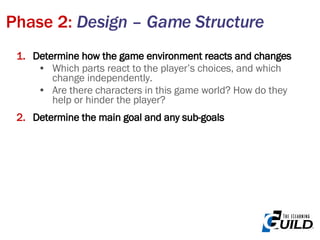
Phase 2:  Design – Game Structure Determine how the game environment reacts and changes Which parts react to the player’s choices, and which change independently. Are there characters in this game world? How do they help or hinder the player? Determine the main goal and any sub-goals
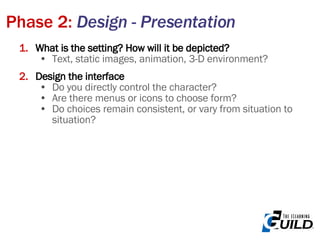
Phase 2:  Design - Presentation What is the setting? How will it be depicted?   Text, static images, animation, 3-D environment? Design the interface Do you directly control the character? Are there menus or icons to choose form? Do choices remain consistent, or vary from situation to situation?
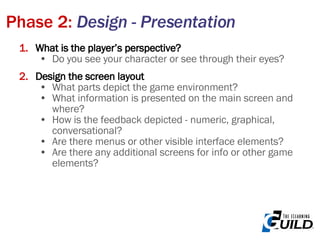
Phase 2:  Design - Presentation What is the player’s perspective?   Do you see your character or see through their eyes? Design the screen layout What parts depict the game environment? What information is presented on the main screen and where? How is the feedback depicted - numeric, graphical, conversational? Are there menus or other visible interface elements? Are there any additional screens for info or other game elements?
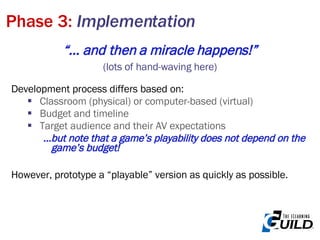
Phase 3:  Implementation “…  and then a miracle happens!” (lots of hand-waving here) Development process differs based on: Classroom (physical) or computer-based (virtual) Budget and timeline Target audience and their AV expectations … but note that a game’s playability does not depend on the game’s budget! However, prototype a “playable” version as quickly as possible.
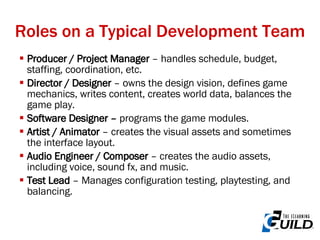
Roles on a Typical Development Team Producer / Project Manager  – handles schedule, budget, staffing, coordination, etc. Director / Designer  – owns the design vision, defines game mechanics, writes content, creates world data, balances the game play. Software Designer –  programs the game modules.  Artist / Animator  – creates the visual assets and sometimes the interface layout. Audio Engineer / Composer  – creates the audio assets, including voice, sound fx, and music. Test Lead  – Manages configuration testing, playtesting, and balancing.
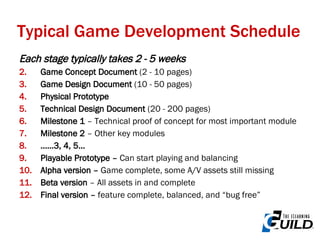
Typical Game Development Schedule Each stage typically takes 2 - 5 weeks Game Concept Document  (2 - 10 pages) Game Design Document  (10 - 50 pages) Physical Prototype Technical Design Document  (20 - 200 pages) Milestone 1  – Technical proof of concept for most important module Milestone 2  – Other key modules …… 3, 4, 5… Playable Prototype –  Can start playing and balancing Alpha version –  Game complete, some A/V assets still missing Beta version  – All assets in and complete Final version –  feature complete, balanced, and “bug free”
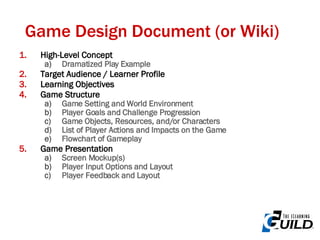
Game Design Document (or Wiki) High-Level Concept Dramatized Play Example Target Audience / Learner Profile Learning Objectives Game Structure Game Setting and World Environment Player Goals and Challenge Progression Game Objects, Resources, and/or Characters List of Player Actions and Impacts on the Game Flowchart of Gameplay Game Presentation Screen Mockup(s) Player Input Options and Layout Player Feedback and Layout
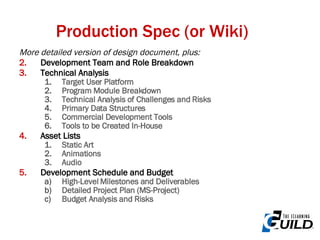
Production Spec (or Wiki) More detailed version of design document, plus: Development Team and Role Breakdown Technical Analysis Target User Platform Program Module Breakdown Technical Analysis of Challenges and Risks Primary Data Structures Commercial Development Tools Tools to be Created In-House Asset Lists Static Art Animations Audio Development Schedule and Budget High-Level Milestones and Deliverables Detailed Project Plan (MS-Project) Budget Analysis and Risks
About Implementation Design First (Don’t let your tool dictate your design) Then Branching PowerPoint HTML SimWriter, Captivate, Lectora, SmartBuilder, etc Model-driven Flash Excel Programming (Java, C, etc) Game Mods (caveat) etc
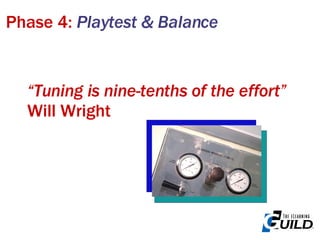
“ Tuning is nine-tenths of the effort” Will Wright Phase 4:  Playtest & Balance
THIS IS WHERE THE REAL LEARNING GOES IN! Playtest the game with a variety of players: Yourself and other game-savvy players Your SME’s Typical target players (Are they young, old, gamer-gen, phobic, ???) Cunning, resourceful, malicious players Naive, unsophisticated players (No hand-holding, please) Phase 4:  Playtest & Balance
Look for: Does intuition and common sense work for players? Do the winning strategies fit your learning objectives? Are there “stupid” strategies that actually work? Does the player focus on the decisions that are important to the learning? Are there decisions that are always made the same way? Why? Phase 4:  Playtest & Balance
Adjust the simulation and the feedback: Does the game seem fair? Is it fun? Why or why not? Does the player understand why he succeeded or failed? When do players get bored or lose interest? Does it stay challenging as players master it? Adjust the resource values, probabilities, goal conditions, messages, etc. Simplify or eliminate the parts that dilute the focus. Phase 4:  Playtest & Balance
Balancing the Challenge
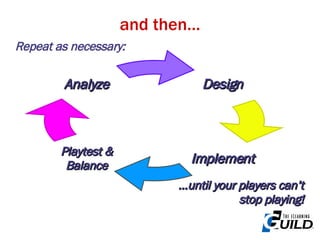
and then… Repeat as necessary: … until your players can’t stop playing! Design Implement Playtest   & Balance Analyze
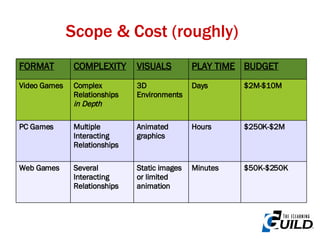
Scope & Cost (roughly) FORMAT COMPLEXITY VISUALS PLAY TIME BUDGET Video Games Complex Relationships in Depth 3D Environments Days $2M-$10M PC Games Multiple Interacting Relationships Animated graphics Hours $250K-$2M Web Games Several Interacting Relationships Static images or limited animation Minutes $50K-$250K
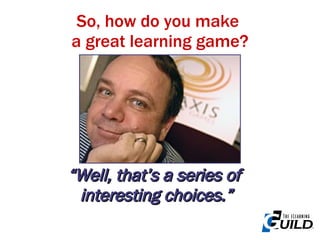
So, how do you make  a great learning game? “ Well, that’s a series of  interesting choices.”
Questions? Jeff Johannigman People Type Consulting [email_address] (512) 990-2340 site: peopletype.com
Appendix A: Recommended Tabletop Games Acquire   – Sid Sackson’s classic game of stock manipulation, mergers, and acquisitions.  Axis & Allies  – a simple but effective WWII simulation, including military, economic, and diplomatic aspects. Betrayal at House on the Hill  – A cooperative game with good story-telling mechanics  Bohnanza   – an entertaining trading game that includes economies of scale. Carcassonne  – a clever tile-based game, where you develop cities, farms, and roads. Cosmic Encounter  – A very influential game design. Every player can “break” a different game rule in a specific way. Cranium   – requires multiple forms of intelligence to win. Diplomacy   – a unique game where your interpersonal skills are the real keys to winning. Dungeons & Dragons Basic Game  – the easiest intro to role-playing games available.  Fluxx   – a card game with a deceptively simple structure, but unpredictable game play. Magic: The Gathering  – combines collectible trading cards with a flexible game format. Settlers of Catan  – a great game of resource development and trade Shadows Over Camelot  – a cooperative game with some role-playing aspects. Ticket to Ride  – an elegantly simple railroad game, with great strategic tension.
Appendix B: Recommended Computer Games Age of Empires   or   Age of Mythology   –   develop and manage a historic or mythic empire. Second Life   – a multiplayer online virtual world built by the players themselves.  Sid Meier’s Civilization  – grow your civilization from prehistory through space travel. Sid Meier’s Pirates  – role-playing as a swashbuckling pirate in connected mini-games. SimCity  – build and manage your city, including transportation, energy, crime  The Sims   – control the lives of a simulated family, including designing their home. Star Wars: Knights of the Old Republic  –  role-play a Jedi Knight through multiple storylines Starcraft   – play one of three alien races building combat forces in different battle missions World of Warcraft  – the most successful multiplayer online game on the market. You Don’t Know Jack   (www.youdontknowjack.com) – a quiz show game with an edge Zoo Tycoon   or  Roller Coaster Tycoon  – design and manage your own zoo or theme park.
Appendix C: Recommended Books Learning by Doing   – Clark Aldrich Simulations and the Future of Learning  – Clark Aldrich Game Design –  Bob Bates Ender’s Game   – Orson Scott Card Chris Crawford on Game Design  – Chris Crawford The Ultimate Guide to Video Game Writing and Design  – Dille & Platten Game Design Workshop  –  Tracy Fullerton A Theory of Fun for Game Design   – Raph Koster Understanding Comics  – Scott McCloud Digital Game-Based Learning  – Marc Prensky Engaging Learning   – Clark Quinn Andrew Rollings and Ernest Adams on Game Design   –Rollings & Adams A Gamut of Games   – Sid Sackson Design Your Own Games and Activities   - Sivasailam “Thiagi” Thiagarajan
Appendix D: Recommended Web Sites www.boardgamegeek.com  – Reviews, ratings, and discussion for thousands of games www.boardgameratings.com   – Online store with game ratings and recommended lists www.costik.com  – Greg Costikyan’s website with several interesting articles.  www.erasmatazz.com   – Chris Crawford’s site www.gamasutra.com   – Industry web site for professional game developers www.games2train.com   - Marc Prensky’s company site www.igda.org   – International Game Developers’ Association www.invisible-city.com   – Features a selection of innovative tabletop game designs www.learningcircuits.org   – ASTD’s source for e-Learning www.nasaga.org   – North American Simulation and Gaming Association www .engaginglearning. com   – Clark Quinn’s book site www.theoryoffun.com   – Raph Koster’s site for his “Theory of Fun” book www.thiagi.com   – The Thiagi Group, respected experts in training games

E Lg Dev Learn Ils

  • 1.
    DevLearn 2008: ImmersiveLearning Simulations with Jeff Johannigman, People Type Consulting
  • 2.
    Jeff Johannigman JeffJohannigman is founder of People Type Consulting, an Austin-based firm that works with companies who want to improve their teamwork and leadership, and with individuals who want to find more fulfilling careers. Jeff’s career began in the computer game industry in Silicon Valley. As a programmer, designer, and eventually producer, he has worked on over 25 published games, including several award-winning hits, for such companies as Electronic Arts, Origin, MicroProse, and Atari. In the mid-nineties, he left the game industry to pursue a career in human resources, training, and career management. He has designed and delivered both classroom and online training for a wide variety of clients, including the University of Texas, IBM, Dell, Whole Foods, Motion Computing, and Drake Beam Morin. Jeff considers himself educationally schizophrenic, holding a Bachelor of Science in Computer Science from Cornell University and a Master of Arts in Human Services from St. Edward's University.
  • 3.
    Jeff’s First Computer– The Atari 800
  • 4.
    I’ve worked onover 25 games from…
  • 5.
  • 6.
  • 7.
  • 8.
    So I hadto ask myself… “ What am I doing to people’s lives?” Why Leave the Games Business?
  • 9.
    “ Anyone whomakes a distinction between games and learning clearly does not know the first thing about either one.” - Marshall McLuhan “ Game designers have a better take on the nature of learning than curriculum designers.” - Seymour Papert, MIT Can I make games that teach something useful?
  • 10.
    What is thiscat doing? Playing Learning Working All of the above For Example…
  • 11.
    Let’s Talk AboutGame Design “ One of the most difficult tasks people can perform, however much others may despise it, is the invention of good games.” - Carl Jung
  • 12.
    Define – Whatis “Fun”? “ Fun arises out of mastery. It arises out of comprehension. It is the act of solving puzzles that makes games fun. In other words, with games, learning is the drug. … That’s what games are, in the end. Teachers. Fun is just another word for learning.” - Raph Koster, from “ A Theory of Fun for Game Design” “ Fun is the emotional response to learning.” - Chris Crawford author of Chris Crawford on Game Design
  • 13.
    Define – Whatis a “Game”? “ A game is a form of art in which participants, termed players, make decisions in order to manage resources through game tokens in the pursuit of a goal.” Greg Costikyan “ One or more causally linked series of challenges in a simulated environment.” - Andrew Rollings & Ernest Adams “ A series of interesting choices.” - Sid Meier
  • 14.
    A game isnot… A game is not a TOY Toys are free-form and open-ended. Games have structure, rules, and goals. A game is not a PUZZLE Puzzles are static and have one solution. Games are dynamic and require strategies. A game is not a STORY Stories are linear and passive. Games are non-linear and interactive.
  • 15.
    Responsible Valuable SeriousImportant Sometimes Tedious Empowering Good for you What Words Go With “Learning”?
  • 16.
    Fun Monopoly, Chess,Candyland, Doom, etc. Childish Violent Frivolous Addictive For males under 30 May not be good for you What Words Go With “Games”?
  • 17.
    Can We Marry“Learning” and “Games”? … or will they just get “ Knocked Up ”?
  • 18.
  • 19.
    Survey Says… WeWant Some Help
  • 20.
    Survey Says… WeAre Using Them More
  • 21.
    … but thereare two BIG barriers
  • 22.
    “ For ourcorporate university, games have been perceived as ‘unprofessional’ and we have not considered adding them. Games don’t fit with our corporate identity as a highly technical, safety and reliability-driven engineering firm. Corporate leadership would be extremely skeptical of anything less than the traditional ‘serious’ learning model.” “ The key in our organization is getting executives to understand that ‘Learning’ and ‘Playing’ are NOT mutually exclusive concepts. The word ‘Game’ implies ‘Play’ and as a matter of semantics it is an emotional enough issue that we intentionally avoid the use of such terms.” “ I believe that we must remove the word ‘GAME’ from any corporate discussions about this topic. That particular word is already included in many corporate internet filters and would be an obstacle we don’t need to fight.” “ It’s very difficult to ask executives to buy in when they perceive programs to be too much like Xbox or other game systems of the sort.” “ Games and simulations (as games) are an underutilized resource to teach. I only wish they had another name.” “ At work we cannot even search the internet using the word ‘game’” … Management Distrusts “Games”
  • 23.
    At the “Serious Games Summit” : Military “got it” thanks to generations of war games. Press loved the oxymoron Academia speculated about what it will be some day. Instructional Designers wondered how to apply ADDIE to it. Game Designers wondered what ADDIE is. Corporations weren’t there at all What’s Wrong with “Serious Games”? Conclusion: “Serious Games” doesn’t explain what it is, just what it isn’t!
  • 24.
    They are engaging , even addictive. People enjoy using them. They can simulate real-world systems and interactions. They immerse you in the game environment. They actively involve the learner, instead of passively transferring information. They are effective , particularly in developing decision-making and problem-solving skills. What Do We Want from Games?
  • 25.
    Interactive Learning G-LearningTraining Simulations Experiential Learning Recursive Learning Goal Guided Training Immersive Learning Other Alternatives?
  • 26.
    Survey Says… …”Immersive Learning” is close
  • 27.
    What does ittake to get buy in from IBM, GM, GE, P&G, NCR, KPMG, KFC, AMD, AT&T, 3M, EDS, USAA, EMC, and HEB? We need a TLA! We need ILS – Immersive Learning Simulations! How Do We Sell It? “ A rose by any other name would still smell as sweet, but would a game by some other name sell to the executive suite?” - Jeff Johannigman
  • 28.
    … and Peopleare Buying it!
  • 29.
    Immersive Learning Simulation… Describes what it IS in three specific words Puts the focus on the positive qualities we want Discards the baggage we don’t need Is NOT synonymous with all forms of game-based learning Does not include Jeopardy, Hangman, quiz games, and other Learning Reinforcement Activities ( LRA ’s?) NB: It’s not about millennials! Why ILS?
  • 30.
    eLearning Linear Goodfor Knowledge Transfer Mostly Passive Information Presented Test Afterwards Failure is Bad ILS Cyclical Good for Problem-Solving and Decision Making Skills Mostly Interactive Principles Discovered Challenge Beforehand Failure (with feedback) is Good Traditional eLearning vs. ILS
  • 31.
    “ The cognitiveprocess of acquiring skill or knowledge” Should be at the center of what we’re doing Still start development by defining specific learning objectives, particularly performance-based ones. Ensure that the decisions the player makes in the ILS are directly tied to the learning objectives. ILS Dissected: Learning
  • 32.
    “ a modelto describe a situation, event, program, or phenomenon. An interactive simulation allows people to manipulate variables that change the state of the model.” (the eLearning Guild 360 Study) “ an imitation of some real thing, state of affairs, or process. The act of simulating something generally entails representing certain key characteristics or behaviors of a selected physical or abstract system” (wikipedia) ILS Dissected: Simulation
  • 33.
  • 34.
  • 35.
    Feedback on Resultsof Your Actions
  • 36.
    ILS Dissected: Immersive “ the impression that someone has of being somewhere while, in reality, he is physically in another place.” (wikipedia) “ the ability of a game to capture the player's attention and make him feel like he is actually in the game. Books and movies have immersive qualities as they can make their audience feel involved in the story by immersing them in the story's world and making them empathize with the characters.” (Rodney Gibbs, game designer)
  • 37.
  • 38.
  • 39.
  • 40.
  • 41.
  • 42.
  • 43.
  • 44.
    Your First Stepto Becoming a Game Designer: PLAY! “ When your only tool is a hammer, every problem begins to resemble a nail.” Abraham Maslow So, play everything you can – board games, card games, computer games, role-playing games, word games, party games, etc.
  • 45.
  • 46.
    Your Next Stepsto Becoming a Game Designer: Learn something about: Programming (even a simple language) Algebra & Geometry Probability & Statistics, maybe even Game Theory Psychology Story-telling – verbal and visual ( Understanding Comics) Literature and Mythology (esp Joseph Campbell) Theatre, Film, and Television production Art and Animation
  • 47.
    The Wide, WideWorld of Games Sports – Baseball, Basketball, Golf, Soccer Paper & Pencil – Hangman, Tic-tac-toe Quiz / TV show – Jeopardy, Family Feud, Trivial Pursuit Card – Poker, Fluxx, Magic: The Gathering, Pokemon Board – Chess, Monopoly, Risk, Go, Acquire, Scrabble RPG & LARP – D & D, Murder Mystery, Vampire Wargames / Miniatures – Axis & Allies, Heroscape, Warhammer , Squad Leader
  • 48.
    …and Computer /Video Games Action – Doom, Halo, Grand Theft Auto, Half-Life Sports – Madden NFL, Tiger Woods PGA Golf Story / RPG – Star Wars: KOTOR, Baldur’s Gate, Pirates Multiplayer – Second Life, World of Warcraft, Everquest Vehicle Sim – MS Flight Sim, Need for Speed, Falcon Simulations – The Sims, Roller Coaster Tycoon, SimCity Strategy – Civilization, Starcraft, Age of Empires Puzzle / Other – Tetris, Hoyle, You Don’t Know Jack
  • 49.
    Types of LearningGames ? For now, we’ll stick with two basic types: Learning Reinforcement Activities (LRA’s) Frame game structure independent of content. Easy to repurpose. Good for assessing and reinforcing fact-based learning. Immersive Learning Simulations (ILS’s) Game structure integral to learning content. Customized game mechanics and setting. Good for strategic thinking and problem-solving.
  • 50.
    Branching Stories Goodopportunities for immersion, including full video Poor interactivity – few decisions to make Poor simulation – Usually few resources and systematic relationships Future – More fluid branching, with decisions that impact simulation variables as well as story direction.
  • 51.
    Mini-Games Good immersion– Usually try to set up story, characters and context, with colorful A/V elements Good interactivity – Usually active and engaging. Poor to Fair Simulation – Often substitute arcade-type activity for real decisions. Cheap – Good games can be built on low budget (typically under $50K)
  • 52.
    Interactive Spreadsheets GoodSimulation - Variables with systematic relationships Poor Immersion – Usually do not have much character or story context attached, and minimal A/V support. Fair Interactivity – Interesting decisions for the numerically minded Future – More supportive fictional immersion. More engaging A/V elements
  • 53.
    Procedural Simulations Example– Captivate -based software simulation, or machine operation simulation Often only one path to success – Essentially just a demonstration with a more complex “Next” button. Poor simulation – Usually do not allow you to step off the prescribed path Fair immersion – Look almost identical to real thing, but rarely have supportive context and challenge Poor interactivity – Decisions are right or wrong. Future – Actual rich simulation as military does, but those are much more expensive to build
  • 54.
    Virtual Leader GoodImmersion – Strong progressive storyline and characters with high A/V production values Good Simulation - Manipulating “subjective” resources such as power, influence, and support. Good Interactivity – Player makes frequent, meaningful decisions Model worth studying – Read Clark Aldrich’s book
  • 55.
    SuperCEO Good Immersion– Strong storyline and characters, but modest A/V production values Fair Simulation – Story node structure with fluid branching Good interactivity – Player makes frequent, meaningful decisions Good example of a solid ILS built for <$100K
  • 56.
    The Ingredients ofa Great Game
  • 57.
    1. Interactivity /Decision-Making
  • 58.
    1. Interactivity /Decision-Making Interactivity is like a conversation : You say something (take an action) The computer thinks about what you said and responds (changes the game state and gives you feedback) You think about what the computer said and respond (take another action) Repeat as needed More Interactivity = Better Game (it’s just that simple) May be many quick decisions or fewer complex ones Players should always be : Thinking about their next decision Making the decision Evaluating the effectiveness of their last decision
  • 59.
  • 60.
    2. Game MechanicsMechanics are the metaphors that translate abstract real world concepts to game objects that can be manipulated. Example game objects: Monopoly spaces and property cards Chess pieces D&D character sheets Objects can have both static and dynamic values: Properties Behaviors Relationships A Game Mechanic defines how your actions interact with the game objects. Good designers have a large toolbox of game mechanics.
  • 61.
    3. Balanced Levelsof Challenge
  • 62.
    3. Balanced Levelsof Challenge Would you become a great basketball player by playing against: A 5 year old child Michael Jordan A series of players, each slightly better than you at the time Learning comes from facing challenges just slightly better than you are, and devising ways to overcome them Challenge can come from: Competition Active conflict Limited resources Other limitations Tuning the progression of challenge is one of the most important aspects of the playtest phase.
  • 63.
    3. Balanced Levelsof Challenge
  • 64.
    4. Feedback inGame Context
  • 65.
    4. Feedback inGame Context Skinner was right. Feedback motivates players - period. “ I could get players to happily spend all day chopping down trees with large fish, if I gave them the right feedback and rewards” – Game designer George MacDonald Feedback can be: Visual, auditory, text Compliments or criticisms from game characters Rewards that increase player options Just a shiny badge Feedback should almost always fit the game fiction. Feedback does not always need to be immediate.
  • 66.
    5. Goals andSubgoals
  • 67.
    5. Goals andSubgoals Football’s main goal – Outscore your opponent Subgoal – Score a touchdown or a field goal with every possession Subgoal – Advance 10 yards within 4 plays Subgoal – Advance the ball with each play Conflicting subgoals can create effective tradeoffs and game tension: Your business needs to increase revenue, improve customer satisfaction, and decrease operating costs. Your Sim wants a big house, lots of friends, and a rewarding career. Progressions of interlinked subgoals give players feelings of accomplishment, but hook them to play “just a little more.”
  • 68.
    6. Increasing Optionsand Abilities
  • 69.
    6. Increasing Optionsand Abilities Examples: “Power-Ups” in video games Bigger weapons in FPS games Character level advances in RPG’s. The most effective way to simultaneously set a goal, reward players for achieving it, and increase their challenge moving forward.
  • 70.
  • 71.
    7. Resource ManagementMost games have both tangible and intangible resources: Tangible - Money, People, Weapons, Ammo, Items Semi-tangible – Time, Health / Hit Points Intangible – Power, Influence, Reputation Classic 1980’s PC game MULE – settle a planet by producing Food – needed to give you game time to take your turn Energy – needed to run your MULEs Smithore – needed to build more MULEs Crystite – the cash commodity that you sell offworld Rich game options come from varying which resources produce which results: Option A – Lots of money, few people, moderate time Option B – Little time, moderate money, lots of people Option C – Little money, moderate people, long time
  • 72.
  • 73.
    8. Personalization /Identification
  • 74.
    8. Personalization /Identification Do you have a favorite Monopoly piece? Why? Increases a player’s emotional investment in the game. Might have NO impact on game play at all. Could be as simple as: Naming your character Choosing a specific icon for yourself Selecting a color Picking a face that looks like you
  • 75.
  • 76.
    9. Story ElementsThree basic elements of story: Setting – Fairly easy to do Character – Somewhat harder to do Plot – Should let the player do “ Stock” characters can still be effective in game settings Important character roles: Mentors Antagonist(s) Resource providers (Shopkeepers) Information providers (Messengers) Friends / sidekicks
  • 77.
  • 78.
    10. Social InteractionNot part of every game, but will usually make a game more satisfying. Can be used for competition and/or cooperation. Even artificial opponents can add fun. Are most players involved throughout, or do they have to wait their turn? Can create interaction outside of game context through high scores, discussion boards, chat, etc.
  • 79.
  • 80.
    11. Exploration &Discovery Curiosity is perhaps the strongest motivation there is. Does not necessarily mean exploring a large landscape. Can also mean: What will my new office look like? Who will I meet next? What new powers / options will I earn? What events will occur?
  • 81.
  • 82.
    12. Predictable RisksUnpredictable events increase replayability Can simulate environmental factors like weather and the stock market Managing risk is an important skill Can help balance those ahead / behind Apply randomness carefully – The more randomness you have, the less players feel in control. Use it like a spice to “kick it up a notch”
  • 83.
    Jeff’s 4-Step Processfor Game Creation Analysis (Objectives and Simulation) Design (Game and Presentation) Implementation Playtest and Balance
  • 84.
    Phase 1: Analysis – Learning Objectives What are the performance issues? What should learners be DOING differently? (NOTE: it’s not what do learners need to KNOW) What is the definition of successful performance? In what ways is that performance measured? What actions and decisions do learners make in getting to those goals?
  • 85.
    Phase 1: Analysis – Learning Objectives What are the common mistakes and bad decisions that learners make? What influences them to make those choices? What external, variable factors can impact whether a decision is a good one or a bad one? Think of several example situations. Walk through how an expert would make decisions about what to do. Repeat for a poor performer.
  • 86.
    Phase 1: Analysis - Simulation What role in the game world will you, the player, take? What motivates you? What goals are you trying to achieve? What are the “verbs”? What will you actually do? What decisions do you make with each type of action? What information, resources, and other factors do you consider when making each decision?
  • 87.
    Phase 1: Analysis - Simulation What are the consequences of good and bad decisions? What motivates you to make a “bad” decision? What resources / tools are at your disposal? What external factors can impact your success?
  • 88.
    Phase 2: Design – Game Structure Decide how to model / measure each game factor: The resources the player uses The environmental objects, characters, and other factors that the player affects and that affect the player The motivating goals List the actions a player can take: What factors are impacted by each action? What tradeoffs are involved? Is the result of an action a certainty or just a probability? Pencil in specific values, even if they are only guesses for now.
  • 89.
    Phase 2: Design – Game Structure Determine how the game environment reacts and changes Which parts react to the player’s choices, and which change independently. Are there characters in this game world? How do they help or hinder the player? Determine the main goal and any sub-goals
  • 90.
    Phase 2: Design - Presentation What is the setting? How will it be depicted? Text, static images, animation, 3-D environment? Design the interface Do you directly control the character? Are there menus or icons to choose form? Do choices remain consistent, or vary from situation to situation?
  • 91.
    Phase 2: Design - Presentation What is the player’s perspective? Do you see your character or see through their eyes? Design the screen layout What parts depict the game environment? What information is presented on the main screen and where? How is the feedback depicted - numeric, graphical, conversational? Are there menus or other visible interface elements? Are there any additional screens for info or other game elements?
  • 92.
    Phase 3: Implementation “… and then a miracle happens!” (lots of hand-waving here) Development process differs based on: Classroom (physical) or computer-based (virtual) Budget and timeline Target audience and their AV expectations … but note that a game’s playability does not depend on the game’s budget! However, prototype a “playable” version as quickly as possible.
  • 93.
    Roles on aTypical Development Team Producer / Project Manager – handles schedule, budget, staffing, coordination, etc. Director / Designer – owns the design vision, defines game mechanics, writes content, creates world data, balances the game play. Software Designer – programs the game modules. Artist / Animator – creates the visual assets and sometimes the interface layout. Audio Engineer / Composer – creates the audio assets, including voice, sound fx, and music. Test Lead – Manages configuration testing, playtesting, and balancing.
  • 94.
    Typical Game DevelopmentSchedule Each stage typically takes 2 - 5 weeks Game Concept Document (2 - 10 pages) Game Design Document (10 - 50 pages) Physical Prototype Technical Design Document (20 - 200 pages) Milestone 1 – Technical proof of concept for most important module Milestone 2 – Other key modules …… 3, 4, 5… Playable Prototype – Can start playing and balancing Alpha version – Game complete, some A/V assets still missing Beta version – All assets in and complete Final version – feature complete, balanced, and “bug free”
  • 95.
    Game Design Document(or Wiki) High-Level Concept Dramatized Play Example Target Audience / Learner Profile Learning Objectives Game Structure Game Setting and World Environment Player Goals and Challenge Progression Game Objects, Resources, and/or Characters List of Player Actions and Impacts on the Game Flowchart of Gameplay Game Presentation Screen Mockup(s) Player Input Options and Layout Player Feedback and Layout
  • 96.
    Production Spec (orWiki) More detailed version of design document, plus: Development Team and Role Breakdown Technical Analysis Target User Platform Program Module Breakdown Technical Analysis of Challenges and Risks Primary Data Structures Commercial Development Tools Tools to be Created In-House Asset Lists Static Art Animations Audio Development Schedule and Budget High-Level Milestones and Deliverables Detailed Project Plan (MS-Project) Budget Analysis and Risks
  • 97.
    About Implementation DesignFirst (Don’t let your tool dictate your design) Then Branching PowerPoint HTML SimWriter, Captivate, Lectora, SmartBuilder, etc Model-driven Flash Excel Programming (Java, C, etc) Game Mods (caveat) etc
  • 98.
    “ Tuning isnine-tenths of the effort” Will Wright Phase 4: Playtest & Balance
  • 99.
    THIS IS WHERETHE REAL LEARNING GOES IN! Playtest the game with a variety of players: Yourself and other game-savvy players Your SME’s Typical target players (Are they young, old, gamer-gen, phobic, ???) Cunning, resourceful, malicious players Naive, unsophisticated players (No hand-holding, please) Phase 4: Playtest & Balance
  • 100.
    Look for: Doesintuition and common sense work for players? Do the winning strategies fit your learning objectives? Are there “stupid” strategies that actually work? Does the player focus on the decisions that are important to the learning? Are there decisions that are always made the same way? Why? Phase 4: Playtest & Balance
  • 101.
    Adjust the simulationand the feedback: Does the game seem fair? Is it fun? Why or why not? Does the player understand why he succeeded or failed? When do players get bored or lose interest? Does it stay challenging as players master it? Adjust the resource values, probabilities, goal conditions, messages, etc. Simplify or eliminate the parts that dilute the focus. Phase 4: Playtest & Balance
  • 102.
  • 103.
    and then… Repeatas necessary: … until your players can’t stop playing! Design Implement Playtest & Balance Analyze
  • 104.
    Scope & Cost(roughly) FORMAT COMPLEXITY VISUALS PLAY TIME BUDGET Video Games Complex Relationships in Depth 3D Environments Days $2M-$10M PC Games Multiple Interacting Relationships Animated graphics Hours $250K-$2M Web Games Several Interacting Relationships Static images or limited animation Minutes $50K-$250K
  • 105.
    So, how doyou make a great learning game? “ Well, that’s a series of interesting choices.”
  • 106.
    Questions? Jeff JohannigmanPeople Type Consulting [email_address] (512) 990-2340 site: peopletype.com
  • 107.
    Appendix A: RecommendedTabletop Games Acquire – Sid Sackson’s classic game of stock manipulation, mergers, and acquisitions. Axis & Allies – a simple but effective WWII simulation, including military, economic, and diplomatic aspects. Betrayal at House on the Hill – A cooperative game with good story-telling mechanics Bohnanza – an entertaining trading game that includes economies of scale. Carcassonne – a clever tile-based game, where you develop cities, farms, and roads. Cosmic Encounter – A very influential game design. Every player can “break” a different game rule in a specific way. Cranium – requires multiple forms of intelligence to win. Diplomacy – a unique game where your interpersonal skills are the real keys to winning. Dungeons & Dragons Basic Game – the easiest intro to role-playing games available. Fluxx – a card game with a deceptively simple structure, but unpredictable game play. Magic: The Gathering – combines collectible trading cards with a flexible game format. Settlers of Catan – a great game of resource development and trade Shadows Over Camelot – a cooperative game with some role-playing aspects. Ticket to Ride – an elegantly simple railroad game, with great strategic tension.
  • 108.
    Appendix B: RecommendedComputer Games Age of Empires or Age of Mythology – develop and manage a historic or mythic empire. Second Life – a multiplayer online virtual world built by the players themselves. Sid Meier’s Civilization – grow your civilization from prehistory through space travel. Sid Meier’s Pirates – role-playing as a swashbuckling pirate in connected mini-games. SimCity – build and manage your city, including transportation, energy, crime The Sims – control the lives of a simulated family, including designing their home. Star Wars: Knights of the Old Republic – role-play a Jedi Knight through multiple storylines Starcraft – play one of three alien races building combat forces in different battle missions World of Warcraft – the most successful multiplayer online game on the market. You Don’t Know Jack (www.youdontknowjack.com) – a quiz show game with an edge Zoo Tycoon or Roller Coaster Tycoon – design and manage your own zoo or theme park.
  • 109.
    Appendix C: RecommendedBooks Learning by Doing – Clark Aldrich Simulations and the Future of Learning – Clark Aldrich Game Design – Bob Bates Ender’s Game – Orson Scott Card Chris Crawford on Game Design – Chris Crawford The Ultimate Guide to Video Game Writing and Design – Dille & Platten Game Design Workshop – Tracy Fullerton A Theory of Fun for Game Design – Raph Koster Understanding Comics – Scott McCloud Digital Game-Based Learning – Marc Prensky Engaging Learning – Clark Quinn Andrew Rollings and Ernest Adams on Game Design –Rollings & Adams A Gamut of Games – Sid Sackson Design Your Own Games and Activities - Sivasailam “Thiagi” Thiagarajan
  • 110.
    Appendix D: RecommendedWeb Sites www.boardgamegeek.com – Reviews, ratings, and discussion for thousands of games www.boardgameratings.com – Online store with game ratings and recommended lists www.costik.com – Greg Costikyan’s website with several interesting articles. www.erasmatazz.com – Chris Crawford’s site www.gamasutra.com – Industry web site for professional game developers www.games2train.com - Marc Prensky’s company site www.igda.org – International Game Developers’ Association www.invisible-city.com – Features a selection of innovative tabletop game designs www.learningcircuits.org – ASTD’s source for e-Learning www.nasaga.org – North American Simulation and Gaming Association www .engaginglearning. com – Clark Quinn’s book site www.theoryoffun.com – Raph Koster’s site for his “Theory of Fun” book www.thiagi.com – The Thiagi Group, respected experts in training games