Learning Through Gaming How Games Naturally Promote Effective Learning
Part I: Defining Games
Gaming did not start with Atari
What is a game? A tentative definition: A game is a system in which  players  engage in an  artificial conflict , defined by  rules , that results in a  quantifiable outcome . Salen & Zimmerman, 2004
What is a game? 2 Examples: Candy Land and Aisle
 
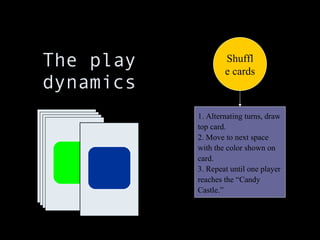
The play dynamics Shuffle cards 1. Alternating turns, draw top card. 2. Move to next space with the color shown on card. 3. Repeat until one player reaches the “Candy Castle.”
Is Candy Land a game? Definition: A game is a system in which players engage in an artificial conflict, defined by rules, that results in a quantifiable outcome.
Is Candy Land a game? Game-like trappings: cards, board, tokens Players compete against each other Rules govern play Someone will win Player has no real impact on the game system
In summary: Candy Land  is widely accepted as a game, but offers no real opportunity for interactivity - the player doesn’t affect the outcome
A contrast: Aisle , by Sam Barlow (1999)
Is this a game? Definition: A game is a system in which players engage in an artificial conflict, defined by rules, that results in a quantifiable outcome.
Is this a game? Not immediately identifiable as a game to many people Conflict - is it present? Rules govern what input is accepted, used An outcome will be achieved (is this “winning?”) Player’s actions determine the course of the game
In summary: Candy Land  is widely accepted as a game, but offers no real opportunity for interactivity - the player doesn’t affect the outcome Aisle  does not resemble the archetypal view of games; the player’s involvement is minimal, but  instrumental  in playing
So… What is a game? “ Golf is a long walk spoiled”  -  Samuel Clemens Games usually have: Goals  (i.e., get to the end of the course) Limitations  (i.e., hit a ball into a hole along the way) Player input  (i.e., swing a golf club) Ludic properties  (a.k.a. play - “This is fun!”)
Important point #1: Anything can be made into a game A good player will provide her own goals, especially if the game designer fails to
Important point #2: Any game can be un-made Players can subvert the goals and limitations of a game (i.e., “cheat”)
The Magic Circle When a player chooses to play a game, he temporarily agrees to be bound by the rules of that game, and to accept the goals of the game as his own. Huizinga, 1955
The Core Mechanic How is the game played?
The Core Mechanic
Part II: Learning in Games
A Bold Statement Games are all about learning.
Learning and playing games Learning can take place on many different levels within the context of a game: Specific rules are encoded declaratively Implementations of the core mechanic are learned procedurally Strategies and meta-knowledge are developed over time
Sophisticated Declarative Knowledge At each of these levels, learning is complex - gamers develop specialist expert knowledge, featuring: Specialized vocabulary Inter-related concepts Complex conditionals
Sophisticated Declarative Knowledge Strike vs. AC and Dodge. AC (armor class) and Dodge reduce your chances of being hit in combat, and thus increase your chances of survival. AC and Dodge are added together to make a combined Difficulty modifier. The Difficulty is added to the attackers Strike Base. The attacker must then roll higher than or equal to the modified Strike Base using a 1d20 and adding all applicable strike bonuses. Note: Encumbrance will reduce your AGL and thus your Dodge (even to a negative number). Additionally a weapon's Penetration can reduce or increase an armor's AC (down to zero but never less). This is a representation to the ability for certain weapons to penetrate armor and for some to have a tougher time doing so.
Sophisticated Declarative Knowledge Hamon, Lord of Striking Thunder [Thunder/Effect] This card cannot be Normal Summoned or Set.  This card cannot be Special Summoned except by sending 3 face-up Continuous Spell Cards  from your side of the field to the Graveyard.  When this card destroys your opponent’s monster as a result of battle and sends it to the Graveyard, inflict 1000 points of damage to your opponent’s Life Points.  While this card is in face-up Defense Position on your side of the field, your opponent cannot select another monster as an attack target.
Sophisticated Declarative Knowledge Holyoak & Simon, 1999 Bidirectional inferences are inherent in the operation of models of thinking that are based on parallel constraint satisfaction. Computational instantiations of such models are typically formulated as networks of units representing possibilities (e.g., possible beliefs or actions) that are interconnected by excitatory and inhibitory links representing positive and negative support relations between pairs of possibilities. Constraint satisfaction models operate by applying a relaxation algorithm, which settles the net- work into a stable state in which the asymptotic activation levels of the units define a set of winning possibilities (those with relatively high activation) that have succeeded in mutually supporting one another and collectively inhibiting their rivals. The bidirectional influences between related possibilities play a critical role in allowing the system to impose a coherent interpretation on an initially ambiguous set of inputs.
the Core Mechanic The primary learning task comes in actually playing the game, however that is accomplished.
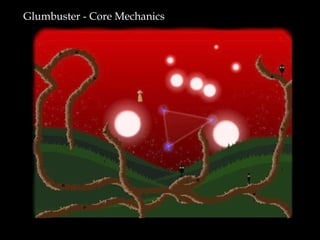
Glumbuster - Core Mechanics player (wasd keys) mouse (left, right buttons)
 
Strategy Learning and Meta-play Learning how to play a game is different from learning how to play a game well.
Part III: Learning As Games
What Can be Learned from Games? According to previous studies and applications: Functioning under divided attention Visual-spatial abilities Real-world skills (like laparoscopy) Greenfield & Cocking, 1996; Rosenberg, Landsittel, & Averch, 2005
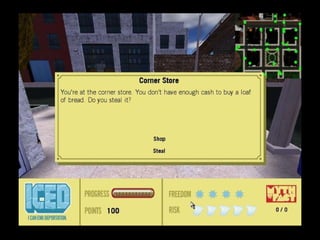
Construct vs. Content How can you communicate through the medium of a game?
 
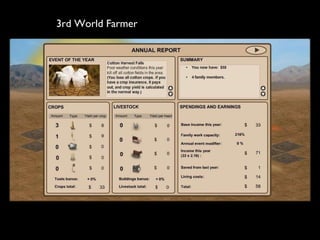
3rd World Farmer
 
Are Digital Games Special?
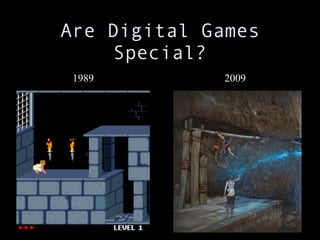
Are Digital Games Special? 1989 2009
Are Digital Games Special? But then again… Immediacy Immersion Complexity Adaptability
Stepping Inside the Circle In a well-designed game, the rules reinforce the goals, and both reinforce a sense of identity.
Refining that Definition “… Comprehension is grounded in perceptual simulations that prepare agents for situated action.” Barsalou, 1999
Refining that Definition (Video) Games are… “ action-and-goal-directed preparations for, and simulations of, embodied experience” …  And education should be, too. Gee, 2007
An Example (Beckett & Shaffer, 2005) The Madison 2200 Project  Introducing the concepts of ecology through a computer simulation/game
Consider the Cheater Will putting more games in education help or hurt?
The Promise of Educational Gaming Present students with goal-directed and action-oriented situations Tailor the rules of the game to the content being taught Foster a sense of identity
 

Learning Through Gaming

  • 1.
    Learning Through GamingHow Games Naturally Promote Effective Learning
  • 2.
  • 3.
    Gaming did notstart with Atari
  • 4.
    What is agame? A tentative definition: A game is a system in which players engage in an artificial conflict , defined by rules , that results in a quantifiable outcome . Salen & Zimmerman, 2004
  • 5.
    What is agame? 2 Examples: Candy Land and Aisle
  • 6.
  • 7.
    The play dynamicsShuffle cards 1. Alternating turns, draw top card. 2. Move to next space with the color shown on card. 3. Repeat until one player reaches the “Candy Castle.”
  • 8.
    Is Candy Landa game? Definition: A game is a system in which players engage in an artificial conflict, defined by rules, that results in a quantifiable outcome.
  • 9.
    Is Candy Landa game? Game-like trappings: cards, board, tokens Players compete against each other Rules govern play Someone will win Player has no real impact on the game system
  • 10.
    In summary: CandyLand is widely accepted as a game, but offers no real opportunity for interactivity - the player doesn’t affect the outcome
  • 11.
    A contrast: Aisle, by Sam Barlow (1999)
  • 12.
    Is this agame? Definition: A game is a system in which players engage in an artificial conflict, defined by rules, that results in a quantifiable outcome.
  • 13.
    Is this agame? Not immediately identifiable as a game to many people Conflict - is it present? Rules govern what input is accepted, used An outcome will be achieved (is this “winning?”) Player’s actions determine the course of the game
  • 14.
    In summary: CandyLand is widely accepted as a game, but offers no real opportunity for interactivity - the player doesn’t affect the outcome Aisle does not resemble the archetypal view of games; the player’s involvement is minimal, but instrumental in playing
  • 15.
    So… What isa game? “ Golf is a long walk spoiled” - Samuel Clemens Games usually have: Goals (i.e., get to the end of the course) Limitations (i.e., hit a ball into a hole along the way) Player input (i.e., swing a golf club) Ludic properties (a.k.a. play - “This is fun!”)
  • 16.
    Important point #1:Anything can be made into a game A good player will provide her own goals, especially if the game designer fails to
  • 17.
    Important point #2:Any game can be un-made Players can subvert the goals and limitations of a game (i.e., “cheat”)
  • 18.
    The Magic CircleWhen a player chooses to play a game, he temporarily agrees to be bound by the rules of that game, and to accept the goals of the game as his own. Huizinga, 1955
  • 19.
    The Core MechanicHow is the game played?
  • 20.
  • 21.
  • 22.
    A Bold StatementGames are all about learning.
  • 23.
    Learning and playinggames Learning can take place on many different levels within the context of a game: Specific rules are encoded declaratively Implementations of the core mechanic are learned procedurally Strategies and meta-knowledge are developed over time
  • 24.
    Sophisticated Declarative KnowledgeAt each of these levels, learning is complex - gamers develop specialist expert knowledge, featuring: Specialized vocabulary Inter-related concepts Complex conditionals
  • 25.
    Sophisticated Declarative KnowledgeStrike vs. AC and Dodge. AC (armor class) and Dodge reduce your chances of being hit in combat, and thus increase your chances of survival. AC and Dodge are added together to make a combined Difficulty modifier. The Difficulty is added to the attackers Strike Base. The attacker must then roll higher than or equal to the modified Strike Base using a 1d20 and adding all applicable strike bonuses. Note: Encumbrance will reduce your AGL and thus your Dodge (even to a negative number). Additionally a weapon's Penetration can reduce or increase an armor's AC (down to zero but never less). This is a representation to the ability for certain weapons to penetrate armor and for some to have a tougher time doing so.
  • 26.
    Sophisticated Declarative KnowledgeHamon, Lord of Striking Thunder [Thunder/Effect] This card cannot be Normal Summoned or Set. This card cannot be Special Summoned except by sending 3 face-up Continuous Spell Cards from your side of the field to the Graveyard. When this card destroys your opponent’s monster as a result of battle and sends it to the Graveyard, inflict 1000 points of damage to your opponent’s Life Points. While this card is in face-up Defense Position on your side of the field, your opponent cannot select another monster as an attack target.
  • 27.
    Sophisticated Declarative KnowledgeHolyoak & Simon, 1999 Bidirectional inferences are inherent in the operation of models of thinking that are based on parallel constraint satisfaction. Computational instantiations of such models are typically formulated as networks of units representing possibilities (e.g., possible beliefs or actions) that are interconnected by excitatory and inhibitory links representing positive and negative support relations between pairs of possibilities. Constraint satisfaction models operate by applying a relaxation algorithm, which settles the net- work into a stable state in which the asymptotic activation levels of the units define a set of winning possibilities (those with relatively high activation) that have succeeded in mutually supporting one another and collectively inhibiting their rivals. The bidirectional influences between related possibilities play a critical role in allowing the system to impose a coherent interpretation on an initially ambiguous set of inputs.
  • 28.
    the Core MechanicThe primary learning task comes in actually playing the game, however that is accomplished.
  • 29.
    Glumbuster - CoreMechanics player (wasd keys) mouse (left, right buttons)
  • 30.
  • 31.
    Strategy Learning andMeta-play Learning how to play a game is different from learning how to play a game well.
  • 32.
  • 33.
    What Can beLearned from Games? According to previous studies and applications: Functioning under divided attention Visual-spatial abilities Real-world skills (like laparoscopy) Greenfield & Cocking, 1996; Rosenberg, Landsittel, & Averch, 2005
  • 34.
    Construct vs. ContentHow can you communicate through the medium of a game?
  • 35.
  • 36.
  • 37.
  • 38.
  • 39.
    Are Digital GamesSpecial? 1989 2009
  • 40.
    Are Digital GamesSpecial? But then again… Immediacy Immersion Complexity Adaptability
  • 41.
    Stepping Inside theCircle In a well-designed game, the rules reinforce the goals, and both reinforce a sense of identity.
  • 42.
    Refining that Definition“… Comprehension is grounded in perceptual simulations that prepare agents for situated action.” Barsalou, 1999
  • 43.
    Refining that Definition(Video) Games are… “ action-and-goal-directed preparations for, and simulations of, embodied experience” … And education should be, too. Gee, 2007
  • 44.
    An Example (Beckett& Shaffer, 2005) The Madison 2200 Project Introducing the concepts of ecology through a computer simulation/game
  • 45.
    Consider the CheaterWill putting more games in education help or hurt?
  • 46.
    The Promise ofEducational Gaming Present students with goal-directed and action-oriented situations Tailor the rules of the game to the content being taught Foster a sense of identity
  • 47.

Editor's Notes

  • #4 Scope of the presentation: Outline what games are and what they can offer; some will be applicable to games in general, some will be more particular to digital games
  • #5 Not necessarily the best definition, but it’s broad enough for an introduction. Not all games that fall under this definition will necessarily be interesting for the purposes of this talk.
  • #6 Many of us probably had our first exposure to games and gaming through the “game” of CandyLand. Both of these games are played in very different manners, and illustrate different aspects of the definition.
  • #7 Many of us probably had our first exposure to games and gaming through the “game” of CandyLand.
  • #14 Free response?
  • #16 Looking at common features that games share…
  • #17 Stripping a game to its bares definition of a goal and arbitrary limitations means that any normal task can be turned into a game.
  • #18 Also known as being a spoilsport. Cheating at games is pervasive, as rules are self-enforced - except for some games, which have referees. Important to keep in mind - will come back to this when considering games in educational environments.
  • #19 We play games because we are willing to temporarily invest ourselves in them and give ourselves over to the game logic. The cheater and the spoilsport are cases where an individual chooses to step outside of the circle; the rules go from being fixed and binding to being arbitrary, as they truly are.
  • #20 Similarly to David Marr’s conception of cognitive processes, the play of a game can be interpreted at different levels of analysis. At the computational level, chutes and ladders is all about reaching a specified target through a semi-randomized, stepwise process. (spinner, chutes, ladders) At the algorithmic level, it’s a numeric progression from 1 to 100, governed by a random number spin plus discrete addition/subtraction events. This necessitates a random number generator, a scorekeeping mechanism, and a rules for adding and subtracting. At the implementation level…
  • #21 On a deep level, many games are fundamentally the same - accumulate more of some resource than a competitor. The particular instantiation of the game is determined by the core mechanic: what you do. (Black square represents verbal game, like 20 Questions)
  • #23 One of the harshest criticisms of a game is that it is too easy - that is, that the player wasn’t challenged in the game. Conversely, games can be criticized for being too hard, or “unfair.” This could also be interpreted as that the game did an ineffective job at creating learning in the player.
  • #28 Terms are embedded - they are functional, enabling the game-player to achieve a goal, and they are situated in the context of an action.
  • #30 Glumbuster is so successful partly because it presents a relatively simple core mechanic, but is constantly redefining the purpose - learning is intrinsic to the gameplay.
  • #31 At a certain point while playing, the world will shift. You’ll still be using the same core mechanic - pressing the same buttons and keys - but they’ll now accomplish different things. Your primary task now is to figure out what has changed and adapt to the new environment.
  • #32 Expert knowledge develops over time; pattern recognition and automaticity may take over for conscious, deliberate processes. Similarly, there’s a lot about playing a game that isn’t included in a rule book - interactions with the other players and with the game system itself are multiply determined. For instance, the goals of a particular player may not be completely in accordance with the stated goal of the game. Not the focus of this talk, however.
  • #34 Primarily what’s been studied has been in reference to action-oriented videogames. However, these are studying training in visual processing, not necessarily games themselves. We need to take a look at what makes games special as a medium of communication.
  • #35 Successfully communicating something through a game requires that the core mechanic matches up with and reinforces the other content of the game - games are experienced through their core mechanic, not through the window dressing.
  • #36 It has content, but there’s no reason for it to be in a game. The game engine has nothing to do with what the game is supposed to be about.
  • #37 There is some relation between content and gameplay, but the game is also incredibly easy - being a 3rd world farmer isn’t that bad. The mechanics are transparent, and so it’s easy to find a maximizing strategy. The core mechanic is appropriate, but used poorly.
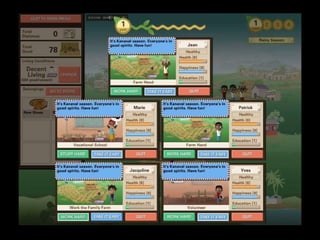
  • #38 Ayiti is a good example of a game that balances content and gameplay - it’s a resource management game like 3rd World Farmer, but it’s tough. It’s also clear what does and doesn’t make a difference in the game; education and careful planning is essential. Otherwise, it’s very easy to fall into a downward spiral of debt and poor health.
  • #39 Hearkens back to levels of analysis - computationally the same, but different implementations.
  • #40 While technology has made huge advances since the advent of digital games, the underlying structure of most digital games has remained unchanged.
  • #41 Digital games seem to have led to a major shift in the cultural perception of games, as well as a much more rapid diversification and popularization of game genres and fundamental styles. On the level of implementation, there is also a lot more that can be done digitally than in any other format.
  • #42 Digital games may be more able to reinforce this idea than non-digital games. In MGS, the goal is to move around without being seen; the type of movements that the player is able to make are designed to facilitate that goal. The player, in turn, learns to see the game world in terms of concealment. As a result of the construct and content of the game emphasizing this style of movement, the player is able to play the game “as” a secret agent.
  • #44 Gee argues that (good) video games put the player into a system where the goal is to learn to identify and respond to affordances in the environment. Learning is situated in context.
  • #45 11 High school seniors in a Summer enrichment program at U of Wisconsin. Their goal was to redesign a city block to try to match residents’ wants. Used MadMod, which let them change zoning designations and see the expected results on several factors (crime, waste, car usage, jobs, revenue, housing). Qualitatively, showed substantial increase in understanding of ecology and the interconnected nature of a city. Through the game, they were able to “think like an ecologist.”
  • #46 The story of Benny (in Erlwanger, 1973): Individually Prescribed Instruction classroom, where kids learned on their own and took tests when they felt they were ready - Benny was able to pass through the tests without knowing anything about fractions. He gamed the system by approaching it from a different perspective than the designers.