FLORIDA   STATE COLLEGE
               AT   J ACKSONVILLE
Who Are           Jeff Kissinger
                 Chief Learning Solutions
                         Architect
 Ian Boswell
 Game Designer
                                       Vanessa Carswe
                                            Instructional Designer
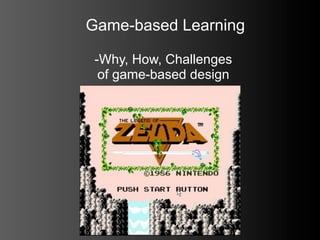
Game-based Learning

 -Why, How, Challenges
  of game-based design
WHAT IS WORTH 1
BILLION DOLLARS?
$1 Billion Worth of:
•   Community
•   Passion
•   Emotional Storytellers
•   Millions of Affinity Groups!!! Invaluable?
Risk of Failure


                  •   Low
                  •   Authentic
                  •   Situated
                  •   Iterative
                  •   Emotional/Affective
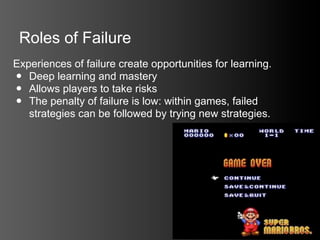
Roles of Failure
Experiences of failure create opportunities for learning.
•  Deep learning and mastery
•  Allows players to take risks
•  The penalty of failure is low: within games, failed
   strategies can be followed by trying new strategies.
Affinity & Emotion
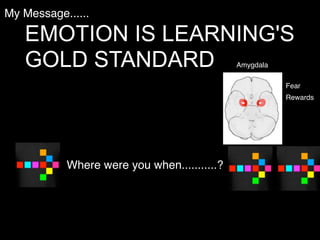
My Message......

   EMOTION IS LEARNING'S
   GOLD STANDARD                             Amygdala

                                                        Fear
                                                        Rewards


           Where were you when...........?
Size matters?


@jeffkiss
Emotional Memory
Video: 9/11 WTC Attack


                 Where were you when
                   the Twin Towers
                      collapsed?
Having Your First Baby
Making Your First Baby
First Kiss
Engagement
Where were you when MLK gave the “I
      Have A Dream Speech”?
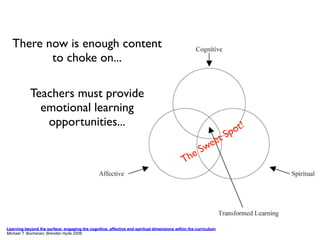
There now is enough content
         to choke on...

            Teachers must provide
              emotional learning
               opportunities...
                                                                                                                Sp ot!
                                                                                                       eet
                                                                                                 e   Sw
                                                                                            Th


Learning beyond the surface: engaging the cognitive, affective and spiritual dimensions within the curriculum
Michael T. Buchanan; Brendan Hyde 2008
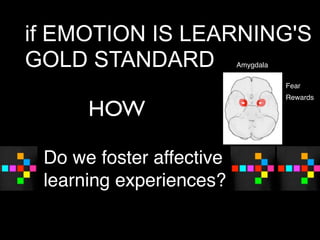
if EMOTION IS LEARNING'S
GOLD STANDARD             Amygdala

                                     Fear
                                     Rewards

      HOW

 Do we foster affective
 learning experiences?
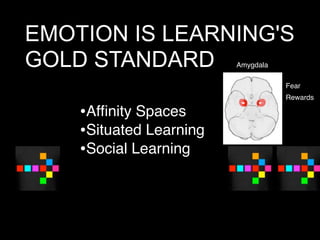
EMOTION IS LEARNING'S
GOLD STANDARD            Amygdala

                                    Fear
                                    Rewards

    •Affinity Spaces
    •Situated Learning
    •Social Learning
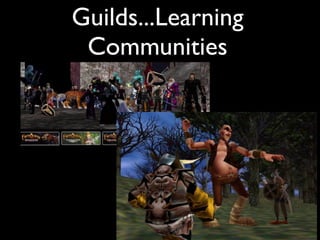
Guilds...Learning
 Communities
Why Use Game-Based Design?
Practice Effort-One must practice what is being learned
before it can be mastered.
•  Active learning
•  Social/Community
•  Goal oriented
•  Interactive
•  Risk free environment
Why Use Game-Based Learning
Design?
Game-based learning design allows active and critical
learning to take place (Gee, 2007).
 1. Learning to experience the world in a new (affective)
    way.
 2. Potential to join and collaborate within a new affinity
    group.
 3. Developing resources for future learning and problem-
    solving in the semiotic domains the game is related to.
 4. Learning how to think about semiotic domains as design
    spaces that engage and manipulate people in certain
    ways, (emotional ways ideally).
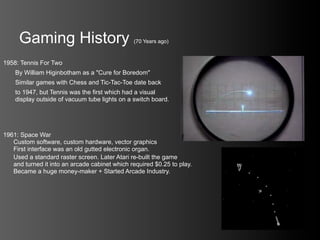
Gaming History                            (70 Years ago)


1958: Tennis For Two
    By William Higinbotham as a "Cure for Boredom"
    Similar games with Chess and Tic-Tac-Toe date back
    to 1947, but Tennis was the first which had a visual
    display outside of vacuum tube lights on a switch board.


1961: Space War
   Custom software, custom hardware, vector graphics
   First interface was an old gutted electronic organ.
   Used a standard raster screen. Later Atari re-built the game
   and turned it into an arcade cabinet which required $0.25 to play.
   Became a huge money-maker + Started Arcade Industry.
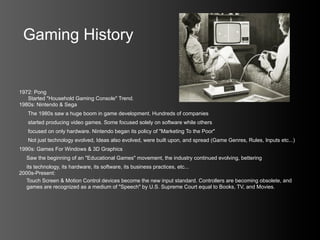
Gaming History


1972: Pong
   Started "Household Gaming Console" Trend.
1980s: Nintendo & Sega
   The 1980s saw a huge boom in game development. Hundreds of companies
   started producing video games. Some focused solely on software while others
   focused on only hardware. Nintendo began its policy of "Marketing To the Poor"

   Not just technology evolved, Ideas also evolved, were built upon, and spread (Game Genres, Rules, Inputs etc...)
1990s: Games For Windows & 3D Graphics
  Saw the beginning of an "Educational Games" movement, the industry continued evolving, bettering
  its technology, its hardware, its software, its business practices, etc...
2000s-Present:
  Touch Screen & Motion Control devices become the new input standard. Controllers are becoming obsolete, and
  games are recognized as a medium of "Speech" by U.S. Supreme Court equal to Books, TV, and Movies.
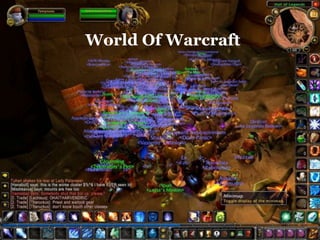
World Of Warcraft
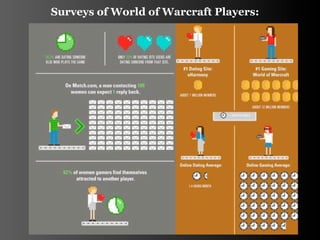
Surveys of World of Warcraft Players:
Serious Games Challenge

GLS Team Higher
Education Judges 2010,
2011 ITSEC Serious
Games Challenge
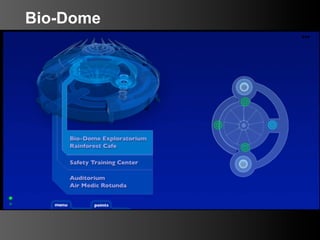
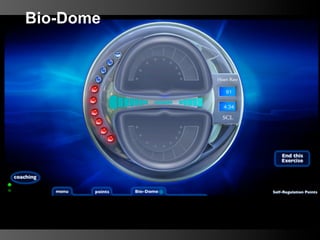
Bio-Dome
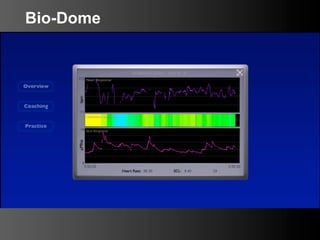
Bio-Dome
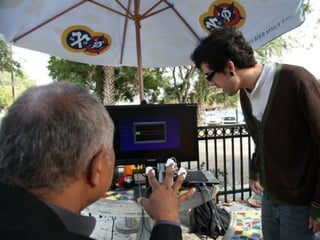
Bio-Dome
Bio-Dome
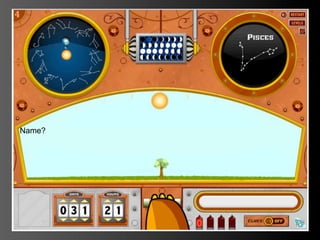
Name?
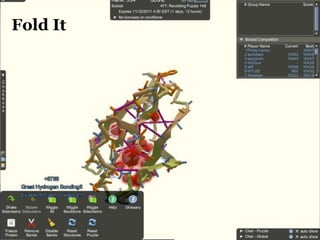
Fold It
Nature Magazine: Fold IT
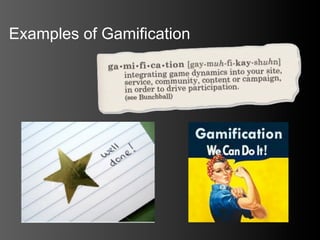
Examples of Gamification
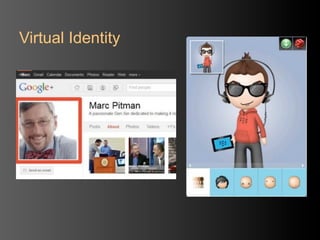
Virtual Identity
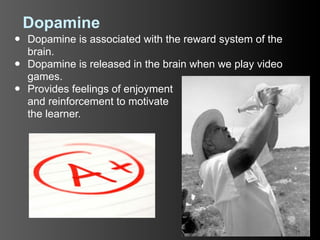
Dopamine
•   Dopamine is associated with the reward system of the
    brain.
•   Dopamine is released in the brain when we play video
    games.
•   Provides feelings of enjoyment
    and reinforcement to motivate
    the learner.
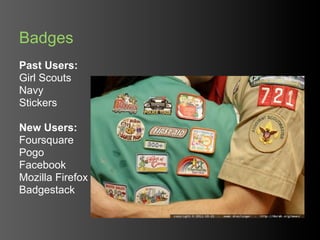
Badges
Past Users:
Girl Scouts
Navy
Stickers

New Users:
Foursquare
Pogo
Facebook
Mozilla Firefox
Badgestack
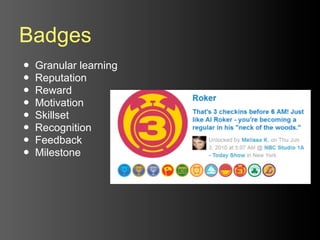
Badges
•   Granular learning
•   Reputation
•   Reward
•   Motivation
•   Skillset
•   Recognition
•   Feedback
•   Milestone
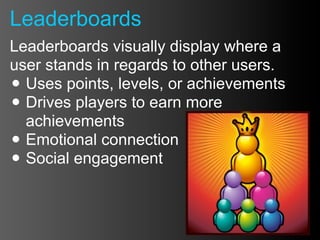
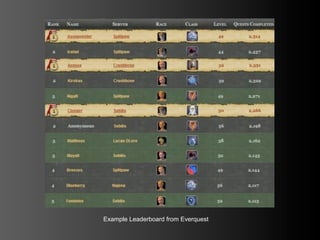
Leaderboards
Leaderboards visually display where a
user stands in regards to other users.
• Uses points, levels, or achievements
• Drives players to earn more
  achievements
• Emotional connection
• Social engagement
Example Leaderboard from Everquest
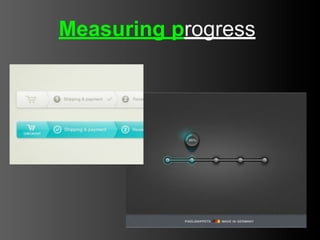
Measuring progress
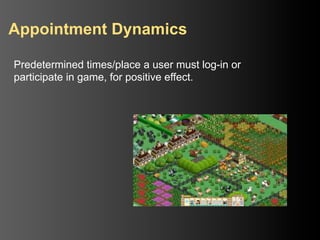
Appointment Dynamics

Predetermined times/place a user must log-in or
participate in game, for positive effect.
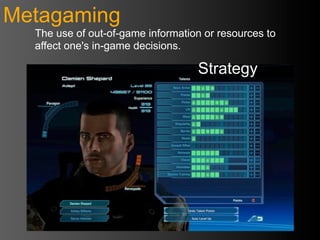
Metagaming
  The use of out-of-game information or resources to
  affect one's in-game decisions.

                                   Strategy
WOW Wiki
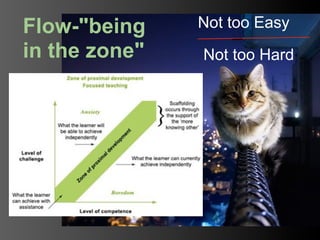
Flow-"being    Not too Easy
in the zone"   Not too Hard
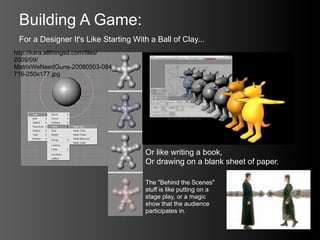
Building A Game:
 For a Designer It's Like Starting With a Ball of Clay...
http://kara.allthingsd.com/files/
2009/09/
MatrixWeNeedGuns-20080503-084
716-250x177.jpg


                                       Or like writing a book,
                                       Or drawing on a blank sheet of paper.

                                       The "Behind the Scenes"
                                       stuff is like putting on a
                                       stage play, or a magic
                                       show that the audience
                                       participates in.
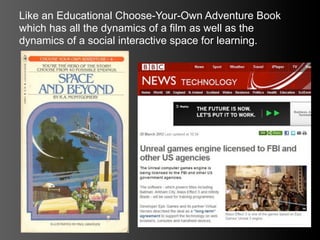
Like an Educational Choose-Your-Own Adventure Book
which has all the dynamics of a film as well as the
dynamics of a social interactive space for learning.
Unreal Engine & Source Engine have already been used
for building learning tools and we can do the same in little
time without needing a massive budget.


The military has been using simulations and
"Serious Games" to train Pilots, Snipers, Engineers, even
Combat Surgeons for years. These same tools can easily
be applied at the University level for any career.
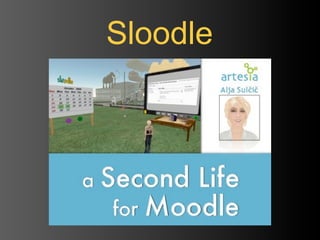
Sloodle
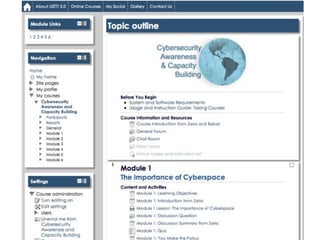
Case Study:
Cyber Security
   Phase 1
Virtual
Discussions,
Real Students
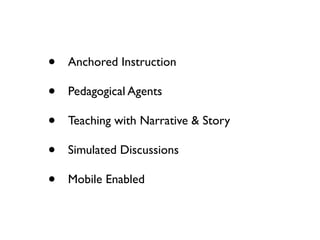
•   Anchored Instruction

•   Pedagogical Agents

•   Teaching with Narrative & Story

•   Simulated Discussions

•   Mobile Enabled
Phase 2 Summer 2012
•   Implement Game-based Learning
•   Design Integrated Gaming Engine
•   Pilot Spring 2013
Thank you, Questions?
•   Jeff Kissinger (904)632-5052 jkissing@fscj.edu

•   Ian Boswell (904)234-1409 i.boswell@gmail.com

•   Vanessa Carswell (904)357-8945
    vcarswel@fscj.edu


                            @LearnWorldwide


                              www.LearnWorldwide.org

Game based learningdesign

  • 2.
    FLORIDA STATE COLLEGE AT J ACKSONVILLE
  • 5.
    Who Are Jeff Kissinger Chief Learning Solutions Architect Ian Boswell Game Designer Vanessa Carswe Instructional Designer
  • 6.
    Game-based Learning -Why,How, Challenges of game-based design
  • 7.
    WHAT IS WORTH1 BILLION DOLLARS?
  • 9.
    $1 Billion Worthof: • Community • Passion • Emotional Storytellers • Millions of Affinity Groups!!! Invaluable?
  • 10.
    Risk of Failure • Low • Authentic • Situated • Iterative • Emotional/Affective
  • 11.
    Roles of Failure Experiencesof failure create opportunities for learning. • Deep learning and mastery • Allows players to take risks • The penalty of failure is low: within games, failed strategies can be followed by trying new strategies.
  • 12.
  • 13.
    My Message...... EMOTION IS LEARNING'S GOLD STANDARD Amygdala Fear Rewards Where were you when...........?
  • 14.
  • 18.
  • 19.
    Video: 9/11 WTCAttack Where were you when the Twin Towers collapsed?
  • 20.
  • 21.
  • 22.
  • 23.
  • 24.
    Where were youwhen MLK gave the “I Have A Dream Speech”?
  • 25.
    There now isenough content to choke on... Teachers must provide emotional learning opportunities... Sp ot! eet e Sw Th Learning beyond the surface: engaging the cognitive, affective and spiritual dimensions within the curriculum Michael T. Buchanan; Brendan Hyde 2008
  • 26.
    if EMOTION ISLEARNING'S GOLD STANDARD Amygdala Fear Rewards HOW Do we foster affective learning experiences?
  • 28.
    EMOTION IS LEARNING'S GOLDSTANDARD Amygdala Fear Rewards •Affinity Spaces •Situated Learning •Social Learning
  • 29.
  • 30.
    Why Use Game-BasedDesign? Practice Effort-One must practice what is being learned before it can be mastered. • Active learning • Social/Community • Goal oriented • Interactive • Risk free environment
  • 31.
    Why Use Game-BasedLearning Design? Game-based learning design allows active and critical learning to take place (Gee, 2007). 1. Learning to experience the world in a new (affective) way. 2. Potential to join and collaborate within a new affinity group. 3. Developing resources for future learning and problem- solving in the semiotic domains the game is related to. 4. Learning how to think about semiotic domains as design spaces that engage and manipulate people in certain ways, (emotional ways ideally).
  • 32.
    Gaming History (70 Years ago) 1958: Tennis For Two By William Higinbotham as a "Cure for Boredom" Similar games with Chess and Tic-Tac-Toe date back to 1947, but Tennis was the first which had a visual display outside of vacuum tube lights on a switch board. 1961: Space War Custom software, custom hardware, vector graphics First interface was an old gutted electronic organ. Used a standard raster screen. Later Atari re-built the game and turned it into an arcade cabinet which required $0.25 to play. Became a huge money-maker + Started Arcade Industry.
  • 33.
    Gaming History 1972: Pong Started "Household Gaming Console" Trend. 1980s: Nintendo & Sega The 1980s saw a huge boom in game development. Hundreds of companies started producing video games. Some focused solely on software while others focused on only hardware. Nintendo began its policy of "Marketing To the Poor" Not just technology evolved, Ideas also evolved, were built upon, and spread (Game Genres, Rules, Inputs etc...) 1990s: Games For Windows & 3D Graphics Saw the beginning of an "Educational Games" movement, the industry continued evolving, bettering its technology, its hardware, its software, its business practices, etc... 2000s-Present: Touch Screen & Motion Control devices become the new input standard. Controllers are becoming obsolete, and games are recognized as a medium of "Speech" by U.S. Supreme Court equal to Books, TV, and Movies.
  • 36.
  • 37.
    Surveys of Worldof Warcraft Players:
  • 38.
    Serious Games Challenge GLSTeam Higher Education Judges 2010, 2011 ITSEC Serious Games Challenge
  • 39.
  • 40.
  • 41.
  • 42.
  • 46.
  • 48.
  • 49.
  • 50.
  • 51.
  • 52.
    Dopamine • Dopamine is associated with the reward system of the brain. • Dopamine is released in the brain when we play video games. • Provides feelings of enjoyment and reinforcement to motivate the learner.
  • 53.
    Badges Past Users: Girl Scouts Navy Stickers NewUsers: Foursquare Pogo Facebook Mozilla Firefox Badgestack
  • 54.
    Badges • Granular learning • Reputation • Reward • Motivation • Skillset • Recognition • Feedback • Milestone
  • 55.
    Leaderboards Leaderboards visually displaywhere a user stands in regards to other users. • Uses points, levels, or achievements • Drives players to earn more achievements • Emotional connection • Social engagement
  • 56.
  • 57.
  • 58.
    Appointment Dynamics Predetermined times/placea user must log-in or participate in game, for positive effect.
  • 59.
    Metagaming Theuse of out-of-game information or resources to affect one's in-game decisions. Strategy
  • 60.
  • 62.
    Flow-"being Not too Easy in the zone" Not too Hard
  • 63.
    Building A Game: For a Designer It's Like Starting With a Ball of Clay... http://kara.allthingsd.com/files/ 2009/09/ MatrixWeNeedGuns-20080503-084 716-250x177.jpg Or like writing a book, Or drawing on a blank sheet of paper. The "Behind the Scenes" stuff is like putting on a stage play, or a magic show that the audience participates in.
  • 64.
    Like an EducationalChoose-Your-Own Adventure Book which has all the dynamics of a film as well as the dynamics of a social interactive space for learning.
  • 65.
    Unreal Engine &Source Engine have already been used for building learning tools and we can do the same in little time without needing a massive budget. The military has been using simulations and "Serious Games" to train Pilots, Snipers, Engineers, even Combat Surgeons for years. These same tools can easily be applied at the University level for any career.
  • 66.
  • 67.
  • 75.
  • 76.
    Anchored Instruction • Pedagogical Agents • Teaching with Narrative & Story • Simulated Discussions • Mobile Enabled
  • 77.
    Phase 2 Summer2012 • Implement Game-based Learning • Design Integrated Gaming Engine • Pilot Spring 2013
  • 78.
    Thank you, Questions? • Jeff Kissinger (904)632-5052 jkissing@fscj.edu • Ian Boswell (904)234-1409 i.boswell@gmail.com • Vanessa Carswell (904)357-8945 vcarswel@fscj.edu @LearnWorldwide www.LearnWorldwide.org