E-Commerce
BY
ANKUR KUMAR
• E-Commerce
• Electronic data interchange
• Virtual Organisition
• Electronic Payment System
• E-Governance
• E-Commerce
Introduction
Process
Security Threats
Advantage
Disadvantages
• Electronic data interchange
Introduction
Architecture
Advantage
Disadvantage
CONTENTS
• Virtual Organisition
• Electronic Payment System
Types
E-Cash
Payment Gateway
E-Wallet
Smart Card
• E-Governance
• A type of industry where the buying and selling of
products or services is conducted over electronic systems
• Generally considered to be the sales aspect of e-business
• An effective and efficient way of communicating within
an organization and one of the most effective and useful
ways of conducting business
• Is a Market entry strategy where the company may or
may not have a physical presence.
E-COMMERCE
Process:-
• Active Content (Trojan horse)-Active Content is used in e-com to place items in
shopping cart and to compute the total invoice.
• Active content refers to programs that are embedded transparently in web pages
and that cause action to occur(ex- Java applets, Active X Control, Java Script)
• Active content can display moving graphics, download and play audio.
• Malicious Codes- Virus , Worms etc
• Server-Side Masquerading- Spoofing, Phishing attack
• Communication channel threats – Nodes are malicious
• Confidentiality threats
• Integrity Threats
• Availability Threats
• Password Hacking.
SECURITY THREATS
• E-commerce can increase sales and reduces
costs.
• It create virtual community- it is a gathering of
peoples of common interest.
• Speed and accuracy
• E-com provide buyers with a wider range of
choice than traditional commerce.
• Better customer services
ADVANTAGE
• Security
• System and data integrity
• System Scalability
• Products are costly
DISADVANTAGES
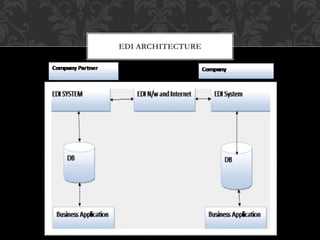
• Electronic Data Interchange is the computer-to computer
exchange of business data and documents between companies
using standard formats recognized both nationally and
internationally.
• The information used in EDI is organized according to a
specified format set by both companies participating in the data
exchange.
It Includes:
• Online business to business transactions
• Online business to consumer transactions
• Digital delivery of products and services
• Automated telephone transactions eg phone banking
WHAT IS EDI?
EDI ARCHITECTURE
• Lower operating costs
• Saves time and money
• Less Errors = More Accuracy
• No data entry, so less human error
• Increased Productivity
• More efficient personnel and faster throughput
ADVANTAGES
• High Dependence on the participation of trading partners
• Costly for smaller companies
• Difficult to agree on standard
DISADVANTAGES
VIRTUAL ORGANIZATION
• A Virtual Org is one whose members are geographically
apart , usually working by computer , email and
groupware while appearing to other to be a single ,
unified org with a real physical location.
• A flexible n/w of independent entities linked by
information technology to share skills, knowledge and
access to others expertise in non technical ways.
• It is a network, not an office.
Electronic Payment System:-
• EPS enable a customer to pay for the goods and
services online by using
integrated hardware and software systems
• The main objectives of EPS are:-
-increase efficiency
-improve security
-enhance customer convenience
ELECTRONIC PAYMENT SYSTEM
TYPES OF EPS:-
• E-Cash
• Payment Gateway
• E-Wallet
• Smart Card
E-CASH
• A system that allows a person to pay for goods or
services by transmitting a number from one computer
to another.
• E-Cash numbers are unique
• It is issued by a bank and represents a specified sum
of real money.
• It is anonymous and reusable.
• A payment gateway is an e-
commerce application service
provider service that
authorizes credit card payments
for e-businesses.
• It facilitates the transfer of
information between a payment
portal and the Front End Processor
or acquiring bank.
PAYMENT GATEWAY
E WALLET
• A digital wallet has both a software and
information component.
• The software provides security and
encryption for the personal information
and for the actual transaction.
• The information component is basically a
database of user-inputted information
• This information consists of your shipping
address, billing address, payment methods
(including credit card numbers, expiry
dates, and security numbers), and other
information.
SMART CARD
• Any pocket-sized card with
embedded integrated circuits.
• Smart cards can
provide identification, authentication, data
storage and application processing.
• Contact smart cards have a contact area of
approximately 1 square centimetre (0.16 sq in),
comprising several gold-plated contact pads.
• These pads provide electrical connectivity when
inserted into a reader, which is used as a
communications medium between the smart
card and a host
E-GOVERNANCE
• E-Governance referred as electronic governance.
• E-Gov is the app of ICT(information & communication
technology)
• Delivering Gov Services between Gov-to-Citizens(G2C), Gov-to-
Business(G2B), Gov-to-Gov(G2G).
• Through E-Gov, government services will be made available to
citizens in a convenient , efficient and transparent manner.
• In E-Gov there are no distinct boundaries.
• It is a two way Communication Protocol.

E commerce

  • 1.
    E-Commerce BY ANKUR KUMAR • E-Commerce •Electronic data interchange • Virtual Organisition • Electronic Payment System • E-Governance
  • 2.
    • E-Commerce Introduction Process Security Threats Advantage Disadvantages •Electronic data interchange Introduction Architecture Advantage Disadvantage CONTENTS • Virtual Organisition • Electronic Payment System Types E-Cash Payment Gateway E-Wallet Smart Card • E-Governance
  • 3.
    • A typeof industry where the buying and selling of products or services is conducted over electronic systems • Generally considered to be the sales aspect of e-business • An effective and efficient way of communicating within an organization and one of the most effective and useful ways of conducting business • Is a Market entry strategy where the company may or may not have a physical presence. E-COMMERCE
  • 4.
  • 5.
    • Active Content(Trojan horse)-Active Content is used in e-com to place items in shopping cart and to compute the total invoice. • Active content refers to programs that are embedded transparently in web pages and that cause action to occur(ex- Java applets, Active X Control, Java Script) • Active content can display moving graphics, download and play audio. • Malicious Codes- Virus , Worms etc • Server-Side Masquerading- Spoofing, Phishing attack • Communication channel threats – Nodes are malicious • Confidentiality threats • Integrity Threats • Availability Threats • Password Hacking. SECURITY THREATS
  • 6.
    • E-commerce canincrease sales and reduces costs. • It create virtual community- it is a gathering of peoples of common interest. • Speed and accuracy • E-com provide buyers with a wider range of choice than traditional commerce. • Better customer services ADVANTAGE
  • 7.
    • Security • Systemand data integrity • System Scalability • Products are costly DISADVANTAGES
  • 8.
    • Electronic DataInterchange is the computer-to computer exchange of business data and documents between companies using standard formats recognized both nationally and internationally. • The information used in EDI is organized according to a specified format set by both companies participating in the data exchange. It Includes: • Online business to business transactions • Online business to consumer transactions • Digital delivery of products and services • Automated telephone transactions eg phone banking WHAT IS EDI?
  • 9.
  • 10.
    • Lower operatingcosts • Saves time and money • Less Errors = More Accuracy • No data entry, so less human error • Increased Productivity • More efficient personnel and faster throughput ADVANTAGES
  • 11.
    • High Dependenceon the participation of trading partners • Costly for smaller companies • Difficult to agree on standard DISADVANTAGES
  • 12.
    VIRTUAL ORGANIZATION • AVirtual Org is one whose members are geographically apart , usually working by computer , email and groupware while appearing to other to be a single , unified org with a real physical location. • A flexible n/w of independent entities linked by information technology to share skills, knowledge and access to others expertise in non technical ways. • It is a network, not an office.
  • 13.
    Electronic Payment System:- •EPS enable a customer to pay for the goods and services online by using integrated hardware and software systems • The main objectives of EPS are:- -increase efficiency -improve security -enhance customer convenience ELECTRONIC PAYMENT SYSTEM
  • 14.
    TYPES OF EPS:- •E-Cash • Payment Gateway • E-Wallet • Smart Card
  • 15.
    E-CASH • A systemthat allows a person to pay for goods or services by transmitting a number from one computer to another. • E-Cash numbers are unique • It is issued by a bank and represents a specified sum of real money. • It is anonymous and reusable.
  • 16.
    • A paymentgateway is an e- commerce application service provider service that authorizes credit card payments for e-businesses. • It facilitates the transfer of information between a payment portal and the Front End Processor or acquiring bank. PAYMENT GATEWAY
  • 17.
    E WALLET • Adigital wallet has both a software and information component. • The software provides security and encryption for the personal information and for the actual transaction. • The information component is basically a database of user-inputted information • This information consists of your shipping address, billing address, payment methods (including credit card numbers, expiry dates, and security numbers), and other information.
  • 18.
    SMART CARD • Anypocket-sized card with embedded integrated circuits. • Smart cards can provide identification, authentication, data storage and application processing. • Contact smart cards have a contact area of approximately 1 square centimetre (0.16 sq in), comprising several gold-plated contact pads. • These pads provide electrical connectivity when inserted into a reader, which is used as a communications medium between the smart card and a host
  • 19.
    E-GOVERNANCE • E-Governance referredas electronic governance. • E-Gov is the app of ICT(information & communication technology) • Delivering Gov Services between Gov-to-Citizens(G2C), Gov-to- Business(G2B), Gov-to-Gov(G2G). • Through E-Gov, government services will be made available to citizens in a convenient , efficient and transparent manner. • In E-Gov there are no distinct boundaries. • It is a two way Communication Protocol.