EDI

Electronic Data Interchange
Agenda
•   Earlier Data Transfer Systems (non electronic)
•   Disadvantages
•   What is EDI
•   EDI History
•   EDI Benefits
Earlier Data Transfer System
• Physical document transfer
  – Person
  – Use of Animals
  – Road / Sea
  – Air (Fed-Ex)
  – Fax

• Use of signals
  – Teletext
Disadvantages of earlier systems
•   Time / Duration
•   Global reach
•   Human error
•   Duplication
•   Efficiency
•   Cost
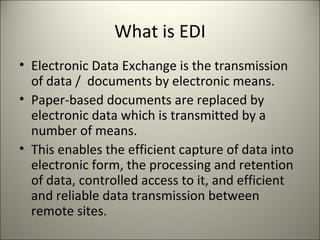
What is EDI
• Electronic Data Exchange is the transmission
  of data / documents by electronic means.
• Paper-based documents are replaced by
  electronic data which is transmitted by a
  number of means.
• This enables the efficient capture of data into
  electronic form, the processing and retention
  of data, controlled access to it, and efficient
  and reliable data transmission between
  remote sites.
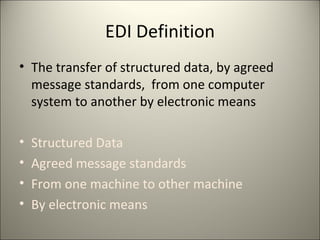
EDI Definition
• The transfer of structured data, by agreed
  message standards, from one computer
  system to another by electronic means

•   Structured Data
•   Agreed message standards
•   From one machine to other machine
•   By electronic means
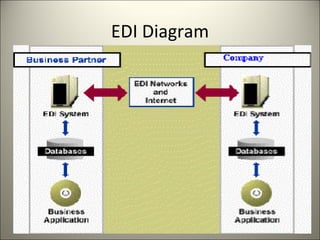
EDI Diagram
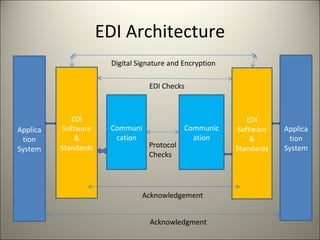
EDI Architecture
                        Digital Signature and Encryption

                                   EDI Checks


             EDI                                              EDI
Applica   Software     Communi                Communic     Software    Applica
 tion         &         cation                  ation          &        tion
          Standards                Protocol                Standards   System
System
                                   Checks


                                 Acknowledgement


                                   Acknowledgment
EDI - History
• 1960 – Business orders and shipping data used
  to be transmitted over networks
• This was restricted to Transport Industry
• Data transfer between businesses who were
  on the same network
• Transportation Data Coordinating Committee
  was formed (TDCC) to regulate the activity
• American National Standard Institute (ANSI)
  formed the Rules called X12
EDI History
• UK Customs and Excise dept. In collaboration
  with British Simplification of Trade Procedures
  board (SITPRO) published documentation
  called Tradecoms.
• Tradecoms were extended by United Nations
  Economic Commission for Europe called
  (UNECE) into General Purpose Trade Data
  Interchange Standards (GTDI)
EDI History
• So there were 2 standards ANSI & GTDI
• To resolve this problem UN-JEDI developed
  new standard called – Electronic Data
  Interchange for Administration, Commerce &
  Transport (EDIFACT)
• Now other industries started coming into
  picture like Automobile industry
• So work started on defining standards for
  various industries
EDIFACT Standards
• EDIFACT
  –   CEFIC – Chemical
  –   EANCOM – Retail
  –   EDIBDB – Construction
  –   EDIFICE – High Tech Industry
  –   EDIFURN – Furniture
  –   EDIGAS – Gas
  –   EDILEKTRO - Electro
  –   EDILIBE – Books
  –   EDITEC - Sanitary
  –   EDITEX – Fashion
  –   EDIFOR/EDITRANS - Transports & Logistics
  –   EDIWHEEL - Wheels & Tyres
  –   ETIS - Telecommunication
EDI - Protocols
•   HTTP(S)
•   C1OnRamp (based on HTTP)
•   POP3/SMTP
•   FTP/FTP-S (SSL) /S-FTP (SSH)
•   OFTP / OFTP2
•   SOAP
•   WebDAV
•   X.400
•   HTTP
•   EDIINT AS1 (extension to mail transport)
•   EDIINT AS2 (based on HTTP transport
•   EDIINT AS3 (based on FTP transport)
EDI - History
• Fixed-length formats
  – EURITMO


• Separator formats
  – CSV
Case Study
• Your Admission Process and document flow


                                             15
If you are Interested …
• Why XML

• What is XHTML, WSDL, WAP & WML, RSS, SMIL

• What is BACS

• SWIFT Messaging

• What is STP

E business edi_basics

  • 1.
  • 2.
    Agenda • Earlier Data Transfer Systems (non electronic) • Disadvantages • What is EDI • EDI History • EDI Benefits
  • 3.
    Earlier Data TransferSystem • Physical document transfer – Person – Use of Animals – Road / Sea – Air (Fed-Ex) – Fax • Use of signals – Teletext
  • 4.
    Disadvantages of earliersystems • Time / Duration • Global reach • Human error • Duplication • Efficiency • Cost
  • 5.
    What is EDI •Electronic Data Exchange is the transmission of data / documents by electronic means. • Paper-based documents are replaced by electronic data which is transmitted by a number of means. • This enables the efficient capture of data into electronic form, the processing and retention of data, controlled access to it, and efficient and reliable data transmission between remote sites.
  • 6.
    EDI Definition • Thetransfer of structured data, by agreed message standards, from one computer system to another by electronic means • Structured Data • Agreed message standards • From one machine to other machine • By electronic means
  • 7.
  • 8.
    EDI Architecture Digital Signature and Encryption EDI Checks EDI EDI Applica Software Communi Communic Software Applica tion & cation ation & tion Standards Protocol Standards System System Checks Acknowledgement Acknowledgment
  • 9.
    EDI - History •1960 – Business orders and shipping data used to be transmitted over networks • This was restricted to Transport Industry • Data transfer between businesses who were on the same network • Transportation Data Coordinating Committee was formed (TDCC) to regulate the activity • American National Standard Institute (ANSI) formed the Rules called X12
  • 10.
    EDI History • UKCustoms and Excise dept. In collaboration with British Simplification of Trade Procedures board (SITPRO) published documentation called Tradecoms. • Tradecoms were extended by United Nations Economic Commission for Europe called (UNECE) into General Purpose Trade Data Interchange Standards (GTDI)
  • 11.
    EDI History • Sothere were 2 standards ANSI & GTDI • To resolve this problem UN-JEDI developed new standard called – Electronic Data Interchange for Administration, Commerce & Transport (EDIFACT) • Now other industries started coming into picture like Automobile industry • So work started on defining standards for various industries
  • 12.
    EDIFACT Standards • EDIFACT – CEFIC – Chemical – EANCOM – Retail – EDIBDB – Construction – EDIFICE – High Tech Industry – EDIFURN – Furniture – EDIGAS – Gas – EDILEKTRO - Electro – EDILIBE – Books – EDITEC - Sanitary – EDITEX – Fashion – EDIFOR/EDITRANS - Transports & Logistics – EDIWHEEL - Wheels & Tyres – ETIS - Telecommunication
  • 13.
    EDI - Protocols • HTTP(S) • C1OnRamp (based on HTTP) • POP3/SMTP • FTP/FTP-S (SSL) /S-FTP (SSH) • OFTP / OFTP2 • SOAP • WebDAV • X.400 • HTTP • EDIINT AS1 (extension to mail transport) • EDIINT AS2 (based on HTTP transport • EDIINT AS3 (based on FTP transport)
  • 14.
    EDI - History •Fixed-length formats – EURITMO • Separator formats – CSV
  • 15.
    Case Study • YourAdmission Process and document flow 15
  • 16.
    If you areInterested … • Why XML • What is XHTML, WSDL, WAP & WML, RSS, SMIL • What is BACS • SWIFT Messaging • What is STP