2013 ACC/AHA
Blood Cholesterol
Treatment Guidelines
“Intensity Of Statin Therapy”
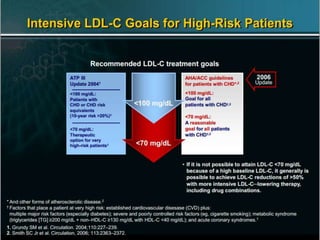
Aim to Reduce RISK … not at Target levels
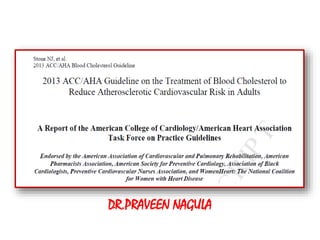
DR.PRAVEEN NAGULA
Scope of guideline
• to reduce atherosclerotic cardiovascular disease(ASCVD)risk
{RCTs,systematic analysis and metaanalysis of RCTs}.
• ASCVD – coronary heart disease(CHD),stroke,and
peripheral arterial disease,all of presumed atherosclerotic
origin.
• to provide strong evidence-based foundation.
• only evidence from statin RCTs were used to develop
guidelines.****
• Comprehensive approach to lipid management for purposes
with relation to ASCVD reduction only,not for complex lipid
disorders.
What do present guidelines
say.....
Patient centered approach
rather than
one treatment fits all
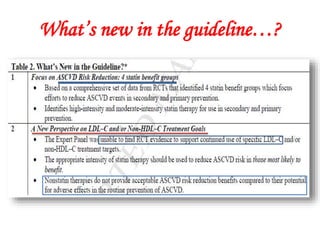
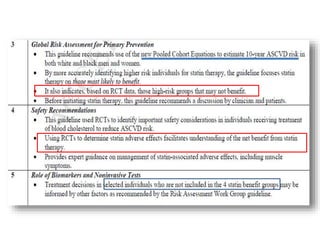
What’s new in the guideline…?
Benefits of Statins
• High intensity therapy – lowering LDL cholesterol by >50%.
• Moderate intensity therapy - lowering LDL cholesterol by 30-50%.
• Reduces ASCVD events across the spectrum of baseline LDL-C
levels > 70 mg/dl.
• Relative reduction in ASCVD risk is consistent for primary and
secondary prevention.
 Absolute reduction in ASCVD events is proportional to baseline
absolute ASCVD risk.
 Statin therapy only for individuals at increased ASCVD risk .
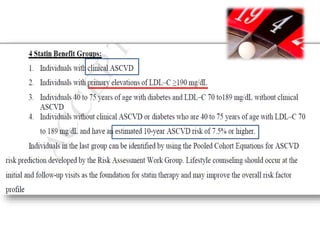
Who are to be benefited
by Statins ?????
Primary prevention of ASCVD
• Based on the estimated absolute 10 yr risk of ASCVD
(non fatal MI,CHD death,nonfatal and fatal stroke)…
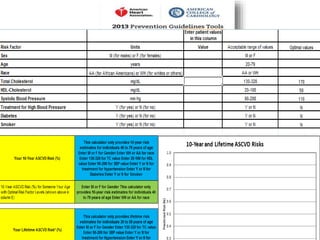
• The omnibus CV risk calculator for
 Pts without clinical ASCVD and LDL 70-189mg/dl
Estimates 10 yr risk of ASCVD
 In diabetics ,for primary prevention
Not in pts with clinical ASCVD
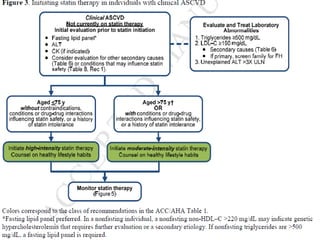
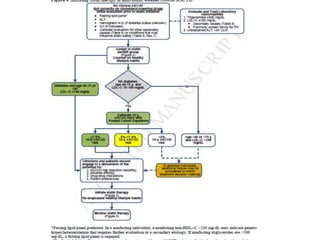
Statin treatment:Recommendations
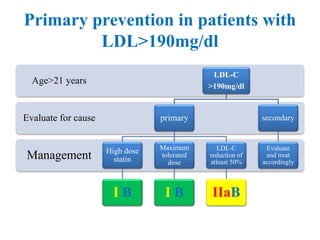
Primary prevention in patients with
LDL>190mg/dl
Management
Evaluate for cause
Age>21 years
LDL-C
>190mg/dl
primary
High dose
statin
I B
Maximum
tolerated
dose
I B
LDL-C
reduction of
atleast 50%
IIaB
secondary
Evaluate
and treat
accordingly
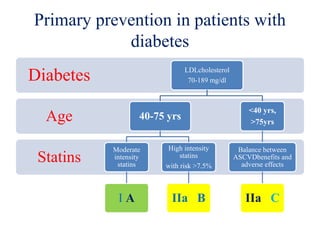
Primary prevention in patients with
diabetes
Statins
Age
Diabetes LDLcholesterol
70-189 mg/dl
40-75 yrs
Moderate
intensity
statins
I A
High intensity
statins
with risk >7.5%
IIa B
<40 yrs,
>75yrs
Balance between
ASCVDbenefits and
adverse effects
IIa C
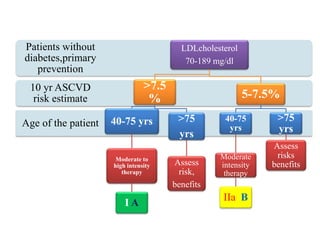
Age of the patient
10 yr ASCVD
risk estimate
Patients without
diabetes,primary
prevention
LDLcholesterol
70-189 mg/dl
>7.5
%
40-75 yrs
Moderate to
high intensity
therapy
I A
>75
yrs
Assess
risk,
benefits
5-7.5%
40-75
yrs
Moderate
intensity
therapy
IIa B
>75
yrs
Assess
risks
benefits
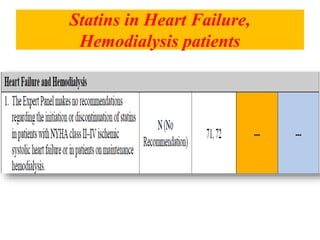
Statins in Heart Failure,
Hemodialysis patients
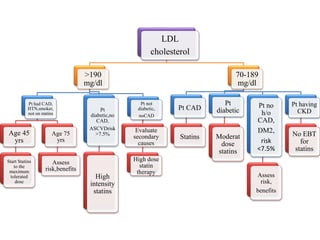
LDL
cholesterol
>190
mg/dl
Pt had CAD,
HTN,smoker,
not on statins
Age 45
yrs
Start Statins
to the
maximum
tolerated
dose
Age 75
yrs
Assess
risk,benefits
Pt
diabetic,no
CAD,
ASCVDrisk
>7.5%
High
intensity
statins
Pt not
diabetic,
noCAD
Evaluate
secondary
causes
High dose
statin
therapy
70-189
mg/dl
Pt CAD
Statins
Pt
diabetic
Moderat
dose
statins
Pt no
h/o
CAD,
DM2,
risk
<7.5%
Assess
risk,
benefits
Pt having
CKD
No EBT
for
statins
High- Moderate – and Low –
Intensity Statin Therapy
Clinical application by Statin dose
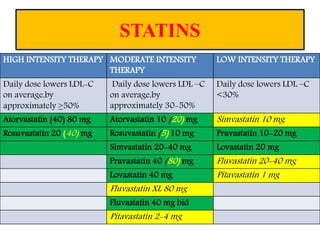
STATINS
HIGH INTENSITY THERAPY MODERATE INTENSITY
THERAPY
LOW INTENSITY THERAPY
Daily dose lowers LDL-C
on average,by
approximately ≥50%
Daily dose lowers LDL –C
on average,by
approximately 30-50%
Daily dose lowers LDL –C
<30%
Atorvastatin (40) 80 mg Atorvastatin 10 (20) mg Simvastatin 10 mg
Rosuvastatin 20 (40) mg Rosuvastatin (5) 10 mg Pravastatin 10-20 mg
Simvastatin 20-40 mg Lovastatin 20 mg
Pravastatin 40 (80) mg Fluvastatin 20-40 mg
Lovastatin 40 mg Pitavastatin 1 mg
Fluvastatin XL 80 mg
Fluvastatin 40 mg bid
Pitavastatin 2-4 mg
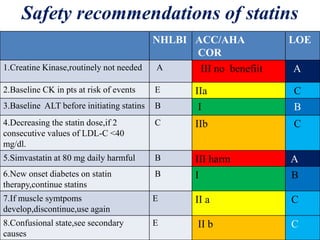
Safety recommendations of statins
NHLBI ACC/AHA
COR
LOE
1.Creatine Kinase,routinely not needed A III no benefiit A
2.Baseline CK in pts at risk of events E IIa C
3.Baseline ALT before initiating statins B I B
4.Decreasing the statin dose,if 2
consecutive values of LDL-C <40
mg/dl.
C IIb C
5.Simvastatin at 80 mg daily harmful B III harm A
6.New onset diabetes on statin
therapy,continue statins
B I B
7.If muscle symtpoms
develop,discontinue,use again
E II a C
8.Confusional state,see secondary
causes
E II b C
Monitoring statin treatment
What do guidelines say..
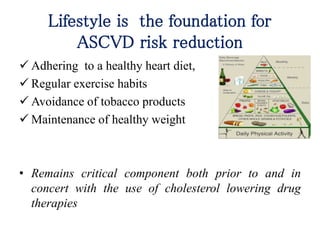
Lifestyle is the foundation for
ASCVD risk reduction
 Adhering to a healthy heart diet,
 Regular exercise habits
 Avoidance of tobacco products
 Maintenance of healthy weight
• Remains critical component both prior to and in
concert with the use of cholesterol lowering drug
therapies
What is the fate of
nonstatins in guidelines
are they Ignored??
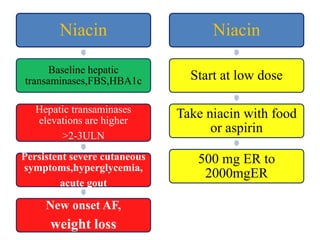
Niacin
Baseline hepatic
transaminases,FBS,HBA1c
Hepatic transaminases
elevations are higher
>2-3ULN
Persistent severe cutaneous
symptoms,hyperglycemia,
acute gout
New onset AF,
weight loss
Niacin
Start at low dose
Take niacin with food
or aspirin
500 mg ER to
2000mgER
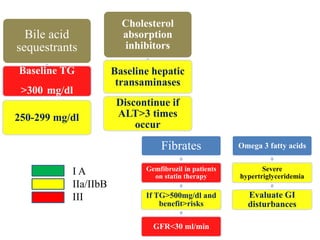
Bile acid
sequestrants
Baseline TG
>300 mg/dl
250-299 mg/dl
Cholesterol
absorption
inhibitors
Baseline hepatic
transaminases
Discontinue if
ALT>3 times
occur
Fibrates
Gemfibrozil in patients
on statin therapy
If TG>500mg/dl and
benefit>risks
GFR<30 ml/min
Omega 3 fatty acids
Severe
hypertriglyceridemia
Evaluate GI
disturbances
I A
IIa/IIbB
III
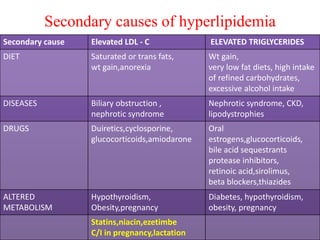
Secondary causes of hyperlipidemia
Secondary cause Elevated LDL - C ELEVATED TRIGLYCERIDES
DIET Saturated or trans fats,
wt gain,anorexia
Wt gain,
very low fat diets, high intake
of refined carbohydrates,
excessive alcohol intake
DISEASES Biliary obstruction ,
nephrotic syndrome
Nephrotic syndrome, CKD,
lipodystrophies
DRUGS Duiretics,cyclosporine,
glucocorticoids,amiodarone
Oral
estrogens,glucocorticoids,
bile acid sequestrants
protease inhibitors,
retinoic acid,sirolimus,
beta blockers,thiazides
ALTERED
METABOLISM
Hypothyroidism,
Obesity,pregnancy
Diabetes, hypothyroidism,
obesity, pregnancy
Statins,niacin,ezetimbe
C/I in pregnancy,lactation
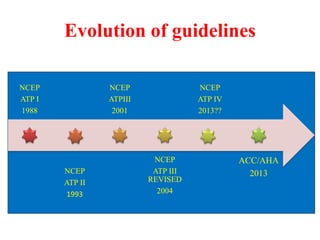
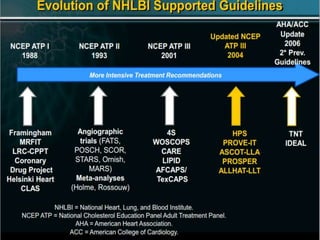
Evolution of guidelines
NCEP
ATP I
1988
NCEP
ATP II
1993
NCEP
ATPIII
2001
NCEP
ATP III
REVISED
2004
NCEP
ATP IV
2013??
ACC/AHA
2013
Basis for the New Guidelines
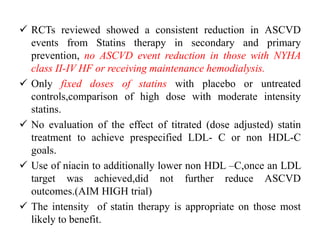
 RCTs reviewed showed a consistent reduction in ASCVD
events from Statins therapy in secondary and primary
prevention, no ASCVD event reduction in those with NYHA
class II-IV HF or receiving maintenance hemodialysis.
 Only fixed doses of statins with placebo or untreated
controls,comparison of high dose with moderate intensity
statins.
 No evaluation of the effect of titrated (dose adjusted) statin
treatment to achieve prespecified LDL- C or non HDL-C
goals.
 Use of niacin to additionally lower non HDL –C,once an LDL
target was achieved,did not further reduce ASCVD
outcomes.(AIM HIGH trial)
 The intensity of statin therapy is appropriate on those most
likely to benefit.
• Rosuvastatin to prevent vascular events in men and women with elevated C-reactive protein. N Engl J Med 2008;359:2195-207
• AFCAPS-TEXCAPS, JAMA 1998;279:1615–1622
• MEGA trial, Lancet 2006;368:1155–1163.
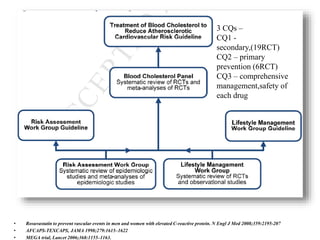
3 CQs –
CQ1 -
secondary,(19RCT)
CQ2 – primary
prevention (6RCT)
CQ3 – comprehensive
management,safety of
each drug
Why other approaches
ignored???
 1.Treat to Target – widely used for past 15 yrs
What is the target ?
What is the additional risk reduction beyond one target lower
than other?
adverse effects from multidrug therapy that occur in achieving
goal
undertreatment with statins, overtreatment with nonstatins
 2.lowest is best
adverse effects?
 3.lifetime risk
long term follow up >15 yrs?
statins>10yrs?
Why Target level therapy
ignored..how came the picture of
statin benefit groups?
Hypothesis or Evidence based..
Myth or reality
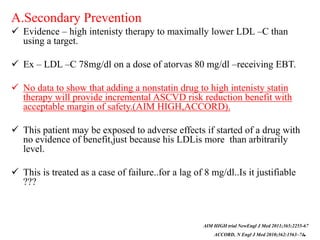
A.Secondary Prevention
 Evidence – high intenisty therapy to maximally lower LDL –C than
using a target.
 Ex – LDL –C 78mg/dl on a dose of atorvas 80 mg/dl –receiving EBT.
 No data to show that adding a nonstatin drug to high intenisty statin
therapy will provide incremental ASCVD risk reduction benefit with
acceptable margin of safety.(AIM HIGH,ACCORD).
 This patient may be exposed to adverse effects if started of a drug with
no evidence of benefit,just because his LDLis more than arbitrarily
level.
 This is treated as a case of failure..for a lag of 8 mg/dl..Is it justifiable
???
AIM HIGH trial NewEngl J Med 2011;365:2255-67
ACCORD, N Engl J Med 2010;362:1563–74.
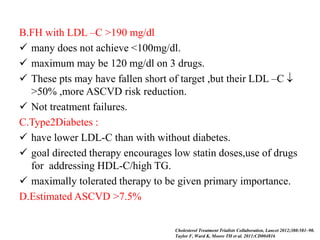
B.FH with LDL –C >190 mg/dl
 many does not achieve <100mg/dl.
 maximum may be 120 mg/dl on 3 drugs.
 These pts may have fallen short of target ,but their LDL –C 
>50% ,more ASCVD risk reduction.
 Not treatment failures.
C.Type2Diabetes :
 have lower LDL-C than with without diabetes.
 goal directed therapy encourages low statin doses,use of drugs
for addressing HDL-C/high TG.
 maximally tolerated therapy to be given primary importance.
D.Estimated ASCVD >7.5%
Cholesterol Treatment Trialists Collaboration, Lancet 2012;380:581–90.
Taylor F, Ward K, Moore TH et al. 2011:CD004816
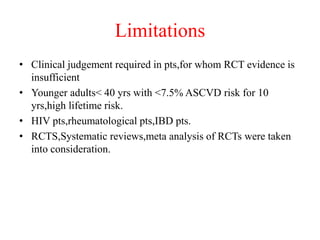
Limitations
• Clinical judgement required in pts,for whom RCT evidence is
insufficient
• Younger adults< 40 yrs with <7.5% ASCVD risk for 10
yrs,high lifetime risk.
• HIV pts,rheumatological pts,IBD pts.
• RCTS,Systematic reviews,meta analysis of RCTs were taken
into consideration.
New Drugs
• Cholesterol ester transfer protein (CETP) inhibitors -
Anacetrapib(DEFINE,REVEAL), dalcetrapib
• Ab to pro-protein convertase subtilisin/kexin 9 (PCSK9).
• Apolipoprotein B synthesis inhibitors - Mipomersen
• Microsomal triglyceride transfer protein (MTP) inhibitors,
• Thyroid hormone analogue Eprotirome
Future..
 Primary prevention in >75 yrs age
 Alternate treatment strategies.
 Effectiveness of submaximal doses of statins vs nonstatins in
intolerant pts
 Evaluation of the incidence of new onset diabetes associated
with statin therapy.
 Outcomes of RCTs of new lipid modifying agents to determine
the incremental ASCVD reduction when added to statin
therapy.
Future updates required for..
 1.The treatment of Hypertriglyceridemia.
 2.Use of NonHDL-C in decision making.
 3.Whether on-treatment markers such as
apoB,Lp(a),LDLparticles are useful in guiding decisions.
 4.Best approaches to use noninvasive imaging for refining
risk estimates to guide treatment.
 5.Optimal age for starting treatment for reducing lifetime risk
of ASCVD.
 6.What to do in pts with HF,hemodialysis.
 7.Long term effects of statin associated new onset diabetes and
management.
Conclusions
 Patient centered approach is to be given importance rather than
one treatment fits all concept.
 Statins to be given at high intenisty,moderate intensity doses but not
with target levels of attainment.
 Nonstatins give no ASCVD benefit in pts with high intensity statin
therapy.
 Use of lipoprotein a ,non HDLcholesterol levels assessment is not
recommended.
 Pts without ASCVD should be started of the statins after assessing 10 yr
risk by omnibus calculators.
 New onset diabetes due to statins needs further assessment in future.
 New drugs in pipeline,RCT s required for their incremental benefit in
ASCVD risk reduction when added to statins
 Lifestyle modification remains the key concept of the management of
blood cholesterol.
Guidelinesonlipidmanagement 131214232350-phpapp01

Guidelinesonlipidmanagement 131214232350-phpapp01

  • 1.
    2013 ACC/AHA Blood Cholesterol TreatmentGuidelines “Intensity Of Statin Therapy” Aim to Reduce RISK … not at Target levels
  • 2.
  • 3.
    Scope of guideline •to reduce atherosclerotic cardiovascular disease(ASCVD)risk {RCTs,systematic analysis and metaanalysis of RCTs}. • ASCVD – coronary heart disease(CHD),stroke,and peripheral arterial disease,all of presumed atherosclerotic origin. • to provide strong evidence-based foundation. • only evidence from statin RCTs were used to develop guidelines.**** • Comprehensive approach to lipid management for purposes with relation to ASCVD reduction only,not for complex lipid disorders.
  • 4.
    What do presentguidelines say.....
  • 5.
    Patient centered approach ratherthan one treatment fits all
  • 6.
    What’s new inthe guideline…?
  • 8.
    Benefits of Statins •High intensity therapy – lowering LDL cholesterol by >50%. • Moderate intensity therapy - lowering LDL cholesterol by 30-50%. • Reduces ASCVD events across the spectrum of baseline LDL-C levels > 70 mg/dl. • Relative reduction in ASCVD risk is consistent for primary and secondary prevention.  Absolute reduction in ASCVD events is proportional to baseline absolute ASCVD risk.  Statin therapy only for individuals at increased ASCVD risk .
  • 9.
    Who are tobe benefited by Statins ?????
  • 12.
    Primary prevention ofASCVD • Based on the estimated absolute 10 yr risk of ASCVD (non fatal MI,CHD death,nonfatal and fatal stroke)… • The omnibus CV risk calculator for  Pts without clinical ASCVD and LDL 70-189mg/dl Estimates 10 yr risk of ASCVD  In diabetics ,for primary prevention Not in pts with clinical ASCVD
  • 14.
  • 17.
    Primary prevention inpatients with LDL>190mg/dl Management Evaluate for cause Age>21 years LDL-C >190mg/dl primary High dose statin I B Maximum tolerated dose I B LDL-C reduction of atleast 50% IIaB secondary Evaluate and treat accordingly
  • 18.
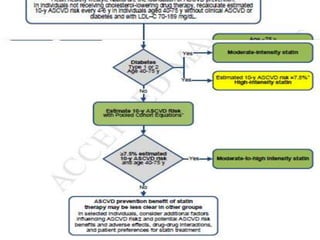
    Primary prevention inpatients with diabetes Statins Age Diabetes LDLcholesterol 70-189 mg/dl 40-75 yrs Moderate intensity statins I A High intensity statins with risk >7.5% IIa B <40 yrs, >75yrs Balance between ASCVDbenefits and adverse effects IIa C
  • 19.
    Age of thepatient 10 yr ASCVD risk estimate Patients without diabetes,primary prevention LDLcholesterol 70-189 mg/dl >7.5 % 40-75 yrs Moderate to high intensity therapy I A >75 yrs Assess risk, benefits 5-7.5% 40-75 yrs Moderate intensity therapy IIa B >75 yrs Assess risks benefits
  • 20.
    Statins in HeartFailure, Hemodialysis patients
  • 21.
    LDL cholesterol >190 mg/dl Pt had CAD, HTN,smoker, noton statins Age 45 yrs Start Statins to the maximum tolerated dose Age 75 yrs Assess risk,benefits Pt diabetic,no CAD, ASCVDrisk >7.5% High intensity statins Pt not diabetic, noCAD Evaluate secondary causes High dose statin therapy 70-189 mg/dl Pt CAD Statins Pt diabetic Moderat dose statins Pt no h/o CAD, DM2, risk <7.5% Assess risk, benefits Pt having CKD No EBT for statins
  • 22.
    High- Moderate –and Low – Intensity Statin Therapy Clinical application by Statin dose
  • 23.
    STATINS HIGH INTENSITY THERAPYMODERATE INTENSITY THERAPY LOW INTENSITY THERAPY Daily dose lowers LDL-C on average,by approximately ≥50% Daily dose lowers LDL –C on average,by approximately 30-50% Daily dose lowers LDL –C <30% Atorvastatin (40) 80 mg Atorvastatin 10 (20) mg Simvastatin 10 mg Rosuvastatin 20 (40) mg Rosuvastatin (5) 10 mg Pravastatin 10-20 mg Simvastatin 20-40 mg Lovastatin 20 mg Pravastatin 40 (80) mg Fluvastatin 20-40 mg Lovastatin 40 mg Pitavastatin 1 mg Fluvastatin XL 80 mg Fluvastatin 40 mg bid Pitavastatin 2-4 mg
  • 24.
    Safety recommendations ofstatins NHLBI ACC/AHA COR LOE 1.Creatine Kinase,routinely not needed A III no benefiit A 2.Baseline CK in pts at risk of events E IIa C 3.Baseline ALT before initiating statins B I B 4.Decreasing the statin dose,if 2 consecutive values of LDL-C <40 mg/dl. C IIb C 5.Simvastatin at 80 mg daily harmful B III harm A 6.New onset diabetes on statin therapy,continue statins B I B 7.If muscle symtpoms develop,discontinue,use again E II a C 8.Confusional state,see secondary causes E II b C
  • 25.
  • 27.
    Lifestyle is thefoundation for ASCVD risk reduction  Adhering to a healthy heart diet,  Regular exercise habits  Avoidance of tobacco products  Maintenance of healthy weight • Remains critical component both prior to and in concert with the use of cholesterol lowering drug therapies
  • 28.
    What is thefate of nonstatins in guidelines are they Ignored??
  • 29.
    Niacin Baseline hepatic transaminases,FBS,HBA1c Hepatic transaminases elevationsare higher >2-3ULN Persistent severe cutaneous symptoms,hyperglycemia, acute gout New onset AF, weight loss Niacin Start at low dose Take niacin with food or aspirin 500 mg ER to 2000mgER
  • 30.
    Bile acid sequestrants Baseline TG >300mg/dl 250-299 mg/dl Cholesterol absorption inhibitors Baseline hepatic transaminases Discontinue if ALT>3 times occur Fibrates Gemfibrozil in patients on statin therapy If TG>500mg/dl and benefit>risks GFR<30 ml/min Omega 3 fatty acids Severe hypertriglyceridemia Evaluate GI disturbances I A IIa/IIbB III
  • 31.
    Secondary causes ofhyperlipidemia Secondary cause Elevated LDL - C ELEVATED TRIGLYCERIDES DIET Saturated or trans fats, wt gain,anorexia Wt gain, very low fat diets, high intake of refined carbohydrates, excessive alcohol intake DISEASES Biliary obstruction , nephrotic syndrome Nephrotic syndrome, CKD, lipodystrophies DRUGS Duiretics,cyclosporine, glucocorticoids,amiodarone Oral estrogens,glucocorticoids, bile acid sequestrants protease inhibitors, retinoic acid,sirolimus, beta blockers,thiazides ALTERED METABOLISM Hypothyroidism, Obesity,pregnancy Diabetes, hypothyroidism, obesity, pregnancy Statins,niacin,ezetimbe C/I in pregnancy,lactation
  • 33.
    Evolution of guidelines NCEP ATPI 1988 NCEP ATP II 1993 NCEP ATPIII 2001 NCEP ATP III REVISED 2004 NCEP ATP IV 2013?? ACC/AHA 2013
  • 38.
    Basis for theNew Guidelines
  • 39.
     RCTs reviewedshowed a consistent reduction in ASCVD events from Statins therapy in secondary and primary prevention, no ASCVD event reduction in those with NYHA class II-IV HF or receiving maintenance hemodialysis.  Only fixed doses of statins with placebo or untreated controls,comparison of high dose with moderate intensity statins.  No evaluation of the effect of titrated (dose adjusted) statin treatment to achieve prespecified LDL- C or non HDL-C goals.  Use of niacin to additionally lower non HDL –C,once an LDL target was achieved,did not further reduce ASCVD outcomes.(AIM HIGH trial)  The intensity of statin therapy is appropriate on those most likely to benefit.
  • 40.
    • Rosuvastatin toprevent vascular events in men and women with elevated C-reactive protein. N Engl J Med 2008;359:2195-207 • AFCAPS-TEXCAPS, JAMA 1998;279:1615–1622 • MEGA trial, Lancet 2006;368:1155–1163. 3 CQs – CQ1 - secondary,(19RCT) CQ2 – primary prevention (6RCT) CQ3 – comprehensive management,safety of each drug
  • 41.
  • 42.
     1.Treat toTarget – widely used for past 15 yrs What is the target ? What is the additional risk reduction beyond one target lower than other? adverse effects from multidrug therapy that occur in achieving goal undertreatment with statins, overtreatment with nonstatins  2.lowest is best adverse effects?  3.lifetime risk long term follow up >15 yrs? statins>10yrs?
  • 43.
    Why Target leveltherapy ignored..how came the picture of statin benefit groups? Hypothesis or Evidence based.. Myth or reality
  • 44.
    A.Secondary Prevention  Evidence– high intenisty therapy to maximally lower LDL –C than using a target.  Ex – LDL –C 78mg/dl on a dose of atorvas 80 mg/dl –receiving EBT.  No data to show that adding a nonstatin drug to high intenisty statin therapy will provide incremental ASCVD risk reduction benefit with acceptable margin of safety.(AIM HIGH,ACCORD).  This patient may be exposed to adverse effects if started of a drug with no evidence of benefit,just because his LDLis more than arbitrarily level.  This is treated as a case of failure..for a lag of 8 mg/dl..Is it justifiable ??? AIM HIGH trial NewEngl J Med 2011;365:2255-67 ACCORD, N Engl J Med 2010;362:1563–74.
  • 45.
    B.FH with LDL–C >190 mg/dl  many does not achieve <100mg/dl.  maximum may be 120 mg/dl on 3 drugs.  These pts may have fallen short of target ,but their LDL –C  >50% ,more ASCVD risk reduction.  Not treatment failures. C.Type2Diabetes :  have lower LDL-C than with without diabetes.  goal directed therapy encourages low statin doses,use of drugs for addressing HDL-C/high TG.  maximally tolerated therapy to be given primary importance. D.Estimated ASCVD >7.5% Cholesterol Treatment Trialists Collaboration, Lancet 2012;380:581–90. Taylor F, Ward K, Moore TH et al. 2011:CD004816
  • 46.
    Limitations • Clinical judgementrequired in pts,for whom RCT evidence is insufficient • Younger adults< 40 yrs with <7.5% ASCVD risk for 10 yrs,high lifetime risk. • HIV pts,rheumatological pts,IBD pts. • RCTS,Systematic reviews,meta analysis of RCTs were taken into consideration.
  • 47.
    New Drugs • Cholesterolester transfer protein (CETP) inhibitors - Anacetrapib(DEFINE,REVEAL), dalcetrapib • Ab to pro-protein convertase subtilisin/kexin 9 (PCSK9). • Apolipoprotein B synthesis inhibitors - Mipomersen • Microsomal triglyceride transfer protein (MTP) inhibitors, • Thyroid hormone analogue Eprotirome
  • 48.
    Future..  Primary preventionin >75 yrs age  Alternate treatment strategies.  Effectiveness of submaximal doses of statins vs nonstatins in intolerant pts  Evaluation of the incidence of new onset diabetes associated with statin therapy.  Outcomes of RCTs of new lipid modifying agents to determine the incremental ASCVD reduction when added to statin therapy.

  • 49.
    Future updates requiredfor..  1.The treatment of Hypertriglyceridemia.  2.Use of NonHDL-C in decision making.  3.Whether on-treatment markers such as apoB,Lp(a),LDLparticles are useful in guiding decisions.  4.Best approaches to use noninvasive imaging for refining risk estimates to guide treatment.  5.Optimal age for starting treatment for reducing lifetime risk of ASCVD.  6.What to do in pts with HF,hemodialysis.  7.Long term effects of statin associated new onset diabetes and management.
  • 50.
    Conclusions  Patient centeredapproach is to be given importance rather than one treatment fits all concept.  Statins to be given at high intenisty,moderate intensity doses but not with target levels of attainment.  Nonstatins give no ASCVD benefit in pts with high intensity statin therapy.  Use of lipoprotein a ,non HDLcholesterol levels assessment is not recommended.  Pts without ASCVD should be started of the statins after assessing 10 yr risk by omnibus calculators.  New onset diabetes due to statins needs further assessment in future.  New drugs in pipeline,RCT s required for their incremental benefit in ASCVD risk reduction when added to statins  Lifestyle modification remains the key concept of the management of blood cholesterol.