Dyslipidemia &
Residual Risk
1
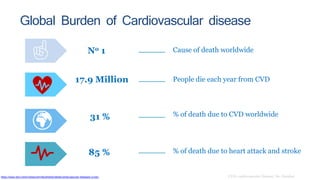
Global Burden of Cardiovascular disease
17.9 Million People die each year from CVD
31 % % of death due to CVD worldwide
85 % % of death due to heart attack and stroke
No 1 Cause of death worldwide
https://www.who.int/en/newsroom/factsheets/detail/cardiovascular-diseases-(cvds) CVD: cardiovascular Disease, No :Number
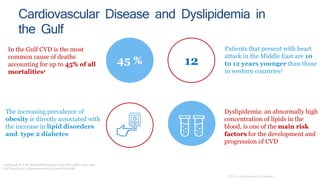
Cardiovascular Disease and Dyslipidemia in
the Gulf
The increasing prevalence of
obesity is directly associated with
the increase in lipid disorders
and type 2 diabetes
45 %
In the Gulf CVD is the most
common cause of deaths
accounting for up to 45% of all
mortalities1
1-Al Rasadi K et al, Oman Med Journal, 2015 Nov; 30(6): 403–405
2-Al Rasadi et al, Atherosclerosis 252 (2016) 182e187
Patients that present with heart
attack in the Middle East are 10
to 12 years younger than those
in western countries2
12
Dyslipidemia: an abnormally high
concentration of lipids in the
blood, is one of the main risk
factors for the development and
progression of CVD
CVD: cardiovascular Disease
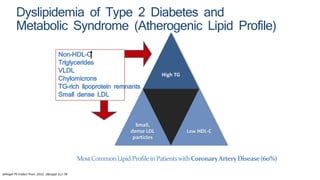
MostCommonLipidProfileinPatientswithCoronaryArteryDisease(60%)
Dyslipidemia of Type 2 Diabetes and
Metabolic Syndrome (Atherogenic Lipid Profile)
Non-HDL-C
Triglycerides
VLDL
Chylomicrons
TG-rich lipoprotein remnants
Small dense LDL
Jellinger PS Endocr Pract. 2012; 18(suppl 1);1-78
High TG
Small,
dense LDL
particles
Low HDL-C
Study
Prevention
type
Treatment
Diabetic
populatio
n
Coronary risk reduction Events
not
avoided
(%)
Overall
population
Diabetic population (p)
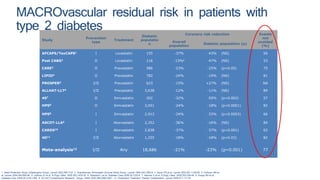
AFCAPS/TexCAPS1 I Lovastatin 155 -37% -43% (NS) 56
Post CABG2 II Lovastatin 116 -13%a -47% (NS) 53
CARE3 II Pravastatin 586 -23% -25% (p=0.05) 75
LIPID4 II Pravastatin 782 -24% -19% (NS) 81
PROSPER5 I/II Pravastatin 623 -15% +27% (NS) NA
ALLHAT-LLT6 I/II Pravastatin 3,638 -12% -11% (NS) 89
4S7 II Simvastatin 202 -32% -55% (p=0.002) 57
HPS8 II Simvastatin 3,051 -24% -18% (p<0.0001) 82
HPS8 I Simvastatin 2,912 -24% -33% (p<0.0003) 66
ASCOT-LLA9 I Atorvastatin 2,352 -36% -16% (NS) 84
CARDS10 I Atorvastatin 2,838 -37% -37% (p=0.001) 63
4D11 I/II Atorvastatin 1,255 -18% -18% (p=0.03) 82
Meta-analysis12 I/II Any 18,686 -21% -23% (p=0.001) 77
MACROvascular residual risk in patients with
type 2 diabetes
1. Heart Protection Study Collaborative Group. Lancet 2002;360:7-22. 2. Scandinavian Simvastatin Survival Study Group. Lancet 1994;344:1383-9. 3. Sever PS et al. Lancet 2003;361:1149-58. 4. Colhoun HM et
al. Lancet 2004;364:685-96. 5. LaRosa JC et al. N Engl J Med. 2005;352:1425-35. 6. Shepherd J et al. Diabetes Care 2006;29:1220-6. 7. Wanner C et al. N Engl J Med. 2005;353:238-48. 8. Knopp RH et al.
Diabetes Care 2006;29:1478-1485. 9. ALLHAT Collaborative Research Group. JAMA 2002;288:2998-3007. 10. Cholesterol Treatment Trialists’ Collaboration. Lancet 2008;371:117-25.
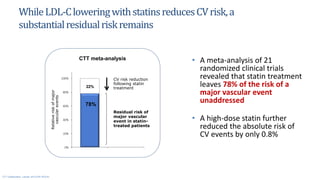
WhileLDL-CloweringwithstatinsreducesCVrisk,a
substantialresidualriskremains
6
• A meta-analysis of 21
randomized clinical trials
revealed that statin treatment
leaves 78% of the risk of a
major vascular event
unaddressed
• A high-dose statin further
reduced the absolute risk of
CV events by only 0.8%
78%
22%
0%
20%
40%
60%
80%
100%
CTT meta-analysis
Relative
risk
of
major
vascular
events
Residual risk of
major vascular
event in statin-
treated patients
CV risk reduction
following statin
treatment
CTT Collaboration. Lancet. 2010;376:1670-81.
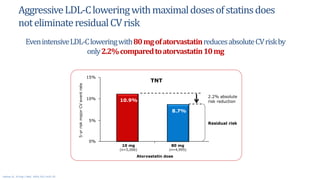
AggressiveLDL-Cloweringwithmaximaldosesofstatinsdoes
noteliminateresidualCVrisk
7
EvenintensiveLDL-Cloweringwith80mgofatorvastatinreducesabsoluteCVriskby
only2.2%comparedtoatorvastatin10mg
10 mg
(n=5,006)
80 mg
(n=4,995)
TNT
0%
5%
10%
15%
5-yr
risk
major
CV
event
rate
Atorvastatin dose
10.9%
8.7%
2.2% absolute
risk reduction
Residual risk
8.7%
LaRosa JC. N Engl J Med. 2005;352;1425-35.
Non-HDL Cholesterol
8
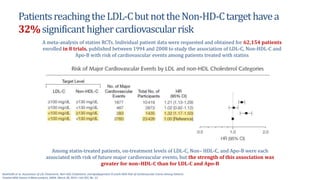
PatientsreachingtheLDL-CbutnottheNon-HD-Ctargethavea
32%significanthighercardiovascularrisk
A meta-analysis of statins RCTs. Individual patient data were requested and obtained for 62,154 patients
enrolled in 8 trials, published between 1994 and 2008 to study the association of LDL-C, Non-HDL-C and
Apo-B with risk of cardiovascular events among patients treated with statins
Boekholdt et al. Association of LDL Cholesterol, Non–HDL Cholesterol, and Apolipoprotein B Levels With Risk of Cardiovascular Events Among Patients
Treated With Statins A Meta-analysis, JAMA, March 28, 2012—Vol 307, No. 12
Among statin-treated patients, on-treatment levels of LDL-C, Non– HDL-C, and Apo-B were each
associated with risk of future major cardiovascular events, but the strength of this association was
greater for non–HDL-C than for LDL-C and Apo-B
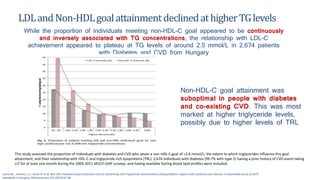
LDLandNon-HDLgoalattainmentdeclinedathigherTGlevels
While the proportion of individuals meeting non-HDL-C goal appeared to be continuously
and inversely associated with TG concentrations, the relationship with LDL-C
achievement appeared to plateau at TG levels of around 2.5 mmol/L in 2,674 patients
with Diabetes and CVD from Hungary
Laszlo M., Antonio J. V., Istvan R. et al. Non-HDL cholesterol goal attainment and its relationship with triglyceride concentrations among diabetic subjects with cardiovascular disease: A nationwide survey of 2674
individuals in Hungary, Atherosclerosis 241 (2015) 62-68
Non-HDL-C goal attainment was
suboptimal in people with diabetes
and co-existing CVD. This was most
marked at higher triglyceride levels,
possibly due to higher levels of TRL
This study assessed the proportion of individuals with diabetes and CVD who attain a non-HDL-C goal of <2.6 mmol/L, the extent to which triglycerides influence this goal
attainment, and their relationship with HDL-C and triglyceride-rich lipoproteins (TRL). 2,674 individuals with diabetes (99.7% with type 2) having a prior history of CVD event taking
LLT for at least one month during the 2009-2011 MULTI-GAP surveys, and having available fasting blood lipid profiles were included.
Non-HDL-cholesterol
Advantages as a target for treatment
1. Aguiar C et al. Atheroscler Suppl 2015;19:1.
2. Sniderman A et al. J Clin Lipidol 2010;4:152. 3. Nordestgaard BG et al. Eur Heart J 2016;37:1944.
11
Non-HDL-c = Total Cholesterol – HDL-c
• Non-HDL-c includes an assessment of all apo B-containing lipoproteins
considered to be atherogenic (good correlation with apo B)1
• VLDL, IDL, LDL, and even Lp(a)
• Non-HDL-c is an indirect estimate of LDL particle number, and LDL
particle number relates more closely to CVD risk than LDL-c2
Non-HDL-cholesterol
Advantages as a target for treatment
1. Aguiar C et al. Atheroscler Suppl 2015;19:1.
2. Sniderman A et al. J Clin Lipidol 2010;4:152. 3. Nordestgaard BG et al. Eur Heart J 2016;37:1944.
12
• Non-HDL-c makes no assumption about the relationship between VLDL-c
and TGs
• In T2DM, this relationship can be altered, leading to falsely low LDL-c values
as calculated by the Friedewald formula
• Practical advantages
• Does not require fasting3
• Easily calculated (difference between 2 well standardized assays) and inexpensive (vs apo
B)
• Can be used in patients with TG >400 mg/dL (4.5 mmol/L)
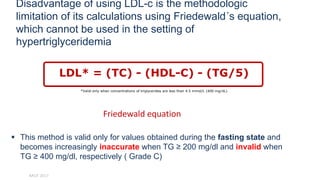
Disadvantage of using LDL-c is the methodologic
limitation of its calculations using Friedewald´s equation,
which cannot be used in the setting of
hypertriglyceridemia
Friedewald equation
*Valid only when concentrations of triglycerides are less than 4.5 mmol/L (400 mg/dL)
LDL* = (TC) - (HDL-C) - (TG/5)
AACE 2017
ď‚§ This method is valid only for values obtained during the fasting state and
becomes increasingly inaccurate when TG ≥ 200 mg/dl and invalid when
TG ≥ 400 mg/dl, respectively ( Grade C)
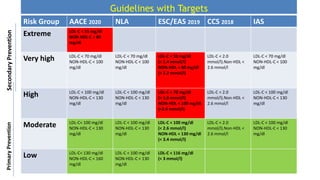
Guidelines on dyslipidemia
Risk Group AACE 2020 NLA ESC/EAS 2019 CCS 2018 IAS
Extreme LDL-C < 55 mg/dl
NON-HDL-C < 80
mg/dl
Very high LDL-C < 70 mg/dl
NON-HDL-C < 100
mg/dl
LDL-C < 70 mg/dl
NON-HDL-C < 100
mg/dl
LDL-C < 55 mg/dl
(< 1.4 mmol/l)
NON-HDL < 80 mg/dl
(< 2.2 mmol/l)
LDL-C < 2.0
mmol/l).Non-HDL <
2.6 mmol/l
LDL-C < 70 mg/dl
NON-HDL-C < 100
mg/dl
High LDL-C < 100 mg/dl
NON-HDL-C < 130
mg/dl
LDL-C < 100 mg/dl
NON-HDL-C < 130
mg/dl
LDL-C < 70 mg/dl
(< 1.8 mmol/l)
NON-HDL < 100 mg/dl
(<2.6 mmol/l)
LDL-C < 2.0
mmol/l).Non-HDL <
2.6 mmol/l
LDL-C < 100 mg/dl
NON-HDL-C < 130
mg/dl
Moderate LDL-C< 100 mg/dl
NON-HDL-C < 130
mg/dl
LDL-C < 100 mg/dl
NON-HDL-C < 130
mg/dl
LDL-C < 100 mg/dl
(< 2.6 mmol/l)
NON-HDL < 130 mg/dl
(< 3.4 mmol/l)
LDL-C < 2.0
mmol/l).Non-HDL <
2.6 mmol/l
LDL-C < 100 mg/dl
NON-HDL-C < 130
mg/dl
Low LDL-C< 130 mg/dl
NON-HDL-C < 160
mg/dl
LDL-C < 100 mg/dl
NON-HDL-C < 130
mg/dl
LDL-C < 116 mg/dl
(< 3 mmol/l)
Guidelines with Targets
Secondary
Prevention
Primary
Prevention
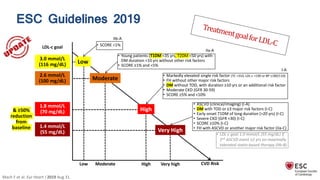
ESC Guidelines 2019
Mach F et al. Eur Heart J 2019 Aug 31.
16
• LDL-c goal 1.0 mmol/L (55 mg/dL) if
2nd ASCVD event ≤2 yrs on maximally
tolerated statin-based therapy (IIb-B)
• ASCVD (clinical/imaging) (I-A)
• DM with TOD or ≥3 major risk factors (I-C)
• Early onset T1DM of long duration (>20 yrs) (I-C)
• Severe CKD (GFR <30) (I-C)
• SCORE ≥10% (I-C)
• FH with ASCVD or another major risk factor (IIa-C)
• Markedly elevated single risk factor (TC >310, LDL-c >190 or BP ≥180/110)
• FH without other major risk factors
• DM without TOD, with duration ≥10 yrs or an additional risk factor
• Moderate CKD (GFR 30-59)
• SCORE ≥5% and <10%
• Young patients (T1DM <35 yrs, T2DM <50 yrs) with
DM duration <10 yrs without other risk factors
• SCORE ≥1% and <5%
• SCORE <1%
3.0 mmol/L
(116 mg/dL)
2.6 mmol/L
(100 mg/dL)
1.8 mmol/L
(70 mg/dL)
1.4 mmol/L
(55 mg/dL)
& ≥50%
reduction
from
baseline
Low Moderate High Very high CVD Risk
LDL-c goal
Low
Moderate
High
Very High
IIa-A
I-A
IIb-A
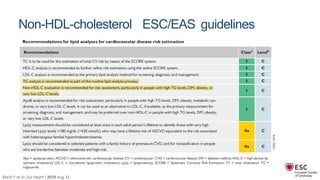
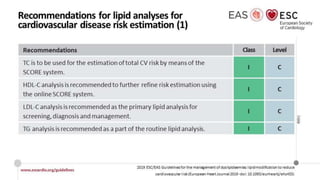
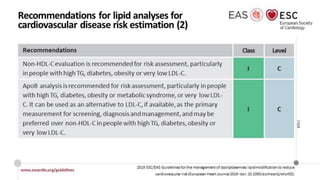
Non-HDL-cholesterol ESC/EAS guidelines
17
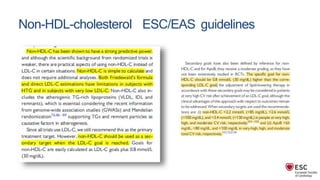
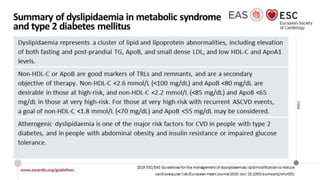
Non-HDL-cholesterol ESC/EAS guidelines
18
Mach F et al. Eur Heart J 2019 Aug 31.
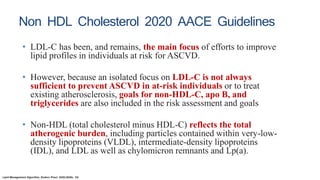
• LDL-C has been, and remains, the main focus of efforts to improve
lipid profiles in individuals at risk for ASCVD.
• However, because an isolated focus on LDL-C is not always
sufficient to prevent ASCVD in at-risk individuals or to treat
existing atherosclerosis, goals for non-HDL-C, apo B, and
triglycerides are also included in the risk assessment and goals
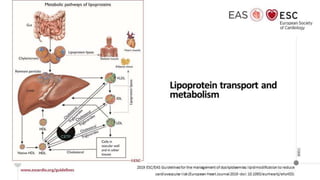
• Non-HDL (total cholesterol minus HDL-C) reflects the total
atherogenic burden, including particles contained within very-low-
density lipoproteins (VLDL), intermediate-density lipoproteins
(IDL), and LDL as well as chylomicron remnants and Lp(a). 23
Non HDL Cholesterol 2020 AACE Guidelines
Lipid Management Algorithm, Endocr Pract. 2020;26(No. 10)
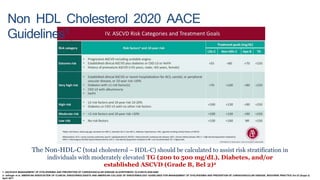
Non HDL Cholesterol 2020 AACE
Guidelines1
1- AACE/ACE MANAGEMENT OF DYSLIPIDEMIA AND PREVENTION OF CARDIOVASCULAR DISEASE ALGORITHMDOI 10.4158/CS-2020-0490
2- Jellinger et al. AMERICAN ASSOCIATION OF CLINICAL ENDOCRINOLOGISTS AND AMERICAN COLLEGE OF ENDOCRINOLOGY GUIDELINES FOR MANAGEMENT OF DYSLIPIDEMIA AND PREVENTION OF CARDIOVASCULAR DISEASE, NDOCRINE PRACTICE Vol 23 (Suppl 2)
April 2017
The Non-HDL-C (total cholesterol – HDL-C) should be calculated to assist risk stratification in
individuals with moderately elevated TG (200 to 500 mg/dL), Diabetes, and/or
established ASCVD (Grade B, Bel 2)2
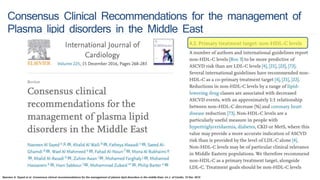
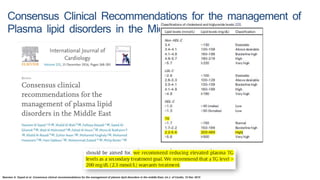
Consensus Clinical Recommendations for the management of
Plasma lipid disorders in the Middle East
Nasreen A. Sayed et al. Consensus clinical recommendations for the management of plasma lipid disorders in the middle East, int J. of Cardio, 15 Dec 2015
Consensus Clinical Recommendations for the management of
Plasma lipid disorders in the Middle East
Nasreen A. Sayed et al. Consensus clinical recommendations for the management of plasma lipid disorders in the middle East, int J. of Cardio, 15 Dec 2015

HYPERLIPIDEMIA.pptx

  • 1.
  • 2.
    Global Burden ofCardiovascular disease 17.9 Million People die each year from CVD 31 % % of death due to CVD worldwide 85 % % of death due to heart attack and stroke No 1 Cause of death worldwide https://www.who.int/en/newsroom/factsheets/detail/cardiovascular-diseases-(cvds) CVD: cardiovascular Disease, No :Number
  • 3.
    Cardiovascular Disease andDyslipidemia in the Gulf The increasing prevalence of obesity is directly associated with the increase in lipid disorders and type 2 diabetes 45 % In the Gulf CVD is the most common cause of deaths accounting for up to 45% of all mortalities1 1-Al Rasadi K et al, Oman Med Journal, 2015 Nov; 30(6): 403–405 2-Al Rasadi et al, Atherosclerosis 252 (2016) 182e187 Patients that present with heart attack in the Middle East are 10 to 12 years younger than those in western countries2 12 Dyslipidemia: an abnormally high concentration of lipids in the blood, is one of the main risk factors for the development and progression of CVD CVD: cardiovascular Disease
  • 4.
    MostCommonLipidProfileinPatientswithCoronaryArteryDisease(60%) Dyslipidemia of Type2 Diabetes and Metabolic Syndrome (Atherogenic Lipid Profile) Non-HDL-C Triglycerides VLDL Chylomicrons TG-rich lipoprotein remnants Small dense LDL Jellinger PS Endocr Pract. 2012; 18(suppl 1);1-78 High TG Small, dense LDL particles Low HDL-C
  • 5.
    Study Prevention type Treatment Diabetic populatio n Coronary risk reductionEvents not avoided (%) Overall population Diabetic population (p) AFCAPS/TexCAPS1 I Lovastatin 155 -37% -43% (NS) 56 Post CABG2 II Lovastatin 116 -13%a -47% (NS) 53 CARE3 II Pravastatin 586 -23% -25% (p=0.05) 75 LIPID4 II Pravastatin 782 -24% -19% (NS) 81 PROSPER5 I/II Pravastatin 623 -15% +27% (NS) NA ALLHAT-LLT6 I/II Pravastatin 3,638 -12% -11% (NS) 89 4S7 II Simvastatin 202 -32% -55% (p=0.002) 57 HPS8 II Simvastatin 3,051 -24% -18% (p<0.0001) 82 HPS8 I Simvastatin 2,912 -24% -33% (p<0.0003) 66 ASCOT-LLA9 I Atorvastatin 2,352 -36% -16% (NS) 84 CARDS10 I Atorvastatin 2,838 -37% -37% (p=0.001) 63 4D11 I/II Atorvastatin 1,255 -18% -18% (p=0.03) 82 Meta-analysis12 I/II Any 18,686 -21% -23% (p=0.001) 77 MACROvascular residual risk in patients with type 2 diabetes 1. Heart Protection Study Collaborative Group. Lancet 2002;360:7-22. 2. Scandinavian Simvastatin Survival Study Group. Lancet 1994;344:1383-9. 3. Sever PS et al. Lancet 2003;361:1149-58. 4. Colhoun HM et al. Lancet 2004;364:685-96. 5. LaRosa JC et al. N Engl J Med. 2005;352:1425-35. 6. Shepherd J et al. Diabetes Care 2006;29:1220-6. 7. Wanner C et al. N Engl J Med. 2005;353:238-48. 8. Knopp RH et al. Diabetes Care 2006;29:1478-1485. 9. ALLHAT Collaborative Research Group. JAMA 2002;288:2998-3007. 10. Cholesterol Treatment Trialists’ Collaboration. Lancet 2008;371:117-25.
  • 6.
    WhileLDL-CloweringwithstatinsreducesCVrisk,a substantialresidualriskremains 6 • A meta-analysisof 21 randomized clinical trials revealed that statin treatment leaves 78% of the risk of a major vascular event unaddressed • A high-dose statin further reduced the absolute risk of CV events by only 0.8% 78% 22% 0% 20% 40% 60% 80% 100% CTT meta-analysis Relative risk of major vascular events Residual risk of major vascular event in statin- treated patients CV risk reduction following statin treatment CTT Collaboration. Lancet. 2010;376:1670-81.
  • 7.
  • 8.
  • 9.
    PatientsreachingtheLDL-CbutnottheNon-HD-Ctargethavea 32%significanthighercardiovascularrisk A meta-analysis ofstatins RCTs. Individual patient data were requested and obtained for 62,154 patients enrolled in 8 trials, published between 1994 and 2008 to study the association of LDL-C, Non-HDL-C and Apo-B with risk of cardiovascular events among patients treated with statins Boekholdt et al. Association of LDL Cholesterol, Non–HDL Cholesterol, and Apolipoprotein B Levels With Risk of Cardiovascular Events Among Patients Treated With Statins A Meta-analysis, JAMA, March 28, 2012—Vol 307, No. 12 Among statin-treated patients, on-treatment levels of LDL-C, Non– HDL-C, and Apo-B were each associated with risk of future major cardiovascular events, but the strength of this association was greater for non–HDL-C than for LDL-C and Apo-B
  • 10.
    LDLandNon-HDLgoalattainmentdeclinedathigherTGlevels While the proportionof individuals meeting non-HDL-C goal appeared to be continuously and inversely associated with TG concentrations, the relationship with LDL-C achievement appeared to plateau at TG levels of around 2.5 mmol/L in 2,674 patients with Diabetes and CVD from Hungary Laszlo M., Antonio J. V., Istvan R. et al. Non-HDL cholesterol goal attainment and its relationship with triglyceride concentrations among diabetic subjects with cardiovascular disease: A nationwide survey of 2674 individuals in Hungary, Atherosclerosis 241 (2015) 62-68 Non-HDL-C goal attainment was suboptimal in people with diabetes and co-existing CVD. This was most marked at higher triglyceride levels, possibly due to higher levels of TRL This study assessed the proportion of individuals with diabetes and CVD who attain a non-HDL-C goal of <2.6 mmol/L, the extent to which triglycerides influence this goal attainment, and their relationship with HDL-C and triglyceride-rich lipoproteins (TRL). 2,674 individuals with diabetes (99.7% with type 2) having a prior history of CVD event taking LLT for at least one month during the 2009-2011 MULTI-GAP surveys, and having available fasting blood lipid profiles were included.
  • 11.
    Non-HDL-cholesterol Advantages as atarget for treatment 1. Aguiar C et al. Atheroscler Suppl 2015;19:1. 2. Sniderman A et al. J Clin Lipidol 2010;4:152. 3. Nordestgaard BG et al. Eur Heart J 2016;37:1944. 11 Non-HDL-c = Total Cholesterol – HDL-c • Non-HDL-c includes an assessment of all apo B-containing lipoproteins considered to be atherogenic (good correlation with apo B)1 • VLDL, IDL, LDL, and even Lp(a) • Non-HDL-c is an indirect estimate of LDL particle number, and LDL particle number relates more closely to CVD risk than LDL-c2
  • 12.
    Non-HDL-cholesterol Advantages as atarget for treatment 1. Aguiar C et al. Atheroscler Suppl 2015;19:1. 2. Sniderman A et al. J Clin Lipidol 2010;4:152. 3. Nordestgaard BG et al. Eur Heart J 2016;37:1944. 12 • Non-HDL-c makes no assumption about the relationship between VLDL-c and TGs • In T2DM, this relationship can be altered, leading to falsely low LDL-c values as calculated by the Friedewald formula • Practical advantages • Does not require fasting3 • Easily calculated (difference between 2 well standardized assays) and inexpensive (vs apo B) • Can be used in patients with TG >400 mg/dL (4.5 mmol/L)
  • 13.
    Disadvantage of usingLDL-c is the methodologic limitation of its calculations using Friedewald´s equation, which cannot be used in the setting of hypertriglyceridemia Friedewald equation *Valid only when concentrations of triglycerides are less than 4.5 mmol/L (400 mg/dL) LDL* = (TC) - (HDL-C) - (TG/5) AACE 2017  This method is valid only for values obtained during the fasting state and becomes increasingly inaccurate when TG ≥ 200 mg/dl and invalid when TG ≥ 400 mg/dl, respectively ( Grade C)
  • 14.
  • 15.
    Risk Group AACE2020 NLA ESC/EAS 2019 CCS 2018 IAS Extreme LDL-C < 55 mg/dl NON-HDL-C < 80 mg/dl Very high LDL-C < 70 mg/dl NON-HDL-C < 100 mg/dl LDL-C < 70 mg/dl NON-HDL-C < 100 mg/dl LDL-C < 55 mg/dl (< 1.4 mmol/l) NON-HDL < 80 mg/dl (< 2.2 mmol/l) LDL-C < 2.0 mmol/l).Non-HDL < 2.6 mmol/l LDL-C < 70 mg/dl NON-HDL-C < 100 mg/dl High LDL-C < 100 mg/dl NON-HDL-C < 130 mg/dl LDL-C < 100 mg/dl NON-HDL-C < 130 mg/dl LDL-C < 70 mg/dl (< 1.8 mmol/l) NON-HDL < 100 mg/dl (<2.6 mmol/l) LDL-C < 2.0 mmol/l).Non-HDL < 2.6 mmol/l LDL-C < 100 mg/dl NON-HDL-C < 130 mg/dl Moderate LDL-C< 100 mg/dl NON-HDL-C < 130 mg/dl LDL-C < 100 mg/dl NON-HDL-C < 130 mg/dl LDL-C < 100 mg/dl (< 2.6 mmol/l) NON-HDL < 130 mg/dl (< 3.4 mmol/l) LDL-C < 2.0 mmol/l).Non-HDL < 2.6 mmol/l LDL-C < 100 mg/dl NON-HDL-C < 130 mg/dl Low LDL-C< 130 mg/dl NON-HDL-C < 160 mg/dl LDL-C < 100 mg/dl NON-HDL-C < 130 mg/dl LDL-C < 116 mg/dl (< 3 mmol/l) Guidelines with Targets Secondary Prevention Primary Prevention
  • 16.
    ESC Guidelines 2019 MachF et al. Eur Heart J 2019 Aug 31. 16 • LDL-c goal 1.0 mmol/L (55 mg/dL) if 2nd ASCVD event ≤2 yrs on maximally tolerated statin-based therapy (IIb-B) • ASCVD (clinical/imaging) (I-A) • DM with TOD or ≥3 major risk factors (I-C) • Early onset T1DM of long duration (>20 yrs) (I-C) • Severe CKD (GFR <30) (I-C) • SCORE ≥10% (I-C) • FH with ASCVD or another major risk factor (IIa-C) • Markedly elevated single risk factor (TC >310, LDL-c >190 or BP ≥180/110) • FH without other major risk factors • DM without TOD, with duration ≥10 yrs or an additional risk factor • Moderate CKD (GFR 30-59) • SCORE ≥5% and <10% • Young patients (T1DM <35 yrs, T2DM <50 yrs) with DM duration <10 yrs without other risk factors • SCORE ≥1% and <5% • SCORE <1% 3.0 mmol/L (116 mg/dL) 2.6 mmol/L (100 mg/dL) 1.8 mmol/L (70 mg/dL) 1.4 mmol/L (55 mg/dL) & ≥50% reduction from baseline Low Moderate High Very high CVD Risk LDL-c goal Low Moderate High Very High IIa-A I-A IIb-A
  • 17.
  • 18.
    Non-HDL-cholesterol ESC/EAS guidelines 18 MachF et al. Eur Heart J 2019 Aug 31.
  • 23.
    • LDL-C hasbeen, and remains, the main focus of efforts to improve lipid profiles in individuals at risk for ASCVD. • However, because an isolated focus on LDL-C is not always sufficient to prevent ASCVD in at-risk individuals or to treat existing atherosclerosis, goals for non-HDL-C, apo B, and triglycerides are also included in the risk assessment and goals • Non-HDL (total cholesterol minus HDL-C) reflects the total atherogenic burden, including particles contained within very-low- density lipoproteins (VLDL), intermediate-density lipoproteins (IDL), and LDL as well as chylomicron remnants and Lp(a). 23 Non HDL Cholesterol 2020 AACE Guidelines Lipid Management Algorithm, Endocr Pract. 2020;26(No. 10)
  • 24.
    Non HDL Cholesterol2020 AACE Guidelines1 1- AACE/ACE MANAGEMENT OF DYSLIPIDEMIA AND PREVENTION OF CARDIOVASCULAR DISEASE ALGORITHMDOI 10.4158/CS-2020-0490 2- Jellinger et al. AMERICAN ASSOCIATION OF CLINICAL ENDOCRINOLOGISTS AND AMERICAN COLLEGE OF ENDOCRINOLOGY GUIDELINES FOR MANAGEMENT OF DYSLIPIDEMIA AND PREVENTION OF CARDIOVASCULAR DISEASE, NDOCRINE PRACTICE Vol 23 (Suppl 2) April 2017 The Non-HDL-C (total cholesterol – HDL-C) should be calculated to assist risk stratification in individuals with moderately elevated TG (200 to 500 mg/dL), Diabetes, and/or established ASCVD (Grade B, Bel 2)2
  • 25.
    Consensus Clinical Recommendationsfor the management of Plasma lipid disorders in the Middle East Nasreen A. Sayed et al. Consensus clinical recommendations for the management of plasma lipid disorders in the middle East, int J. of Cardio, 15 Dec 2015
  • 26.
    Consensus Clinical Recommendationsfor the management of Plasma lipid disorders in the Middle East Nasreen A. Sayed et al. Consensus clinical recommendations for the management of plasma lipid disorders in the middle East, int J. of Cardio, 15 Dec 2015