SGLT-2 Inhibitors
The Game Changer
Ahmed ElBorae, MSc
Assistant lecturer of Cardiology, Cairo University
Specialist of Cardiology, Aswan Heart Centre
Agenda
• Mechanism of action
• Cardiovascular prevention
• Heart failure treatment
• Renal protection
• Daily practice guidance
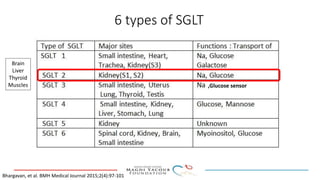
6 types of SGLT
Bhargavan, et al. BMH Medical Journal 2015;2(4):97-101

Brain
Liver
Thyroid
Muscles ,Glucose sensor
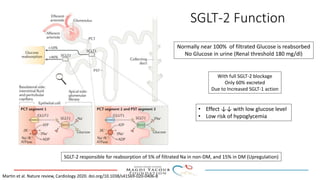
SGLT-2 Function
• Effect ↓↓ with low glucose level
• Low risk of hypoglycemia
Martin et al. Nature review, Cardiology 2020. doi.org/10.1038/s41569-020-0406-8
Normally near 100% of filtrated Glucose is reabsorbed
No Glucose in urine (Renal threshold 180 mg/dl)
With full SGLT-2 blockage
Only 60% excreted
Due to Increased SGLT-1 action
SGLT-2 responsible for reabsorption of 5% of filtrated Na in non-DM, and 15% in DM (Upregulation)
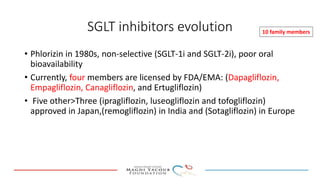
SGLT inhibitors evolution
• Phlorizin in 1980s, non-selective (SGLT-1i and SGLT-2i), poor oral
bioavailability
• Currently, four members are licensed by FDA/EMA: (Dapagliflozin,
Empagliflozin, Canagliflozin, and Ertugliflozin)
• Five other>Three (ipragliflozin, luseogliflozin and tofogliflozin)
approved in Japan,(remogliflozin) in India and (Sotagliflozin) in Europe
10 family members
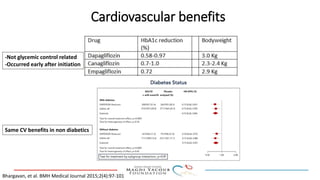
Cardiovascular benefits
-Not glycemic control related
-Occurred early after initiation
Same CV benefits in non diabetics
Bhargavan, et al. BMH Medical Journal 2015;2(4):97-101
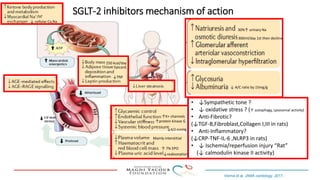
SGLT-2 inhibitors mechanism of action
• ↓Sympathetic tone ?
• ↓ oxidative stress ? (↑ autophagy, Lysosomal activity)
• Anti-Fibrotic?
(↓TGF-B,Fibroblast,Collagen I,III in rats)
• Anti-Inflammatory?
(↓CRP-TNF-IL-6 ,NLRP3 in rats)
• ↓ Ischemia/reperfusion injury “Rat”
(↓ calmodulin kinase II activity)
Verma et al. JAMA cardiology. 2017.
n
250 kcal/day
↓4/2 mmHg
300ml/day 1st then decline
↑ 7% EPO
↓ A/C ratio by 15mg/g
↓TNF
Epicard.
↑K+ channels
↑protein kinase G
↓reabsorption
↓ cellular Ca,Na
30%↑ urinary Na
Mainly interstitial
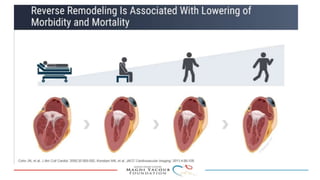
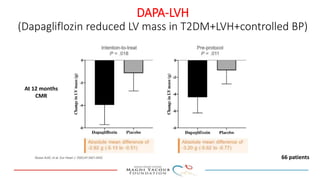
DAPA-LVH
(Dapagliflozin reduced LV mass in T2DM+LVH+controlled BP)
At 12 months
CMR
66 patients
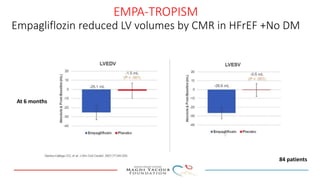
EMPA-TROPISM
Empagliflozin reduced LV volumes by CMR in HFrEF +No DM
At 6 months
84 patients
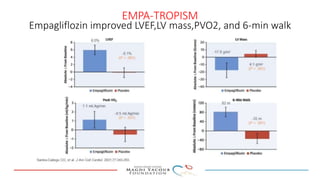
EMPA-TROPISM
Empagliflozin improved LVEF,LV mass,PVO2, and 6-min walk
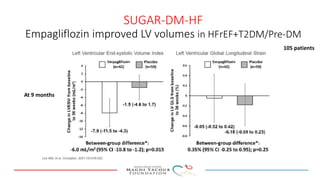
SUGAR-DM-HF
Empagliflozin improved LV volumes in HFrEF+T2DM/Pre-DM
105 patients
At 9 months
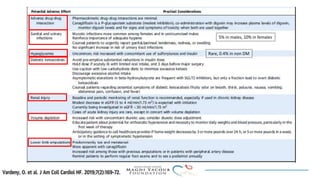
Rare, 0.4% in non DM
5% in males, 10% in females
Agenda
• Mechanism of action
• Cardiovascular prevention
• Heart failure treatment
• Renal protection
• Daily practice guidance
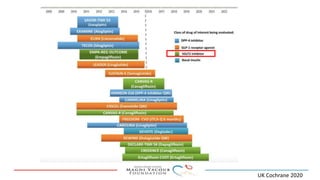
UK Cochrane 2020
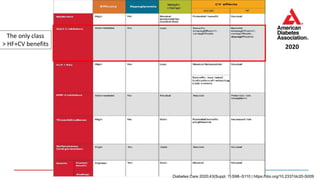
The only class
> HF+CV benefits
Diabetes Care 2020;43(Suppl. 1):S98–S110 | https://doi.org/10.2337/dc20-S009
2020
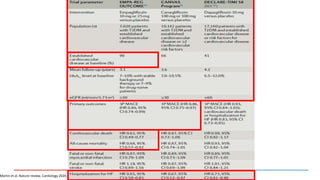
Martin et al. Nature review, Cardiology 2020.
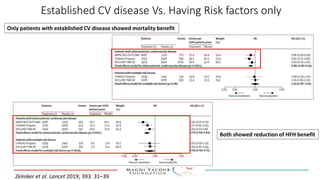
Established CV disease Vs. Having Risk factors only
Only patients with established CV disease showed mortality benefit
Both showed reduction of HFH benefit
Zelniker et al. Lancet 2019; 393: 31–39
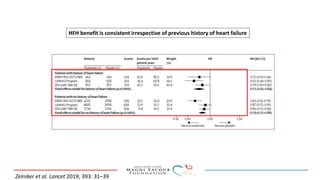
HFH benefit is consistent irrespective of previous history of heart failure
Zelniker et al. Lancet 2019; 393: 31–39
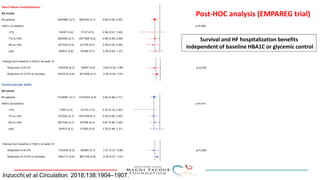
Survival and HF hospitalization benefits
independent of baseline HBA1C or glycemic control
Inzucchi,et al.Circulation. 2018;138:1904–1907.
Post-HOC analysis (EMPAREG trial)
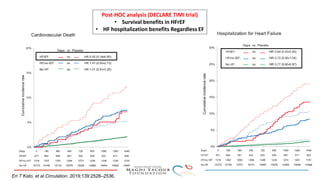
Post-HOC analysis (DECLARE TIMI trial)
• Survival benefits in HFrEF
• HF hospitalization benefits Regardless EF
Eri T Kato, et al.Circulation. 2019;139:2528–2536.
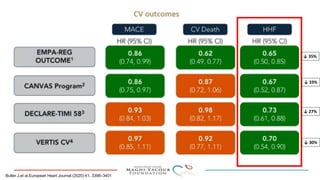
↓ 35%
↓ 33%
↓ 27%
↓ 30%
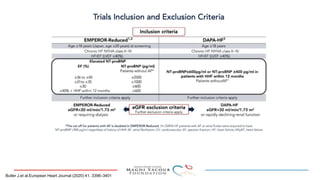
Butler J,et al.European Heart Journal (2020) 41, 3398–3401
Agenda
• Mechanism of action
• Cardiovascular prevention
• Heart failure treatment
• Renal protection
• Daily practice guidance
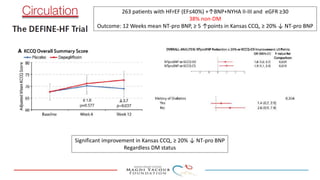
263 patients with HFrEF (EF≤40%) +↑BNP+NYHA II-III and eGFR ≥30
38% non-DM
Outcome: 12 Weeks mean NT-pro BNP, ≥ 5 ↑points in Kansas CCQ, ≥ 20% ↓ NT-pro BNP
Significant improvement in Kansas CCQ, ≥ 20% ↓ NT-pro BNP
Regardless DM status
Butler J,et al.European Heart Journal (2020) 41, 3398–3401
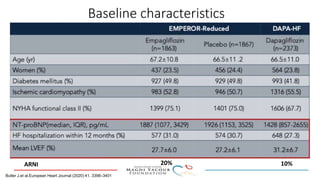
Baseline characteristics
ARNI 20% 10%
Butler J,et al.European Heart Journal (2020) 41, 3398–3401
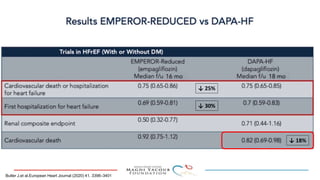
↓ 25%
↓ 30%
↓ 18%
Butler J,et al.European Heart Journal (2020) 41, 3398–3401
Zelniker et al. Lancet 2019; 393: 31–39
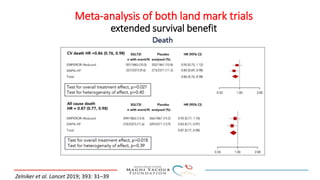
Meta-analysis of both land mark trials
extended survival benefit
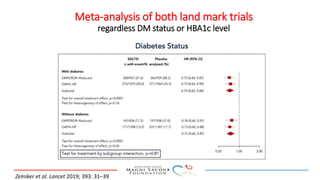
Zelniker et al. Lancet 2019; 393: 31–39
Meta-analysis of both land mark trials
regardless DM status or HBA1c level
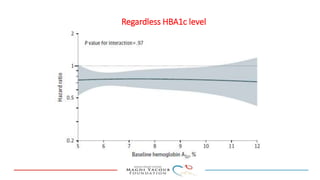
Regardless HBA1c level
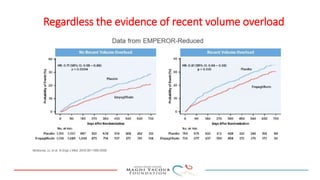
Regardless the evidence of recent volume overload
Acute heart failure ?
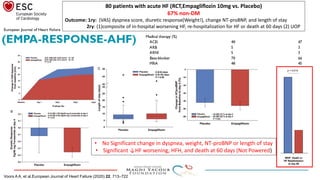
Voors A A, et al.European Journal of Heart Failure (2020) 22, 713–722
80 patients with acute HF (RCT,Empagliflozin 10mg vs. Placebo)
67% non-DM
Outcome: 1ry: (VAS) dyspnea score, diuretic response(Weight!), change NT-proBNP, and length of stay
2ry: (1)composite of in-hospital worsening HF, re-hospitalization for HF or death at 60 days (2) UOP
• No Significant change in dyspnea, weight, NT-proBNP or length of stay
• Significant ↓HF worsening, HFH, and death at 60 days (Not Powered)
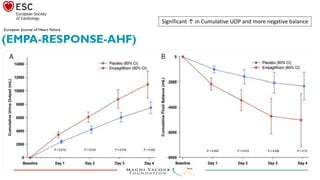
Significant ↑ in Cumulative UOP and more negative balance
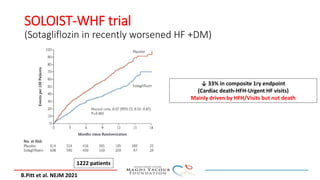
SOLOIST-WHF trial
(Sotagliflozin in recently worsened HF +DM)
1222 patients
↓ 33% in composite 1ry endpoint
(Cardiac death-HFH-Urgent HF visits)
Mainly driven by HFH/Visits but not death
B.Pitt et al. NEJM 2021
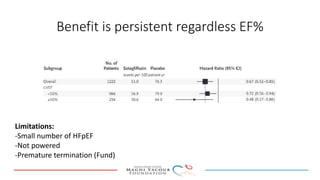
Benefit is persistent regardless EF%
Limitations:
-Small number of HFpEF
-Not powered
-Premature termination (Fund)
Agenda
• Mechanism of action
• Cardiovascular prevention
• Heart failure treatment
• Renal protection
• Daily practice guidance
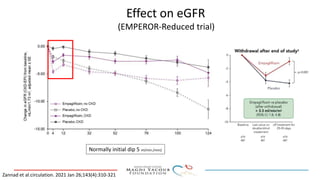
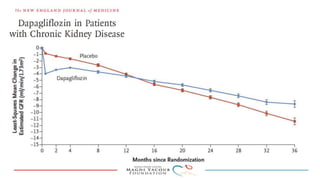
Normally initial dip 5 ml/min./mm2
Effect on eGFR
(EMPEROR-Reduced trial)
Zannad et al.circulation. 2021 Jan 26;143(4):310-321
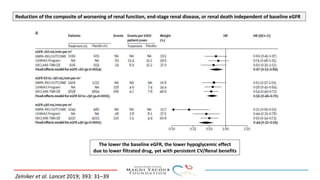
Reduction of the composite of worsening of renal function, end-stage renal disease, or renal death independent of baseline eGFR
Zelniker et al. Lancet 2019; 393: 31–39
The lower the baseline eGFR, the lower hypoglycemic effect
due to lower filtrated drug, yet with persistent CV/Renal benefits
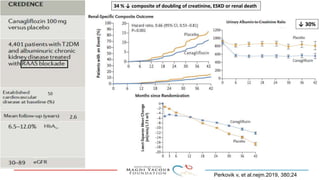
34 % ↓ composite of doubling of creatinine, ESKD or renal death
↓ 30%
Perkovik v, et al.nejm.2019, 380;24
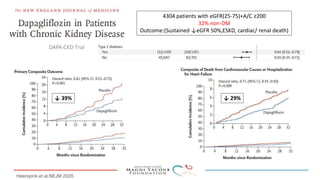
4304 patients with eGFR(25-75)+A/C ≥200
32% non-DM
Outcome:(Sustained ↓eGFR 50%,ESKD, cardiac/ renal death)
↓ 39% ↓ 29%
Heerspink,et al.NEJM 2020.
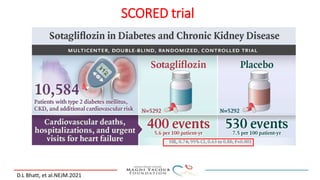
SCORED trial
D.L Bhatt, et al.NEJM.2021
Agenda
• Mechanism of action
• Cardiovascular prevention
• Heart failure treatment
• Renal protection
• Daily practice guidance
Heart failure
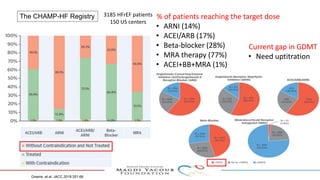
The CHAMP-HF Registry
Greene ,et al. JACC.2018:351-66
Current gap in GDMT
• Need uptitration
3185 HFrEF patients
150 US centers
% of patients reaching the target dose
• ARNI (14%)
• ACEI/ARB (17%)
• Beta-blocker (28%)
• MRA therapy (77%)
• ACEI+BB+MRA (1%)
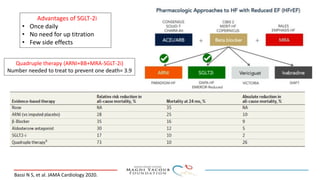
Advantages of SGLT-2i
• Once daily
• No need for up titration
• Few side effects
Bassi N S, et al. JAMA Cardiology 2020.
Quadruple therapy (ARNI+BB+MRA-SGLT-2i)
Number needed to treat to prevent one death= 3.9
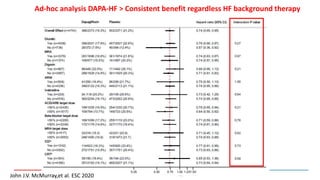
Ad-hoc analysis DAPA-HF > Consistent benefit regardless HF background therapy
John J.V. McMurray,et al. ESC 2020
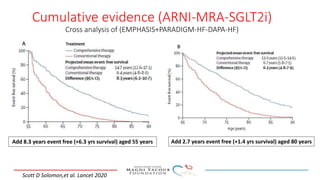
Cumulative evidence (ARNI-MRA-SGLT2i)
Cross analysis of (EMPHASIS+PARADIGM-HF-DAPA-HF)
Add 8.3 years event free (+6.3 yrs survival) aged 55 years Add 2.7 years event free (+1.4 yrs survival) aged 80 years
Scott D Solomon,et al. Lancet 2020
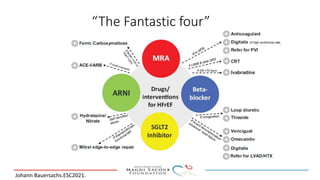
“The Fantastic four”
Johann Bauersachs.ESC2021.
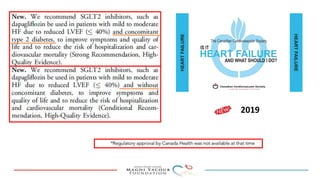
What about guidelines?
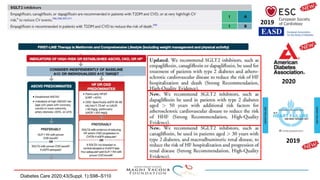
2019
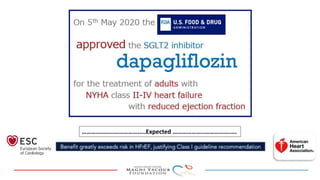
………………..…………….….Expected ………………..…………….….
Cardiac prevention in Type 2 DM
2019
2020
Diabetes Care 2020;43(Suppl. 1):S98–S110
2019
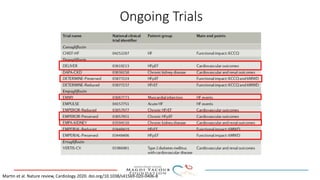
Ongoing Trials
Martin et al. Nature review, Cardiology 2020. doi.org/10.1038/s41569-020-0406-8
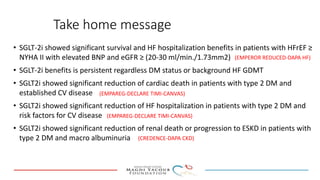
Take home message
• SGLT-2i showed significant survival and HF hospitalization benefits in patients with HFrEF ≥
NYHA II with elevated BNP and eGFR ≥ (20-30 ml/min./1.73mm2)
• SGLT-2i benefits is persistent regardless DM status or background HF GDMT
• SGLT2i showed significant reduction of cardiac death in patients with type 2 DM and
established CV disease
• SGLT2i showed significant reduction of HF hospitalization in patients with type 2 DM and
risk factors for CV disease
• SGLT2i showed significant reduction of renal death or progression to ESKD in patients with
type 2 DM and macro albuminuria
(EMPAREG-DECLARE TIMI-CANVAS)
(EMPEROR REDUCED-DAPA HF)
(CREDENCE-DAPA CKD)
(EMPAREG-DECLARE TIMI-CANVAS)
Thank You

SGLT2 inhibitors

  • 1.
    SGLT-2 Inhibitors The GameChanger Ahmed ElBorae, MSc Assistant lecturer of Cardiology, Cairo University Specialist of Cardiology, Aswan Heart Centre
  • 2.
    Agenda • Mechanism ofaction • Cardiovascular prevention • Heart failure treatment • Renal protection • Daily practice guidance
  • 3.
    6 types ofSGLT Bhargavan, et al. BMH Medical Journal 2015;2(4):97-101 Brain Liver Thyroid Muscles ,Glucose sensor
  • 4.
    SGLT-2 Function • Effect↓↓ with low glucose level • Low risk of hypoglycemia Martin et al. Nature review, Cardiology 2020. doi.org/10.1038/s41569-020-0406-8 Normally near 100% of filtrated Glucose is reabsorbed No Glucose in urine (Renal threshold 180 mg/dl) With full SGLT-2 blockage Only 60% excreted Due to Increased SGLT-1 action SGLT-2 responsible for reabsorption of 5% of filtrated Na in non-DM, and 15% in DM (Upregulation)
  • 5.
    SGLT inhibitors evolution •Phlorizin in 1980s, non-selective (SGLT-1i and SGLT-2i), poor oral bioavailability • Currently, four members are licensed by FDA/EMA: (Dapagliflozin, Empagliflozin, Canagliflozin, and Ertugliflozin) • Five other>Three (ipragliflozin, luseogliflozin and tofogliflozin) approved in Japan,(remogliflozin) in India and (Sotagliflozin) in Europe 10 family members
  • 6.
    Cardiovascular benefits -Not glycemiccontrol related -Occurred early after initiation Same CV benefits in non diabetics Bhargavan, et al. BMH Medical Journal 2015;2(4):97-101
  • 7.
    SGLT-2 inhibitors mechanismof action • ↓Sympathetic tone ? • ↓ oxidative stress ? (↑ autophagy, Lysosomal activity) • Anti-Fibrotic? (↓TGF-B,Fibroblast,Collagen I,III in rats) • Anti-Inflammatory? (↓CRP-TNF-IL-6 ,NLRP3 in rats) • ↓ Ischemia/reperfusion injury “Rat” (↓ calmodulin kinase II activity) Verma et al. JAMA cardiology. 2017. n 250 kcal/day ↓4/2 mmHg 300ml/day 1st then decline ↑ 7% EPO ↓ A/C ratio by 15mg/g ↓TNF Epicard. ↑K+ channels ↑protein kinase G ↓reabsorption ↓ cellular Ca,Na 30%↑ urinary Na Mainly interstitial
  • 9.
    DAPA-LVH (Dapagliflozin reduced LVmass in T2DM+LVH+controlled BP) At 12 months CMR 66 patients
  • 10.
    EMPA-TROPISM Empagliflozin reduced LVvolumes by CMR in HFrEF +No DM At 6 months 84 patients
  • 11.
  • 12.
    SUGAR-DM-HF Empagliflozin improved LVvolumes in HFrEF+T2DM/Pre-DM 105 patients At 9 months
  • 13.
    Rare, 0.4% innon DM 5% in males, 10% in females
  • 14.
    Agenda • Mechanism ofaction • Cardiovascular prevention • Heart failure treatment • Renal protection • Daily practice guidance
  • 15.
  • 16.
    The only class >HF+CV benefits Diabetes Care 2020;43(Suppl. 1):S98–S110 | https://doi.org/10.2337/dc20-S009 2020
  • 17.
    Martin et al.Nature review, Cardiology 2020.
  • 18.
    Established CV diseaseVs. Having Risk factors only Only patients with established CV disease showed mortality benefit Both showed reduction of HFH benefit Zelniker et al. Lancet 2019; 393: 31–39
  • 19.
    HFH benefit isconsistent irrespective of previous history of heart failure Zelniker et al. Lancet 2019; 393: 31–39
  • 20.
    Survival and HFhospitalization benefits independent of baseline HBA1C or glycemic control Inzucchi,et al.Circulation. 2018;138:1904–1907. Post-HOC analysis (EMPAREG trial)
  • 21.
    Post-HOC analysis (DECLARETIMI trial) • Survival benefits in HFrEF • HF hospitalization benefits Regardless EF Eri T Kato, et al.Circulation. 2019;139:2528–2536.
  • 22.
    ↓ 35% ↓ 33% ↓27% ↓ 30% Butler J,et al.European Heart Journal (2020) 41, 3398–3401
  • 23.
    Agenda • Mechanism ofaction • Cardiovascular prevention • Heart failure treatment • Renal protection • Daily practice guidance
  • 25.
    263 patients withHFrEF (EF≤40%) +↑BNP+NYHA II-III and eGFR ≥30 38% non-DM Outcome: 12 Weeks mean NT-pro BNP, ≥ 5 ↑points in Kansas CCQ, ≥ 20% ↓ NT-pro BNP Significant improvement in Kansas CCQ, ≥ 20% ↓ NT-pro BNP Regardless DM status
  • 26.
    Butler J,et al.EuropeanHeart Journal (2020) 41, 3398–3401
  • 27.
    Baseline characteristics ARNI 20%10% Butler J,et al.European Heart Journal (2020) 41, 3398–3401
  • 28.
    ↓ 25% ↓ 30% ↓18% Butler J,et al.European Heart Journal (2020) 41, 3398–3401
  • 29.
    Zelniker et al.Lancet 2019; 393: 31–39 Meta-analysis of both land mark trials extended survival benefit
  • 30.
    Zelniker et al.Lancet 2019; 393: 31–39 Meta-analysis of both land mark trials regardless DM status or HBA1c level
  • 31.
  • 32.
    Regardless the evidenceof recent volume overload
  • 33.
  • 34.
    Voors A A,et al.European Journal of Heart Failure (2020) 22, 713–722 80 patients with acute HF (RCT,Empagliflozin 10mg vs. Placebo) 67% non-DM Outcome: 1ry: (VAS) dyspnea score, diuretic response(Weight!), change NT-proBNP, and length of stay 2ry: (1)composite of in-hospital worsening HF, re-hospitalization for HF or death at 60 days (2) UOP • No Significant change in dyspnea, weight, NT-proBNP or length of stay • Significant ↓HF worsening, HFH, and death at 60 days (Not Powered)
  • 35.
    Significant ↑ inCumulative UOP and more negative balance
  • 36.
    SOLOIST-WHF trial (Sotagliflozin inrecently worsened HF +DM) 1222 patients ↓ 33% in composite 1ry endpoint (Cardiac death-HFH-Urgent HF visits) Mainly driven by HFH/Visits but not death B.Pitt et al. NEJM 2021
  • 37.
    Benefit is persistentregardless EF% Limitations: -Small number of HFpEF -Not powered -Premature termination (Fund)
  • 38.
    Agenda • Mechanism ofaction • Cardiovascular prevention • Heart failure treatment • Renal protection • Daily practice guidance
  • 39.
    Normally initial dip5 ml/min./mm2 Effect on eGFR (EMPEROR-Reduced trial) Zannad et al.circulation. 2021 Jan 26;143(4):310-321
  • 40.
    Reduction of thecomposite of worsening of renal function, end-stage renal disease, or renal death independent of baseline eGFR Zelniker et al. Lancet 2019; 393: 31–39 The lower the baseline eGFR, the lower hypoglycemic effect due to lower filtrated drug, yet with persistent CV/Renal benefits
  • 41.
    34 % ↓composite of doubling of creatinine, ESKD or renal death ↓ 30% Perkovik v, et al.nejm.2019, 380;24
  • 42.
    4304 patients witheGFR(25-75)+A/C ≥200 32% non-DM Outcome:(Sustained ↓eGFR 50%,ESKD, cardiac/ renal death) ↓ 39% ↓ 29% Heerspink,et al.NEJM 2020.
  • 44.
    SCORED trial D.L Bhatt,et al.NEJM.2021
  • 45.
    Agenda • Mechanism ofaction • Cardiovascular prevention • Heart failure treatment • Renal protection • Daily practice guidance
  • 46.
  • 47.
    The CHAMP-HF Registry Greene,et al. JACC.2018:351-66 Current gap in GDMT • Need uptitration 3185 HFrEF patients 150 US centers % of patients reaching the target dose • ARNI (14%) • ACEI/ARB (17%) • Beta-blocker (28%) • MRA therapy (77%) • ACEI+BB+MRA (1%)
  • 48.
    Advantages of SGLT-2i •Once daily • No need for up titration • Few side effects Bassi N S, et al. JAMA Cardiology 2020. Quadruple therapy (ARNI+BB+MRA-SGLT-2i) Number needed to treat to prevent one death= 3.9
  • 49.
    Ad-hoc analysis DAPA-HF> Consistent benefit regardless HF background therapy John J.V. McMurray,et al. ESC 2020
  • 50.
    Cumulative evidence (ARNI-MRA-SGLT2i) Crossanalysis of (EMPHASIS+PARADIGM-HF-DAPA-HF) Add 8.3 years event free (+6.3 yrs survival) aged 55 years Add 2.7 years event free (+1.4 yrs survival) aged 80 years Scott D Solomon,et al. Lancet 2020
  • 51.
  • 52.
  • 53.
  • 55.
  • 56.
  • 57.
  • 58.
    Ongoing Trials Martin etal. Nature review, Cardiology 2020. doi.org/10.1038/s41569-020-0406-8
  • 59.
    Take home message •SGLT-2i showed significant survival and HF hospitalization benefits in patients with HFrEF ≥ NYHA II with elevated BNP and eGFR ≥ (20-30 ml/min./1.73mm2) • SGLT-2i benefits is persistent regardless DM status or background HF GDMT • SGLT2i showed significant reduction of cardiac death in patients with type 2 DM and established CV disease • SGLT2i showed significant reduction of HF hospitalization in patients with type 2 DM and risk factors for CV disease • SGLT2i showed significant reduction of renal death or progression to ESKD in patients with type 2 DM and macro albuminuria (EMPAREG-DECLARE TIMI-CANVAS) (EMPEROR REDUCED-DAPA HF) (CREDENCE-DAPA CKD) (EMPAREG-DECLARE TIMI-CANVAS)
  • 60.

Editor's Notes

  • #7 Not shown with other classes with similar glycemic effect
  • #8 nucleotide-binding oligomerization domain, leucinerich repeat, and pyrin domain-containing 3 [NLRP3])
  • #16 Other anti DM either no role or increase CV risk except GLP1 which decrease MI
  • #22 4 % HfrEf, 7% HFpEF
  • #42 Interim analysis