CURRENT STATUS & RECENT
ADVANCES IN DYSLIPIDEMIA
TREATMENT
Dr. Jeffrey Pradeep Raj
Post-graduate
Dept. of Pharmacology – SJMC
02-11-2015
OUTLINE
• Introduction
• Lipid handling in the body
• Pathophysiology of atherosclerosis
• Current Hypolipidaemic drugs
• Newer Hypolipidaemic drugs
• ACC/AHA Clinical guidelines 2013
• Pipeline drugs
• Summary
INTRODUCTION
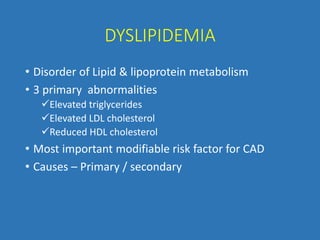
DYSLIPIDEMIA
• Disorder of Lipid & lipoprotein metabolism
• 3 primary abnormalities
Elevated triglycerides
Elevated LDL cholesterol
Reduced HDL cholesterol
• Most important modifiable risk factor for CAD
• Causes – Primary / secondary
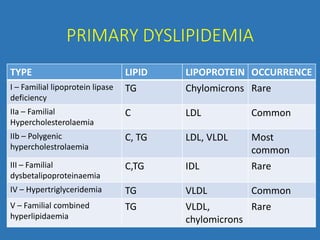
PRIMARY DYSLIPIDEMIA
TYPE LIPID LIPOPROTEIN OCCURRENCE
I – Familial lipoprotein lipase
deficiency
TG Chylomicrons Rare
IIa – Familial
Hypercholesterolaemia
C LDL Common
IIb – Polygenic
hypercholestrolaemia
C, TG LDL, VLDL Most
common
III – Familial
dysbetalipoproteinaemia
C,TG IDL Rare
IV – Hypertriglyceridemia TG VLDL Common
V – Familial combined
hyperlipidaemia
TG VLDL,
chylomicrons
Rare
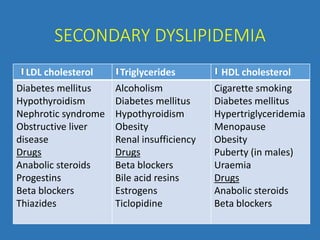
SECONDARY DYSLIPIDEMIA
LDL cholesterol Triglycerides HDL cholesterol
Diabetes mellitus
Hypothyroidism
Nephrotic syndrome
Obstructive liver
disease
Drugs
Anabolic steroids
Progestins
Beta blockers
Thiazides
Alcoholism
Diabetes mellitus
Hypothyroidism
Obesity
Renal insufficiency
Drugs
Beta blockers
Bile acid resins
Estrogens
Ticlopidine
Cigarette smoking
Diabetes mellitus
Hypertriglyceridemia
Menopause
Obesity
Puberty (in males)
Uraemia
Drugs
Anabolic steroids
Beta blockers
LIPID HANDLING IN THE
BODY
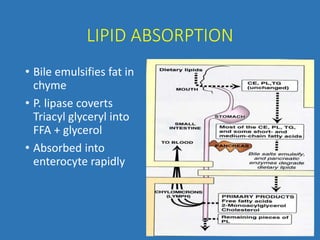
LIPID ABSORPTION
• Bile emulsifies fat in
chyme
• P. lipase coverts
Triacyl glyceryl into
FFA + glycerol
• Absorbed into
enterocyte rapidly
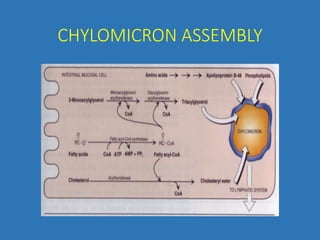
CHYLOMICRON ASSEMBLY
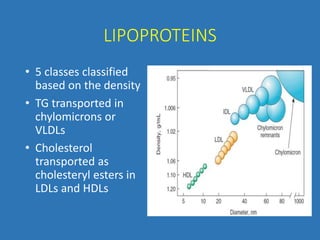
LIPOPROTEINS
• 5 classes classified
based on the density
• TG transported in
chylomicrons or
VLDLs
• Cholesterol
transported as
cholesteryl esters in
LDLs and HDLs
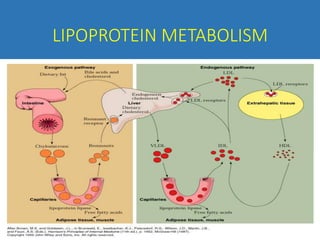
LIPOPROTEIN METABOLISM
PATHOPHYSIOLOGY OF
ATHEROSCLEROSIS
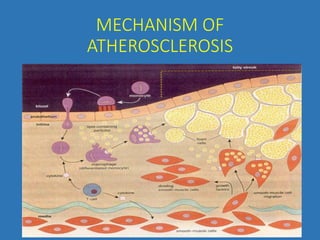
MECHANISM OF
ATHEROSCLEROSIS
CURRENT
HYPOLIPIDAEMIC DRUGS
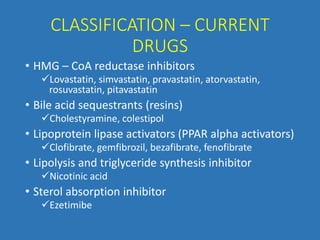
CLASSIFICATION – CURRENT
DRUGS
• HMG – CoA reductase inhibitors
Lovastatin, simvastatin, pravastatin, atorvastatin,
rosuvastatin, pitavastatin
• Bile acid sequestrants (resins)
Cholestyramine, colestipol
• Lipoprotein lipase activators (PPAR alpha activators)
Clofibrate, gemfibrozil, bezafibrate, fenofibrate
• Lipolysis and triglyceride synthesis inhibitor
Nicotinic acid
• Sterol absorption inhibitor
Ezetimibe
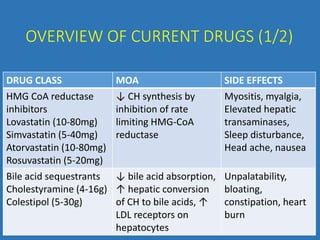
OVERVIEW OF CURRENT DRUGS (1/2)
DRUG CLASS MOA SIDE EFFECTS
HMG CoA reductase
inhibitors
Lovastatin (10-80mg)
Simvastatin (5-40mg)
Atorvastatin (10-80mg)
Rosuvastatin (5-20mg)
↓ CH synthesis by
inhibition of rate
limiting HMG-CoA
reductase
Myositis, myalgia,
Elevated hepatic
transaminases,
Sleep disturbance,
Head ache, nausea
Bile acid sequestrants
Cholestyramine (4-16g)
Colestipol (5-30g)
↓ bile acid absorption,
↑ hepatic conversion
of CH to bile acids, ↑
LDL receptors on
hepatocytes
Unpalatability,
bloating,
constipation, heart
burn
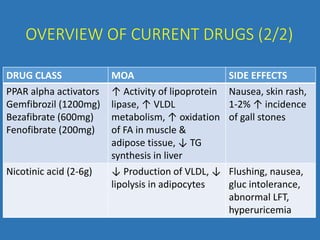
OVERVIEW OF CURRENT DRUGS (2/2)
DRUG CLASS MOA SIDE EFFECTS
PPAR alpha activators
Gemfibrozil (1200mg)
Bezafibrate (600mg)
Fenofibrate (200mg)
↑ Activity of lipoprotein
lipase, ↑ VLDL
metabolism, ↑ oxidation
of FA in muscle &
adipose tissue, ↓ TG
synthesis in liver
Nausea, skin rash,
1-2% ↑ incidence
of gall stones
Nicotinic acid (2-6g) ↓ Production of VLDL, ↓
lipolysis in adipocytes
Flushing, nausea,
gluc intolerance,
abnormal LFT,
hyperuricemia
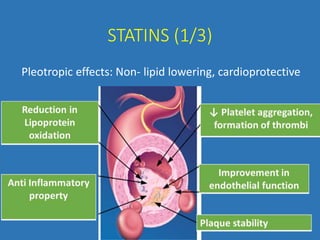
STATINS (1/3)
Pleotropic effects: Non- lipid lowering, cardioprotective
STATINS (2/3)
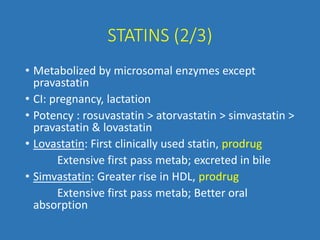
• Metabolized by microsomal enzymes except
pravastatin
• CI: pregnancy, lactation
• Potency : rosuvastatin > atorvastatin > simvastatin >
pravastatin & lovastatin
• Lovastatin: First clinically used statin, prodrug
Extensive first pass metab; excreted in bile
• Simvastatin: Greater rise in HDL, prodrug
Extensive first pass metab; Better oral
absorption
STATINS (3/3)
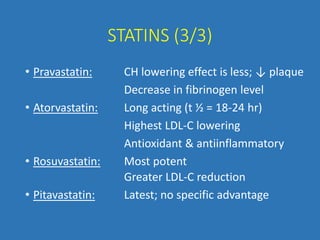
• Pravastatin: CH lowering effect is less; ↓ plaque
Decrease in fibrinogen level
• Atorvastatin: Long acting (t ½ = 18-24 hr)
Highest LDL-C lowering
Antioxidant & antiinflammatory
• Rosuvastatin: Most potent
Greater LDL-C reduction
• Pitavastatin: Latest; no specific advantage
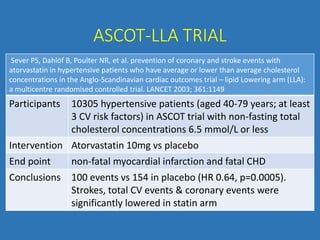
ASCOT-LLA TRIAL
Sever PS, DahlĂśf B, Poulter NR, et al. prevention of coronary and stroke events with
atorvastatin in hypertensive patients who have average or lower than average cholesterol
concentrations in the Anglo-Scandinavian cardiac outcomes trial – lipid Lowering arm (LLA):
a multicentre randomised controlled trial. LANCET 2003; 361:1149
Participants 10305 hypertensive patients (aged 40-79 years; at least
3 CV risk factors) in ASCOT trial with non-fasting total
cholesterol concentrations 6.5 mmol/L or less
Intervention Atorvastatin 10mg vs placebo
End point non-fatal myocardial infarction and fatal CHD
Conclusions 100 events vs 154 in placebo (HR 0.64, p=0.0005).
Strokes, total CV events & coronary events were
significantly lowered in statin arm
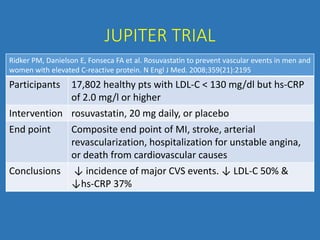
JUPITER TRIAL
Ridker PM, Danielson E, Fonseca FA et al. Rosuvastatin to prevent vascular events in men and
women with elevated C-reactive protein. N Engl J Med. 2008;359(21):2195
Participants 17,802 healthy pts with LDL-C < 130 mg/dl but hs-CRP
of 2.0 mg/l or higher
Intervention rosuvastatin, 20 mg daily, or placebo
End point Composite end point of MI, stroke, arterial
revascularization, hospitalization for unstable angina,
or death from cardiovascular causes
Conclusions ↓ incidence of major CVS events. ↓ LDL-C 50% &
↓hs-CRP 37%
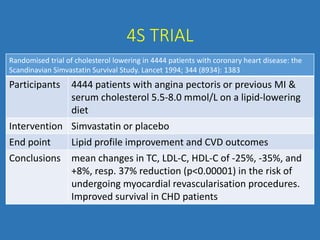
4S TRIAL
Randomised trial of cholesterol lowering in 4444 patients with coronary heart disease: the
Scandinavian Simvastatin Survival Study. Lancet 1994; 344 (8934): 1383
Participants 4444 patients with angina pectoris or previous MI &
serum cholesterol 5.5-8.0 mmol/L on a lipid-lowering
diet
Intervention Simvastatin or placebo
End point Lipid profile improvement and CVD outcomes
Conclusions mean changes in TC, LDL-C, HDL-C of -25%, -35%, and
+8%, resp. 37% reduction (p<0.00001) in the risk of
undergoing myocardial revascularisation procedures.
Improved survival in CHD patients
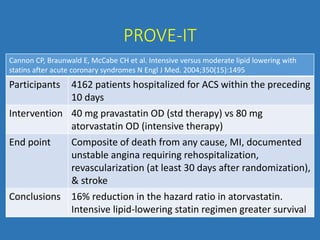
PROVE-IT
Cannon CP, Braunwald E, McCabe CH et al. Intensive versus moderate lipid lowering with
statins after acute coronary syndromes N Engl J Med. 2004;350(15):1495
Participants 4162 patients hospitalized for ACS within the preceding
10 days
Intervention 40 mg pravastatin OD (std therapy) vs 80 mg
atorvastatin OD (intensive therapy)
End point Composite of death from any cause, MI, documented
unstable angina requiring rehospitalization,
revascularization (at least 30 days after randomization),
& stroke
Conclusions 16% reduction in the hazard ratio in atorvastatin.
Intensive lipid-lowering statin regimen greater survival
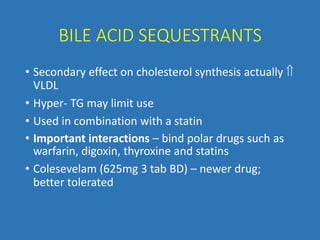
BILE ACID SEQUESTRANTS
• Secondary effect on cholesterol synthesis actually 
VLDL
• Hyper- TG may limit use
• Used in combination with a statin
• Important interactions – bind polar drugs such as
warfarin, digoxin, thyroxine and statins
• Colesevelam (625mg 3 tab BD) – newer drug;
better tolerated
FIBRATES (1/2)
• Most effective at reducing VLDL (TG); smaller  in
LDL-C ; useful  in HDL-C
• Less favourable effect on clinical outcomes
• Improvements in microvascular outcomes
• Important interactions
Increased risk of myositis on a statin
reduction in dose requirements (~30%) for patients on
warfarin
FIBRATES (2/2)
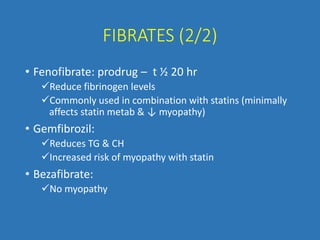
• Fenofibrate: prodrug – t ½ 20 hr
Reduce fibrinogen levels
Commonly used in combination with statins (minimally
affects statin metab & ↓ myopathy)
• Gemfibrozil:
Reduces TG & CH
Increased risk of myopathy with statin
• Bezafibrate:
No myopathy
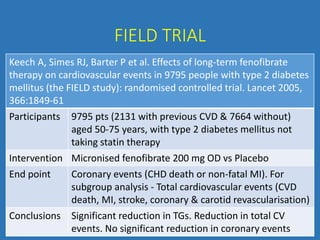
FIELD TRIAL
Keech A, Simes RJ, Barter P et al. Effects of long-term fenofibrate
therapy on cardiovascular events in 9795 people with type 2 diabetes
mellitus (the FIELD study): randomised controlled trial. Lancet 2005,
366:1849-61
Participants 9795 pts (2131 with previous CVD & 7664 without)
aged 50-75 years, with type 2 diabetes mellitus not
taking statin therapy
Intervention Micronised fenofibrate 200 mg OD vs Placebo
End point Coronary events (CHD death or non-fatal MI). For
subgroup analysis - Total cardiovascular events (CVD
death, MI, stroke, coronary & carotid revascularisation)
Conclusions Significant reduction in TGs. Reduction in total CV
events. No significant reduction in coronary events
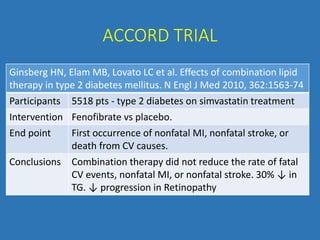
ACCORD TRIAL
Ginsberg HN, Elam MB, Lovato LC et al. Effects of combination lipid
therapy in type 2 diabetes mellitus. N Engl J Med 2010, 362:1563-74
Participants 5518 pts - type 2 diabetes on simvastatin treatment
Intervention Fenofibrate vs placebo.
End point First occurrence of nonfatal MI, nonfatal stroke, or
death from CV causes.
Conclusions Combination therapy did not reduce the rate of fatal
CV events, nonfatal MI, or nonfatal stroke. 30% ↓ in
TG. ↓ progression in Retinopathy
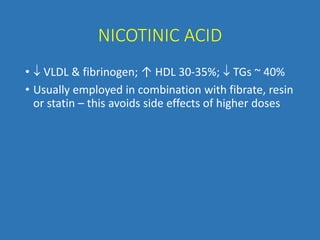
NICOTINIC ACID
•  VLDL & fibrinogen; ↑ HDL 30-35%;  TGs ~ 40%
• Usually employed in combination with fibrate, resin
or statin – this avoids side effects of higher doses
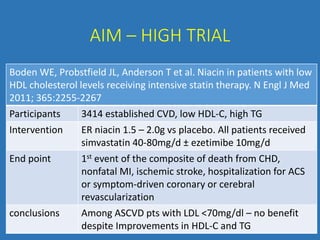
AIM – HIGH TRIAL
Boden WE, Probstfield JL, Anderson T et al. Niacin in patients with low
HDL cholesterol levels receiving intensive statin therapy. N Engl J Med
2011; 365:2255-2267
Participants 3414 established CVD, low HDL-C, high TG
Intervention ER niacin 1.5 – 2.0g vs placebo. All patients received
simvastatin 40-80mg/d Âą ezetimibe 10mg/d
End point 1st event of the composite of death from CHD,
nonfatal MI, ischemic stroke, hospitalization for ACS
or symptom-driven coronary or cerebral
revascularization
conclusions Among ASCVD pts with LDL <70mg/dl – no benefit
despite Improvements in HDL-C and TG
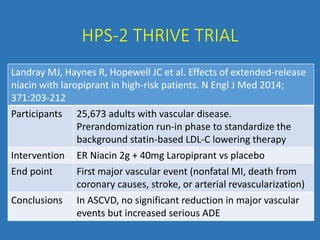
HPS-2 THRIVE TRIAL
Landray MJ, Haynes R, Hopewell JC et al. Effects of extended-release
niacin with laropiprant in high-risk patients. N Engl J Med 2014;
371:203-212
Participants 25,673 adults with vascular disease.
Prerandomization run-in phase to standardize the
background statin-based LDL-C lowering therapy
Intervention ER Niacin 2g + 40mg Laropiprant vs placebo
End point First major vascular event (nonfatal MI, death from
coronary causes, stroke, or arterial revascularization)
Conclusions In ASCVD, no significant reduction in major vascular
events but increased serious ADE
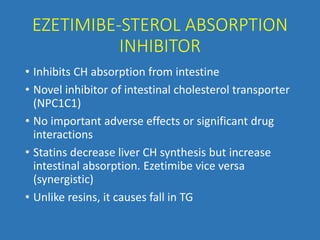
EZETIMIBE-STEROL ABSORPTION
INHIBITOR
• Inhibits CH absorption from intestine
• Novel inhibitor of intestinal cholesterol transporter
(NPC1C1)
• No important adverse effects or significant drug
interactions
• Statins decrease liver CH synthesis but increase
intestinal absorption. Ezetimibe vice versa
(synergistic)
• Unlike resins, it causes fall in TG
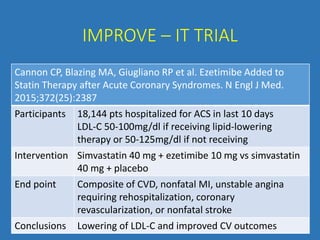
IMPROVE – IT TRIAL
Cannon CP, Blazing MA, Giugliano RP et al. Ezetimibe Added to
Statin Therapy after Acute Coronary Syndromes. N Engl J Med.
2015;372(25):2387
Participants 18,144 pts hospitalized for ACS in last 10 days
LDL-C 50-100mg/dl if receiving lipid-lowering
therapy or 50-125mg/dl if not receiving
Intervention Simvastatin 40 mg + ezetimibe 10 mg vs simvastatin
40 mg + placebo
End point Composite of CVD, nonfatal MI, unstable angina
requiring rehospitalization, coronary
revascularization, or nonfatal stroke
Conclusions Lowering of LDL-C and improved CV outcomes
NEWER
HYPOLIPIDAEMIC DRUGS
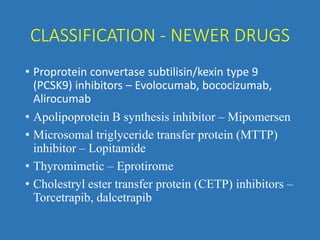
CLASSIFICATION - NEWER DRUGS
• Proprotein convertase subtilisin/kexin type 9
(PCSK9) inhibitors – Evolocumab, bococizumab,
Alirocumab
• Apolipoprotein B synthesis inhibitor – Mipomersen
• Microsomal triglyceride transfer protein (MTTP)
inhibitor – Lopitamide
• Thyromimetic – Eprotirome
• Cholestryl ester transfer protein (CETP) inhibitors –
Torcetrapib, dalcetrapib
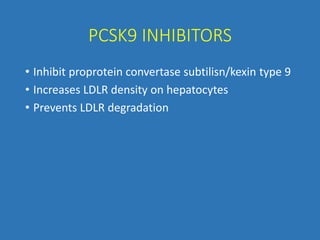
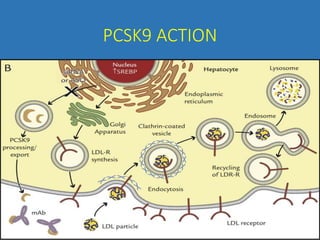
PCSK9 INHIBITORS
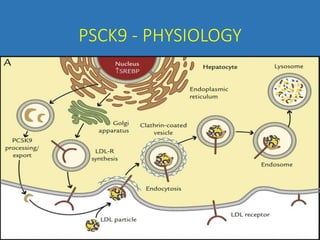
• Inhibit proprotein convertase subtilisn/kexin type 9
• Increases LDLR density on hepatocytes
• Prevents LDLR degradation
PSCK9 - PHYSIOLOGY
PCSK9 ACTION
APPROACHES TO PCSK 9
INHIBITION
• Monoclonal antibodies: RG-7652 and LY3015014
• Peptide mimics - Peptides that mimic the EGFA
domain of the LDLR that binds to PCSK9 (1D05-
IgG2 )
• Gene silencing:
PCSK9 antisense oligonucleotide, increases expression
of the LDLR
Locked nucleic acid – reduced PCSK9 mRNA
RNA interference (ALN PCS02)
• Naturally occurring inhibitors: Plant alkaloid
berberine & endogenous Annexin A2
ALIROCUMAB – PRALUENT
• First drug of PCSK9I to be approved (July24, 2015)
• Second line treatment for adults next to diet &
statin for clinical ASCVD & FH
• Side effects -
Nose & throat irritation
Injection site reactions and bruising
Flu-like symptoms
Diarrhoea
Bronchitis and cough
Muscle pain, soreness, and spasms
ODYSSEY TRIAL
Robinson JG, Farnier M, Krempf M et al. Efficacy and Safety of
Alirocumab in Reducing Lipids and Cardiovascular Events
Participants 2341 patients at high risk for CVD. LDL-C of 70 mg/dl or
more + receiving rx with statins at the maximum
tolerated dose, +/- other lipid-lowering therapy
Intervention Patients randomly assigned in a 2:1 ratio to receive
alirocumab (150 mg) or placebo as a 1-ml S/C every 2
weeks for 78 weeks
End point Percentage change in calculated LDL cholesterol level
from baseline to week 24
Conclusions At 24 weeks % change from baseline was 64%
(p<0.001) Over 78 weeks significant ↓ LDL-C. In a post
hoc analysis, evidence of ↓cardiovascular events
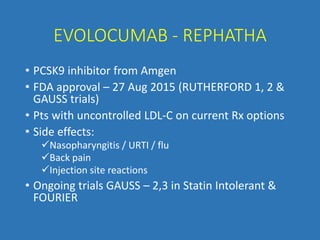
EVOLOCUMAB - REPHATHA
• PCSK9 inhibitor from Amgen
• FDA approval – 27 Aug 2015 (RUTHERFORD 1, 2 &
GAUSS trials)
• Pts with uncontrolled LDL-C on current Rx options
• Side effects:
Nasopharyngitis / URTI / flu
Back pain
Injection site reactions
• Ongoing trials GAUSS – 2,3 in Statin Intolerant &
FOURIER
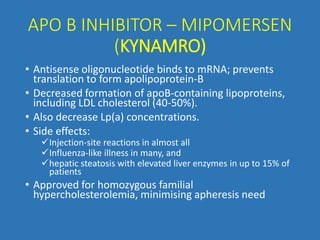
APO B INHIBITOR – MIPOMERSEN
(KYNAMRO)
• Antisense oligonucleotide binds to mRNA; prevents
translation to form apolipoprotein-B
• Decreased formation of apoB-containing lipoproteins,
including LDL cholesterol (40-50%).
• Also decrease Lp(a) concentrations.
• Side effects:
Injection-site reactions in almost all
Influenza-like illness in many, and
hepatic steatosis with elevated liver enzymes in up to 15% of
patients
• Approved for homozygous familial
hypercholesterolemia, minimising apheresis need
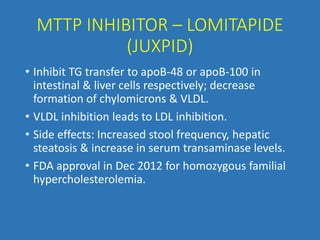
MTTP INHIBITOR – LOMITAPIDE
(JUXPID)
• Inhibit TG transfer to apoB-48 or apoB-100 in
intestinal & liver cells respectively; decrease
formation of chylomicrons & VLDL.
• VLDL inhibition leads to LDL inhibition.
• Side effects: Increased stool frequency, hepatic
steatosis & increase in serum transaminase levels.
• FDA approval in Dec 2012 for homozygous familial
hypercholesterolemia.
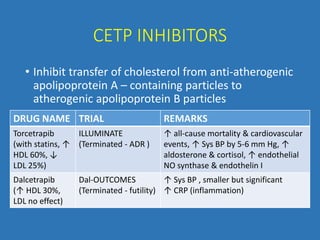
CETP INHIBITORS
• Inhibit transfer of cholesterol from anti-atherogenic
apolipoprotein A – containing particles to
atherogenic apolipoprotein B particles
DRUG NAME TRIAL REMARKS
Torcetrapib
(with statins, ↑
HDL 60%, ↓
LDL 25%)
ILLUMINATE
(Terminated - ADR )
↑ all-cause mortality & cardiovascular
events, ↑ Sys BP by 5-6 mm Hg, ↑
aldosterone & cortisol, ↑ endothelial
NO synthase & endothelin I
Dalcetrapib
(↑ HDL 30%,
LDL no effect)
Dal-OUTCOMES
(Terminated - futility)
↑ Sys BP , smaller but significant
↑ CRP (inflammation)
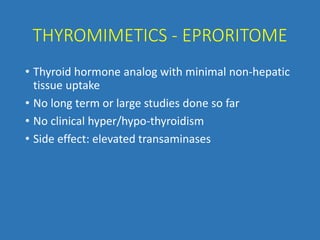
THYROMIMETICS - EPRORITOME
• Thyroid hormone analog with minimal non-hepatic
tissue uptake
• No long term or large studies done so far
• No clinical hyper/hypo-thyroidism
• Side effect: elevated transaminases
MISCELLANEOUS DRUGS
• Probucol – ↓ LDL-C and HDL-C; facilitate resorption
of cutaneous & tendon xanthomas
• Neomycin – ↓ LDL-C & Lp(a) 25%; similar in action
to bile acid sequestrants
• Oestrogen Replacement therapy in post-
menopausal women - ↓ LDL-C ↑ HDL-C
• Tamoxifen - ↓ LDL-C & tot. CH. No effect on HDL
CLINICAL GUIDELINES
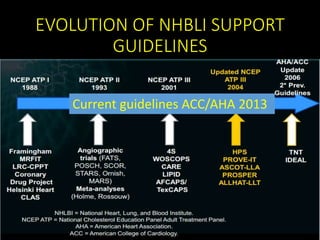
EVOLUTION OF NHBLI SUPPORT
GUIDELINES
Current guidelines ACC/AHA 2013
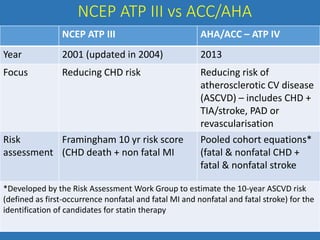
NCEP ATP III vs ACC/AHA
NCEP ATP III AHA/ACC – ATP IV
Year 2001 (updated in 2004) 2013
Focus Reducing CHD risk Reducing risk of
atherosclerotic CV disease
(ASCVD) – includes CHD +
TIA/stroke, PAD or
revascularisation
Risk
assessment
Framingham 10 yr risk score
(CHD death + non fatal MI
Pooled cohort equations*
(fatal & nonfatal CHD +
fatal & nonfatal stroke
*Developed by the Risk Assessment Work Group to estimate the 10-year ASCVD risk
(defined as first-occurrence nonfatal and fatal MI and nonfatal and fatal stroke) for the
identification of candidates for statin therapy
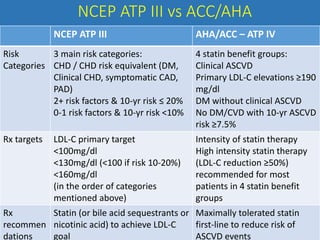
NCEP ATP III vs ACC/AHA
NCEP ATP III AHA/ACC – ATP IV
Risk
Categories
3 main risk categories:
CHD / CHD risk equivalent (DM,
Clinical CHD, symptomatic CAD,
PAD)
2+ risk factors & 10-yr risk ≤ 20%
0-1 risk factors & 10-yr risk <10%
4 statin benefit groups:
Clinical ASCVD
Primary LDL-C elevations ≥190
mg/dl
DM without clinical ASCVD
No DM/CVD with 10-yr ASCVD
risk ≥7.5%
Rx targets LDL-C primary target
<100mg/dl
<130mg/dl (<100 if risk 10-20%)
<160mg/dl
(in the order of categories
mentioned above)
Intensity of statin therapy
High intensity statin therapy
(LDL-C reduction ≥50%)
recommended for most
patients in 4 statin benefit
groups
Rx
recommen
dations
Statin (or bile acid sequestrants or
nicotinic acid) to achieve LDL-C
goal
Maximally tolerated statin
first-line to reduce risk of
ASCVD events
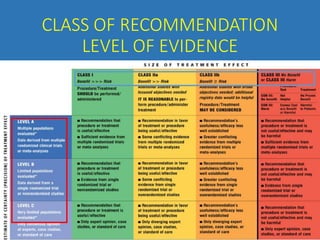
CLASS OF RECOMMENDATION
LEVEL OF EVIDENCE
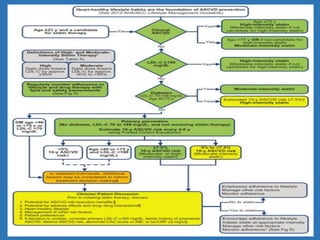
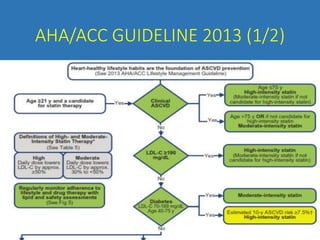
AHA/ACC GUIDELINE 2013 (1/2)
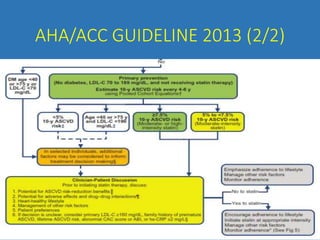
AHA/ACC GUIDELINE 2013 (2/2)
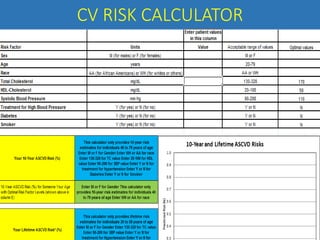
CV RISK CALCULATOR
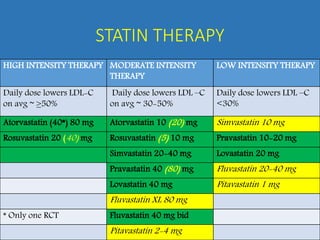
HIGH INTENSITY THERAPY MODERATE INTENSITY
THERAPY
LOW INTENSITY THERAPY
Daily dose lowers LDL-C
on avg ~ ≥50%
Daily dose lowers LDL –C
on avg ~ 30-50%
Daily dose lowers LDL –C
<30%
Atorvastatin (40*) 80 mg Atorvastatin 10 (20) mg Simvastatin 10 mg
Rosuvastatin 20 (40) mg Rosuvastatin (5) 10 mg Pravastatin 10-20 mg
Simvastatin 20-40 mg Lovastatin 20 mg
Pravastatin 40 (80) mg Fluvastatin 20-40 mg
Lovastatin 40 mg Pitavastatin 1 mg
Fluvastatin XL 80 mg
* Only one RCT Fluvastatin 40 mg bid
Pitavastatin 2-4 mg
STATIN THERAPY
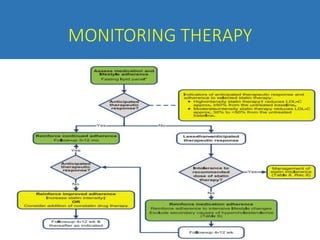
MONITORING THERAPY
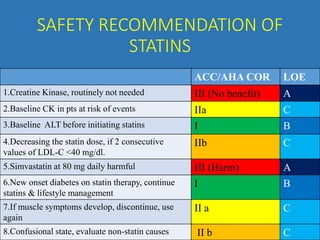
ACC/AHA COR LOE
1.Creatine Kinase, routinely not needed III (No benefit) A
2.Baseline CK in pts at risk of events IIa C
3.Baseline ALT before initiating statins I B
4.Decreasing the statin dose, if 2 consecutive
values of LDL-C <40 mg/dl.
IIb C
5.Simvastatin at 80 mg daily harmful III (Harm) A
6.New onset diabetes on statin therapy, continue
statins & lifestyle management
I B
7.If muscle symptoms develop, discontinue, use
again
II a C
8.Confusional state, evaluate non-statin causes II b C
SAFETY RECOMMENDATION OF
STATINS
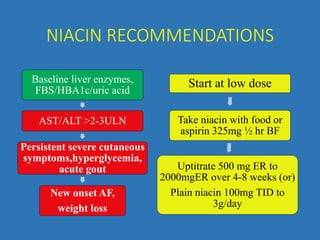
NIACIN RECOMMENDATIONS
Baseline liver enzymes,
FBS/HBA1c/uric acid
AST/ALT >2-3ULN
Persistent severe cutaneous
symptoms,hyperglycemia,
acute gout
New onset AF,
weight loss
Start at low dose
Take niacin with food or
aspirin 325mg ½ hr BF
Uptitrate 500 mg ER to
2000mgER over 4-8 weeks (or)
Plain niacin 100mg TID to
3g/day
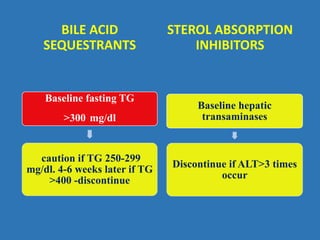
BILE ACID
SEQUESTRANTS
Baseline fasting TG
>300 mg/dl
caution if TG 250-299
mg/dl. 4-6 weeks later if TG
>400 -discontinue
STEROL ABSORPTION
INHIBITORS
Baseline hepatic
transaminases
Discontinue if ALT>3 times
occur
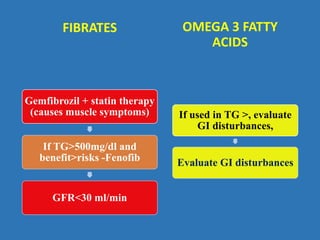
FIBRATES OMEGA 3 FATTY
ACIDS
If used in TG >, evaluate
GI disturbances,
Evaluate GI disturbances
Gemfibrozil + statin therapy
(causes muscle symptoms)
If TG>500mg/dl and
benefit>risks -Fenofib
GFR<30 ml/min
PIPELINE DRUGS
BOCOCIZUMAB (Pfizer)
• PCSK9 inhibitor
• Phase 2b - Monthly or bimonthly injections ↓ LDL-
C at 12 weeks. *
• SPIRE trials (Phase 3) - plans to enrol 17,000 pts.
Intolerant to statins
Hereditary heterozygous hypercholesterolemia
Primary hyperlipidemia/mixed dyslipidemia (3 trials)
At highrisk CVD (2 trials)
* Ballantyne CM, Neutel J, Cropp A et al. Results of Bococizumab, A Monoclonal
Antibody Against Proprotein Convertase Subtilisin/Kexin Type 9, from a
Randomized, Placebo-Controlled, Dose-Ranging Study in Statin-Treated Subjects
With Hypercholesterolemia. Am J Cardiol. 2015 May 1;115(9):1212-21.
RG7652 (Roche)
• Monoclonal antibody – PCSK9 inhibitor
• July 2013: Phase II EQUATOR trial completed
(unpublished)
• July 2014:
Discontinued - Phase-I; Metabolic disorders
(Switzerland)
Discontinued - Phase-II; Coronary disorders &
Hyperlipidaemia (USA, Canada, Czech Republic,
Germany, Hungary, New Zealand, Norway, Slovakia and
South Africa)
LY3015014 (Eli Lilly)
• Monocloncal antibody – PCSK9 inhibitor
• 3 Phase 2 trials completed by June 2014
• No liver / muscle safety issues
• Upto 51% ↓ in LDL-C, significant ↓ non-HDL-C,
ApoB and Lp(a)*
* Kastelein J, Nissen S; Rader D et al. Safety and Efficacy of LY3015014, a New
Monoclonal Antibody to Proprotein Convertase Subtilisin/Kexin Type 9 (PCSK9)
with an Inherently Longer Duration of Action, in Patients with Primary
Hypercholesterolemia: A Randomized, PlaceboControlled, Dose-Ranging, Phase 2
Study. J Am Coll Cardiol. 2015;65(10_S)
1D05-IgG2
• Fragment antigen-binding (Fab) protein that mimics
EGFA domain of LDLR
• Current status: Preclinical studies
• Ts mouse model LDL-C ↓ 40% & ↑ hepatic LDLR
protein levels 5 fold.
• In healthy rhesus monkeys, LDL cholesterol ↓
20%–50% for over 2 weeks
*Ni YG, Di Marco S, Condra JH et al. A PCSK9-binding antibody that structurally
mimics the EGF(A) domain of LDL-receptor reduces LDL cholesterol in vivo. J
Lipid Res. 2011 Jan;52(1):78-86
ALN-PCS02 (Alnylam Pharma)
• siRNA against PCSK9 gene
• Phase 1 trail completed
• IV infusion for 32 patients
• Results officially not published
• However, significant impact on lipid management
PCSK9 VACCINE
• Virus like particle (VLP) – immunogenic carrier of PCSK9
antigenic peptide
• VLP – virus without DNA – no replication. External
structure – antigen display
• Animal studies showed high titre IgG antibodies
• Significant ↓ total cholesterol, TG & PL
* Crossey E, Amar MJ, Sampson M, Peabody J, Schiller JT, Chackerian B,
Remaley AT (2015). "A cholesterol-lowering VLP vaccine that targets
PCSK9". Vaccine 33(43): 5747–55
EVACETRAPIB – CETP inhibitor
• ACCELERATE trial – 12095 high risk CVD patients;
stopped prematurely (Oct 2015) for lack of efficacy
• ACCENTUATE trial – pts with hyperlipidemia or DM
ANACETRAPIB – CETP INHIBITOR
• DEFINE – Phase III trial*
1623 pt with CHD or at high risk on statins
100mg anacetrapib vs placebo
↑ HDL 138.1%, ↓LDL-C 36%, ↓Lp(a) 36.4% in
comparison with placebo by 24 weeks
No change in BP, Electrolyte or aldosterone by 76w
No ↑ in CVD events
• REVEAL – Phase III trial (ongoing) 30,000 pts with
occlusive arterial disease
* Cannon P, Shah S, Dansky HM et al. Safety of Anacetrapib in Patients with or at
High Risk for Coronary Heart Disease. NEJM 2010; 363:2406-2415
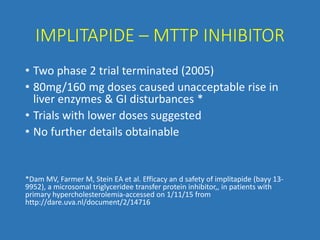
IMPLITAPIDE – MTTP INHIBITOR
• Two phase 2 trial terminated (2005)
• 80mg/160 mg doses caused unacceptable rise in
liver enzymes & GI disturbances *
• Trials with lower doses suggested
• No further details obtainable
*Dam MV, Farmer M, Stein EA et al. Efficacy an d safety of implitapide (bayy 13-
9952), a microsomal triglyceridee transfer protein inhibitor,, in patients with
primary hypercholesterolemia-accessed on 1/11/15 from
http://dare.uva.nl/document/2/14716
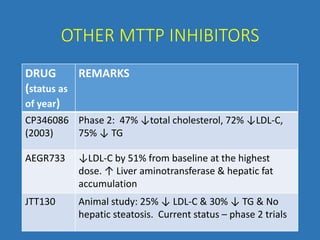
OTHER MTTP INHIBITORS
DRUG
(status as
of year)
REMARKS
CP346086
(2003)
Phase 2: 47% ↓total cholesterol, 72% ↓LDL-C,
75% ↓ TG
AEGR733 ↓LDL-C by 51% from baseline at the highest
dose. ↑ Liver aminotransferase & hepatic fat
accumulation
JTT130 Animal study: 25% ↓ LDL-C & 30% ↓ TG & No
hepatic steatosis. Current status – phase 2 trials
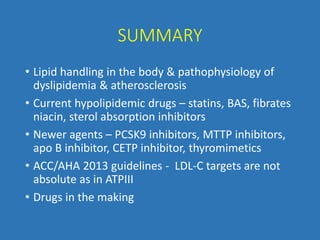
SUMMARY
• Lipid handling in the body & pathophysiology of
dyslipidemia & atherosclerosis
• Current hypolipidemic drugs – statins, BAS, fibrates
niacin, sterol absorption inhibitors
• Newer agents – PCSK9 inhibitors, MTTP inhibitors,
apo B inhibitor, CETP inhibitor, thyromimetics
• ACC/AHA 2013 guidelines - LDL-C targets are not
absolute as in ATPIII
• Drugs in the making
REFERENCES
• Tonkin A, Byrnes A. Treatment of dyslipidemia. F1000Prime
Reports. 2014;6:17
• Robert SR. Lipid lowering with drugs other than statins and
fibrates (accessed on 15/09/2015)
http://www.uptodate.com/contents/lipid-lowering-with-
drugs-other-than-statins-and-fibrates
• Robert SR. Lipid lowering with fibric acid derivatives.
(accessed on 15/09/2015)
http://www.uptodate.com/content/lipid-lowering-with-
fibric-acid-derivatives
• 2013 ACC/AHA Guideline on the Treatment of Blood
Cholesterol to Reduce Atherosclerotic Cardiovascular Risk
in Adults A Report of the American College of
Cardiology/American Heart Association Task Force on
Practice Guidelines. (accessed on 22/10/2015)
• Sahebkar A, Watts GF. New LDL-Cholesterol
Lowering Therapies: Pharmacology, Clinical Trials,
and Relevance to Acute Coronary Syndromes. Clin
Ther. 2013 Aug;35(8):1082-98
• For pipeline drugs status
(http://adisinsight.springer.com/drugs )
• For various trial details (https://clinicaltrials.gov)