BASIC –MR
PART (A)
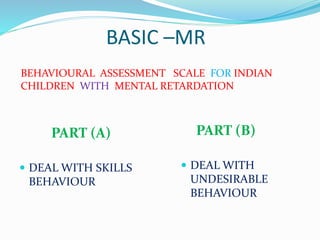
 DEAL WITH SKILLS
BEHAVIOUR
PART (B)
 DEAL WITH
UNDESIRABLE
BEHAVIOUR
BEHAVIOURAL ASSESSMENT SCALE FOR INDIAN
CHILDREN WITH MENTAL RETARDATION
PART (A)
DEAL WITH SKILLS BEHAVIOUR
It is used for understanding the strength and needs of
the children with Mental Retardation to develop the
educational programmes.
PART (B)
DEAL WITH UNDESIRABLE BEHAVIOUR
It is used to assess the problem behaviours of the
children with Mental Retardation to intervenes and
reduce the problem behaviour which are the main
hindrances for their learning.
Both the parts are useful for assessment of
adaptive behaviour and maladaptive behaviour of
children with Mental Retardation for classroom
management.
PART (A)
DEAL WITH SKILLS
BEHAVIOUR
DEAL WITH SKILLS BEHAVIOUR
 Motor
 Activities of Daily Living
 Language
 Number
 Reading
 Domestic-Social
 Pre-vocational
It has seven areas and each area has ‘40’ items. The details
of the test domains are given below:
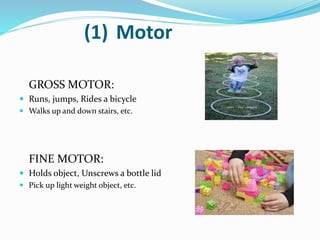
(1) Motor
GROSS MOTOR:
 Runs, jumps, Rides a bicycle
 Walks up and down stairs, etc.
FINE MOTOR:
 Holds object, Unscrews a bottle lid
 Pick up light weight object, etc.
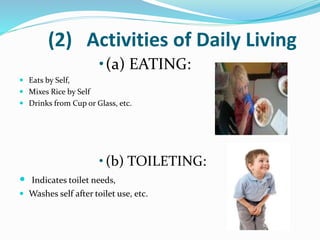
(2) Activities of Daily Living
•(a) EATING:
 Eats by Self,
 Mixes Rice by Self
 Drinks from Cup or Glass, etc.
•(b) TOILETING:
 Indicates toilet needs,
 Washes self after toilet use, etc.
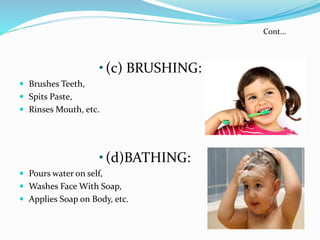
•(c) BRUSHING:
 Brushes Teeth,
 Spits Paste,
 Rinses Mouth, etc.
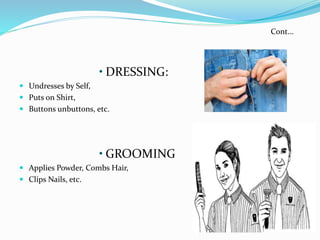
•(d)BATHING:
 Pours water on self,
 Washes Face With Soap,
 Applies Soap on Body, etc.
Cont...
• DRESSING:
 Undresses by Self,
 Puts on Shirt,
 Buttons unbuttons, etc.
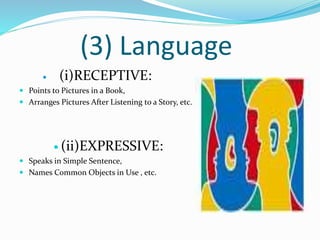
• GROOMING
 Applies Powder, Combs Hair,
 Clips Nails, etc.
Cont...
(3) Language
 (i)RECEPTIVE:
 Points to Pictures in a Book,
 Arranges Pictures After Listening to a Story, etc.
 (ii)EXPRESSIVE:
 Speaks in Simple Sentence,
 Names Common Objects in Use , etc.
(4) Number
• NUMBER and TIME:
 Counts Five Objects Meaningfully,
 Add Single Digit Numbers,
 Identifies Day,
 Date and Months of year , etc.
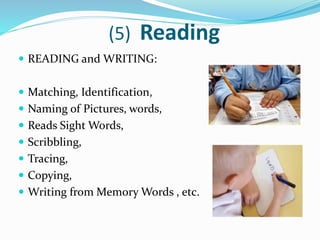
(5) Reading
 READING and WRITING:
 Matching, Identification,
 Naming of Pictures, words,
 Reads Sight Words,
 Scribbling,
 Tracing,
 Copying,
 Writing from Memory Words , etc.
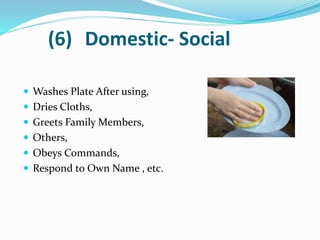
(6) Domestic- Social
 Washes Plate After using,
 Dries Cloths,
 Greets Family Members,
 Others,
 Obeys Commands,
 Respond to Own Name , etc.
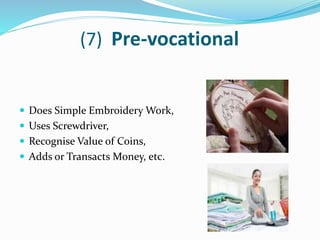
(7) Pre-vocational
 Does Simple Embroidery Work,
 Uses Screwdriver,
 Recognise Value of Coins,
 Adds or Transacts Money, etc.
PART (B)
(DEAL WITH UNDESIRABLE
BEHAVIOUR)
PART (B)
(DEAL WITH UNDESIRABLE BEHAVIOUR)
It has ten areas and each areas having all together ’75’
items. Different areas have different varying number of
items. The details of the test are given below:
• Violent and distractive
behaviour
• Temper tantrums
• Misbehaviour with
other
• Self injurious
behaviour
• Repetitive behaviour
• Odd behaviour
• Hyper activity
• Rebellious
behaviour
• Anti social
behaviour
• Fears and others
(i) Violent and distractive behaviour
VIOLENT and DESTRUCTIVE BEHAVIOURS:
 Tears book,
 Breaks things,
 Throws objects, etc.
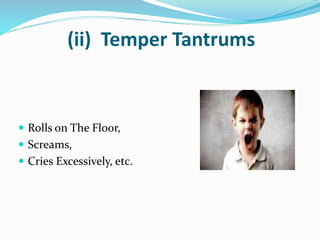
(ii) Temper Tantrums
 Rolls on The Floor,
 Screams,
 Cries Excessively, etc.
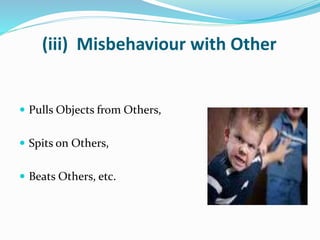
(iii) Misbehaviour with Other
 Pulls Objects from Others,
 Spits on Others,
 Beats Others, etc.
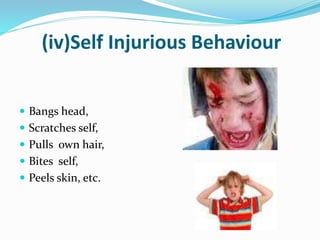
(iv)Self Injurious Behaviour
 Bangs head,
 Scratches self,
 Pulls own hair,
 Bites self,
 Peels skin, etc.
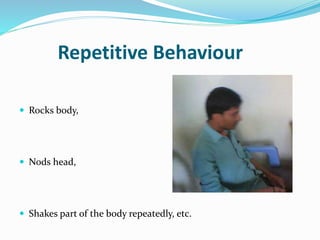
Repetitive Behaviour
 Rocks body,
 Nods head,
 Shakes part of the body repeatedly, etc.
Odd Behaviour
 Smiles,
 Laughs to self without reason,
 Talks to self without reason,
 Collects rubbish, etc
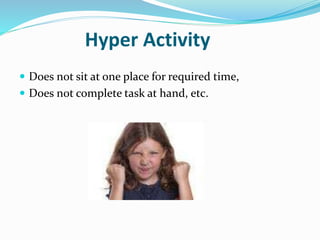
Hyper Activity
 Does not sit at one place for required time,
 Does not complete task at hand, etc.
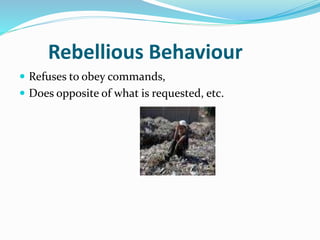
Rebellious Behaviour
 Refuses to obey commands,
 Does opposite of what is requested, etc.
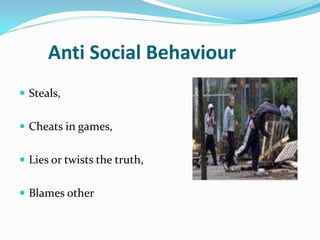
Anti Social Behaviour
 Steals,
 Cheats in games,
 Lies or twists the truth,
 Blames other
Fears and Others
 Fear of places,
 Persons,
 Animal,
 Objects, etc.
Administration
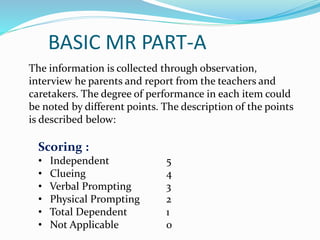
BASIC MR PART-A
The information is collected through observation,
interview he parents and report from the teachers and
caretakers. The degree of performance in each item could
be noted by different points. The description of the points
is described below:
Scoring :
• Independent 5
• Clueing 4
• Verbal Prompting 3
• Physical Prompting 2
• Total Dependent 1
• Not Applicable 0
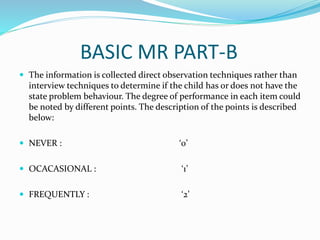
BASIC MR PART-B
 The information is collected direct observation techniques rather than
interview techniques to determine if the child has or does not have the
state problem behaviour. The degree of performance in each item could
be noted by different points. The description of the points is described
below:
 NEVER : ‘0’
 OCACASIONAL : ‘1’
 FREQUENTLY : ‘2’
Mohammad Shadab Alam
M.Ed. Spl. Edu. (MR/ID)
NIMH ( 2015 – 17 )

Basic mr

  • 1.
    BASIC –MR PART (A) DEAL WITH SKILLS BEHAVIOUR PART (B)  DEAL WITH UNDESIRABLE BEHAVIOUR BEHAVIOURAL ASSESSMENT SCALE FOR INDIAN CHILDREN WITH MENTAL RETARDATION
  • 2.
    PART (A) DEAL WITHSKILLS BEHAVIOUR It is used for understanding the strength and needs of the children with Mental Retardation to develop the educational programmes.
  • 3.
    PART (B) DEAL WITHUNDESIRABLE BEHAVIOUR It is used to assess the problem behaviours of the children with Mental Retardation to intervenes and reduce the problem behaviour which are the main hindrances for their learning. Both the parts are useful for assessment of adaptive behaviour and maladaptive behaviour of children with Mental Retardation for classroom management.
  • 4.
    PART (A) DEAL WITHSKILLS BEHAVIOUR
  • 5.
    DEAL WITH SKILLSBEHAVIOUR  Motor  Activities of Daily Living  Language  Number  Reading  Domestic-Social  Pre-vocational It has seven areas and each area has ‘40’ items. The details of the test domains are given below:
  • 6.
    (1) Motor GROSS MOTOR: Runs, jumps, Rides a bicycle  Walks up and down stairs, etc. FINE MOTOR:  Holds object, Unscrews a bottle lid  Pick up light weight object, etc.
  • 7.
    (2) Activities ofDaily Living •(a) EATING:  Eats by Self,  Mixes Rice by Self  Drinks from Cup or Glass, etc. •(b) TOILETING:  Indicates toilet needs,  Washes self after toilet use, etc.
  • 8.
    •(c) BRUSHING:  BrushesTeeth,  Spits Paste,  Rinses Mouth, etc. •(d)BATHING:  Pours water on self,  Washes Face With Soap,  Applies Soap on Body, etc. Cont...
  • 9.
    • DRESSING:  Undressesby Self,  Puts on Shirt,  Buttons unbuttons, etc. • GROOMING  Applies Powder, Combs Hair,  Clips Nails, etc. Cont...
  • 10.
    (3) Language  (i)RECEPTIVE: Points to Pictures in a Book,  Arranges Pictures After Listening to a Story, etc.  (ii)EXPRESSIVE:  Speaks in Simple Sentence,  Names Common Objects in Use , etc.
  • 11.
    (4) Number • NUMBERand TIME:  Counts Five Objects Meaningfully,  Add Single Digit Numbers,  Identifies Day,  Date and Months of year , etc.
  • 12.
    (5) Reading  READINGand WRITING:  Matching, Identification,  Naming of Pictures, words,  Reads Sight Words,  Scribbling,  Tracing,  Copying,  Writing from Memory Words , etc.
  • 13.
    (6) Domestic- Social Washes Plate After using,  Dries Cloths,  Greets Family Members,  Others,  Obeys Commands,  Respond to Own Name , etc.
  • 14.
    (7) Pre-vocational  DoesSimple Embroidery Work,  Uses Screwdriver,  Recognise Value of Coins,  Adds or Transacts Money, etc.
  • 15.
    PART (B) (DEAL WITHUNDESIRABLE BEHAVIOUR)
  • 16.
    PART (B) (DEAL WITHUNDESIRABLE BEHAVIOUR) It has ten areas and each areas having all together ’75’ items. Different areas have different varying number of items. The details of the test are given below: • Violent and distractive behaviour • Temper tantrums • Misbehaviour with other • Self injurious behaviour • Repetitive behaviour • Odd behaviour • Hyper activity • Rebellious behaviour • Anti social behaviour • Fears and others
  • 17.
    (i) Violent anddistractive behaviour VIOLENT and DESTRUCTIVE BEHAVIOURS:  Tears book,  Breaks things,  Throws objects, etc.
  • 18.
    (ii) Temper Tantrums Rolls on The Floor,  Screams,  Cries Excessively, etc.
  • 19.
    (iii) Misbehaviour withOther  Pulls Objects from Others,  Spits on Others,  Beats Others, etc.
  • 20.
    (iv)Self Injurious Behaviour Bangs head,  Scratches self,  Pulls own hair,  Bites self,  Peels skin, etc.
  • 21.
    Repetitive Behaviour  Rocksbody,  Nods head,  Shakes part of the body repeatedly, etc.
  • 22.
    Odd Behaviour  Smiles, Laughs to self without reason,  Talks to self without reason,  Collects rubbish, etc
  • 23.
    Hyper Activity  Doesnot sit at one place for required time,  Does not complete task at hand, etc.
  • 24.
    Rebellious Behaviour  Refusesto obey commands,  Does opposite of what is requested, etc.
  • 25.
    Anti Social Behaviour Steals,  Cheats in games,  Lies or twists the truth,  Blames other
  • 26.
    Fears and Others Fear of places,  Persons,  Animal,  Objects, etc.
  • 27.
  • 28.
    BASIC MR PART-A Theinformation is collected through observation, interview he parents and report from the teachers and caretakers. The degree of performance in each item could be noted by different points. The description of the points is described below: Scoring : • Independent 5 • Clueing 4 • Verbal Prompting 3 • Physical Prompting 2 • Total Dependent 1 • Not Applicable 0
  • 29.
    BASIC MR PART-B The information is collected direct observation techniques rather than interview techniques to determine if the child has or does not have the state problem behaviour. The degree of performance in each item could be noted by different points. The description of the points is described below:  NEVER : ‘0’  OCACASIONAL : ‘1’  FREQUENTLY : ‘2’
  • 30.
    Mohammad Shadab Alam M.Ed.Spl. Edu. (MR/ID) NIMH ( 2015 – 17 )