1
Lecture on Routing in Mobile Wireless Networks
Prof. Maria Papadopouli
University of Crete
ICS-FORTH
http://www.ics.forth.gr/mobile
Wireless Networks & Mobile Computing
ACKNOWLEDGEMENT:
Slides used from presentations by
Manolis Spanakis, Michalis Faloutsos
P.R. Kumar, Charles Perkins, Kurose & Ross
Issues
• Limited wireless transmission range
• Broadcast nature of the wireless medium
• Hidden terminal problem
• Packet losses due to transmission errors
• Mobility-induced route changes
• Mobility-induced packet losses
• Battery constraints
• Potentially frequent network partitions
• Ease of snooping on wireless transmissions (security hazard)
Diversity in Mobile Ad Hoc Networks
• Traffic characteristics, wireless link quality, bit rate, mobility
• Reliability & delay requirements, unicast, multicast
• Host-based/ content-based/ capability-based addressing
• Co-exist and Co-operate with infrastructure-based networks
• Symmetric vs. Asymmetric (nodes’ capabilities and responsibilities)
• Pervasive (cheap) devices: Power constraints
• Security/Confidentiality issues
Mobile Ad Hoc Networks (MANET)
• Formed by a collection of wireless mobile hosts
• Without any pre-existing infrastructure or the aid of any centralized
administration
• Network characteristics change over time
• Routes between nodes may potentially contain multiple hops
• Number of hosts in the network
Routing Issues
• Which is the best path?
• Shortest path (fewest hops)
• Lowest latency
• Shortest weighted path (utilize available bandwidth, battery)?
• Who decides? Source, intermediate, or destination nodes?
Source (“path”) routing [Like airline travel]
• Source specifies entire route
• Intermediate nodes just forward to specified next hop
Destination (“hop-by-hop”) routing [Like postal service]
• Source specifies only destination in message header
• Intermediate nodes look at destination in header, consult internal tables to
determine appropriate next hop
Proactive Protocols
• Proactive: maintain routing information independently of need for
communication
• Update messages send throughout the network periodically or when network
topology changes
• Low latency, suitable for real-time traffic
• Bandwidth might get wasted due to periodic updates
• They maintain O(N) state per node, N = #nodes
On-Demand or Reactive Routing
• Reactive: discover route only when you need it
• Saves energy and bandwidth during inactivity
• Can be bursty -> congestion during high activity
• Significant delay might occur as a result of route discovery
• Good for light loads, collapse in large loads
Hybrid Routing
• Proactive for neighborhood, reactive for far away
• Proactive for long distance, reactive for neighborhood
• Attempts to strike balance between the two
Hierarchical Routing
• Nodes are organized in clusters
• Cluster head “controls” cluster
• Trade off
• Overhead and confusion for leader election
• Scalability: intra-cluster vs intercluster
• One or Multiple levels of hierarchy
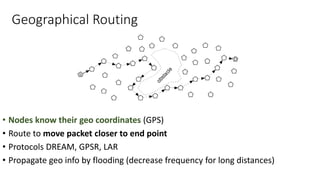
Geographical Routing
• Nodes know their geo coordinates (GPS)
• Route to move packet closer to end point
• Protocols DREAM, GPSR, LAR
• Propagate geo info by flooding (decrease frequency for long distances)
IETF MANET Working Group
The purpose of the MANET working group is to standardize IP routing protocol functionality suitable for
wireless routing application within both static & dynamic topologies with increased dynamics due to
node motion or other factors.
Approaches are intended to be
• lightweight in nature,
• suitable for multiple hardware and wireless environments, and
• address scenarios where MANETs are deployed at the edges of an IP infrastructure.
• Hybrid mesh infrastructures (e.g., a mixture of fixed and mobile routers) should also be supported by
MANET specifications and management features.
• Using mature components from previous work on experimental reactive and proactive protocols, the
WG will develop two Standards track routing protocol specifications:
• Reactive MANET Protocol (RMP) & Proactive MANET Protocol (PMP)
• The charter and official IETF Home Page for manet are found at
https://datatracker.ietf.org/wg/manet/charter
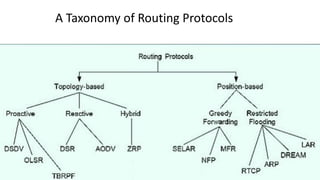
A Taxonomy of Routing Protocols
Trade offs
• Latency of route discovery
• Proactive protocols may have lower latency since routes are maintained at all times
• Reactive protocols may have higher latency because a route from X to Y will be found only
when X attempts to send to Y
• Overhead of route discovery/maintenance
• Reactive protocols may have lower overhead since routes are determined only if needed
• Proactive protocols can (but not necessarily) result in higher overhead due to continuous
route updating
• Which approach achieves a better trade-off depends on the traffic & mobility
patterns
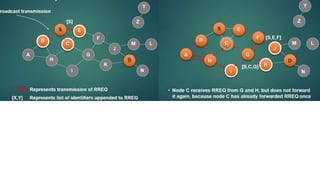
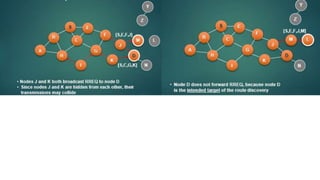
Dynamic Source Routing (DSR)
• Source routing: entire path to destination supplied by source in packet header
• Utilizes extension header following standard IP header to carry protocol
information (route to destination)
• Route discovery: Undertaken when source needs a route to a destination
• Route maintenance: Is used only when the source is actually sending packets &
detect network topology changes
• Intermediate nodes cache overheard routes
• “Eavesdrop” on routes contained in headers
• Reduces need for route discovery
• Intermediate node may return Route Reply to source, if it already has a path stored
By David Johnson, David Maltz, Josh Broch
• Route Reply can be sent by reversing the route in Route Request (RREQ) only if links
are guaranteed to be bi-directional
• To ensure this, RREQ should be forwarded only if it received on a link that is known to
be bi-directional
• If unidirectional (asymmetric) links are allowed, then RREP may need a route
discovery for S from node D
Unless node D already knows a route to node S
• If a route discovery is initiated by D for a route to S, then the Route Reply is
piggybacked on the Route Request from D
• If IEEE 802.11 MAC is used to send data, then links have to be bi-directional (since Ack
is used)
Key points
• Node S on receiving RREP, caches the route included in the RREP
• When node S sends a data packet to D, the entire route is included in the
packet header (hence the name source routing)
• Intermediate nodes use the source route included in a packet to determine
to whom a packet should be forwarded
DSR – Advantages Disadvantages
• Packet header size grows with route
length due to source routing
• Flood of route requests may
potentially reach all nodes in the
network
• Care must be taken to avoid
collisions between route requests
propagated by neighboring nodes
• Insertion of random delays before
forwarding RREQ
• Routes maintained only between nodes who
need to communicate
• Reduces overhead of route maintenance
• Route caching can further reduce route
discovery overhead
• A single route discovery may yield many routes
to the destination due to intermediate nodes
replying from local caches
• Automatic route shortening, if one or more of
their intermediate hops become unnecessary
Ad-hoc On-demand Distance Vector (AODV)
Routes are discovered on an as-needed basis
1. When a node needs a route to a
destination, it broadcasts a RREQ
2. Any node with a current route to that
destination can unicast a RREP back to the
source node
3. Route info is maintained by each node in
its route table
4. Information obtained through RREQ &
RREP messages is kept with other routing
info in the routing table
5. Sequence numbers are used to eliminate
stale routes
6. Routes with old sequence numbers are
aged out of the system
• By Charles Perkins, Elizabeth Royer
Ad-hoc On-demand Distance Vector (AODV) Protocol
• Hop-by-hop protocol: intermediate nodes
use lookup table to determine next hop
based on destination
• Utilizes only standard IP header
Route discovery
Undertaken whenever a node needs a “next
hop” to forward a packet to a destination
Route maintenance
Used when link breaks, rendering next hop
unusable
Route Discovery
1. Route Request:
• Source broadcasts Route Request (RREQ)
message for specified destination
• Intermediate node Forward message toward
destination
2. Route Reply
• Destination unicasts Route Reply msg to
source
• Intermediate node creates next-hop entry
for destination & forwards the reply
• If source receives multiple replies, it uses
the one with lowest hop count
Zone Routing Protocol (ZRP)
• A zone is defined around each node: k-neighborhood, which consists of all nodes within k
hops of the node
• Border nodes are nodes which are exactly k hops away from a source node
• Hybrid Scheme
• Proactively maintains routes within a local region (routing zone)
• Also a globally reactive route query/reply mechanism available
• If a packet's destination is in the same zone as the origin, the proactive protocol using an
already stored routing table is used to deliver the packet immediately
• If the route extends outside the packet's originating zone, a reactive protocol takes over to
check each successive zone in the route to see whether the destination is inside that zone
This reduces the processing overhead for those routes. Once a zone is confirmed as
containing the destination node, the proactive protocol, or stored route-listing table, is used to
deliver the packet.
By Zygmunt Haas, Marc Pearlman
Inter-zone Routing
• For routes beyond the local zone, route discovery
happens reactively.
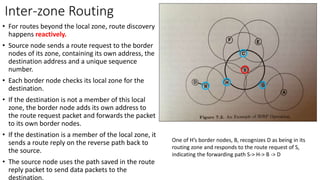
• Source node sends a route request to the border
nodes of its zone, containing its own address, the
destination address and a unique sequence
number.
• Each border node checks its local zone for the
destination.
• If the destination is not a member of this local
zone, the border node adds its own address to
the route request packet and forwards the packet
to its own border nodes.
• If the destination is a member of the local zone, it
sends a route reply on the reverse path back to
the source.
• The source node uses the path saved in the route
reply packet to send data packets to the
destination.
One of H’s border nodes, B, recognizes D as being in its
routing zone and responds to the route request of S,
indicating the forwarding path S-> H-> B -> D
25
Location-Aided Routing (LAR) - Basic Idea
• Route discovery using flooding algorithm has large overhead
• When nodes know their location, improve routing by minimizing search zone & reducing
routing overhead
• Use last known location information & average speed for route discovery
• Limited destination zone (expected zone)
• Restricted flooding (request zone)
• Route discovery is initiated when source does not know a route to a destination or previous
route is broken
• Further reduction of the search zone, when speed & direction information is available
• Also increases the probability to find a node
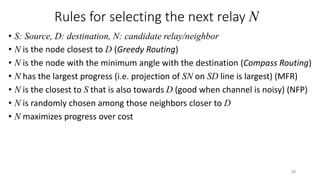
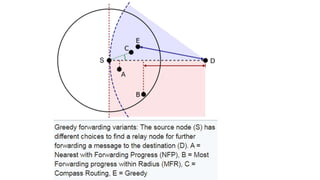
Rules for selecting the next relay N
• S: Source, D: destination, N: candidate relay/neighbor
• N is the node closest to D (Greedy Routing)
• N is the node with the minimum angle with the destination (Compass Routing)
• N has the largest progress (i.e. projection of SN on SD line is largest) (MFR)
• N is the closest to S that is also towards D (good when channel is noisy) (NFP)
• N is randomly chosen among those neighbors closer to D
• N maximizes progress over cost
26
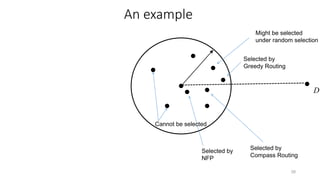
An example
28
D
Selected by
Compass Routing
Selected by
Greedy Routing
Might be selected
under random selection
Cannot be selected
Selected by
NFP
Advantages of Geographic Routing
• Robust with respect to change of topology
Who handles the packet is unimportant, and can be decided at the very last moment.
• Very little state is needed
With traditional routing, nodes need to keep (and update) routing tables and/or packets
need to carry the routes they will follow
It scales very well with network size.
29
Local Maximum Problem Challenge: While forwarding, it is possible that the best node to
receive the packet is the current holder.
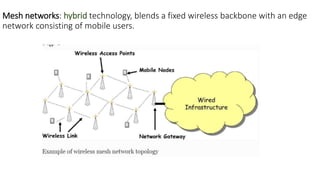
Mesh networks: hybrid technology, blends a fixed wireless backbone with an edge
network consisting of mobile users.
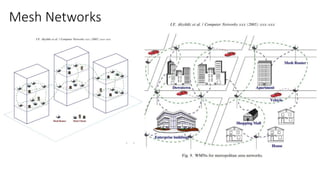
Mesh Networks
Mesh Networks
• Multi-hop wireless network. Aim to extend the coverage range without sacrificing the
channel capacity as well as provide non-line-of-sight (NLOS) connectivity among the
users without direct line-of-sight.
• Mesh routers usually have minimal mobility, while mesh clients can be stationary or
mobile nodes. Mesh routers usually do not have strict constraints on power
consumption. However, mesh clients may require power efficient protocols.
• In WMNs, both backhaul access to the Internet and peer-to-peer (P2P)
communications are supported. In addition, the integration of WMNs with other
wireless networks and providing services to end-users of these networks can be
accomplished through WMNs.
• Support for ad hoc networking, and capability of self-forming, self-healing, and self-
organization. WMNs enhance network performance, because of flexible network
architecture, easy deployment and configuration, fault tolerance, and mesh
connectivity, i.e., multipoint-to-multipoint communications.
• Dedicated routing and configuration. Unlike ad hoc networks, in which end-user
devices perform routing, in WMNs, mesh routers perform this functionality.
Routing Metrics
• Hop Count: Number of hops between the source and the destination.
• Expected Transmission Count (ETX): Accounts for data loss due to medium access contention
& environmental hazards, and considers the number of retransmissions needed to
successfully transmit a packet over a link
• Expected Transmission Time (ETT): enhancement of ETX; further includes the bandwidth of
the link in its computation.
• Energy consumption: A node energy level can be considered as a routing metric if some nodes
are energy-constrained and their involvement in the routing process can lead to path failure if
they suffer from energy depletion.
• Path availability/reliability: Percentage of time a path is available. Node mobility effect can be
captured by this metric; Particularly important in MANET.
Routing in Mesh Networks
• Variation of DSR using the expected transmission time as a metric instead of the
number of hops (i.e., the shortest paths are determined based on least packet
loss)
• Enhancing existing routing protocols with new routing metrics more appropriate
for WMNs.
• The fixed wireless backbone allows a better estimation of the link quality
through regular measurements.
• Employ channel diversity in the network infrastructure so as to reduce
interference and increase overall throughput.
A fundamental Cost/Delay Tradeoff
• C/DEGs capture a fundamental tradeoff of DTNs: the cost of
transporting a packet from node A to node B with a delay of at most T
is a decreasing function of T.
• If we are willing to wait for more time, the topology might become more
favorable.
• In the C/DEG setting, the smallest-cost journey of delay at most T is found
considering all C/DEG paths of delay at most T. Increasing T implies more
paths are considered.
35
Portable mobile networking
• Requires connection to same provider (ISP)
• Cellular systems, Bluetooth, Wireless Ethernet
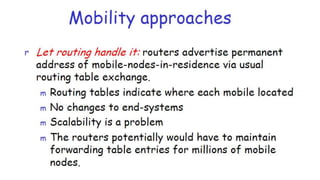
Mobility & Standard IP Routing
• IP assumes end hosts are in fixed physical locations
• IP addresses enable IP routing algorithms to get packets to the correct network
• IP address has network part and host part
• Host part should not be in routing tables
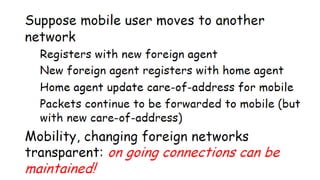
• What if a user roams between networks?
• Want transparency
• Routing information becomes invalid
• Why can’t mobile users change IP when running an application?
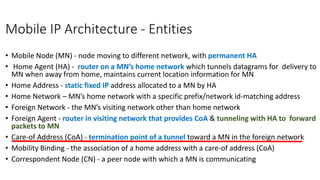
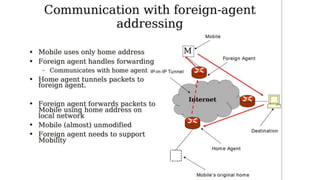
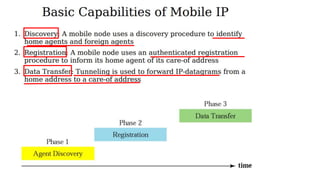
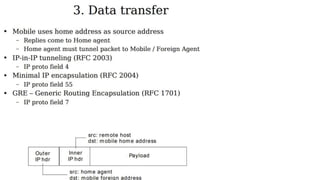
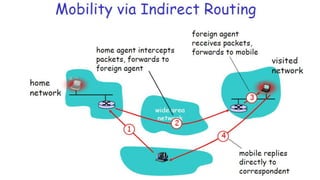
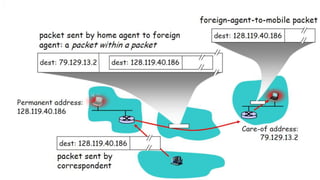
Mobile IP Architecture - Entities
• Mobile Node (MN) - node moving to different network, with permanent HΑ
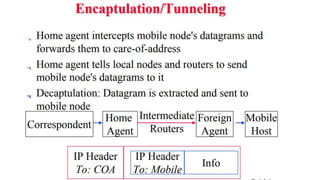
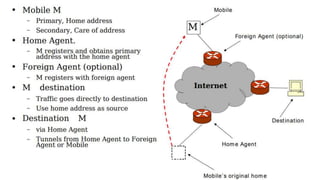
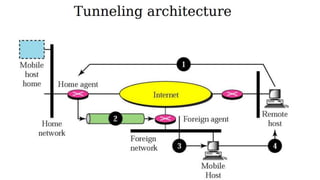
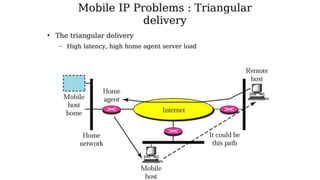
• Home Agent (HA) - router on a MN’s home network which tunnels datagrams for delivery to
MN when away from home, maintains current location information for MN
• Home Address - static fixed IP address allocated to a MN by HA
• Home Network – MN’s home network with a specific prefix/network id-matching address
• Foreign Network - the MN’s visiting network other than home network
• Foreign Agent - router in visiting network that provides CoA & tunneling with HA to forward
packets to MN
• Care-of Address (CoA) - termination point of a tunnel toward a MN in the foreign network
• Mobility Binding - the association of a home address with a care-of address (CoA)
• Correspondent Node (CN) - a peer node with which a MN is communicating
• Packet Sniffing, Denial Of service, and Hijacking of session
• Firewalls block all classes of incoming packets that do not meet specified criteria.
• Enterprise firewalls are typically configured to block packets from entering via the Internet
that appear to emanate from internal computers.
Although this permits management of internal Internet nodes without great attention to
security, it presents difficulties for mobile nodes wishing to communicate with other nodes
within their home enterprise networks. Such communications, originating from the mobile
node, carry the mobile node's home address, and would thus be blocked by the firewall.
Security Challenges in Mobile IP
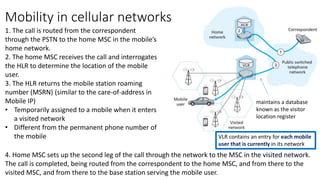
Mobility in cellular networks
1. The call is routed from the correspondent
through the PSTN to the home MSC in the mobile’s
home network.
2. The home MSC receives the call and interrogates
the HLR to determine the location of the mobile
user.
3. The HLR returns the mobile station roaming
number (MSRN) (similar to the care-of-address in
Mobile IP)
• Temporarily assigned to a mobile when it enters
a visited network
• Different from the permanent phone number of
the mobile
4. Home MSC sets up the second leg of the call through the network to the MSC in the visited network.
The call is completed, being routed from the correspondent to the home MSC, and from there to the
visited MSC, and from there to the base station serving the mobile user.
maintains a database
known as the visitor
location register
VLR contains an entry for each mobile
user that is currently in its network
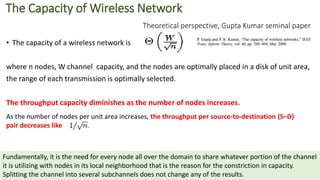
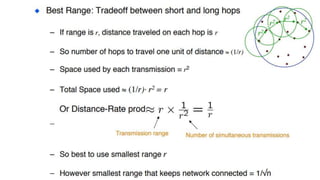
The Capacity of Wireless Network
Theoretical perspective, Gupta Kumar seminal paper
• The capacity of a wireless network is
where n nodes, W channel capacity, and the nodes are optimally placed in a disk of unit area,
the range of each transmission is optimally selected.
The throughput capacity diminishes as the number of nodes increases.
Fundamentally, it is the need for every node all over the domain to share whatever portion of the channel
it is utilizing with nodes in its local neighborhood that is the reason for the constriction in capacity.
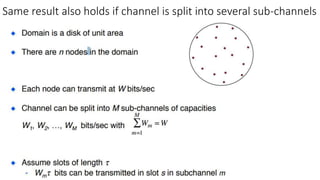
Splitting the channel into several subchannels does not change any of the results.
As the number of nodes per unit area increases, the throughput per source-to-destination (S–D)
pair decreases like
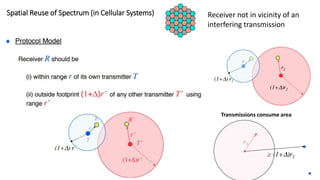
Spatial Reuse of Spectrum (in Cellular Systems) Receiver not in vicinity of an
interfering transmission
Transmissions consume area
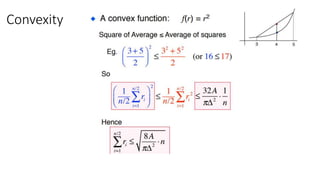
Convexity
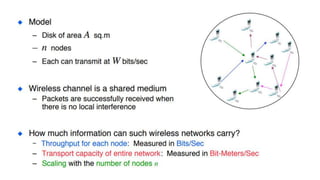
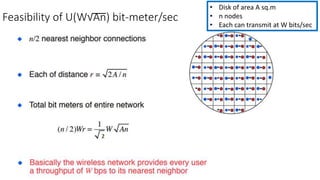
Feasibility of U(W√An) bit-meter/sec
• Disk of area A sq.m
• n nodes
• Each can transmit at W bits/sec
2
Same result also holds if channel is split into several sub-channels
Mobility Increases the Capacity of Ad Hoc Wireless Networks
Matthias Grossglauser and David N. C. Tse
• Spread the traffic to intermediate relay nodes to exploit the multiuser diversity benefits of
having additional “routes” between a source and a destination.
• Two-hop routes are sufficient to achieve the maximum throughput capacity of the network
within the limits imposed by the interference model.
• Appropriate only for delay tolerant applications
• The performance depends strongly on the mobility pattern

MobileAdHocRoutingProtocols.pptx

  • 1.
    1 Lecture on Routingin Mobile Wireless Networks Prof. Maria Papadopouli University of Crete ICS-FORTH http://www.ics.forth.gr/mobile Wireless Networks & Mobile Computing
  • 2.
    ACKNOWLEDGEMENT: Slides used frompresentations by Manolis Spanakis, Michalis Faloutsos P.R. Kumar, Charles Perkins, Kurose & Ross
  • 3.
    Issues • Limited wirelesstransmission range • Broadcast nature of the wireless medium • Hidden terminal problem • Packet losses due to transmission errors • Mobility-induced route changes • Mobility-induced packet losses • Battery constraints • Potentially frequent network partitions • Ease of snooping on wireless transmissions (security hazard)
  • 4.
    Diversity in MobileAd Hoc Networks • Traffic characteristics, wireless link quality, bit rate, mobility • Reliability & delay requirements, unicast, multicast • Host-based/ content-based/ capability-based addressing • Co-exist and Co-operate with infrastructure-based networks • Symmetric vs. Asymmetric (nodes’ capabilities and responsibilities) • Pervasive (cheap) devices: Power constraints • Security/Confidentiality issues
  • 5.
    Mobile Ad HocNetworks (MANET) • Formed by a collection of wireless mobile hosts • Without any pre-existing infrastructure or the aid of any centralized administration • Network characteristics change over time • Routes between nodes may potentially contain multiple hops • Number of hosts in the network
  • 6.
    Routing Issues • Whichis the best path? • Shortest path (fewest hops) • Lowest latency • Shortest weighted path (utilize available bandwidth, battery)? • Who decides? Source, intermediate, or destination nodes? Source (“path”) routing [Like airline travel] • Source specifies entire route • Intermediate nodes just forward to specified next hop Destination (“hop-by-hop”) routing [Like postal service] • Source specifies only destination in message header • Intermediate nodes look at destination in header, consult internal tables to determine appropriate next hop
  • 7.
    Proactive Protocols • Proactive:maintain routing information independently of need for communication • Update messages send throughout the network periodically or when network topology changes • Low latency, suitable for real-time traffic • Bandwidth might get wasted due to periodic updates • They maintain O(N) state per node, N = #nodes
  • 8.
    On-Demand or ReactiveRouting • Reactive: discover route only when you need it • Saves energy and bandwidth during inactivity • Can be bursty -> congestion during high activity • Significant delay might occur as a result of route discovery • Good for light loads, collapse in large loads
  • 9.
    Hybrid Routing • Proactivefor neighborhood, reactive for far away • Proactive for long distance, reactive for neighborhood • Attempts to strike balance between the two
  • 10.
    Hierarchical Routing • Nodesare organized in clusters • Cluster head “controls” cluster • Trade off • Overhead and confusion for leader election • Scalability: intra-cluster vs intercluster • One or Multiple levels of hierarchy
  • 11.
    Geographical Routing • Nodesknow their geo coordinates (GPS) • Route to move packet closer to end point • Protocols DREAM, GPSR, LAR • Propagate geo info by flooding (decrease frequency for long distances)
  • 12.
    IETF MANET WorkingGroup The purpose of the MANET working group is to standardize IP routing protocol functionality suitable for wireless routing application within both static & dynamic topologies with increased dynamics due to node motion or other factors. Approaches are intended to be • lightweight in nature, • suitable for multiple hardware and wireless environments, and • address scenarios where MANETs are deployed at the edges of an IP infrastructure. • Hybrid mesh infrastructures (e.g., a mixture of fixed and mobile routers) should also be supported by MANET specifications and management features. • Using mature components from previous work on experimental reactive and proactive protocols, the WG will develop two Standards track routing protocol specifications: • Reactive MANET Protocol (RMP) & Proactive MANET Protocol (PMP) • The charter and official IETF Home Page for manet are found at https://datatracker.ietf.org/wg/manet/charter
  • 13.
    A Taxonomy ofRouting Protocols
  • 14.
    Trade offs • Latencyof route discovery • Proactive protocols may have lower latency since routes are maintained at all times • Reactive protocols may have higher latency because a route from X to Y will be found only when X attempts to send to Y • Overhead of route discovery/maintenance • Reactive protocols may have lower overhead since routes are determined only if needed • Proactive protocols can (but not necessarily) result in higher overhead due to continuous route updating • Which approach achieves a better trade-off depends on the traffic & mobility patterns
  • 15.
    Dynamic Source Routing(DSR) • Source routing: entire path to destination supplied by source in packet header • Utilizes extension header following standard IP header to carry protocol information (route to destination) • Route discovery: Undertaken when source needs a route to a destination • Route maintenance: Is used only when the source is actually sending packets & detect network topology changes • Intermediate nodes cache overheard routes • “Eavesdrop” on routes contained in headers • Reduces need for route discovery • Intermediate node may return Route Reply to source, if it already has a path stored By David Johnson, David Maltz, Josh Broch
  • 18.
    • Route Replycan be sent by reversing the route in Route Request (RREQ) only if links are guaranteed to be bi-directional • To ensure this, RREQ should be forwarded only if it received on a link that is known to be bi-directional • If unidirectional (asymmetric) links are allowed, then RREP may need a route discovery for S from node D Unless node D already knows a route to node S • If a route discovery is initiated by D for a route to S, then the Route Reply is piggybacked on the Route Request from D • If IEEE 802.11 MAC is used to send data, then links have to be bi-directional (since Ack is used)
  • 19.
    Key points • NodeS on receiving RREP, caches the route included in the RREP • When node S sends a data packet to D, the entire route is included in the packet header (hence the name source routing) • Intermediate nodes use the source route included in a packet to determine to whom a packet should be forwarded
  • 20.
    DSR – AdvantagesDisadvantages • Packet header size grows with route length due to source routing • Flood of route requests may potentially reach all nodes in the network • Care must be taken to avoid collisions between route requests propagated by neighboring nodes • Insertion of random delays before forwarding RREQ • Routes maintained only between nodes who need to communicate • Reduces overhead of route maintenance • Route caching can further reduce route discovery overhead • A single route discovery may yield many routes to the destination due to intermediate nodes replying from local caches • Automatic route shortening, if one or more of their intermediate hops become unnecessary
  • 21.
    Ad-hoc On-demand DistanceVector (AODV) Routes are discovered on an as-needed basis 1. When a node needs a route to a destination, it broadcasts a RREQ 2. Any node with a current route to that destination can unicast a RREP back to the source node 3. Route info is maintained by each node in its route table 4. Information obtained through RREQ & RREP messages is kept with other routing info in the routing table 5. Sequence numbers are used to eliminate stale routes 6. Routes with old sequence numbers are aged out of the system • By Charles Perkins, Elizabeth Royer
  • 22.
    Ad-hoc On-demand DistanceVector (AODV) Protocol • Hop-by-hop protocol: intermediate nodes use lookup table to determine next hop based on destination • Utilizes only standard IP header Route discovery Undertaken whenever a node needs a “next hop” to forward a packet to a destination Route maintenance Used when link breaks, rendering next hop unusable Route Discovery 1. Route Request: • Source broadcasts Route Request (RREQ) message for specified destination • Intermediate node Forward message toward destination 2. Route Reply • Destination unicasts Route Reply msg to source • Intermediate node creates next-hop entry for destination & forwards the reply • If source receives multiple replies, it uses the one with lowest hop count
  • 23.
    Zone Routing Protocol(ZRP) • A zone is defined around each node: k-neighborhood, which consists of all nodes within k hops of the node • Border nodes are nodes which are exactly k hops away from a source node • Hybrid Scheme • Proactively maintains routes within a local region (routing zone) • Also a globally reactive route query/reply mechanism available • If a packet's destination is in the same zone as the origin, the proactive protocol using an already stored routing table is used to deliver the packet immediately • If the route extends outside the packet's originating zone, a reactive protocol takes over to check each successive zone in the route to see whether the destination is inside that zone This reduces the processing overhead for those routes. Once a zone is confirmed as containing the destination node, the proactive protocol, or stored route-listing table, is used to deliver the packet. By Zygmunt Haas, Marc Pearlman
  • 24.
    Inter-zone Routing • Forroutes beyond the local zone, route discovery happens reactively. • Source node sends a route request to the border nodes of its zone, containing its own address, the destination address and a unique sequence number. • Each border node checks its local zone for the destination. • If the destination is not a member of this local zone, the border node adds its own address to the route request packet and forwards the packet to its own border nodes. • If the destination is a member of the local zone, it sends a route reply on the reverse path back to the source. • The source node uses the path saved in the route reply packet to send data packets to the destination. One of H’s border nodes, B, recognizes D as being in its routing zone and responds to the route request of S, indicating the forwarding path S-> H-> B -> D
  • 25.
    25 Location-Aided Routing (LAR)- Basic Idea • Route discovery using flooding algorithm has large overhead • When nodes know their location, improve routing by minimizing search zone & reducing routing overhead • Use last known location information & average speed for route discovery • Limited destination zone (expected zone) • Restricted flooding (request zone) • Route discovery is initiated when source does not know a route to a destination or previous route is broken • Further reduction of the search zone, when speed & direction information is available • Also increases the probability to find a node
  • 26.
    Rules for selectingthe next relay N • S: Source, D: destination, N: candidate relay/neighbor • N is the node closest to D (Greedy Routing) • N is the node with the minimum angle with the destination (Compass Routing) • N has the largest progress (i.e. projection of SN on SD line is largest) (MFR) • N is the closest to S that is also towards D (good when channel is noisy) (NFP) • N is randomly chosen among those neighbors closer to D • N maximizes progress over cost 26
  • 28.
    An example 28 D Selected by CompassRouting Selected by Greedy Routing Might be selected under random selection Cannot be selected Selected by NFP
  • 29.
    Advantages of GeographicRouting • Robust with respect to change of topology Who handles the packet is unimportant, and can be decided at the very last moment. • Very little state is needed With traditional routing, nodes need to keep (and update) routing tables and/or packets need to carry the routes they will follow It scales very well with network size. 29 Local Maximum Problem Challenge: While forwarding, it is possible that the best node to receive the packet is the current holder.
  • 30.
    Mesh networks: hybridtechnology, blends a fixed wireless backbone with an edge network consisting of mobile users.
  • 31.
  • 32.
    Mesh Networks • Multi-hopwireless network. Aim to extend the coverage range without sacrificing the channel capacity as well as provide non-line-of-sight (NLOS) connectivity among the users without direct line-of-sight. • Mesh routers usually have minimal mobility, while mesh clients can be stationary or mobile nodes. Mesh routers usually do not have strict constraints on power consumption. However, mesh clients may require power efficient protocols. • In WMNs, both backhaul access to the Internet and peer-to-peer (P2P) communications are supported. In addition, the integration of WMNs with other wireless networks and providing services to end-users of these networks can be accomplished through WMNs. • Support for ad hoc networking, and capability of self-forming, self-healing, and self- organization. WMNs enhance network performance, because of flexible network architecture, easy deployment and configuration, fault tolerance, and mesh connectivity, i.e., multipoint-to-multipoint communications. • Dedicated routing and configuration. Unlike ad hoc networks, in which end-user devices perform routing, in WMNs, mesh routers perform this functionality.
  • 33.
    Routing Metrics • HopCount: Number of hops between the source and the destination. • Expected Transmission Count (ETX): Accounts for data loss due to medium access contention & environmental hazards, and considers the number of retransmissions needed to successfully transmit a packet over a link • Expected Transmission Time (ETT): enhancement of ETX; further includes the bandwidth of the link in its computation. • Energy consumption: A node energy level can be considered as a routing metric if some nodes are energy-constrained and their involvement in the routing process can lead to path failure if they suffer from energy depletion. • Path availability/reliability: Percentage of time a path is available. Node mobility effect can be captured by this metric; Particularly important in MANET.
  • 34.
    Routing in MeshNetworks • Variation of DSR using the expected transmission time as a metric instead of the number of hops (i.e., the shortest paths are determined based on least packet loss) • Enhancing existing routing protocols with new routing metrics more appropriate for WMNs. • The fixed wireless backbone allows a better estimation of the link quality through regular measurements. • Employ channel diversity in the network infrastructure so as to reduce interference and increase overall throughput.
  • 35.
    A fundamental Cost/DelayTradeoff • C/DEGs capture a fundamental tradeoff of DTNs: the cost of transporting a packet from node A to node B with a delay of at most T is a decreasing function of T. • If we are willing to wait for more time, the topology might become more favorable. • In the C/DEG setting, the smallest-cost journey of delay at most T is found considering all C/DEG paths of delay at most T. Increasing T implies more paths are considered. 35
  • 36.
    Portable mobile networking •Requires connection to same provider (ISP) • Cellular systems, Bluetooth, Wireless Ethernet
  • 37.
    Mobility & StandardIP Routing • IP assumes end hosts are in fixed physical locations • IP addresses enable IP routing algorithms to get packets to the correct network • IP address has network part and host part • Host part should not be in routing tables • What if a user roams between networks? • Want transparency • Routing information becomes invalid • Why can’t mobile users change IP when running an application?
  • 39.
    Mobile IP Architecture- Entities • Mobile Node (MN) - node moving to different network, with permanent HΑ • Home Agent (HA) - router on a MN’s home network which tunnels datagrams for delivery to MN when away from home, maintains current location information for MN • Home Address - static fixed IP address allocated to a MN by HA • Home Network – MN’s home network with a specific prefix/network id-matching address • Foreign Network - the MN’s visiting network other than home network • Foreign Agent - router in visiting network that provides CoA & tunneling with HA to forward packets to MN • Care-of Address (CoA) - termination point of a tunnel toward a MN in the foreign network • Mobility Binding - the association of a home address with a care-of address (CoA) • Correspondent Node (CN) - a peer node with which a MN is communicating
  • 52.
    • Packet Sniffing,Denial Of service, and Hijacking of session • Firewalls block all classes of incoming packets that do not meet specified criteria. • Enterprise firewalls are typically configured to block packets from entering via the Internet that appear to emanate from internal computers. Although this permits management of internal Internet nodes without great attention to security, it presents difficulties for mobile nodes wishing to communicate with other nodes within their home enterprise networks. Such communications, originating from the mobile node, carry the mobile node's home address, and would thus be blocked by the firewall. Security Challenges in Mobile IP
  • 53.
    Mobility in cellularnetworks 1. The call is routed from the correspondent through the PSTN to the home MSC in the mobile’s home network. 2. The home MSC receives the call and interrogates the HLR to determine the location of the mobile user. 3. The HLR returns the mobile station roaming number (MSRN) (similar to the care-of-address in Mobile IP) • Temporarily assigned to a mobile when it enters a visited network • Different from the permanent phone number of the mobile 4. Home MSC sets up the second leg of the call through the network to the MSC in the visited network. The call is completed, being routed from the correspondent to the home MSC, and from there to the visited MSC, and from there to the base station serving the mobile user. maintains a database known as the visitor location register VLR contains an entry for each mobile user that is currently in its network
  • 54.
    The Capacity ofWireless Network Theoretical perspective, Gupta Kumar seminal paper • The capacity of a wireless network is where n nodes, W channel capacity, and the nodes are optimally placed in a disk of unit area, the range of each transmission is optimally selected. The throughput capacity diminishes as the number of nodes increases. Fundamentally, it is the need for every node all over the domain to share whatever portion of the channel it is utilizing with nodes in its local neighborhood that is the reason for the constriction in capacity. Splitting the channel into several subchannels does not change any of the results. As the number of nodes per unit area increases, the throughput per source-to-destination (S–D) pair decreases like
  • 57.
    Spatial Reuse ofSpectrum (in Cellular Systems) Receiver not in vicinity of an interfering transmission Transmissions consume area
  • 58.
  • 59.
    Feasibility of U(W√An)bit-meter/sec • Disk of area A sq.m • n nodes • Each can transmit at W bits/sec 2
  • 61.
    Same result alsoholds if channel is split into several sub-channels
  • 62.
    Mobility Increases theCapacity of Ad Hoc Wireless Networks Matthias Grossglauser and David N. C. Tse • Spread the traffic to intermediate relay nodes to exploit the multiuser diversity benefits of having additional “routes” between a source and a destination. • Two-hop routes are sufficient to achieve the maximum throughput capacity of the network within the limits imposed by the interference model. • Appropriate only for delay tolerant applications • The performance depends strongly on the mobility pattern