Routing Protocols
in MANETs
CS290F
Winter 2005
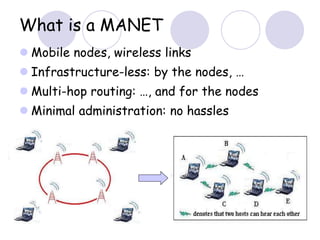
What is a MANET
 Mobile nodes, wireless links
 Infrastructure-less: by the nodes, …
 Multi-hop routing: …, and for the nodes
 Minimal administration: no hassles
What’s unique about a MANET ?
 Moving nodes  ever changing topology
 Wireless links
  various and volatile link quality
 Pervasive (cheap) devices
 Power constraints
 Security
 Confidentiality, other attacks
Challenges in MANET Routing
 Need dynamic routing
Frequent topological changes possible.
Very different from dynamic routing in the Internet.
Potential of network partitions.
 Routing overhead must be kept minimal
Wireless  low bandwidth
Mobile  low power
Minimize # of routing control messages
Minimize routing state at each node
Other Challenges
 Auto configuration issues
 Address assignment
 Service discovery
 Security issues
 Ease of denial-of-service attack
 Misbehaving nodes difficult to identify
 Nodes can be easily compromised
 New Applications/services
 Location based: Distribute some information to all nodes in a
geographic area (geocast).
 Content based: Query all sensors that sensed something
particular in the past hour.
MANET Protocol Zoo
 Topology based routing
 Proactive approach, e.g., DSDV.
 Reactive approach, e.g., DSR, AODV, TORA.
 Hybrid approach, e.g., Cluster, ZRP.
 Position based routing
 Location Services:
DREAM, Quorum-based, GLS, Home zone etc.
 Forwarding Strategy:
Greedy, GPSR, RDF, Hierarchical, etc.
Routing Protocols
 Reactive (On-demand) protocols
Discover routes when needed
Source-initiated route discovery
 Proactive protocols
Traditional distributed shortest-path protocols
Based on periodic updates. High routing overhead
 Tradeoff
State maintenance traffic vs. route discovery traffic
Route via maintained route vs. delay for route
discovery
Reactive Routing
 Key Goal: Reduction in routing overhead
Useful when number of traffic sessions is much
lower than the number of nodes.
 No routing structure created a priori. Let
the structure emerge in response to a
need
 Two key methods for route discovery
source routing
backward learning (similar to intra-AS routing)
 Introduces delay
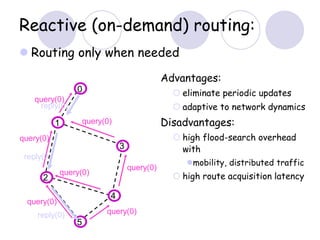
Reactive (on-demand) routing:
 Routing only when needed
0
5
1
2
4
3
query(0)
query(0)
query(0)
query(0)
query(0)
query(0)
query(0)
reply(0)
reply(0)
reply(0)
Advantages:
 eliminate periodic updates
 adaptive to network dynamics
Disadvantages:
 high flood-search overhead
with
mobility, distributed traffic
 high route acquisition latency
Reactive Routing – Source initiated
 Source floods the network with a route request
packet when a route is required to a destination
 Flood is propagated outwards from the source
 Pure flooding = every node transmits the request only
once
 Destination replies to request
 Reply uses reversed path of route request
 sets up the forward path
 Two key protocols: DSR and AODV
Dynamic Source Routing (DSR)
 Cooperative nodes
 Relatively small network diameter (5-10 hops)
 Detectable packet error
 Unidirectional or bidirectional link
 Promiscuous mode (optional)
A
B
C
E
D
G
H
F
A
A
A-B
A-C
A-C-E
A-C-E
A-C-E
A-B-D
A-B-D-G
A-B-D-G
A-B-D-G
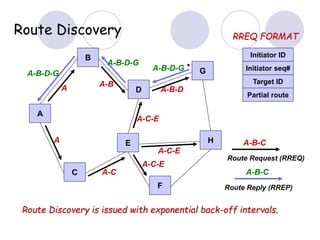
Route Discovery
A-B-C
A-B-C
Route Request (RREQ)
Route Reply (RREP)
Route Discovery is issued with exponential back-off intervals.
Initiator ID
Initiator seq#
Target ID
Partial route
RREQ FORMAT
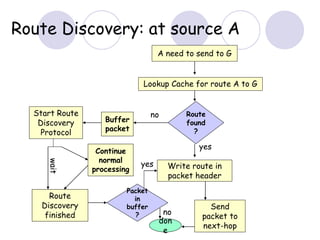
Route Discovery: at source A
A need to send to G
Lookup Cache for route A to G
Route
found
?
Start Route
Discovery
Protocol
Continue
normal
processing
Route
Discovery
finished
Packet
in
buffer
?
Send
packet to
next-hop
don
e
Buffer
packet
no
Write route in
packet header
yes
yes
no
wait
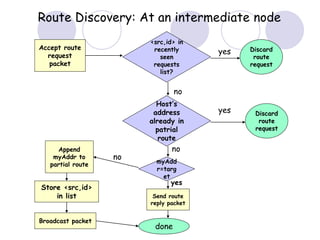
Route Discovery: At an intermediate node
Accept route
request
packet
<src,id> in
recently
seen
requests
list?
Discard
route
request
yes
no
Host’s
address
already in
patrial
route
Discard
route
request
yes
Store <src,id>
in list
Broadcast packet
Send route
reply packet
done
myAdd
r=targ
et
no
Append
myAddr to
partial route
no
yes
DSR - Route Discovery
 Route Reply message containing path information is
sent back to the source either by
the destination, or
intermediate nodes that have a route to the
destination
 Reverse the order of the route record, and include it in
Route Reply.
 Unicast, source routing
 Each node maintains a Route Cache which records
routes it has learned and overheard over time
Route Maintenance
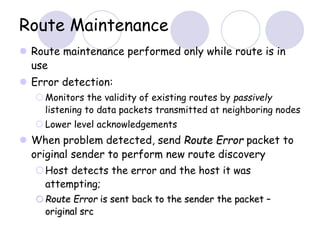
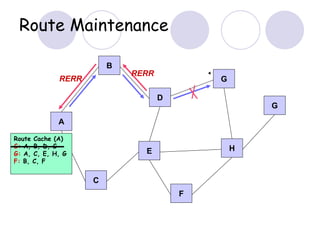
 Route maintenance performed only while route is in
use
 Error detection:
 Monitors the validity of existing routes by passively
listening to data packets transmitted at neighboring nodes
 Lower level acknowledgements
 When problem detected, send Route Error packet to
original sender to perform new route discovery
Host detects the error and the host it was
attempting;
 Route Error is sent back to the sender the packet –
original src
A
B
C
E
D
G
H
F
G
RERR
RERR
Route Cache (A)
G: A, B, D, G
G: A, C, E, H, G
F: B, C, F
Route Maintenance
A Summary of DSR
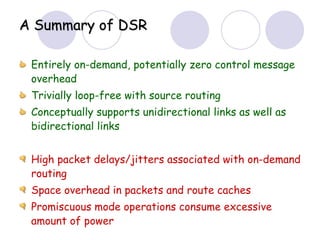
Entirely on-demand, potentially zero control message
overhead
Trivially loop-free with source routing
Conceptually supports unidirectional links as well as
bidirectional links
High packet delays/jitters associated with on-demand
routing
Space overhead in packets and route caches
Promiscuous mode operations consume excessive
amount of power
Break…
Then AODV
AODV Routing Protocol
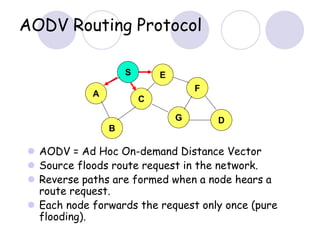
 AODV = Ad Hoc On-demand Distance Vector
 Source floods route request in the network.
 Reverse paths are formed when a node hears a
route request.
 Each node forwards the request only once (pure
flooding).
A
S E
F
B
C
G D
AODV Route Discovery
A
S E
F
B
C
G D
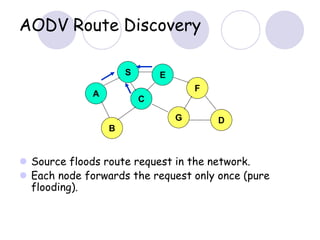
 Source floods route request in the network.
 Each node forwards the request only once (pure
flooding).
AODV Route Discovery
A
S E
F
B
C
G D
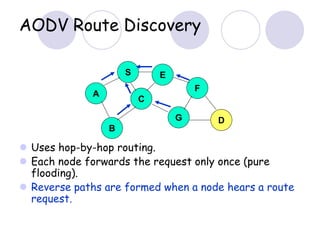
 Uses hop-by-hop routing.
 Each node forwards the request only once (pure
flooding).
 Reverse paths are formed when a node hears a route
request.
AODV Route Discovery
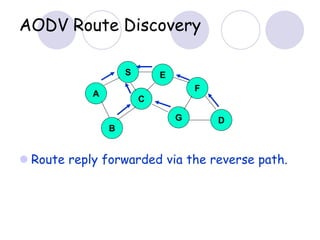
 Route reply forwarded via the reverse path.
A
S E
F
B
C
G D
AODV Route Discovery
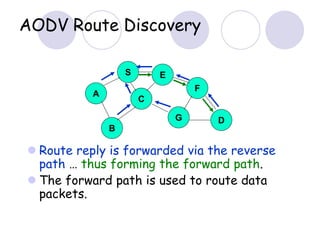
 Route reply is forwarded via the reverse
path … thus forming the forward path.
 The forward path is used to route data
packets.
A
S E
F
B
C
G D
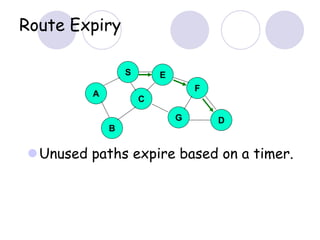
Route Expiry
Unused paths expire based on a timer.
A
S E
F
B
C
G D
AODV – Optimization
 Useful optimization: An intermediate node
with a route to D can reply to route request.
Faster operation.
Quenches route request flood.
 Above optimization can cause loops in
presence of link failures
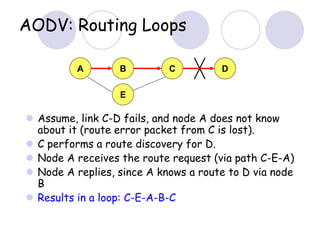
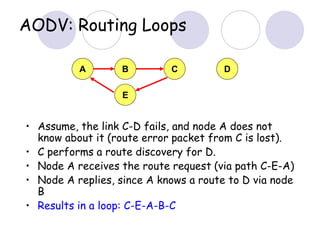
AODV: Routing Loops
 Assume, link C-D fails, and node A does not know
about it (route error packet from C is lost).
 C performs a route discovery for D.
 Node A receives the route request (via path C-E-A)
 Node A replies, since A knows a route to D via node
B
 Results in a loop: C-E-A-B-C
A B C D
E
AODV: Routing Loops
A B C D
E
• Assume, the link C-D fails, and node A does not
know about it (route error packet from C is lost).
• C performs a route discovery for D.
• Node A receives the route request (via path C-E-A)
• Node A replies, since A knows a route to D via node
B
• Results in a loop: C-E-A-B-C
AODV: Use Sequence Numbers
 Each node X maintains a sequence number
acts as a time stamp
incremented every time X sends any message)
 Each route to X (at any node Y) also has X’s
sequence number associated with it, which is
Y’s latest knowledge of X’s sequence number.
 Sequence number signifies ‘freshness’ of the
route – higher the number, more up to date is
the route.
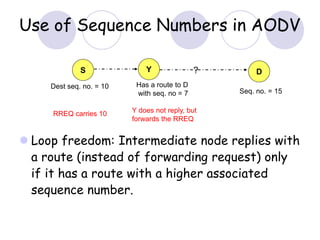
Use of Sequence Numbers in AODV
 Loop freedom: Intermediate node replies with
a route (instead of forwarding request) only
if it has a route with a higher associated
sequence number.
S Y D
?
Dest seq. no. = 10 Has a route to D
with seq. no = 7 Seq. no. = 15
RREQ carries 10 Y does not reply, but
forwards the RREQ
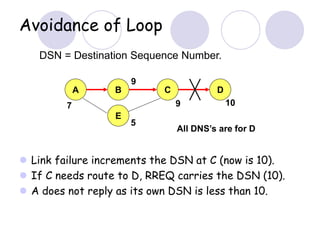
Avoidance of Loop
 Link failure increments the DSN at C (now is 10).
 If C needs route to D, RREQ carries the DSN (10).
 A does not reply as its own DSN is less than 10.
A B C D
E
10
9
9
7
5
All DNS’s are for D
DSN = Destination Sequence Number.
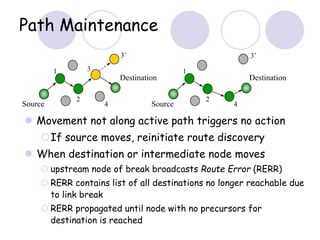
Path Maintenance
 Movement not along active path triggers no action
If source moves, reinitiate route discovery
 When destination or intermediate node moves
 upstream node of break broadcasts Route Error (RERR)
 RERR contains list of all destinations no longer reachable due
to link break
 RERR propagated until node with no precursors for
destination is reached
Source
Destination
1
2
3
4
3’
Source
Destination
1
2
4
3’
Summary: AODV
 At most one route per destination maintained
at each node
After link break, all routes using the failed link are
erased.
 Expiration based on timeouts.
 Use of sequence numbers to prevent loops.
 Optimizations
 Routing tables instead of storing full routes.
 Control flooding (incrementally increase ‘region’)
Questions…
Other notes
Acknowledgements
DSR Slides:
Yinzhe Yu (umn.edu)
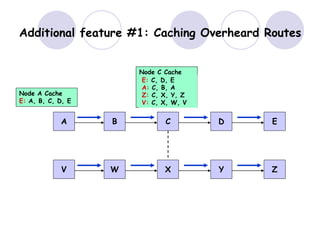
Additional feature #1: Caching Overheard Routes
A B C D E
V W X Y Z
Node A Cache
E: A, B, C, D, E
Node C Cache
E: C, D, E
E: C, D, E
A: C, B, A
E: C, D, E
A: C, B, A
Z: C, X, Y, Z
V: C, X, W, V
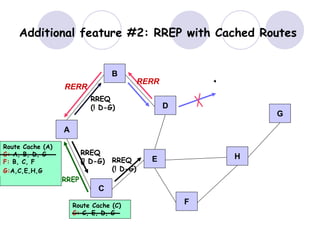
Additional feature #2: RREP with Cached Routes
A
B
C
E
D
H
F
G
RERR
RERR
Route Cache (A)
G: A, B, D, G
F: B, C, F
RREQ
RREQ
Route Cache (C)
G: C, E, H, G
RREP
G:A,C,E,H,G
Route Cache (C)
G: C, E, D, G
RREQ
(! D-G)
RREQ
(! D-G) RREQ
(! D-G)
A
B
C
E
D
G
H
F
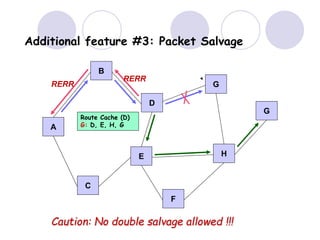
Additional feature #3: Packet Salvage
G
RERR
RERR
Route Cache (D)
G: D, E, H, G
Caution: No double salvage allowed !!!
Proposed Routing Approaches
 Conventional wired-type schemes (global
routing, proactive):
Distance Vector; Link State
 Hierarchical (global routing) schemes:
Fisheye, Hierarchical State Routing, Landmark
Routing
 On- Demand, reactive routing:
Source routing; backward learning
 Location Assisted routing (Geo-routing):
DREAM, LAR etc
Conventional wired routing
limitations
 Distance Vector (eg, Bellman-Ford, DSDV):
routing control O/H linearly increasing with net size
convergence problems (count to infinity); potential
loops
 Link State (eg, OSPF):
link update flooding O/H caused by frequent
topology changes
CONVENTIONAL ROUTING DOES NOT SCALE TO SIZE AND
MOBILITY
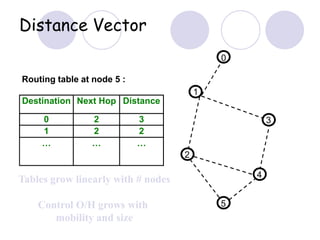
Distance Vector
0
5
1
2
4
3
Destination Next Hop Distance
0 2 3
1 2 2
… … …
Routing table at node 5 :
Tables grow linearly with # nodes
Control O/H grows with
mobility and size
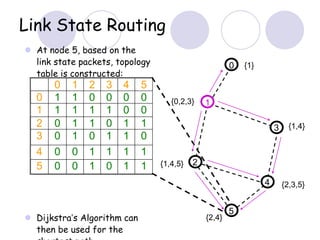
Link State Routing
 At node 5, based on the
link state packets, topology
table is constructed:
 Dijkstra’s Algorithm can
then be used for the
0
5
1
2
4
3
{1}
{0,2,3}
{1,4}
{2,4}
{2,3,5}
{1,4,5}
0 1 2 3 4 5
0 1 1 0 0 0 0
1 1 1 1 1 0 0
2 0 1 1 0 1 1
3 0 1 0 1 1 0
4 0 0 1 1 1 1
5 0 0 1 0 1 1
Existing On-Demand Protocols
 Dynamic Source Routing (DSR)
 Associativity-Based Routing (ABR)
 Ad-hoc On-demand Distance Vector (AODV)
 Temporarily Ordered Routing Algorithm (TORA)
 Zone Routing Protocol (ZRP)
 Signal Stability Based Adaptive Routing (SSA)
 On Demand Multicast Routing Protocol (ODMRP)
 …

RoutingProtocols.ppt

  • 1.
  • 2.
    What is aMANET  Mobile nodes, wireless links  Infrastructure-less: by the nodes, …  Multi-hop routing: …, and for the nodes  Minimal administration: no hassles
  • 3.
    What’s unique abouta MANET ?  Moving nodes  ever changing topology  Wireless links   various and volatile link quality  Pervasive (cheap) devices  Power constraints  Security  Confidentiality, other attacks
  • 4.
    Challenges in MANETRouting  Need dynamic routing Frequent topological changes possible. Very different from dynamic routing in the Internet. Potential of network partitions.  Routing overhead must be kept minimal Wireless  low bandwidth Mobile  low power Minimize # of routing control messages Minimize routing state at each node
  • 5.
    Other Challenges  Autoconfiguration issues  Address assignment  Service discovery  Security issues  Ease of denial-of-service attack  Misbehaving nodes difficult to identify  Nodes can be easily compromised  New Applications/services  Location based: Distribute some information to all nodes in a geographic area (geocast).  Content based: Query all sensors that sensed something particular in the past hour.
  • 6.
    MANET Protocol Zoo Topology based routing  Proactive approach, e.g., DSDV.  Reactive approach, e.g., DSR, AODV, TORA.  Hybrid approach, e.g., Cluster, ZRP.  Position based routing  Location Services: DREAM, Quorum-based, GLS, Home zone etc.  Forwarding Strategy: Greedy, GPSR, RDF, Hierarchical, etc.
  • 7.
    Routing Protocols  Reactive(On-demand) protocols Discover routes when needed Source-initiated route discovery  Proactive protocols Traditional distributed shortest-path protocols Based on periodic updates. High routing overhead  Tradeoff State maintenance traffic vs. route discovery traffic Route via maintained route vs. delay for route discovery
  • 8.
    Reactive Routing  KeyGoal: Reduction in routing overhead Useful when number of traffic sessions is much lower than the number of nodes.  No routing structure created a priori. Let the structure emerge in response to a need  Two key methods for route discovery source routing backward learning (similar to intra-AS routing)  Introduces delay
  • 9.
    Reactive (on-demand) routing: Routing only when needed 0 5 1 2 4 3 query(0) query(0) query(0) query(0) query(0) query(0) query(0) reply(0) reply(0) reply(0) Advantages:  eliminate periodic updates  adaptive to network dynamics Disadvantages:  high flood-search overhead with mobility, distributed traffic  high route acquisition latency
  • 10.
    Reactive Routing –Source initiated  Source floods the network with a route request packet when a route is required to a destination  Flood is propagated outwards from the source  Pure flooding = every node transmits the request only once  Destination replies to request  Reply uses reversed path of route request  sets up the forward path  Two key protocols: DSR and AODV
  • 11.
    Dynamic Source Routing(DSR)  Cooperative nodes  Relatively small network diameter (5-10 hops)  Detectable packet error  Unidirectional or bidirectional link  Promiscuous mode (optional)
  • 12.
    A B C E D G H F A A A-B A-C A-C-E A-C-E A-C-E A-B-D A-B-D-G A-B-D-G A-B-D-G Route Discovery A-B-C A-B-C Route Request(RREQ) Route Reply (RREP) Route Discovery is issued with exponential back-off intervals. Initiator ID Initiator seq# Target ID Partial route RREQ FORMAT
  • 13.
    Route Discovery: atsource A A need to send to G Lookup Cache for route A to G Route found ? Start Route Discovery Protocol Continue normal processing Route Discovery finished Packet in buffer ? Send packet to next-hop don e Buffer packet no Write route in packet header yes yes no wait
  • 14.
    Route Discovery: Atan intermediate node Accept route request packet <src,id> in recently seen requests list? Discard route request yes no Host’s address already in patrial route Discard route request yes Store <src,id> in list Broadcast packet Send route reply packet done myAdd r=targ et no Append myAddr to partial route no yes
  • 15.
    DSR - RouteDiscovery  Route Reply message containing path information is sent back to the source either by the destination, or intermediate nodes that have a route to the destination  Reverse the order of the route record, and include it in Route Reply.  Unicast, source routing  Each node maintains a Route Cache which records routes it has learned and overheard over time
  • 16.
    Route Maintenance  Routemaintenance performed only while route is in use  Error detection:  Monitors the validity of existing routes by passively listening to data packets transmitted at neighboring nodes  Lower level acknowledgements  When problem detected, send Route Error packet to original sender to perform new route discovery Host detects the error and the host it was attempting;  Route Error is sent back to the sender the packet – original src
  • 17.
    A B C E D G H F G RERR RERR Route Cache (A) G:A, B, D, G G: A, C, E, H, G F: B, C, F Route Maintenance
  • 18.
    A Summary ofDSR Entirely on-demand, potentially zero control message overhead Trivially loop-free with source routing Conceptually supports unidirectional links as well as bidirectional links High packet delays/jitters associated with on-demand routing Space overhead in packets and route caches Promiscuous mode operations consume excessive amount of power
  • 19.
  • 20.
    AODV Routing Protocol AODV = Ad Hoc On-demand Distance Vector  Source floods route request in the network.  Reverse paths are formed when a node hears a route request.  Each node forwards the request only once (pure flooding). A S E F B C G D
  • 21.
    AODV Route Discovery A SE F B C G D  Source floods route request in the network.  Each node forwards the request only once (pure flooding).
  • 22.
    AODV Route Discovery A SE F B C G D  Uses hop-by-hop routing.  Each node forwards the request only once (pure flooding).  Reverse paths are formed when a node hears a route request.
  • 23.
    AODV Route Discovery Route reply forwarded via the reverse path. A S E F B C G D
  • 24.
    AODV Route Discovery Route reply is forwarded via the reverse path … thus forming the forward path.  The forward path is used to route data packets. A S E F B C G D
  • 25.
    Route Expiry Unused pathsexpire based on a timer. A S E F B C G D
  • 26.
    AODV – Optimization Useful optimization: An intermediate node with a route to D can reply to route request. Faster operation. Quenches route request flood.  Above optimization can cause loops in presence of link failures
  • 27.
    AODV: Routing Loops Assume, link C-D fails, and node A does not know about it (route error packet from C is lost).  C performs a route discovery for D.  Node A receives the route request (via path C-E-A)  Node A replies, since A knows a route to D via node B  Results in a loop: C-E-A-B-C A B C D E
  • 28.
    AODV: Routing Loops AB C D E • Assume, the link C-D fails, and node A does not know about it (route error packet from C is lost). • C performs a route discovery for D. • Node A receives the route request (via path C-E-A) • Node A replies, since A knows a route to D via node B • Results in a loop: C-E-A-B-C
  • 29.
    AODV: Use SequenceNumbers  Each node X maintains a sequence number acts as a time stamp incremented every time X sends any message)  Each route to X (at any node Y) also has X’s sequence number associated with it, which is Y’s latest knowledge of X’s sequence number.  Sequence number signifies ‘freshness’ of the route – higher the number, more up to date is the route.
  • 30.
    Use of SequenceNumbers in AODV  Loop freedom: Intermediate node replies with a route (instead of forwarding request) only if it has a route with a higher associated sequence number. S Y D ? Dest seq. no. = 10 Has a route to D with seq. no = 7 Seq. no. = 15 RREQ carries 10 Y does not reply, but forwards the RREQ
  • 31.
    Avoidance of Loop Link failure increments the DSN at C (now is 10).  If C needs route to D, RREQ carries the DSN (10).  A does not reply as its own DSN is less than 10. A B C D E 10 9 9 7 5 All DNS’s are for D DSN = Destination Sequence Number.
  • 32.
    Path Maintenance  Movementnot along active path triggers no action If source moves, reinitiate route discovery  When destination or intermediate node moves  upstream node of break broadcasts Route Error (RERR)  RERR contains list of all destinations no longer reachable due to link break  RERR propagated until node with no precursors for destination is reached Source Destination 1 2 3 4 3’ Source Destination 1 2 4 3’
  • 33.
    Summary: AODV  Atmost one route per destination maintained at each node After link break, all routes using the failed link are erased.  Expiration based on timeouts.  Use of sequence numbers to prevent loops.  Optimizations  Routing tables instead of storing full routes.  Control flooding (incrementally increase ‘region’)
  • 34.
  • 35.
  • 36.
    Additional feature #1:Caching Overheard Routes A B C D E V W X Y Z Node A Cache E: A, B, C, D, E Node C Cache E: C, D, E E: C, D, E A: C, B, A E: C, D, E A: C, B, A Z: C, X, Y, Z V: C, X, W, V
  • 37.
    Additional feature #2:RREP with Cached Routes A B C E D H F G RERR RERR Route Cache (A) G: A, B, D, G F: B, C, F RREQ RREQ Route Cache (C) G: C, E, H, G RREP G:A,C,E,H,G Route Cache (C) G: C, E, D, G RREQ (! D-G) RREQ (! D-G) RREQ (! D-G)
  • 38.
    A B C E D G H F Additional feature #3:Packet Salvage G RERR RERR Route Cache (D) G: D, E, H, G Caution: No double salvage allowed !!!
  • 39.
    Proposed Routing Approaches Conventional wired-type schemes (global routing, proactive): Distance Vector; Link State  Hierarchical (global routing) schemes: Fisheye, Hierarchical State Routing, Landmark Routing  On- Demand, reactive routing: Source routing; backward learning  Location Assisted routing (Geo-routing): DREAM, LAR etc
  • 40.
    Conventional wired routing limitations Distance Vector (eg, Bellman-Ford, DSDV): routing control O/H linearly increasing with net size convergence problems (count to infinity); potential loops  Link State (eg, OSPF): link update flooding O/H caused by frequent topology changes CONVENTIONAL ROUTING DOES NOT SCALE TO SIZE AND MOBILITY
  • 41.
    Distance Vector 0 5 1 2 4 3 Destination NextHop Distance 0 2 3 1 2 2 … … … Routing table at node 5 : Tables grow linearly with # nodes Control O/H grows with mobility and size
  • 42.
    Link State Routing At node 5, based on the link state packets, topology table is constructed:  Dijkstra’s Algorithm can then be used for the 0 5 1 2 4 3 {1} {0,2,3} {1,4} {2,4} {2,3,5} {1,4,5} 0 1 2 3 4 5 0 1 1 0 0 0 0 1 1 1 1 1 0 0 2 0 1 1 0 1 1 3 0 1 0 1 1 0 4 0 0 1 1 1 1 5 0 0 1 0 1 1
  • 43.
    Existing On-Demand Protocols Dynamic Source Routing (DSR)  Associativity-Based Routing (ABR)  Ad-hoc On-demand Distance Vector (AODV)  Temporarily Ordered Routing Algorithm (TORA)  Zone Routing Protocol (ZRP)  Signal Stability Based Adaptive Routing (SSA)  On Demand Multicast Routing Protocol (ODMRP)  …