Macquarie FICCAM – Dynamic Currency Hedging
March 2010
2
Accurate forecasting is near impossible
> Forecasting the future direction
and magnitude of currency
moves is very difficult.
> 8 out of 14 years, expert
forecasts miss the actual rate
by more than 10%.
> In many years experts get the
direction of the currency move
completely wrong (like in 2008)
Source: Macquarie
A professional currency manager
will provide full hedging services
to protect your overseas assets.
-30
-20
-10
0
10
20
30
1996 1998 2000 2002 2004 2006 2008
0.4
0.5
0.6
0.7
0.8
0.9
1
% missed in forecast (LHS) AUD/USD (RHS)
% $
3
The high cost of wrong direction
> During the second half of 2008, the cost of having
the wrong strategy (hedged) versus those with the
right strategy (unhedged) was 34%.
> A wrong hedging strategy may bring a top
performing company to the bottom of the peer
group.
> There is a high correlation between periods of AUD
depreciation and fall in asset value which makes a
wrong decision very costly and unmanageable.
- What happens if your assets are illiquid?
- How do you finance the drawdowns?
34%
Can you leave a 34% fall
unmanaged?
Source: Bloomberg. The results are calculated based on a MSCI currency basket from July 2008 to October 2008
Hedge your overseas assets and choose the
appropriate hedging solution
4
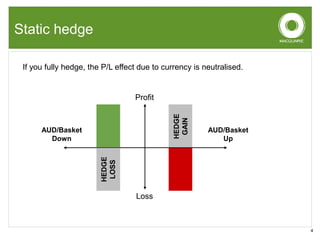
Static hedge
Profit
Loss
AUD/Basket
Down
AUD/Basket
Up
If you fully hedge, the P/L effect due to currency is neutralised.
HEDGE
GAIN
HEDGE
LOSS
5
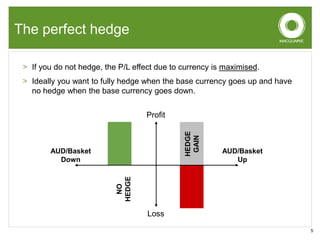
The perfect hedge
Profit
Loss
> If you do not hedge, the P/L effect due to currency is maximised.
HEDGE
GAIN
NO
HEDGE
AUD/Basket
Down
AUD/Basket
Up
> Ideally you want to fully hedge when the base currency goes up and have
no hedge when the base currency goes down.
6
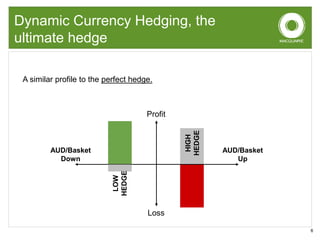
Dynamic Currency Hedging, the
ultimate hedge
Profit
Loss
A similar profile to the perfect hedge.
HIGH
HEDGE
LOW
HEDGE
AUD/Basket
Down
AUD/Basket
Up
7
What is Dynamic Currency Hedging (DCH)?
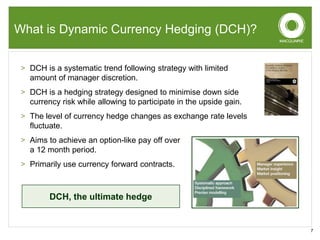
> DCH is a systematic trend following strategy with limited
amount of manager discretion.
> DCH is a hedging strategy designed to minimise down side
currency risk while allowing to participate in the upside gain.
> The level of currency hedge changes as exchange rate levels
fluctuate.
> Aims to achieve an option-like pay off over
a 12 month period.
> Primarily use currency forward contracts.
DCH, the ultimate hedge
8
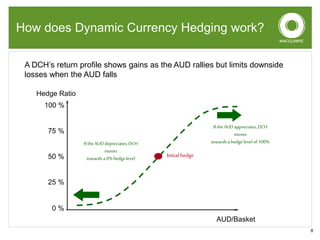
How does Dynamic Currency Hedging work?
AUD/Basket
50 %
25 %
0 %
100 %
75 %
IftheAUDappreciates,DCH
moves
towardsa hedgelevelof100%
Hedge Ratio
IftheAUDdepreciates,DCH
moves
towardsa 0%hedgelevel
A DCH’s return profile shows gains as the AUD rallies but limits downside
losses when the AUD falls
Initial hedge
9
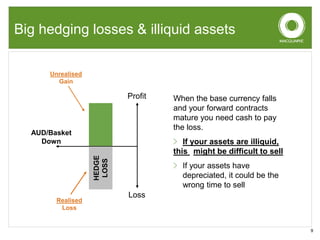
Big hedging losses & illiquid assets
Profit
Loss
When the base currency falls
and your forward contracts
mature you need cash to pay
the loss.
> If your assets are illiquid,
this might be difficult to sell
> If your assets have
depreciated, it could be the
wrong time to sell
HEDGE
LOSS
Unrealised
Gain
Realised
Loss
AUD/Basket
Down
The AUD as a proxy for world growth
10
0.4
0.5
0.6
0.7
0.8
0.9
1
1.1
400
500
600
700
800
900
1000
1100
1200
1300
Dec-05
Mar-06
Jun-06
Sep-06
Dec-06
Mar-07
Jun-07
Sep-07
Dec-07
Mar-08
Jun-08
Sep-08
Dec-08
Mar-09
Jun-09
Sep-09
Dec-09
AUD/USD
MSCI World
(Local Currency)
Source: Bloomberg, Morgan Stanley.
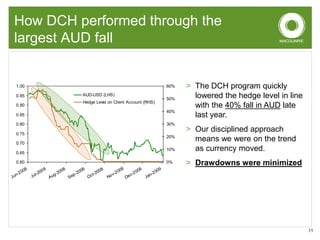
How DCH performed through the
largest AUD fall
> The DCH program quickly
lowered the hedge level in line
with the 40% fall in AUD late
last year.
> Our disciplined approach
means we were on the trend
as currency moved.
> Drawdowns were minimized
11
0.60
0.65
0.70
0.75
0.80
0.85
0.90
0.95
1.00
Jun-2008
Jul-2008
Aug-2008
Sep-2008
Oct-2008
Nov-2008
Dec-2008
Jan-2009
0%
10%
20%
30%
40%
50%
60%
AUD-USD (LHS)
Hedge Level on Client Account (RHS)
12
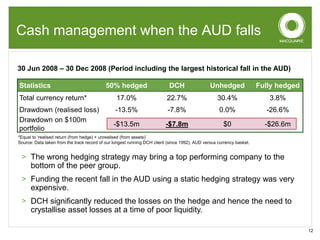
Statistics 50% hedged DCH Unhedged Fully hedged
Total currency return* 17.0% 22.7% 30.4% 3.8%
Drawdown (realised loss) -13.5% -7.8% 0.0% -26.6%
Drawdown on $100m
portfolio
-$13.5m -$7.8m $0 -$26.6m
Cash management when the AUD falls
*Equal to ‘realised return (from hedge) + unrealised (from assets)’
Source: Data taken from the track record of our longest running DCH client (since 1992), AUD versus currency basket.
30 Jun 2008 – 30 Dec 2008 (Period including the largest historical fall in the AUD)
> The wrong hedging strategy may bring a top performing company to the
bottom of the peer group.
> Funding the recent fall in the AUD using a static hedging strategy was very
expensive.
> DCH significantly reduced the losses on the hedge and hence the need to
crystallise asset losses at a time of poor liquidity.
13
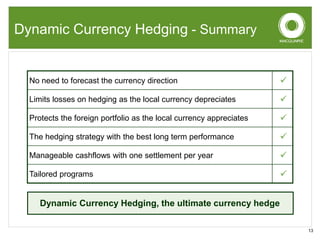
Dynamic Currency Hedging - Summary
Dynamic Currency Hedging, the ultimate currency hedge
No need to forecast the currency direction 
Limits losses on hedging as the local currency depreciates 
Protects the foreign portfolio as the local currency appreciates 
The hedging strategy with the best long term performance 
Manageable cashflows with one settlement per year 
Tailored programs 

Dynamic Currency Hedging

  • 1.
    Macquarie FICCAM –Dynamic Currency Hedging March 2010
  • 2.
    2 Accurate forecasting isnear impossible > Forecasting the future direction and magnitude of currency moves is very difficult. > 8 out of 14 years, expert forecasts miss the actual rate by more than 10%. > In many years experts get the direction of the currency move completely wrong (like in 2008) Source: Macquarie A professional currency manager will provide full hedging services to protect your overseas assets. -30 -20 -10 0 10 20 30 1996 1998 2000 2002 2004 2006 2008 0.4 0.5 0.6 0.7 0.8 0.9 1 % missed in forecast (LHS) AUD/USD (RHS) % $
  • 3.
    3 The high costof wrong direction > During the second half of 2008, the cost of having the wrong strategy (hedged) versus those with the right strategy (unhedged) was 34%. > A wrong hedging strategy may bring a top performing company to the bottom of the peer group. > There is a high correlation between periods of AUD depreciation and fall in asset value which makes a wrong decision very costly and unmanageable. - What happens if your assets are illiquid? - How do you finance the drawdowns? 34% Can you leave a 34% fall unmanaged? Source: Bloomberg. The results are calculated based on a MSCI currency basket from July 2008 to October 2008 Hedge your overseas assets and choose the appropriate hedging solution
  • 4.
    4 Static hedge Profit Loss AUD/Basket Down AUD/Basket Up If youfully hedge, the P/L effect due to currency is neutralised. HEDGE GAIN HEDGE LOSS
  • 5.
    5 The perfect hedge Profit Loss >If you do not hedge, the P/L effect due to currency is maximised. HEDGE GAIN NO HEDGE AUD/Basket Down AUD/Basket Up > Ideally you want to fully hedge when the base currency goes up and have no hedge when the base currency goes down.
  • 6.
    6 Dynamic Currency Hedging,the ultimate hedge Profit Loss A similar profile to the perfect hedge. HIGH HEDGE LOW HEDGE AUD/Basket Down AUD/Basket Up
  • 7.
    7 What is DynamicCurrency Hedging (DCH)? > DCH is a systematic trend following strategy with limited amount of manager discretion. > DCH is a hedging strategy designed to minimise down side currency risk while allowing to participate in the upside gain. > The level of currency hedge changes as exchange rate levels fluctuate. > Aims to achieve an option-like pay off over a 12 month period. > Primarily use currency forward contracts. DCH, the ultimate hedge
  • 8.
    8 How does DynamicCurrency Hedging work? AUD/Basket 50 % 25 % 0 % 100 % 75 % IftheAUDappreciates,DCH moves towardsa hedgelevelof100% Hedge Ratio IftheAUDdepreciates,DCH moves towardsa 0%hedgelevel A DCH’s return profile shows gains as the AUD rallies but limits downside losses when the AUD falls Initial hedge
  • 9.
    9 Big hedging losses& illiquid assets Profit Loss When the base currency falls and your forward contracts mature you need cash to pay the loss. > If your assets are illiquid, this might be difficult to sell > If your assets have depreciated, it could be the wrong time to sell HEDGE LOSS Unrealised Gain Realised Loss AUD/Basket Down
  • 10.
    The AUD asa proxy for world growth 10 0.4 0.5 0.6 0.7 0.8 0.9 1 1.1 400 500 600 700 800 900 1000 1100 1200 1300 Dec-05 Mar-06 Jun-06 Sep-06 Dec-06 Mar-07 Jun-07 Sep-07 Dec-07 Mar-08 Jun-08 Sep-08 Dec-08 Mar-09 Jun-09 Sep-09 Dec-09 AUD/USD MSCI World (Local Currency) Source: Bloomberg, Morgan Stanley.
  • 11.
    How DCH performedthrough the largest AUD fall > The DCH program quickly lowered the hedge level in line with the 40% fall in AUD late last year. > Our disciplined approach means we were on the trend as currency moved. > Drawdowns were minimized 11 0.60 0.65 0.70 0.75 0.80 0.85 0.90 0.95 1.00 Jun-2008 Jul-2008 Aug-2008 Sep-2008 Oct-2008 Nov-2008 Dec-2008 Jan-2009 0% 10% 20% 30% 40% 50% 60% AUD-USD (LHS) Hedge Level on Client Account (RHS)
  • 12.
    12 Statistics 50% hedgedDCH Unhedged Fully hedged Total currency return* 17.0% 22.7% 30.4% 3.8% Drawdown (realised loss) -13.5% -7.8% 0.0% -26.6% Drawdown on $100m portfolio -$13.5m -$7.8m $0 -$26.6m Cash management when the AUD falls *Equal to ‘realised return (from hedge) + unrealised (from assets)’ Source: Data taken from the track record of our longest running DCH client (since 1992), AUD versus currency basket. 30 Jun 2008 – 30 Dec 2008 (Period including the largest historical fall in the AUD) > The wrong hedging strategy may bring a top performing company to the bottom of the peer group. > Funding the recent fall in the AUD using a static hedging strategy was very expensive. > DCH significantly reduced the losses on the hedge and hence the need to crystallise asset losses at a time of poor liquidity.
  • 13.
    13 Dynamic Currency Hedging- Summary Dynamic Currency Hedging, the ultimate currency hedge No need to forecast the currency direction  Limits losses on hedging as the local currency depreciates  Protects the foreign portfolio as the local currency appreciates  The hedging strategy with the best long term performance  Manageable cashflows with one settlement per year  Tailored programs 