5 Aug 03 
Communicating in a Crisis 
John McCracken 
Sydney
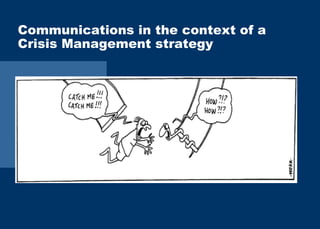
Communications in the context of a 
Crisis Management strategy
What is a Crisis? 
 A Crisis is an escalating incident that poses a 
serious threat to the people, operation, viability 
and/or reputation of an organisation 
Marsh 3
What is Crisis Management? 
 Crisis Management is the implementation and 
management of response, recovery and restoration 
strategies 
 These strategies should be implemented with a view to 
minimising the potential impact an escalating incident can 
have on an organisation’s people, operation, viability 
and/or reputation 
 These actions will assist an organisation to fully recover 
from such an event 
Marsh 4
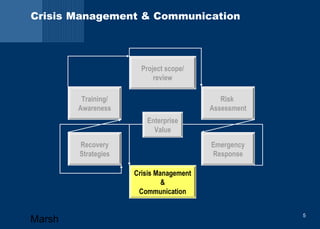
Crisis Management & Communication 
Project scope/ 
review 
Enterprise 
Value 
Crisis Management 
& 
Communication 
Training/ 
Awareness 
Recovery 
Strategies 
Risk 
Assessment 
Emergency 
Response 
Marsh 5
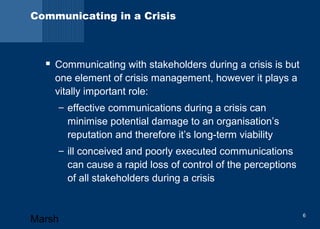
Communicating in a Crisis 
 Communicating with stakeholders during a crisis is but 
one element of crisis management, however it plays a 
vitally important role: 
– effective communications during a crisis can 
minimise potential damage to an organisation’s 
reputation and therefore it’s long-term viability 
– ill conceived and poorly executed communications 
can cause a rapid loss of control of the perceptions 
of all stakeholders during a crisis 
Marsh 6
Internal versus external 
communications strategies and issues
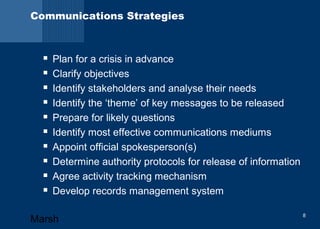
Communications Strategies 
 Plan for a crisis in advance 
 Clarify objectives 
 Identify stakeholders and analyse their needs 
 Identify the ‘theme’ of key messages to be released 
 Prepare for likely questions 
 Identify most effective communications mediums 
 Appoint official spokesperson(s) 
 Determine authority protocols for release of information 
 Agree activity tracking mechanism 
 Develop records management system 
Marsh 8
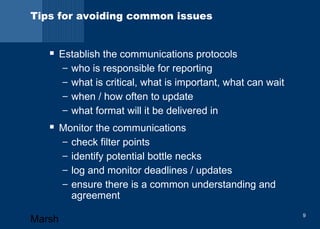
Tips for avoiding common issues 
 Establish the communications protocols 
– who is responsible for reporting 
– what is critical, what is important, what can wait 
– when / how often to update 
– what format will it be delivered in 
 Monitor the communications 
– check filter points 
– identify potential bottle necks 
– log and monitor deadlines / updates 
– ensure there is a common understanding and 
agreement 
Marsh 9
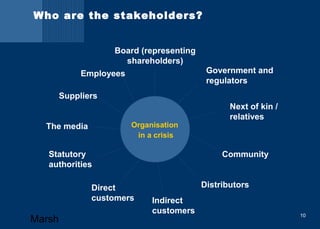
Government and 
regulators 
Next of kin / 
relatives 
Community 
Who are the stakeholders? 
Distributors 
Board (representing 
shareholders) 
Organisation 
in a crisis 
Indirect 
customers 
Employees 
Suppliers 
The media 
Statutory 
authorities 
Direct 
customers 
Marsh 10
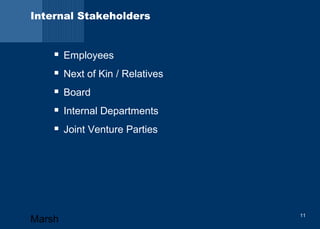
Internal Stakeholders 
 Employees 
 Next of Kin / Relatives 
 Board 
 Internal Departments 
 Joint Venture Parties 
Marsh 11
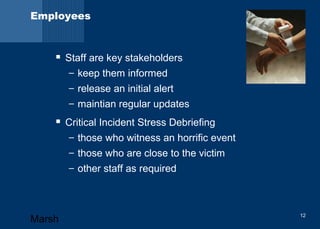
Employees 
 Staff are key stakeholders 
– keep them informed 
– release an initial alert 
– maintian regular updates 
 Critical Incident Stress Debriefing 
– those who witness an horrific event 
– those who are close to the victim 
– other staff as required 
Marsh 12
Next of Kin / Relatives 
 Agree arrangements for visits to notify immediate family, 
relatives, friends, etc of any workforce fatality or serious 
injury 
 Determine the process of dealing with calls and direct 
contact with the next of kin and/or relatives 
 Provide processes to deal with expected inquiries including: 
– accessing records and information 
– activating a team or location to deal with calls 
– telephone procedures 
– methods of dealing with distressed relatives 
– other information as necessary 
Marsh 13
Board, Internal Departments, Joint Venture 
Parties, etc 
 Ensure pre-determined processes capture 
communications protocols including: 
– reporting lines 
– delegated points of contact 
– agree communications mechansims 
– agreed reporting criteria 
 Ensure an appropriate management 
structure is implemented and utilised 
throughout all phases of the crisis 
Marsh 14
External Stakeholders 
 Customers, suppliers and distributors 
 Legal and insurers 
 Government authorities, regulators, statutory 
authorities, industry associations - EPA, 
WorkCover, Consumer Affairs, Unions, etc 
 Emergency Services 
 Community 
Marsh 15
Customers, Suppliers and Distributors 
 Identify and communicate with: 
– key customers 
– key suppliers 
– transport organisations 
– alternative suppliers 
 Clear message on what is happening, what’s been 
done to rectify, alternative arrangements, etc 
 Information must be linked to what is being said to 
media, community and other stakeholders 
Marsh 16
Marsh 17
Legal and Insurers 
 Involve legal and insurance advisers early 
 Log events carefully and ensure they are signed 
 Collect all information generated and store in a safe 
place 
 Ensure legal advisers are involved in any significant 
investigation 
Marsh 18
Authorities and Regulators 
 Ensure you satisfy regulatory reporting requirements 
 Public Corporations: 
– deal with political stakeholders & their concerns/issues 
 Private Corporations: 
– consider political implications of incidents and the likely 
responses of Government and Government Authorities 
 Consider implications on all levels of Government (Local, State & 
Federal) 
 If situation is overseas: 
– consider who and how the organisation will liaise with both 
indigenous and Local Government(s) 
Marsh 19
Emergency Services 
 Ensure there is a clear and defined conduit 
between the Emergency Services and the 
organisation 
 Advise Emergency Services personnel of any 
potential issues 
 Ensure that information given by the Emergency 
Services is communicated to the Crisis 
Management Team 
Marsh 20
Community 
 Address immediate concerns 
 Use community groups, media and/or emergency 
services to assist with getting the message out 
 Keep them regularly informed 
 Maintain open, honest and ongoing contact 
 Appoint spokesperson(s) for the organisation 
 Same rules apply as to media interaction 
 Remember, your organisation is part of the community 
and needs their support to continue 
Marsh 21
Media Interaction
The Media are out there … 
Like Them Or Not 
 The Media can be a powerful friend or foe during a 
Crisis. 
 The media have the facilities to: 
– amplify your key facts and information 
– reach a very wide audience quickly 
– reach specific or target audiences 
 All for low or no cost. 
Marsh 23
Role of the Media 
 Accepted wisdom: 
– The Media plays an important role within the 
local, national and global community: 
 gather facts and information of community 
interest 
 amplify information of interest and concern to 
the community 
 provide the community with a common 
understanding of events 
Marsh 24
Role of the Media 
 Gather facts and information of community interest: 
– All of the above, PROVIDED THAT: 
 it’s entertaining 
 it’s ‘newsworthy’ in the view of the audience 
 it provides a financial return for the media 
Marsh 25
Remember: Social Amplification of Risk 
 Activists and the media amplify outrage, they don’t create 
it, therefore: 
– pay attention to the outrage where the public is 
concerned, because outraged people do not listen to 
data 
Marsh 26
Types of Media 
 The types of media to consider utilising during a crisis 
are: 
– Print 
– Radio 
– Internet 
– Television 
Marsh 27
Gaining Control of the Agenda 
 Use a media communications team 
 To ensure you are not always reacting to the media: 
– determine who your audience is 
– know what the community is asking 
– determine your key messages 
– get your messages out fast 
– stick to your messages 
– continue to provide accurate and regular 
information and updates 
Marsh 28
The Critical Questions 
 Generally speaking the media and community ask: 
– what, where, when, why, who, (etc)? 
– are we safe? 
– has everything possible been done to care for all 
those affected? 
– have you apologised? 
– what’s being done to prevent it from occurring again? 
Marsh 29
Ways of Conveying your Message via Media 
Release 
 A means, often the first, to state your case 
 A Media Release : 
– can be prepared in advance - Holding Statement 
– must stick to the facts 
– must convey concern and regret, positively 
– can allay fears and misinformation 
– can be used to keep staff & stakeholders informed 
– should advise if a press conference is to be held 
and a contact point for the organisation 
Marsh 30
Fact Sheets/Files 
 A means of ensuring journalists know what your 
organisation does. 
 A Fact Sheet/File: 
– provides information about the organisation and its 
activities 
– can provide supporting background information to 
Media Releases 
– gives the media “facts” about you so that the 
information is correct 
Marsh 31
Media Conferences 
 A necessary or prudent action to clarify your position 
and keep control of the agenda. A Media 
Conference: 
– should feature as few spokespersons as 
practicable, 
– must be thoroughly prepared and rehearsed, 
– must be tightly controlled, 
– should follow an agreed format, 
– should be recorded, 
– MUST have key messages. 
Marsh 32
Lessons for Everyday Communications
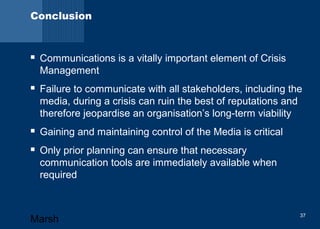
Communications are Critical 
 Write down information 
 Use active listening skills 
 Verify data 
 Don’t be too hasty 
 Strive to minimise corruption of data 
 Information is everyone’s responsibility 
Marsh 34
Communication Elements 
3 Major Components: 
 ‘Technical’ 
– physical medium; face-to-face, telephone, fax, 
email, etc 
 ‘Meaning’ 
– conveying the desired meaning 
 ‘Effectiveness’ 
– how the meaning effects the recipients’ reactions 
and decisions 
Marsh 35
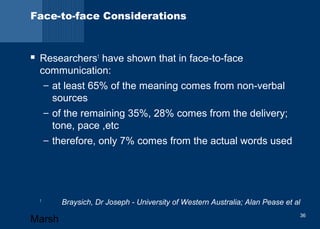
Face-to-face Considerations 
 Researchers1 have shown that in face-to-face 
communication: 
– at least 65% of the meaning comes from non-verbal 
sources 
– of the remaining 35%, 28% comes from the delivery; 
tone, pace ,etc 
– therefore, only 7% comes from the actual words used 
1 Braysich, Dr Joseph - University of Western Australia; Alan Pease et al 
Marsh 36
Conclusion 
 Communications is a vitally important element of Crisis 
Management 
 Failure to communicate with all stakeholders, including the 
media, during a crisis can ruin the best of reputations and 
therefore jeopardise an organisation’s long-term viability 
 Gaining and maintaining control of the Media is critical 
 Only prior planning can ensure that necessary 
communication tools are immediately available when 
required 
Marsh 37
John McCracken 
02 9375 9812 
0414 495 922 
john.p.mccracken@marsh.com

Communicating in a Crisis

  • 1.
    5 Aug 03 Communicating in a Crisis John McCracken Sydney
  • 2.
    Communications in thecontext of a Crisis Management strategy
  • 3.
    What is aCrisis?  A Crisis is an escalating incident that poses a serious threat to the people, operation, viability and/or reputation of an organisation Marsh 3
  • 4.
    What is CrisisManagement?  Crisis Management is the implementation and management of response, recovery and restoration strategies  These strategies should be implemented with a view to minimising the potential impact an escalating incident can have on an organisation’s people, operation, viability and/or reputation  These actions will assist an organisation to fully recover from such an event Marsh 4
  • 5.
    Crisis Management &Communication Project scope/ review Enterprise Value Crisis Management & Communication Training/ Awareness Recovery Strategies Risk Assessment Emergency Response Marsh 5
  • 6.
    Communicating in aCrisis  Communicating with stakeholders during a crisis is but one element of crisis management, however it plays a vitally important role: – effective communications during a crisis can minimise potential damage to an organisation’s reputation and therefore it’s long-term viability – ill conceived and poorly executed communications can cause a rapid loss of control of the perceptions of all stakeholders during a crisis Marsh 6
  • 7.
    Internal versus external communications strategies and issues
  • 8.
    Communications Strategies Plan for a crisis in advance  Clarify objectives  Identify stakeholders and analyse their needs  Identify the ‘theme’ of key messages to be released  Prepare for likely questions  Identify most effective communications mediums  Appoint official spokesperson(s)  Determine authority protocols for release of information  Agree activity tracking mechanism  Develop records management system Marsh 8
  • 9.
    Tips for avoidingcommon issues  Establish the communications protocols – who is responsible for reporting – what is critical, what is important, what can wait – when / how often to update – what format will it be delivered in  Monitor the communications – check filter points – identify potential bottle necks – log and monitor deadlines / updates – ensure there is a common understanding and agreement Marsh 9
  • 10.
    Government and regulators Next of kin / relatives Community Who are the stakeholders? Distributors Board (representing shareholders) Organisation in a crisis Indirect customers Employees Suppliers The media Statutory authorities Direct customers Marsh 10
  • 11.
    Internal Stakeholders Employees  Next of Kin / Relatives  Board  Internal Departments  Joint Venture Parties Marsh 11
  • 12.
    Employees  Staffare key stakeholders – keep them informed – release an initial alert – maintian regular updates  Critical Incident Stress Debriefing – those who witness an horrific event – those who are close to the victim – other staff as required Marsh 12
  • 13.
    Next of Kin/ Relatives  Agree arrangements for visits to notify immediate family, relatives, friends, etc of any workforce fatality or serious injury  Determine the process of dealing with calls and direct contact with the next of kin and/or relatives  Provide processes to deal with expected inquiries including: – accessing records and information – activating a team or location to deal with calls – telephone procedures – methods of dealing with distressed relatives – other information as necessary Marsh 13
  • 14.
    Board, Internal Departments,Joint Venture Parties, etc  Ensure pre-determined processes capture communications protocols including: – reporting lines – delegated points of contact – agree communications mechansims – agreed reporting criteria  Ensure an appropriate management structure is implemented and utilised throughout all phases of the crisis Marsh 14
  • 15.
    External Stakeholders Customers, suppliers and distributors  Legal and insurers  Government authorities, regulators, statutory authorities, industry associations - EPA, WorkCover, Consumer Affairs, Unions, etc  Emergency Services  Community Marsh 15
  • 16.
    Customers, Suppliers andDistributors  Identify and communicate with: – key customers – key suppliers – transport organisations – alternative suppliers  Clear message on what is happening, what’s been done to rectify, alternative arrangements, etc  Information must be linked to what is being said to media, community and other stakeholders Marsh 16
  • 17.
  • 18.
    Legal and Insurers  Involve legal and insurance advisers early  Log events carefully and ensure they are signed  Collect all information generated and store in a safe place  Ensure legal advisers are involved in any significant investigation Marsh 18
  • 19.
    Authorities and Regulators  Ensure you satisfy regulatory reporting requirements  Public Corporations: – deal with political stakeholders & their concerns/issues  Private Corporations: – consider political implications of incidents and the likely responses of Government and Government Authorities  Consider implications on all levels of Government (Local, State & Federal)  If situation is overseas: – consider who and how the organisation will liaise with both indigenous and Local Government(s) Marsh 19
  • 20.
    Emergency Services Ensure there is a clear and defined conduit between the Emergency Services and the organisation  Advise Emergency Services personnel of any potential issues  Ensure that information given by the Emergency Services is communicated to the Crisis Management Team Marsh 20
  • 21.
    Community  Addressimmediate concerns  Use community groups, media and/or emergency services to assist with getting the message out  Keep them regularly informed  Maintain open, honest and ongoing contact  Appoint spokesperson(s) for the organisation  Same rules apply as to media interaction  Remember, your organisation is part of the community and needs their support to continue Marsh 21
  • 22.
  • 23.
    The Media areout there … Like Them Or Not  The Media can be a powerful friend or foe during a Crisis.  The media have the facilities to: – amplify your key facts and information – reach a very wide audience quickly – reach specific or target audiences  All for low or no cost. Marsh 23
  • 24.
    Role of theMedia  Accepted wisdom: – The Media plays an important role within the local, national and global community:  gather facts and information of community interest  amplify information of interest and concern to the community  provide the community with a common understanding of events Marsh 24
  • 25.
    Role of theMedia  Gather facts and information of community interest: – All of the above, PROVIDED THAT:  it’s entertaining  it’s ‘newsworthy’ in the view of the audience  it provides a financial return for the media Marsh 25
  • 26.
    Remember: Social Amplificationof Risk  Activists and the media amplify outrage, they don’t create it, therefore: – pay attention to the outrage where the public is concerned, because outraged people do not listen to data Marsh 26
  • 27.
    Types of Media  The types of media to consider utilising during a crisis are: – Print – Radio – Internet – Television Marsh 27
  • 28.
    Gaining Control ofthe Agenda  Use a media communications team  To ensure you are not always reacting to the media: – determine who your audience is – know what the community is asking – determine your key messages – get your messages out fast – stick to your messages – continue to provide accurate and regular information and updates Marsh 28
  • 29.
    The Critical Questions  Generally speaking the media and community ask: – what, where, when, why, who, (etc)? – are we safe? – has everything possible been done to care for all those affected? – have you apologised? – what’s being done to prevent it from occurring again? Marsh 29
  • 30.
    Ways of Conveyingyour Message via Media Release  A means, often the first, to state your case  A Media Release : – can be prepared in advance - Holding Statement – must stick to the facts – must convey concern and regret, positively – can allay fears and misinformation – can be used to keep staff & stakeholders informed – should advise if a press conference is to be held and a contact point for the organisation Marsh 30
  • 31.
    Fact Sheets/Files A means of ensuring journalists know what your organisation does.  A Fact Sheet/File: – provides information about the organisation and its activities – can provide supporting background information to Media Releases – gives the media “facts” about you so that the information is correct Marsh 31
  • 32.

    Media Conferences A necessary or prudent action to clarify your position and keep control of the agenda. A Media Conference: – should feature as few spokespersons as practicable, – must be thoroughly prepared and rehearsed, – must be tightly controlled, – should follow an agreed format, – should be recorded, – MUST have key messages. Marsh 32
  • 33.
    Lessons for EverydayCommunications
  • 34.
    Communications are Critical  Write down information  Use active listening skills  Verify data  Don’t be too hasty  Strive to minimise corruption of data  Information is everyone’s responsibility Marsh 34
  • 35.
    Communication Elements 3Major Components:  ‘Technical’ – physical medium; face-to-face, telephone, fax, email, etc  ‘Meaning’ – conveying the desired meaning  ‘Effectiveness’ – how the meaning effects the recipients’ reactions and decisions Marsh 35
  • 36.
    Face-to-face Considerations Researchers1 have shown that in face-to-face communication: – at least 65% of the meaning comes from non-verbal sources – of the remaining 35%, 28% comes from the delivery; tone, pace ,etc – therefore, only 7% comes from the actual words used 1 Braysich, Dr Joseph - University of Western Australia; Alan Pease et al Marsh 36
  • 37.
    Conclusion  Communicationsis a vitally important element of Crisis Management  Failure to communicate with all stakeholders, including the media, during a crisis can ruin the best of reputations and therefore jeopardise an organisation’s long-term viability  Gaining and maintaining control of the Media is critical  Only prior planning can ensure that necessary communication tools are immediately available when required Marsh 37
  • 38.
    John McCracken 029375 9812 0414 495 922 john.p.mccracken@marsh.com