MEANING OF RISK
 Risk may relate to loss of capital, delay in repayment of
capital, non-payment of interest, or variability of returns. While
some investments like government securities and bank
deposits are riskless, others are more risky. The risk of an
investment depends on the following factors :
1) The longer the maturity period, the larger is the risk.
2) The lower credit worthiness of the borrower, the higher is the
risk.
3) Investments in ownership securities like equity shares carry
higher risk compared to investments in debt instruments like
debentures and bonds. Risk and return of an investment are
related. Normally, the higher the risk, the higher is the return.
TYPES OF RISK
 Default risk
 Business risk
 Financial risk
 Purchasing power risk
 Interest rate risk
 Market risk
 Liquidity risk
 Systematic risk
 Unsystematic risk
DEFAULT RISK
 It is the risk of issuer of investment going bankrupt.
An investors who purchase shares debentures will
have to face the possibility of the default and
bankrupt of the company. In the case of fixed
income securities such as debenture or fixed
deposit of companies, the investor may take the
care to see that the credit rating give to the
company, so that the risk is can be minimized .
BUSINESS RISK
 business risk means the risk of a particular business failing and
thereby your investment is lost. e.g. changes in tastes, preferences
of consumers, strikes, increased competition, change in
government policy, obsolescence etc.
 Business risks can major by the influence by two major risks:
Internal risks: (within the organization) Internal risks which can be
controlled such as human factors, technological factors, physical
factors.
external risks: (outside the organization) External risks which
cannot be controlled such as economic factors, natural factors,
political factors.
FINANCIAL RISK
 Financial risk as the term suggests is the risk that
involves financial loss to firms. Financial risk generally
arises due to instability and losses in the financial
market caused by movements in stock prices,
currencies, interest rates and more.
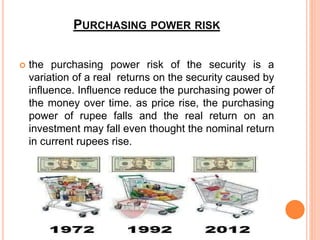
PURCHASING POWER RISK
 the purchasing power risk of the security is a
variation of a real returns on the security caused by
influence. Influence reduce the purchasing power of
the money over time. as price rise, the purchasing
power of rupee falls and the real return on an
investment may fall even thought the nominal return
in current rupees rise.
INTEREST RATE RISK
 the earning of the company and the performance of
their share and sensitive to interest rate changes.
the price of dept security and all other securities
with fixed payout are depend upon the level of
market interest rate. when the interest rate price
bond value will generally fall. the returns on other
types of securities also depend upon the interest
rate
MARKET RISK
 Market risk is the risk that the value of an
investment will decrease due to move in market
factor. this is the most familiar of all risks. Also
referred to as volatility, market risk is the day-to-day
fluctuations in a stock's price. It is a causes by
investor reaction to tangible as well as intangible
event in market.
LIQUIDITY RISK
 liquidity risk arise from the inability to convert an
investment quickly into cash. it refers to the ease
with which stock may be sold. if a stock is higher
liquid, it can be sold very quickly at a price which is
more or less equal to its previous market price.
 when an investor want to sell a stock he is a
concern with its liquidity. on the other hand, when a
investor want to buy a stock he interest in its
availability.
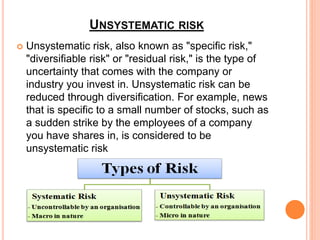
SYSTEMATIC RISK
 Systematic risk, also known as "market risk" or "un-
diversifiable risk", is the uncertainty inherent to the
entire market or entire market segment. Also
referred to as volatility, systematic risk consists of
the day-to-day fluctuations in a stock's price.
Volatility is a measure of risk because it refers to
the behavior, or "temperament," of your investment
rather than the reason for this behavior. Because
market movement is the reason why people can
make money from stocks, volatility is essential for
returns, and the more unstable the investment the
more chance there is that it will experience a
dramatic change in either direction.
UNSYSTEMATIC RISK
 Unsystematic risk, also known as "specific risk,"
"diversifiable risk" or "residual risk," is the type of
uncertainty that comes with the company or
industry you invest in. Unsystematic risk can be
reduced through diversification. For example, news
that is specific to a small number of stocks, such as
a sudden strike by the employees of a company
you have shares in, is considered to be
unsystematic risk
Risk

Risk

  • 2.
    MEANING OF RISK Risk may relate to loss of capital, delay in repayment of capital, non-payment of interest, or variability of returns. While some investments like government securities and bank deposits are riskless, others are more risky. The risk of an investment depends on the following factors : 1) The longer the maturity period, the larger is the risk. 2) The lower credit worthiness of the borrower, the higher is the risk. 3) Investments in ownership securities like equity shares carry higher risk compared to investments in debt instruments like debentures and bonds. Risk and return of an investment are related. Normally, the higher the risk, the higher is the return.
  • 3.
    TYPES OF RISK Default risk  Business risk  Financial risk  Purchasing power risk  Interest rate risk  Market risk  Liquidity risk  Systematic risk  Unsystematic risk
  • 4.
    DEFAULT RISK  Itis the risk of issuer of investment going bankrupt. An investors who purchase shares debentures will have to face the possibility of the default and bankrupt of the company. In the case of fixed income securities such as debenture or fixed deposit of companies, the investor may take the care to see that the credit rating give to the company, so that the risk is can be minimized .
  • 5.
    BUSINESS RISK  businessrisk means the risk of a particular business failing and thereby your investment is lost. e.g. changes in tastes, preferences of consumers, strikes, increased competition, change in government policy, obsolescence etc.  Business risks can major by the influence by two major risks: Internal risks: (within the organization) Internal risks which can be controlled such as human factors, technological factors, physical factors. external risks: (outside the organization) External risks which cannot be controlled such as economic factors, natural factors, political factors.
  • 6.
    FINANCIAL RISK  Financialrisk as the term suggests is the risk that involves financial loss to firms. Financial risk generally arises due to instability and losses in the financial market caused by movements in stock prices, currencies, interest rates and more.
  • 7.
    PURCHASING POWER RISK the purchasing power risk of the security is a variation of a real returns on the security caused by influence. Influence reduce the purchasing power of the money over time. as price rise, the purchasing power of rupee falls and the real return on an investment may fall even thought the nominal return in current rupees rise.
  • 8.
    INTEREST RATE RISK the earning of the company and the performance of their share and sensitive to interest rate changes. the price of dept security and all other securities with fixed payout are depend upon the level of market interest rate. when the interest rate price bond value will generally fall. the returns on other types of securities also depend upon the interest rate
  • 9.
    MARKET RISK  Marketrisk is the risk that the value of an investment will decrease due to move in market factor. this is the most familiar of all risks. Also referred to as volatility, market risk is the day-to-day fluctuations in a stock's price. It is a causes by investor reaction to tangible as well as intangible event in market.
  • 10.
    LIQUIDITY RISK  liquidityrisk arise from the inability to convert an investment quickly into cash. it refers to the ease with which stock may be sold. if a stock is higher liquid, it can be sold very quickly at a price which is more or less equal to its previous market price.  when an investor want to sell a stock he is a concern with its liquidity. on the other hand, when a investor want to buy a stock he interest in its availability.
  • 11.
    SYSTEMATIC RISK  Systematicrisk, also known as "market risk" or "un- diversifiable risk", is the uncertainty inherent to the entire market or entire market segment. Also referred to as volatility, systematic risk consists of the day-to-day fluctuations in a stock's price. Volatility is a measure of risk because it refers to the behavior, or "temperament," of your investment rather than the reason for this behavior. Because market movement is the reason why people can make money from stocks, volatility is essential for returns, and the more unstable the investment the more chance there is that it will experience a dramatic change in either direction.
  • 12.
    UNSYSTEMATIC RISK  Unsystematicrisk, also known as "specific risk," "diversifiable risk" or "residual risk," is the type of uncertainty that comes with the company or industry you invest in. Unsystematic risk can be reduced through diversification. For example, news that is specific to a small number of stocks, such as a sudden strike by the employees of a company you have shares in, is considered to be unsystematic risk