

Venture capital
 It is defined as equity investment in a growth oriented
small/medium business to enable investees to
accomplish corporate objectives, in return for minority
shareholding in the business or the irrevocable right to
acquire it.
 Venture capital institution/fund- Intermediary
between investors looking for returns and
entrepreneurs who need institutional capital as they
are yet not ready to go to the public.
Venture capital
 Features
- Primarily equity finance
- Long term investment
- Substantial degree of active involvement
- High risk return spectrum
- Not only technology finance
Selection of investment
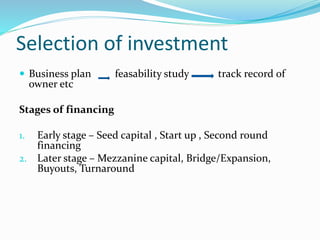
 Business plan feasability study track record of
owner etc
Stages of financing
1. Early stage – Seed capital , Start up , Second round
financing
2. Later stage – Mezzanine capital, Bridge/Expansion,
Buyouts, Turnaround
Selection of investment(stages)
1. Early stage
 Seed capital /pre start up
- Applied research phase
- Entrepreneurial skills match with the market
opportunity
- High risk
- Marketing related risk
Selection of investment(stages)
 Start up
- Includes new projects based on technology, knowledge
new projects by established companies or a new
company
- Indication about potential market
- High risk
 Second round financing
- Product launched but not profitable
- large funds
- Debt and some income
Selection of investment(stages)
2. Later stage financing
 Mezzanine /development capital
- Require additional finance but cannot resort to public
issue
- Expansion , penetration ,new management etc
 Bridge/expansion
- Low risk
- Acquisition of other firms
Selection of investment(stages)
 Buyout
- Management buyout
- Management buyins
 Turnaround
- Buying the control of sick company
Selection of investment (FA)
Financial analysis
 Various methods include
I Conventional Venture Capitalist Valuation Method
II The First Chicago Method
III The Revenue Multiplier Method
Selection of investment (FA)
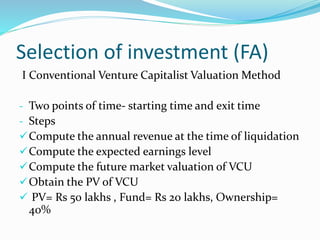
I Conventional Venture Capitalist Valuation Method
- Two points of time- starting time and exit time
- Steps
Compute the annual revenue at the time of liquidation
Compute the expected earnings level
Compute the future market valuation of VCU
Obtain the PV of VCU
 PV= Rs 50 lakhs , Fund= Rs 20 lakhs, Ownership=
40%
Selection of investment (FA)
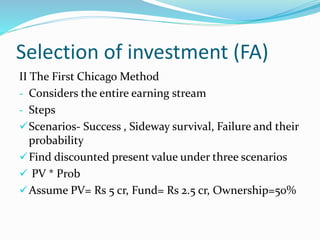
II The First Chicago Method
- Considers the entire earning stream
- Steps
Scenarios- Success , Sideway survival, Failure and their
probability
Find discounted present value under three scenarios
 PV * Prob
Assume PV= Rs 5 cr, Fund= Rs 2.5 cr, Ownership=50%
Selection of investment (FA)
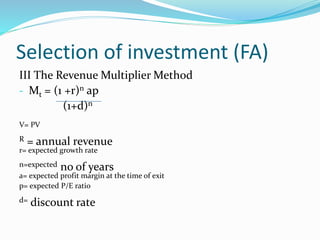
III The Revenue Multiplier Method
- Mt = (1 +r)n ap
(1+d)n
V= PV
R = annual revenue
r= expected growth rate
n=expected no of years
a= expected profit margin at the time of exit
p= expected P/E ratio
d= discount rate
Selection of investment ( Structuring)
Structuring the deal / Financial Instruments
 Refers to financial instruments through which investment is made.
 Types
1. Equity
- Ordinary
- Non voting
- Deferred
- Preferred
- Equity warrants
- Preference shares
- Cumulative convertible pref shares
- Participating pref shares
- Cumulative convertible participatory preferred ordinary
- Convertible cumulative redeemable preference shares
Selection of investment ( Structuring)
2. Debt
- Conditional loan
- Conventional loan
- Income notes
- Non convertible debentures
- Partly convertible debentures
- Zero interest bonds
- Secured Premium notes
- Deep discount bonds
Selection of investment (Aftercare)
Investment Nurturing/Aftercare
 The enduring relationship between VCI and VCU and
the active relationship played by the former in the
management of latter.
 Styles
1. Hands on
2. Hands off
3. Hand holding
Selection of investment (Aftercare)
1. Hands on
- Continuous and constant involvement
- Representation on the board
- Generally in early stage financing
- Need experts
2. Hands off
- Passive role
- Rarely have nominee directors
- Business running smoothly
Selection of investment (Aftercare)
3. Hands holding
- Reactive approach
- Right to nominate
- Actively participates
 Objectives
- Proper utilisation of assistance
- Implement the project
- Finding additional finance
Selection of investment (Aftercare)
- Provide strategic inputs
- Anticipates problem
- No default
- Evaluate the perfomance
- Use the feedback
Selection of investment (Aftercare)
 Techniques
- Personal discussion
- Plant visits
- Feedback through nominee directors
- Periodic reports
- Commissioned studies
Valuation of Portfolio
 Two instruments
1. Equity
2. Debt
1. Equity investments
I. Cost method
II. Market value based method
Valuation of Portfolio
I. Cost method
• At the historical cost
• Simple and objective
• Two values at different times
II. Market value based method
• Quoted MV method
- based on market quotations
- large holdings
Valuation of Portfolio
• Fair market value method
– assets are worth what they can earn
- based on risk and future earnings
 Stages of investment
1. Unquoted venture investments
- immature companies
- at cost
Valuation of Portfolio
-written up : third party, better operating results
- written down : long term problems , need finance
2. Unquoted development investments
- mature companies
- based on P/E ratio and dis rate
3. Quoted investments
- companies with IPO
- restriction on sale of shares
Valuation of Portfolio
2. Debt instruments
i. Convertible debt
 Market value method
- moving averages/weighted average is a better
approach
- MV + fluctuations
- Underestimation
Valuation of Portfolio
 Fair value method
- Price in open market
- Biased
ii. Non convertible debt
 Fixed interest non convertible debt
- Relate nominal yield to current yield
- Maturity date, date of valuation ,safety etc
Valuation of Portfolio
 Non interest non convertible debt
- Discount rate acc to solvency
Highly leveraged investments
- At cost
Structural aspects
 Objectives
- Limited liability
- Simple operation
- Tax transparency
- Tax exemption for managers
- Tax benefits for investors
Structural aspects
 Alternative forms
1. Limited partnership
2. Investment company
3. Investment trust
4. Off shore funds
5. Small business investment company
Structural aspects
1. Limited partnership
- Evolved in USA
- General and limited partners
- General partners : business identification
investment appraisal
Negotiation
Investment monitoring
Exit deals
Others
Structural aspects
- Mode of Compensation: annual mgt fee and carried
interest
- Advantages
taxed for partners only
carried interest
- Disadvantage: unlimited liability
Structural aspects
2 Investment company
- Limited liability
- Double taxation
3. Investment trust
-no tax on dividend
- conditions
Income from investment in shares / security
Not more than 15%
Shares are listed
Distribute income
Structural aspects
4. Offshore investment company
5. Offshore unit trust
6. Small business investment company
- not more than 20% of capital n reserves
- No controlling interest
- loans for five yrs or so
Exit /Disinvestment
 Depends on number of factors
 Equity / quasi equity investments
1. Going public
2. Sale to entrepreneurs
3. Trade sale
4. Selling to new investor
5. Liquidation
Exit /Disinvestment
1. Going public
- Advantage : liquidity , higher price, better image
- Limitations: reporting requirements, disclosures ,
cost , stock exchange regulations
- OTCEI route could be opted
Exit /Disinvestment
2. Sale to entrepreneur
- Directly or through employees
- Exit by put or call option
BV method
P/E ratio
% of Sales method
Multiple cash flow method
Independent valuation
Agreed price
Exit /Disinvestment
3. Trade sales
- Management buyins/ buyout
- alternatives : cash sales of equity shares
issue of notes secured by assets
in consideration
4. Sales to new investor
5. Liquidation
Exit /Disinvestment
 Debt instruments
- Normal loan
- Conditional loan
Disadvantages of VC financing
 Forced management changes
 Loss of equity stake
 Decision making ability
 Delays in funding
 Entrepreneur will be the last to be paid
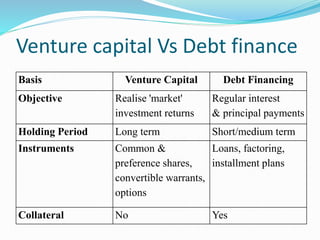
Venture capital Vs Debt finance
Basis Venture Capital Debt Financing
Objective Realise 'market'
investment returns
Regular interest
& principal payments
Holding Period Long term Short/medium term
Instruments Common &
preference shares,
convertible warrants,
options
Loans, factoring,
installment plans
Collateral No Yes
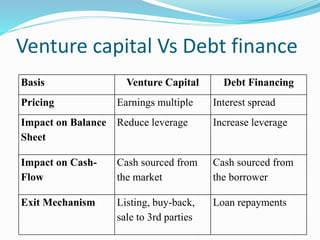
Venture capital Vs Debt finance
Basis Venture Capital Debt Financing
Pricing Earnings multiple Interest spread
Impact on Balance
Sheet
Reduce leverage Increase leverage
Impact on Cash-
Flow
Cash sourced from
the market
Cash sourced from
the borrower
Exit Mechanism Listing, buy-back,
sale to 3rd parties
Loan repayments
Angel Investors, VCs and PE Firms
 Three forms of funding available
 Angel Investor
Retired entrepreneurs
Motivated beyond pure money
Make bigger and better investment
Software ,media, healthcare etc
Seed stage
Angel Investors, VCs and PE Firms
 Venture Capitalists
Comes after seed funding
Highly risk ventures
Diverse mix of enterprises and small businesses
Capable of turning into $100million company
1-3-6 out of 10
Interest in high tech co.s
Angel Investors, VCs and PE Firms
 PE Firms
Raise funds from HNI and institutional investors
Few investments but larger in value
Support companies for expansion
Big firms engage in leveraged buyouts
Indian scenario
Initiative
• More than 150 yrs ago – Managing agency houses acted
as VC
• Tata Iron and Steels and Empress Mills were created
• Investment Corporation of India was formed
• Abolished managing agency system and Public sector
term lending institutions came in
Indian scenario
• 1973- R.S. Bhatt Committee
1986- Research and Development Act
1987- UNDP examined the possibility of developing
VC
1988- CCI issued guidelines
Indian scenario
Guidelines
 Public Sector FI, SBI and banks to set up VC with min
fund of Rs 10 crore :
Promoters- Min 40%
Foreign equity- upto 25%
NRI – upto 74% , 25-40%
 VCC/ VCF can be set up as a joint venture
 Managed by professionals
 Cannot do trading, broking etc
Indian scenario
 Listing according to prescribed conditions
 A person acting as President, VP etc cannot hold same
position
 VC assistance – Upto 10 crore, new technology ,new
promoters ,employing professionals
 Share pricing at the time of disinvestment
Indian scenario
Methods of venture financing
1. Equity
2. Conventional loan
3. Conditional loan
4. Income notes
At present several VCC are incorporated and they are
promoted by All India level institutions or state level
financial institutions
Indian scenario
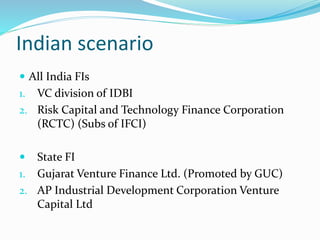
 All India FIs
1. VC division of IDBI
2. Risk Capital and Technology Finance Corporation
(RCTC) (Subs of IFCI)
 State FI
1. Gujarat Venture Finance Ltd. (Promoted by GUC)
2. AP Industrial Development Corporation Venture
Capital Ltd
Indian scenario
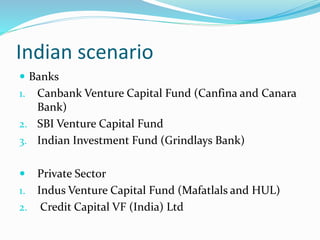
 Banks
1. Canbank Venture Capital Fund (Canfina and Canara
Bank)
2. SBI Venture Capital Fund
3. Indian Investment Fund (Grindlays Bank)
 Private Sector
1. Indus Venture Capital Fund (Mafatlals and HUL)
2. Credit Capital VF (India) Ltd
Indian scenario
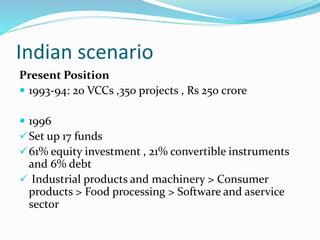
Present Position
 1993-94: 20 VCCs ,350 projects , Rs 250 crore
 1996
Set up 17 funds
61% equity investment , 21% convertible instruments
and 6% debt
 Industrial products and machinery > Consumer
products > Food processing > Software and aservice
sector
Indian scenario
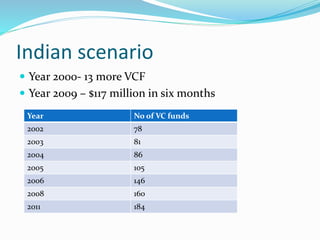
 Year 2000- 13 more VCF
 Year 2009 – $117 million in six months
Year No of VC funds
2002 78
2003 81
2004 86
2005 105
2006 146
2008 160
2011 184
Venture capital financing

Venture capital financing

  • 3.
    Venture capital  Itis defined as equity investment in a growth oriented small/medium business to enable investees to accomplish corporate objectives, in return for minority shareholding in the business or the irrevocable right to acquire it.  Venture capital institution/fund- Intermediary between investors looking for returns and entrepreneurs who need institutional capital as they are yet not ready to go to the public.
  • 4.
    Venture capital  Features -Primarily equity finance - Long term investment - Substantial degree of active involvement - High risk return spectrum - Not only technology finance
  • 5.
    Selection of investment Business plan feasability study track record of owner etc Stages of financing 1. Early stage – Seed capital , Start up , Second round financing 2. Later stage – Mezzanine capital, Bridge/Expansion, Buyouts, Turnaround
  • 6.
    Selection of investment(stages) 1.Early stage  Seed capital /pre start up - Applied research phase - Entrepreneurial skills match with the market opportunity - High risk - Marketing related risk
  • 7.
    Selection of investment(stages) Start up - Includes new projects based on technology, knowledge new projects by established companies or a new company - Indication about potential market - High risk  Second round financing - Product launched but not profitable - large funds - Debt and some income
  • 8.
    Selection of investment(stages) 2.Later stage financing  Mezzanine /development capital - Require additional finance but cannot resort to public issue - Expansion , penetration ,new management etc  Bridge/expansion - Low risk - Acquisition of other firms
  • 9.
    Selection of investment(stages) Buyout - Management buyout - Management buyins  Turnaround - Buying the control of sick company
  • 10.
    Selection of investment(FA) Financial analysis  Various methods include I Conventional Venture Capitalist Valuation Method II The First Chicago Method III The Revenue Multiplier Method
  • 11.
    Selection of investment(FA) I Conventional Venture Capitalist Valuation Method - Two points of time- starting time and exit time - Steps Compute the annual revenue at the time of liquidation Compute the expected earnings level Compute the future market valuation of VCU Obtain the PV of VCU  PV= Rs 50 lakhs , Fund= Rs 20 lakhs, Ownership= 40%
  • 12.
    Selection of investment(FA) II The First Chicago Method - Considers the entire earning stream - Steps Scenarios- Success , Sideway survival, Failure and their probability Find discounted present value under three scenarios  PV * Prob Assume PV= Rs 5 cr, Fund= Rs 2.5 cr, Ownership=50%
  • 13.
    Selection of investment(FA) III The Revenue Multiplier Method - Mt = (1 +r)n ap (1+d)n V= PV R = annual revenue r= expected growth rate n=expected no of years a= expected profit margin at the time of exit p= expected P/E ratio d= discount rate
  • 14.
    Selection of investment( Structuring) Structuring the deal / Financial Instruments  Refers to financial instruments through which investment is made.  Types 1. Equity - Ordinary - Non voting - Deferred - Preferred - Equity warrants - Preference shares - Cumulative convertible pref shares - Participating pref shares - Cumulative convertible participatory preferred ordinary - Convertible cumulative redeemable preference shares
  • 15.
    Selection of investment( Structuring) 2. Debt - Conditional loan - Conventional loan - Income notes - Non convertible debentures - Partly convertible debentures - Zero interest bonds - Secured Premium notes - Deep discount bonds
  • 16.
    Selection of investment(Aftercare) Investment Nurturing/Aftercare  The enduring relationship between VCI and VCU and the active relationship played by the former in the management of latter.  Styles 1. Hands on 2. Hands off 3. Hand holding
  • 17.
    Selection of investment(Aftercare) 1. Hands on - Continuous and constant involvement - Representation on the board - Generally in early stage financing - Need experts 2. Hands off - Passive role - Rarely have nominee directors - Business running smoothly
  • 18.
    Selection of investment(Aftercare) 3. Hands holding - Reactive approach - Right to nominate - Actively participates  Objectives - Proper utilisation of assistance - Implement the project - Finding additional finance
  • 19.
    Selection of investment(Aftercare) - Provide strategic inputs - Anticipates problem - No default - Evaluate the perfomance - Use the feedback
  • 20.
    Selection of investment(Aftercare)  Techniques - Personal discussion - Plant visits - Feedback through nominee directors - Periodic reports - Commissioned studies
  • 21.
    Valuation of Portfolio Two instruments 1. Equity 2. Debt 1. Equity investments I. Cost method II. Market value based method
  • 22.
    Valuation of Portfolio I.Cost method • At the historical cost • Simple and objective • Two values at different times II. Market value based method • Quoted MV method - based on market quotations - large holdings
  • 23.
    Valuation of Portfolio •Fair market value method – assets are worth what they can earn - based on risk and future earnings  Stages of investment 1. Unquoted venture investments - immature companies - at cost
  • 24.
    Valuation of Portfolio -writtenup : third party, better operating results - written down : long term problems , need finance 2. Unquoted development investments - mature companies - based on P/E ratio and dis rate 3. Quoted investments - companies with IPO - restriction on sale of shares
  • 25.
    Valuation of Portfolio 2.Debt instruments i. Convertible debt  Market value method - moving averages/weighted average is a better approach - MV + fluctuations - Underestimation
  • 26.
    Valuation of Portfolio Fair value method - Price in open market - Biased ii. Non convertible debt  Fixed interest non convertible debt - Relate nominal yield to current yield - Maturity date, date of valuation ,safety etc
  • 27.
    Valuation of Portfolio Non interest non convertible debt - Discount rate acc to solvency Highly leveraged investments - At cost
  • 28.
    Structural aspects  Objectives -Limited liability - Simple operation - Tax transparency - Tax exemption for managers - Tax benefits for investors
  • 29.
    Structural aspects  Alternativeforms 1. Limited partnership 2. Investment company 3. Investment trust 4. Off shore funds 5. Small business investment company
  • 30.
    Structural aspects 1. Limitedpartnership - Evolved in USA - General and limited partners - General partners : business identification investment appraisal Negotiation Investment monitoring Exit deals Others
  • 31.
    Structural aspects - Modeof Compensation: annual mgt fee and carried interest - Advantages taxed for partners only carried interest - Disadvantage: unlimited liability
  • 32.
    Structural aspects 2 Investmentcompany - Limited liability - Double taxation 3. Investment trust -no tax on dividend - conditions Income from investment in shares / security Not more than 15% Shares are listed Distribute income
  • 33.
    Structural aspects 4. Offshoreinvestment company 5. Offshore unit trust 6. Small business investment company - not more than 20% of capital n reserves - No controlling interest - loans for five yrs or so
  • 34.
    Exit /Disinvestment  Dependson number of factors  Equity / quasi equity investments 1. Going public 2. Sale to entrepreneurs 3. Trade sale 4. Selling to new investor 5. Liquidation
  • 35.
    Exit /Disinvestment 1. Goingpublic - Advantage : liquidity , higher price, better image - Limitations: reporting requirements, disclosures , cost , stock exchange regulations - OTCEI route could be opted
  • 36.
    Exit /Disinvestment 2. Saleto entrepreneur - Directly or through employees - Exit by put or call option BV method P/E ratio % of Sales method Multiple cash flow method Independent valuation Agreed price
  • 37.
    Exit /Disinvestment 3. Tradesales - Management buyins/ buyout - alternatives : cash sales of equity shares issue of notes secured by assets in consideration 4. Sales to new investor 5. Liquidation
  • 38.
    Exit /Disinvestment  Debtinstruments - Normal loan - Conditional loan
  • 39.
    Disadvantages of VCfinancing  Forced management changes  Loss of equity stake  Decision making ability  Delays in funding  Entrepreneur will be the last to be paid
  • 40.
    Venture capital VsDebt finance Basis Venture Capital Debt Financing Objective Realise 'market' investment returns Regular interest & principal payments Holding Period Long term Short/medium term Instruments Common & preference shares, convertible warrants, options Loans, factoring, installment plans Collateral No Yes
  • 41.
    Venture capital VsDebt finance Basis Venture Capital Debt Financing Pricing Earnings multiple Interest spread Impact on Balance Sheet Reduce leverage Increase leverage Impact on Cash- Flow Cash sourced from the market Cash sourced from the borrower Exit Mechanism Listing, buy-back, sale to 3rd parties Loan repayments
  • 42.
    Angel Investors, VCsand PE Firms  Three forms of funding available  Angel Investor Retired entrepreneurs Motivated beyond pure money Make bigger and better investment Software ,media, healthcare etc Seed stage
  • 43.
    Angel Investors, VCsand PE Firms  Venture Capitalists Comes after seed funding Highly risk ventures Diverse mix of enterprises and small businesses Capable of turning into $100million company 1-3-6 out of 10 Interest in high tech co.s
  • 44.
    Angel Investors, VCsand PE Firms  PE Firms Raise funds from HNI and institutional investors Few investments but larger in value Support companies for expansion Big firms engage in leveraged buyouts
  • 45.
    Indian scenario Initiative • Morethan 150 yrs ago – Managing agency houses acted as VC • Tata Iron and Steels and Empress Mills were created • Investment Corporation of India was formed • Abolished managing agency system and Public sector term lending institutions came in
  • 46.
    Indian scenario • 1973-R.S. Bhatt Committee 1986- Research and Development Act 1987- UNDP examined the possibility of developing VC 1988- CCI issued guidelines
  • 47.
    Indian scenario Guidelines  PublicSector FI, SBI and banks to set up VC with min fund of Rs 10 crore : Promoters- Min 40% Foreign equity- upto 25% NRI – upto 74% , 25-40%  VCC/ VCF can be set up as a joint venture  Managed by professionals  Cannot do trading, broking etc
  • 48.
    Indian scenario  Listingaccording to prescribed conditions  A person acting as President, VP etc cannot hold same position  VC assistance – Upto 10 crore, new technology ,new promoters ,employing professionals  Share pricing at the time of disinvestment
  • 49.
    Indian scenario Methods ofventure financing 1. Equity 2. Conventional loan 3. Conditional loan 4. Income notes At present several VCC are incorporated and they are promoted by All India level institutions or state level financial institutions
  • 50.
    Indian scenario  AllIndia FIs 1. VC division of IDBI 2. Risk Capital and Technology Finance Corporation (RCTC) (Subs of IFCI)  State FI 1. Gujarat Venture Finance Ltd. (Promoted by GUC) 2. AP Industrial Development Corporation Venture Capital Ltd
  • 51.
    Indian scenario  Banks 1.Canbank Venture Capital Fund (Canfina and Canara Bank) 2. SBI Venture Capital Fund 3. Indian Investment Fund (Grindlays Bank)  Private Sector 1. Indus Venture Capital Fund (Mafatlals and HUL) 2. Credit Capital VF (India) Ltd
  • 52.
    Indian scenario Present Position 1993-94: 20 VCCs ,350 projects , Rs 250 crore  1996 Set up 17 funds 61% equity investment , 21% convertible instruments and 6% debt  Industrial products and machinery > Consumer products > Food processing > Software and aservice sector
  • 53.
    Indian scenario  Year2000- 13 more VCF  Year 2009 – $117 million in six months Year No of VC funds 2002 78 2003 81 2004 86 2005 105 2006 146 2008 160 2011 184