The Training Division of
WHAT IS A PROJECT? 
A project is a set of inter-related 
activities with defined start and end 
dates, designed to achieve a unique 
and common objective.
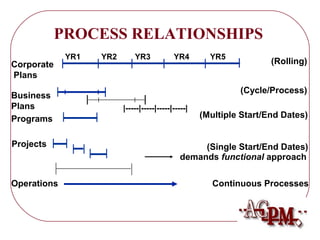
PROCESS RELATIONSHIPS 
YR1 YR2 YR3 YR4 YR5 (Rolling) 
|-----|-----|-----|-----| 
Corporate 
Plans 
Business 
Plans 
(Cycle/Process) 
Programs (Multiple Start/End Dates) 
(Single Start/End Dates) 
demands functional approach 
Projects 
Operations Continuous Processes
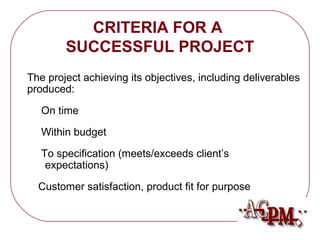
CRITERIA FOR A 
SUCCESSFUL PROJECT 
The project achieving its objectives, including deliverables 
produced: 
 On time 
 Within budget 
 To specification (meets/exceeds client’s 
expectations) 
 Customer satisfaction, product fit for purpose
HOW DO WE ACHIEVE A 
SUCCESSFUL PROJECT? 
Project success begins and 
ends with the Project 
Manager’s effective 
management of the project
WHAT IS PROJECT 
MANAGEMENT? 
Project Management is the management of 
project activity through the project life cycle 
to achieve the delivery of a defined product 
or service within prescribed constraints of 
time, budget, scope and quality
PROJECT LIFE CYCLE 
CONCEPT 
DEVELOPMENT 
IMPLEMENTATION 
FINALISATION
PHASE 1: CONCEPT 
 Identification of core need/s 
 High level planning 
 Range of possible solutions 
 ‘Ball park’ estimates 
 Preliminary risk analyses
PHASE 2: DEVELOPMENT 
 Non-viable options culled 
 High level plans refined into a 
detailed plan 
 Baselines developed 
 Detailed 
designs/specifications/drawings 
developed
TIME, COST  RESOURCE 
MANAGEMENT 
Planning 
Scheduling 
Estimating
Planned Progress 
Assumed Start Point 
Assumed 
Destination 
Correct Starting Point 
Agreed Destination – 
Meets Client’s Needs 
Actual progress
RELUCTANCE TO PLAN 
Takes time (10-25%) 
Commitment is required 
Difficult to plan the future 
Imposes discipline 
Plans are always wrong 
Hard to maintain plans 
“Never needed to before” 
Fear of planning 
Reluctance to Plan
REASONS FOR PLANNING 
Reasons for Planning 
Target Verification 
Enforces Commitments 
Resource Planning 
Basis for “What If” 
Enforces Pre-thinking 
Basis for Control 
Clarifies Risk 
Basis for Delegation
PHASE 3: IMPLEMENTATION 
 Works undertaken per baselines 
 Actual progress checked against 
planned baselines for variance 
 Causes of variance dealt with 
 Project reporting undertaken
THE PROJECT PLANNING 
 CONTROL CYCLE 
INITIATE 
SET TERMS 
OF REFERENCE. 
PLAN 
EXECUTE 
THE WORK 
MONITOR 
PROGRESS 
SIZE THE 
PROBLEM 
ANALYSE 
VARIANCE 
ACT 
MAJOR REVIEW 
COMPARE 
WITH PLAN 
RE-PLAN 
MINOR ADJUSTMENTS
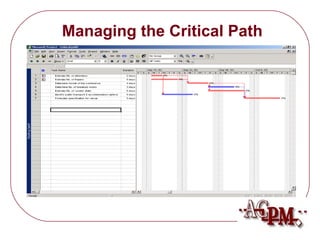
Managing the Critical Path
PHASE 4: FINALISATION 
 Have all deliverables been 
met? 
 Contracts terminated? 
 Transition plan formulated 
 Lessons learned
FUNCTIONS OF PROJECT MANAGEMENT 
Scope 
Time Cost 
Quality 
Risk 
HR Communications 
Procurement/Contracts 
Integratio 
n 
Integratio 
n
SCOPE 
 Describes the outcomes sought 
 Describes the work content  
boundaries 
 Ultimately defines a broad 
strategy 
 BASELINE: Scope Document
TIME 
 Planning – what to do 
 Estimating - duration 
 SCHEDULING – Dependencies 
 CONTROL – Achieving milestones 
 BASELINE: Schedule (Gant Chart)
COST 
 Iteratively estimating cost 
 Top down  bottom up approach 
 Budget definition 
 BASELINE: Time phased 
expenditure/revenue
QUALITY 
 Understanding client expectations 
 Managing, meeting/exceeding them 
 Project Quality system developed 
 BASELINE: Project Quality Plan
RISK 
 Possible adverse occurrences 
 ID 
 Assess 
 Respond (incl. Prioritisation) 
 Create Risk Register (allocate resp.) 
 BASELINE: Risk Management Plan
HUMAN RESOURCES 
 HR Administration 
 Resource Allocation 
 Team performance 
 Motivation 
 BASELINE: Resource Allocation 
Matrix
COMMUNICATIONS 
 Formal and informal 
 Interpersonal communications 
 Communication strategy 
 BASELINE: Communications matrix
CONTRACTS/PROCUREMENT 
 External resources 
 Formation-Award-Performance 
 Bid process 
 Form of contract 
 BASELINE: Procurement schedule
INTEGRATION 
 Overall perspective 
 Interconnected nature of 8 functions 
 Schedule is a powerful integrative tool 
 Learning outcomes 
 BASELINE: Reporting/control
REPORTS 
Factors to be considered: 
 What should be in the report 
 Who is the report going to 
 Collecting the right data 
 Frequency of report
Program Management Committees 
Project Steering Committee 
Project Manager – Program Manager 
Project Manager – Client 
Project Manager – Contractor 
Reports and reviews between 
Exception 
Phase/Project Completion 
Milestone 
Periodically – eg fortnightly, monthly, quarterly 
Reports and reviews 
REPORTS AND REVIEWS
PROJECT REPORTS 
Periodic Progress Reports 
Periodically in accordance with project plan 
Standard format used 
Summary or overview 
Current reporting period 
- Progress to date 
- Planned progress not completed 
Next reporting period 
Schedule 
Issues anticipated/solutions 
Financial update 
Current baseline (Gantt)
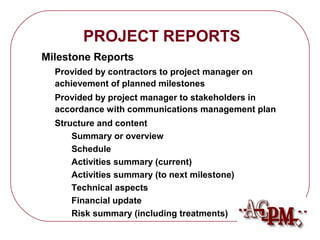
Risk summary (including treatments) 
Financial update 
Technical aspects 
Activities summary (to next milestone) 
Activities summary (current) 
Schedule 
Summary or overview 
Structure and content 
accordance with communications management plan 
Provided by project manager to stakeholders in 
achievement of planned milestones 
Provided by contractors to project manager on 
Milestone Reports 
PROJECT REPORTS
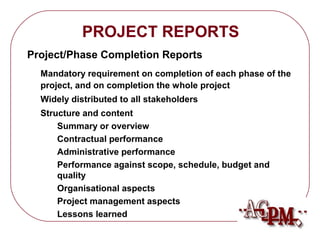
Lessons learned 
Project management aspects 
Organisational aspects 
quality 
Performance against scope, schedule, budget and 
Administrative performance 
Contractual performance 
Summary or overview 
Structure and content 
Widely distributed to all stakeholders 
project, and on completion the whole project 
Mandatory requirement on completion of each phase of the 
Project/Phase Completion Reports 
PROJECT REPORTS
What scares them? 
What drives them? 
Supporter or opponent? 
Extent of influence or impact? 
Influence or Impact? 
Management 
Key Challenge in Project 
Management: Stakeholder
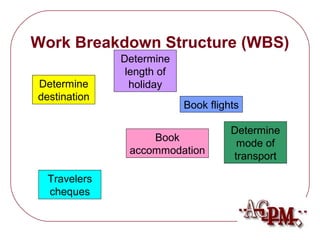
Work Breakdown Structure (WBS) 
Determine 
destination 
Book flights 
Determine 
length of 
holiday 
Determine 
mode of 
transport 
Book 
accommodation 
Travelers 
cheques
Work Breakdown Structure (WBS) 
TRAVEL 
AGENT 
Book 
accommodation 
Travelers 
cheques 
Book flights 
STAKEHOLDER 
1 CONSULTATION 
Determine 
destination 
Determine 
length of 
holiday 
Determine 
mode of 
transport 
1.1 
1.2 
1.3 
2 
2.1 
2.2 
2.3
Best Practice in 
Project 
Management 
MBA/ 
Masters 
What next…? 
QPP RPM MPD 
Tertiary Qualification 
AIPM Recognition 
Certificate IV in 
Project 
Management 
AQF Level 4 
Diploma of 
Project 
Management 
AQF Level 5 
Advanced 
Diploma of 
Project 
Management 
AQF Level 6 
QPP: Qualified Project Practitioner, typically a project team member 
RPM: Registered Project Manager, typically a project manager 
MPD: Master Project Director, typically a program director
CPMGroup 
SYDNEY 
Level 6 
66 King Street 
Sydney 2000 
9279 1610 
info@cpmgroup.com.au 
www.cpmgroup.com.au 
www.acpm.act.edu.au 
Head Office 
Canberra 
[02] 6285 3393 
Sydney 
[02] 9279 1610 
Brisbane 
[07] 3876 2849 
Melbourne 
[03] 9663 9566 
Perth 
[08] 9364 0520 
Townsville 
0413 945 725 
Kuala Lumpur 
[+603] 2175 2284 
Johannesburg 
[+2711] 784 6044 
Auckland 
[+649] 355 1789
THANK YOU

Project management 101

  • 1.
  • 4.
    WHAT IS APROJECT? A project is a set of inter-related activities with defined start and end dates, designed to achieve a unique and common objective.
  • 5.
    PROCESS RELATIONSHIPS YR1YR2 YR3 YR4 YR5 (Rolling) |-----|-----|-----|-----| Corporate Plans Business Plans (Cycle/Process) Programs (Multiple Start/End Dates) (Single Start/End Dates) demands functional approach Projects Operations Continuous Processes
  • 6.
    CRITERIA FOR A SUCCESSFUL PROJECT The project achieving its objectives, including deliverables produced: On time Within budget To specification (meets/exceeds client’s expectations) Customer satisfaction, product fit for purpose
  • 7.
    HOW DO WEACHIEVE A SUCCESSFUL PROJECT? Project success begins and ends with the Project Manager’s effective management of the project
  • 8.
    WHAT IS PROJECT MANAGEMENT? Project Management is the management of project activity through the project life cycle to achieve the delivery of a defined product or service within prescribed constraints of time, budget, scope and quality
  • 9.
    PROJECT LIFE CYCLE CONCEPT DEVELOPMENT IMPLEMENTATION FINALISATION
  • 10.
    PHASE 1: CONCEPT Identification of core need/s High level planning Range of possible solutions ‘Ball park’ estimates Preliminary risk analyses
  • 11.
    PHASE 2: DEVELOPMENT Non-viable options culled High level plans refined into a detailed plan Baselines developed Detailed designs/specifications/drawings developed
  • 12.
    TIME, COST RESOURCE MANAGEMENT Planning Scheduling Estimating
  • 13.
    Planned Progress AssumedStart Point Assumed Destination Correct Starting Point Agreed Destination – Meets Client’s Needs Actual progress
  • 14.
    RELUCTANCE TO PLAN Takes time (10-25%) Commitment is required Difficult to plan the future Imposes discipline Plans are always wrong Hard to maintain plans “Never needed to before” Fear of planning Reluctance to Plan
  • 15.
    REASONS FOR PLANNING Reasons for Planning Target Verification Enforces Commitments Resource Planning Basis for “What If” Enforces Pre-thinking Basis for Control Clarifies Risk Basis for Delegation
  • 16.
    PHASE 3: IMPLEMENTATION Works undertaken per baselines Actual progress checked against planned baselines for variance Causes of variance dealt with Project reporting undertaken
  • 17.
    THE PROJECT PLANNING CONTROL CYCLE INITIATE SET TERMS OF REFERENCE. PLAN EXECUTE THE WORK MONITOR PROGRESS SIZE THE PROBLEM ANALYSE VARIANCE ACT MAJOR REVIEW COMPARE WITH PLAN RE-PLAN MINOR ADJUSTMENTS
  • 18.
  • 19.
    PHASE 4: FINALISATION Have all deliverables been met? Contracts terminated? Transition plan formulated Lessons learned
  • 20.
    FUNCTIONS OF PROJECTMANAGEMENT Scope Time Cost Quality Risk HR Communications Procurement/Contracts Integratio n Integratio n
  • 21.
    SCOPE Describesthe outcomes sought Describes the work content boundaries Ultimately defines a broad strategy BASELINE: Scope Document
  • 22.
    TIME Planning– what to do Estimating - duration SCHEDULING – Dependencies CONTROL – Achieving milestones BASELINE: Schedule (Gant Chart)
  • 23.
    COST Iterativelyestimating cost Top down bottom up approach Budget definition BASELINE: Time phased expenditure/revenue
  • 24.
    QUALITY Understandingclient expectations Managing, meeting/exceeding them Project Quality system developed BASELINE: Project Quality Plan
  • 25.
    RISK Possibleadverse occurrences ID Assess Respond (incl. Prioritisation) Create Risk Register (allocate resp.) BASELINE: Risk Management Plan
  • 26.
    HUMAN RESOURCES HR Administration Resource Allocation Team performance Motivation BASELINE: Resource Allocation Matrix
  • 27.
    COMMUNICATIONS Formaland informal Interpersonal communications Communication strategy BASELINE: Communications matrix
  • 28.
    CONTRACTS/PROCUREMENT Externalresources Formation-Award-Performance Bid process Form of contract BASELINE: Procurement schedule
  • 29.
    INTEGRATION Overallperspective Interconnected nature of 8 functions Schedule is a powerful integrative tool Learning outcomes BASELINE: Reporting/control
  • 30.
    REPORTS Factors tobe considered: What should be in the report Who is the report going to Collecting the right data Frequency of report
  • 31.
    Program Management Committees Project Steering Committee Project Manager – Program Manager Project Manager – Client Project Manager – Contractor Reports and reviews between Exception Phase/Project Completion Milestone Periodically – eg fortnightly, monthly, quarterly Reports and reviews REPORTS AND REVIEWS
  • 32.
    PROJECT REPORTS PeriodicProgress Reports Periodically in accordance with project plan Standard format used Summary or overview Current reporting period - Progress to date - Planned progress not completed Next reporting period Schedule Issues anticipated/solutions Financial update Current baseline (Gantt)
  • 33.
    Risk summary (includingtreatments) Financial update Technical aspects Activities summary (to next milestone) Activities summary (current) Schedule Summary or overview Structure and content accordance with communications management plan Provided by project manager to stakeholders in achievement of planned milestones Provided by contractors to project manager on Milestone Reports PROJECT REPORTS
  • 34.
    Lessons learned Projectmanagement aspects Organisational aspects quality Performance against scope, schedule, budget and Administrative performance Contractual performance Summary or overview Structure and content Widely distributed to all stakeholders project, and on completion the whole project Mandatory requirement on completion of each phase of the Project/Phase Completion Reports PROJECT REPORTS
  • 35.
    What scares them? What drives them? Supporter or opponent? Extent of influence or impact? Influence or Impact? Management Key Challenge in Project Management: Stakeholder
  • 36.
    Work Breakdown Structure(WBS) Determine destination Book flights Determine length of holiday Determine mode of transport Book accommodation Travelers cheques
  • 37.
    Work Breakdown Structure(WBS) TRAVEL AGENT Book accommodation Travelers cheques Book flights STAKEHOLDER 1 CONSULTATION Determine destination Determine length of holiday Determine mode of transport 1.1 1.2 1.3 2 2.1 2.2 2.3
  • 38.
    Best Practice in Project Management MBA/ Masters What next…? QPP RPM MPD Tertiary Qualification AIPM Recognition Certificate IV in Project Management AQF Level 4 Diploma of Project Management AQF Level 5 Advanced Diploma of Project Management AQF Level 6 QPP: Qualified Project Practitioner, typically a project team member RPM: Registered Project Manager, typically a project manager MPD: Master Project Director, typically a program director
  • 39.
    CPMGroup SYDNEY Level6 66 King Street Sydney 2000 9279 1610 info@cpmgroup.com.au www.cpmgroup.com.au www.acpm.act.edu.au Head Office Canberra [02] 6285 3393 Sydney [02] 9279 1610 Brisbane [07] 3876 2849 Melbourne [03] 9663 9566 Perth [08] 9364 0520 Townsville 0413 945 725 Kuala Lumpur [+603] 2175 2284 Johannesburg [+2711] 784 6044 Auckland [+649] 355 1789
  • 40.

Editor's Notes