J. CATON - J. M. PUCH
Lyon, Nice - France
IS IT REASONABLE TO USE
DUAL MOBILITY CUP(DMC)IN
TOTAL HIP ARTHROPLASTY
(THA) FOR ALL CASES?
ABOUT A COMPARATIVE SERIES OF DMC
IN PATIENTS UNDER 55 YEARS OLD OVER
10 YEARS FU
INTRODUCTION
 All publications (more than 180 since 1986) are converging DMC
has demonstrated over 40 years it efficiency to preventTHA
instability .
 C.Vielpeau et al. – 1.15 % at 16,5 years
Int Orthop (2011) – 35- p.225-30
 JL Prudhon, A. Ferreira et al. – 0,95 % at 10 years
Int Orthop (2013) – 37 –p.2945-50
 S. Leclerc et al. – 0 % at 10 years
OTSR (2013) – 99 – p.758-64
 J. Caton, JL Prudhon et al. – 0,95 % at 10 years
Int Orthop (2014) - 38- p.1125-29
 T. Neri,R.Philipot,F.Farizon et al. – 0 % at 25 years
Int Orthop (2016) – doi 10.1007/s00264-016-3373-2
 M. Hamadouche et al. –recurrent dislocation 6 % at 5-13 years
Int. Orthop (2016) - doi 10.1007/s00264-016-3367-0
 M. Mohaddes et al. Swedish register - 1.6 % vs 6.8 % revision at 4 years
Int Orthop (2016) – doi 10.1007/s00264-016-3381-2
 S.Tarasevicius et al. Lithuanian register - 0.7 % vs 2.4 % at 5 years
Int Orthop (2016) – doi 10.1007/s00264-016-3387-7
INTRODUCTION
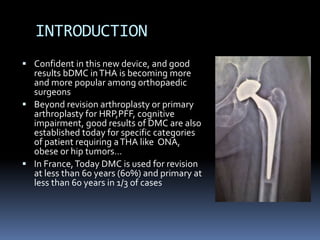
 Confident in this new device, and good
results bDMC inTHA is becoming more
and more popular among orthopaedic
surgeons
 Beyond revision arthroplasty or primary
arthroplasty for HRP,PFF, cognitive
impairment, good results of DMC are also
established today for specific categories
of patient requiring aTHA like ONA,
obese or hip tumors…
 In France,Today DMC is used for revision
at less than 60 years (60%) and primary at
less than 60 years in 1/3 of cases
INTRODUCTION
 For us, it is necessary to demonstrate
that implant improvment might
authorize us to widen DMC :
 in allTHA cases ?
 Whatever age ?
 In our team (QUATTRO – Lyon, Nice,
Grenoble), colleagues from Nice city
(JM. Puch, L. Descamps, G. Derhi)
have been using DMC in allTHA cases
since 1998
MATERIEL & METHOD
 In order to justify this indication, we report
comparative and prospective studies at more than
10 years FU
1. Clinical and radiological outcomes of a more
contemporary DMC performed in young population
under 55 years old (n=119, 2000-2005:group 1)
2. We compare these results to a series of patients over
55 years old ( n=444, 2000-2002:group 2)
 In the same conditions by :
 3 senior surgeons
 Reviewed at 3 months, 6 months, 1 year and each 2 years
MATERIAL & METHOD
 All cementless titanium
 Full-coated (HA)
 Collar stem
 Bilayer coatingTitanium plasma
spray (120µm) and HA (80µm)
In only one case: modular stem
APPROACH:
65% Postero-lateral
35% Hardinge
Femoral implants
MATERIAL & METHOD
 Stainless steel , cementless, grit blasted
 Covered with Hydroxyapatite of calcium(150 microns)
 Peripheral macrostructure for « Press Fit »
 Obturator hook and 2 superior flanges with optional screws
 Insert standard PE sterilized under vacuum
Dual Mobility Cup 2nd generation
 patients > 55 a
 n= 444
 Dead : 179 (40,2 %)*
 LFU : 8,7 %
 Mean Age : 72,3 ans*
 62,3 % female *
 Aetiology :
OA: 84,7%
AVN : 5,4 %
Dysp : 4,7 %
Others : 5.2 %
Material & Methods
 patients ≤55 a
 n= 119
 Dead : 4 (3,3 %)*
 LFU : 4,7 %
 Mean Age : 49,9 ans*
 33,3 % female *
 Aetiology :
OA: 54,3%
AVN : 12,9%
Dysp : 25%
Others : 7.8 %
* p <0,05
 patients > 55 a
 Dislocation : 0 %
 IPD: 0 %
 PMA : 17.4 (9.2)
 Harris : 95.6 (43.9)
 Devane 4&5 : 37 % (3%)*
 Survival rate
(cup revision):
98.4% at 15,5 y
Results
 patients ≤55 a
 Dislocation : 0 %
 IPD: 0 %
 PMA : 17 (8.8)
 Harris : 98 (39.5)
 Devane 4&5 : 79.5 % (5.9%)*
 Survival rate
(cup revision):
98.4% at 14 y
* p <0,05
Results
Survival rate at more than 10 Y FU
End point : cup revision for aseptic loosening
< 55 years> 55 years
DISCUSSION
 Wear process and cup loosening are still a concern with
original Bousquet DMC
 Revision and loosening at 10 years follow-up
 C.Vielpeau et al. – DM Bousquet : 8.5 % at 16.5 y FU
Int. Orthop (2011) – 35 – p.225-30
 J. Caton, JL.Prudhon et al. – QUATTRO (3ème génération) :
1.9 % at more than 10 y FU - Int Orthop (2014) – 38- p.1125-29
 T. Néri et al. : DM Bousquet : 12.7 % at 25 y FU
Int. Orhop (2016) – doi : 10-1007/s00264-016-3373-2
 Our series (JM Puch et al.) – Gyros (2nd generation) :
 Patients < 55 ans : 1.8 % at more than 10 y FU
 Patients > 55 ans : 1.12 % at more than 10 y FU
Int. Orhop (2016) – doi : 10-1007/s00264-016-3325-x
DISCUSSION
 Wear process and cup loosening are still a concern with
original Bousquet DMC (1st generation)
 Wear
 Wear assessment is very difficult to evaluate
 In vitro studies has showed than this wear is in agreement with
fixed cup metal/PE mainly LFA/Charnley.
 P. Adam et al. – 54 mm3/year (explant tribology)
OTSR (2014) – 100-P. 85-91
 B. Boyer et al. – 40 mm3/year (explant CT scan > 15 years)
OTSR (2014) – 100(1) –p.85-91
 M.Wroblewsky et al. - 30 à 80 mm3/year (radiological penetration)
CORR (1986) – 211 – p. 30-35
 Our results in vivo
 Patients < 55 ans : no visible wear
 Patients > 55 ans : 1. 2 % of radiological penetration (5 cases) of the
inner articulation : 1.45 mm (1.14 à 2.20) at more than 10 y FU
DISCUSSION
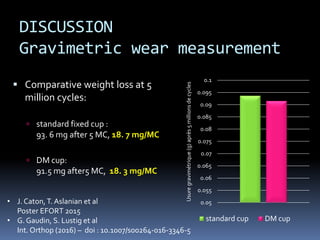
Gravimetric wear measurement
 Comparative weight loss at 5
million cycles:
 standard fixed cup :
93. 6 mg after 5 MC, 18. 7 mg/MC
 DM cup:
91.5 mg after5 MC, 18. 3 mg/MC
0.05
0.055
0.06
0.065
0.07
0.075
0.08
0.085
0.09
0.095
0.1
Usuregravimétrique(g)après5millionsdecycles
standard cup DM cup
• J. Caton,T. Aslanian et al
Poster EFORT 2015
• G. Gaudin, S. Lustig et al
Int. Orthop (2016) – doi : 10.1007/s00264-016-3346-5
DISCUSSION-Intra prosthetic dislocation (IPD)
 IPD arises when the retentive rim of the liner allows
the prosthetic head to jump out
 IPD were mainly secondary to original Bousquet
DMC (1st generation of PE insert and with big and rough neck)
 T. Néri et al. – 4.72 % at 25 y FU(Bousquet 1st gen.)
Int Orthop. (2016) - doi : 10-1007/s00264-016-3373-2
 C.Lautridou, C.Vielpeau et al. – 0.17 % at 15 y FU
(Bousquet 1st gen+ Charnley stem)
OTSR ( 2008) – 94 – p.731-39
 S. Leclerc et al. – 0 % at 10 y FU
OTSR (2013) – 99 – p.758-64
 JL Prudhon et al. – 0 % at 10 y FU
Int Orthop (2013) – 37-p. 2945-50
DISCUSSION
 DMC results inTHA for young patients are :
 excellent in spite of more risk factors
(sport, activities, Devane, Sex, Aetiology, …)
 Same than series of older patients and,
 According to the literature
Discussion:
Patients≤55y,FU >10Y
Cup RevisionOur Series DMC 2nd
generation
11y 105 98.1%
Kerboul L et al
Rev Chir Orthop 2005
Charnley Kerboull 10y 215 96.6%
Gallo j et al
2008
ABG 1 10;9Y 128 87.3%
Boesenach B et al
Acta orthop 2011
Biomet cup, ring loc 10y 141 92%
Eskelinen A et al Finish register
Acta orthop 2006
Biomet uni
ABG II
HG II
10Y 5607 90%
Makela KT et al Finish register
Acta orthop 2011
15y 3668 62%(cup+ stem)
Chana R et al
JBJS B 2013
Cera / Cera 10Y 106 96.5%
Almeda F et al
J Orthop Surg 2010
Threaded cup 10y 75 88%
Phillipot R et al
Rev Chir Orthop 2005
DMC 1 st generation
NOVAE I
10y 46 90.8%
CONCLUSION
 DM cup for young patient is a relevant surgical
option with no dislocation and excellent survival
rate at mild term FU (98.4 % at 14 y FU)
 With contemporary DMC, almost all patients
elligible forTHA could take significant benefits
 Contra-indications remain uncommon
Thank you for your attention
2017 012

2017 012

  • 1.
    J. CATON -J. M. PUCH Lyon, Nice - France IS IT REASONABLE TO USE DUAL MOBILITY CUP(DMC)IN TOTAL HIP ARTHROPLASTY (THA) FOR ALL CASES? ABOUT A COMPARATIVE SERIES OF DMC IN PATIENTS UNDER 55 YEARS OLD OVER 10 YEARS FU
  • 2.
    INTRODUCTION  All publications(more than 180 since 1986) are converging DMC has demonstrated over 40 years it efficiency to preventTHA instability .  C.Vielpeau et al. – 1.15 % at 16,5 years Int Orthop (2011) – 35- p.225-30  JL Prudhon, A. Ferreira et al. – 0,95 % at 10 years Int Orthop (2013) – 37 –p.2945-50  S. Leclerc et al. – 0 % at 10 years OTSR (2013) – 99 – p.758-64  J. Caton, JL Prudhon et al. – 0,95 % at 10 years Int Orthop (2014) - 38- p.1125-29  T. Neri,R.Philipot,F.Farizon et al. – 0 % at 25 years Int Orthop (2016) – doi 10.1007/s00264-016-3373-2  M. Hamadouche et al. –recurrent dislocation 6 % at 5-13 years Int. Orthop (2016) - doi 10.1007/s00264-016-3367-0  M. Mohaddes et al. Swedish register - 1.6 % vs 6.8 % revision at 4 years Int Orthop (2016) – doi 10.1007/s00264-016-3381-2  S.Tarasevicius et al. Lithuanian register - 0.7 % vs 2.4 % at 5 years Int Orthop (2016) – doi 10.1007/s00264-016-3387-7
  • 3.
    INTRODUCTION  Confident inthis new device, and good results bDMC inTHA is becoming more and more popular among orthopaedic surgeons  Beyond revision arthroplasty or primary arthroplasty for HRP,PFF, cognitive impairment, good results of DMC are also established today for specific categories of patient requiring aTHA like ONA, obese or hip tumors…  In France,Today DMC is used for revision at less than 60 years (60%) and primary at less than 60 years in 1/3 of cases
  • 4.
    INTRODUCTION  For us,it is necessary to demonstrate that implant improvment might authorize us to widen DMC :  in allTHA cases ?  Whatever age ?  In our team (QUATTRO – Lyon, Nice, Grenoble), colleagues from Nice city (JM. Puch, L. Descamps, G. Derhi) have been using DMC in allTHA cases since 1998
  • 5.
    MATERIEL & METHOD In order to justify this indication, we report comparative and prospective studies at more than 10 years FU 1. Clinical and radiological outcomes of a more contemporary DMC performed in young population under 55 years old (n=119, 2000-2005:group 1) 2. We compare these results to a series of patients over 55 years old ( n=444, 2000-2002:group 2)  In the same conditions by :  3 senior surgeons  Reviewed at 3 months, 6 months, 1 year and each 2 years
  • 6.
    MATERIAL & METHOD All cementless titanium  Full-coated (HA)  Collar stem  Bilayer coatingTitanium plasma spray (120µm) and HA (80µm) In only one case: modular stem APPROACH: 65% Postero-lateral 35% Hardinge Femoral implants
  • 7.
    MATERIAL & METHOD Stainless steel , cementless, grit blasted  Covered with Hydroxyapatite of calcium(150 microns)  Peripheral macrostructure for « Press Fit »  Obturator hook and 2 superior flanges with optional screws  Insert standard PE sterilized under vacuum Dual Mobility Cup 2nd generation
  • 8.
     patients >55 a  n= 444  Dead : 179 (40,2 %)*  LFU : 8,7 %  Mean Age : 72,3 ans*  62,3 % female *  Aetiology : OA: 84,7% AVN : 5,4 % Dysp : 4,7 % Others : 5.2 % Material & Methods  patients ≤55 a  n= 119  Dead : 4 (3,3 %)*  LFU : 4,7 %  Mean Age : 49,9 ans*  33,3 % female *  Aetiology : OA: 54,3% AVN : 12,9% Dysp : 25% Others : 7.8 % * p <0,05
  • 9.
     patients >55 a  Dislocation : 0 %  IPD: 0 %  PMA : 17.4 (9.2)  Harris : 95.6 (43.9)  Devane 4&5 : 37 % (3%)*  Survival rate (cup revision): 98.4% at 15,5 y Results  patients ≤55 a  Dislocation : 0 %  IPD: 0 %  PMA : 17 (8.8)  Harris : 98 (39.5)  Devane 4&5 : 79.5 % (5.9%)*  Survival rate (cup revision): 98.4% at 14 y * p <0,05
  • 10.
    Results Survival rate atmore than 10 Y FU End point : cup revision for aseptic loosening < 55 years> 55 years
  • 11.
    DISCUSSION  Wear processand cup loosening are still a concern with original Bousquet DMC  Revision and loosening at 10 years follow-up  C.Vielpeau et al. – DM Bousquet : 8.5 % at 16.5 y FU Int. Orthop (2011) – 35 – p.225-30  J. Caton, JL.Prudhon et al. – QUATTRO (3ème génération) : 1.9 % at more than 10 y FU - Int Orthop (2014) – 38- p.1125-29  T. Néri et al. : DM Bousquet : 12.7 % at 25 y FU Int. Orhop (2016) – doi : 10-1007/s00264-016-3373-2  Our series (JM Puch et al.) – Gyros (2nd generation) :  Patients < 55 ans : 1.8 % at more than 10 y FU  Patients > 55 ans : 1.12 % at more than 10 y FU Int. Orhop (2016) – doi : 10-1007/s00264-016-3325-x
  • 12.
    DISCUSSION  Wear processand cup loosening are still a concern with original Bousquet DMC (1st generation)  Wear  Wear assessment is very difficult to evaluate  In vitro studies has showed than this wear is in agreement with fixed cup metal/PE mainly LFA/Charnley.  P. Adam et al. – 54 mm3/year (explant tribology) OTSR (2014) – 100-P. 85-91  B. Boyer et al. – 40 mm3/year (explant CT scan > 15 years) OTSR (2014) – 100(1) –p.85-91  M.Wroblewsky et al. - 30 à 80 mm3/year (radiological penetration) CORR (1986) – 211 – p. 30-35  Our results in vivo  Patients < 55 ans : no visible wear  Patients > 55 ans : 1. 2 % of radiological penetration (5 cases) of the inner articulation : 1.45 mm (1.14 à 2.20) at more than 10 y FU
  • 13.
    DISCUSSION Gravimetric wear measurement Comparative weight loss at 5 million cycles:  standard fixed cup : 93. 6 mg after 5 MC, 18. 7 mg/MC  DM cup: 91.5 mg after5 MC, 18. 3 mg/MC 0.05 0.055 0.06 0.065 0.07 0.075 0.08 0.085 0.09 0.095 0.1 Usuregravimétrique(g)après5millionsdecycles standard cup DM cup • J. Caton,T. Aslanian et al Poster EFORT 2015 • G. Gaudin, S. Lustig et al Int. Orthop (2016) – doi : 10.1007/s00264-016-3346-5
  • 14.
    DISCUSSION-Intra prosthetic dislocation(IPD)  IPD arises when the retentive rim of the liner allows the prosthetic head to jump out  IPD were mainly secondary to original Bousquet DMC (1st generation of PE insert and with big and rough neck)  T. Néri et al. – 4.72 % at 25 y FU(Bousquet 1st gen.) Int Orthop. (2016) - doi : 10-1007/s00264-016-3373-2  C.Lautridou, C.Vielpeau et al. – 0.17 % at 15 y FU (Bousquet 1st gen+ Charnley stem) OTSR ( 2008) – 94 – p.731-39  S. Leclerc et al. – 0 % at 10 y FU OTSR (2013) – 99 – p.758-64  JL Prudhon et al. – 0 % at 10 y FU Int Orthop (2013) – 37-p. 2945-50
  • 15.
    DISCUSSION  DMC resultsinTHA for young patients are :  excellent in spite of more risk factors (sport, activities, Devane, Sex, Aetiology, …)  Same than series of older patients and,  According to the literature
  • 16.
    Discussion: Patients≤55y,FU >10Y Cup RevisionOurSeries DMC 2nd generation 11y 105 98.1% Kerboul L et al Rev Chir Orthop 2005 Charnley Kerboull 10y 215 96.6% Gallo j et al 2008 ABG 1 10;9Y 128 87.3% Boesenach B et al Acta orthop 2011 Biomet cup, ring loc 10y 141 92% Eskelinen A et al Finish register Acta orthop 2006 Biomet uni ABG II HG II 10Y 5607 90% Makela KT et al Finish register Acta orthop 2011 15y 3668 62%(cup+ stem) Chana R et al JBJS B 2013 Cera / Cera 10Y 106 96.5% Almeda F et al J Orthop Surg 2010 Threaded cup 10y 75 88% Phillipot R et al Rev Chir Orthop 2005 DMC 1 st generation NOVAE I 10y 46 90.8%
  • 17.
    CONCLUSION  DM cupfor young patient is a relevant surgical option with no dislocation and excellent survival rate at mild term FU (98.4 % at 14 y FU)  With contemporary DMC, almost all patients elligible forTHA could take significant benefits  Contra-indications remain uncommon
  • 18.
    Thank you foryour attention

Editor's Notes

  • #2 Now I have the honnor to talk you about the dual mobility and the young people. There are some times I spoke about young people less than 50 years but now I’m older and I’ m always active, then less than 55 year feels good for me
  • #3 Naturally THA for young patients is a big challenge It’s the problem of sports and big activity and normally for a long time ! The bearing must be stable and also hard-wearing. So are mid term results same than oldest patients ?
  • #4 Naturally THA for young patients is a big challenge It’s the problem of sports and big activity and normally for a long time ! The bearing must be stable and also hard-wearing. So are mid term results same than oldest patients ?
  • #5 Naturally THA for young patients is a big challenge It’s the problem of sports and big activity and normally for a long time ! The bearing must be stable and also hard-wearing. So are mid term results same than oldest patients ?
  • #6 Since 2000, our team put dual mobility for all patients For this meeting we have chosen cases operarted during the five first years. 116 THA for 102 patients , during the same period , we have put 1014 dmc for the oldest patients. 3 Semior surgeons , it’s a continue and prospective series
  • #7 The femoral implants was always cementless titanium, completly coated and with a collar, except in one case, the surgeon used a modulary stem. Approach was posterior lateral in Sixty five pourcent
  • #8 This cup is a second generation of dual mobility, stainlees steel and cementless, grit blasted and covered with hydroxyapatite of calcium. The insert is a standard PE sterilized under vacuum.
  • #9 Now, discussion and firs: t Are long term results same than oldest patients ? In our global series more than 1000 patients , you see that surely aetiology are different but no dislocation et there isn’t significent difference according to the two studied groups
  • #10 Now, discussion and firs: t Are long term results same than oldest patients ? In our global series more than 1000 patients , you see that surely aetiology are different but no dislocation et there isn’t significent difference according to the two studied groups
  • #12 Since 2000, our team put dual mobility for all patients For this meeting we have chosen cases operarted during the five first years. 116 THA for 102 patients , during the same period , we have put 1014 dmc for the oldest patients. 3 Semior surgeons , it’s a continue and prospective series
  • #13 Since 2000, our team put dual mobility for all patients For this meeting we have chosen cases operarted during the five first years. 116 THA for 102 patients , during the same period , we have put 1014 dmc for the oldest patients. 3 Semior surgeons , it’s a continue and prospective series
  • #15 Since 2000, our team put dual mobility for all patients For this meeting we have chosen cases operarted during the five first years. 116 THA for 102 patients , during the same period , we have put 1014 dmc for the oldest patients. 3 Semior surgeons , it’s a continue and prospective series
  • #16 Since 2000, our team put dual mobility for all patients For this meeting we have chosen cases operarted during the five first years. 116 THA for 102 patients , during the same period , we have put 1014 dmc for the oldest patients. 3 Semior surgeons , it’s a continue and prospective series
  • #17 We studied the various internationnals publications about the young people and a FU more than 10y; Our results are no bad and are similar with the kerboul series with a cimented THA and with the Chana series with a hard bearing ceramique ceramique. And we are better than the first génération of DMC