TOTAL HIP ARTHROPLASTY
 Many mountains climbed
   - many yet to conquer
HISTORICAL REVIEW


The present, like a note of music,
is nothing but as it appertains to
what is past and what is to come
                     Walter Landau
Hip arthroplasty

 interpositional
 excision
 replacement
Interpositional arthroplasty
Excision arthroplasty
Hemiarthroplasty
Judet
Austin Moore   Thompson
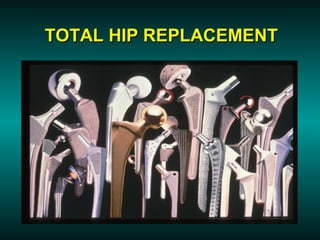
TOTAL HIP REPLACEMENT
1891
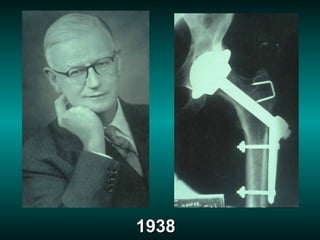
1938
The cart has been
put before the horse:
the artificial joint has
been made and used,
and now we are trying
to find out how and
why it fails
         Charnley 1956
Charnley’s 3 major contributions

  low friction torque arthroplasty
  introduction of high density
   polyethylene
  use of acrylic bone cement to
   secure implant fixation to bone
Survivorship

 81% at 25 year follow-up
  (revision of any component as
  end point)
                         Berry et al 2002
 77% at 25 year follow-up
  (revision of any component as
  end point)
                     Callaghan et al 2000
   (also Kavanagh, Wroblewski, Older, etc)
Why change component design?


Are we addressing a non-problem?
Two basic design concepts

     composite beam
     taper slip
Composite beam

“Shape closed” design
Roughened surfaces
and precoating
contribute to perfect
bond between stem
and cement
Taper slip

Highly polished double
tapered stem
Designed to settle in
the cement mantle thus
re-engaging the taper
and becoming
progressively more stable
Debonding at the cement-metal
interface represents the initiation
of loosening of cemented femoral
components
                         Harris 1992


Slip between metal and cement is
essential to protect the cement-
bone interface
                     Fowler et al 1988
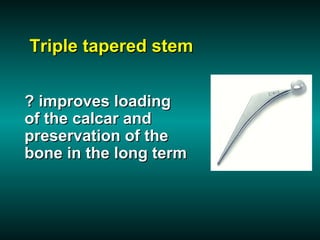
Triple tapered stem


? improves loading
of the calcar and
preservation of the
bone in the long term
“I think my major
contribution was
the concept of
achieving fixation
entirely by means
of cement”
       Charnley 1970
Cement is a grout not a glue
 the surface area of the truncated cone of
  cement presents a much larger surface
  area than the stem


 when loaded, a cemented prosthesis
  transfers the load to the endosteal
  surface through hundreds of trabeculae
Cementing techniques
Can we improve the mechanical
    properties of cement?


Norwegian Hip Study
1987-99

                      → probably not
There is no such thing
  as a small change
Exeter

- surface finish

 matte    10% revised at 10 years
 polished 2.5% revised at 10 years
3M Capital stem

 6 year survival of modular
  flanged stem: 84%
 ? rounded medial and lateral
  surfaces below the shoulder
  reduced torsional stability

     ? Material (titanium)
CEMENT DISEASE
      Jones & Hungerford 1987


→ cementless fixation
CEMENT DISEASE


 Particle disease
  Particle access
      disease
CEMENTLESS FIXATION
              Objectives
Primary
 immediate press-fit stability
 durable biological fixation
Secondary
 biomechanical compatibility
 Avoid
   thigh pain
   stress protection osteopenia
Distal fixation may predispose to

 thigh pain

 proximal stress
  protection
  osteopenia
Reducing the stiffness of the stem
  can reduce thigh pain and reduce
proximal stress protection osteopenia
Bioactive coatings
 tricalcium phosphate
 hydroxyapatite
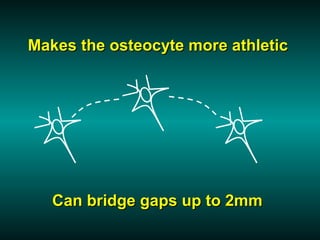
Makes the osteocyte more athletic


   Can bridge gaps up to 2mm
Mid-term results with the
cementless hip replacement

 100% survival of the femoral
  component at 10 years
               Archibeck et al 2001


 99% survival of an HA coated
  femoral stem at 9-12 years
                 McNally et al 2000
CEMENTED FIXATION
Mechanical interlock: static: quality
of bone, cement and consequently
fixation degrade with time

CEMENTLESS FIXATION
Biological osseo-integration:
dynamic: bone replaced and quality
of fixation maintained
“Periprosthetic osteolysis
is the leading problem in
contemporary THR”
                 Harris 1995
STRATEGIES FOR THE
PREVENTION OF OSTEOLYSIS
 prevent particle access
 ↓ number of particles
 inhibit cellular response
  (“pharmacological”)
PREVENT PARTICLE ACCESS

Cementless implantation
 enhanced
  circumferential
  osseo-integration
  (? bioactive coating)
Cemented implantation

 effective cementation to
  avoid early bone cement
  interface lucencies
Ritter et al (1999) demonstrated
38-fold increase of cup loosening
associated with wear if early post-
operative x-ray demonstrated
bone cement lucency in zone 1
Interface can be sealed to exclude
wear debris with PTFE GORE-TEX
membrane + butyl cyanoacrylate
glue
                   Bhumbra et al 1999
 physical seal
  - membrane excludes fibrous
    ingrowth and enhances
    osteogenesis

        ↓
 secondary biological seal
Reduce number
of particles
The great tragedy of science -
the slaying of a beautiful hypothesis
by an ugly fact
                          Thomas Huxley
Highly cross-linked polyethylene

     ↓ wear
     ↓ # toughness
     more vulnerable to
      abrasive environment
In an abrasive environment

↓ fracture toughness associated with
an increased number of particles
and
an increased number in the
biologically active range


         “Watch this space”
Hard-on-hard bearings

Ceramic
 ↓ surface roughness (Ra 0.02)
 wettability
  ↓ coefficient of friction
 hard - not scratch sensitive
Ceramic-ceramic
 alumina must be of high quality
  (roughness/sphericity)
 tight tolerances must be
  maintained in the manufacture of
  the bearing surfaces
 clearance must be <10 µ m

    acetab
    ular
    implan
    t
    should
    not be

    implan
    ted too
Advantages
 low coefficient of friction
   does not degrade with time

 minimal wear
   0.25 microns per year
   4000 x less than M/P coupling
                                Dorlot 1992
 alumina is an inert material and
  the wear particles excite a limited
  inflammatory response
                         Lerouge et al 1992
Disadvantages
 brittle
   do not mix and match femoral heads
    and morse tapers
   avoid scratching the morse taper and
    clean thoroughly before applying the
    head
   avoid heavy hammering
1978 - 2000

 > 3000 Al/Al couples
   1 # head
   1 # socket
                  Witvoet 1999

 1763 femoral heads
   1 # (0.06%)
           Fritz and Gleitz 1996
Metal-metal couple


1938
Look for new ideas in old
books, because old ideas
are found in new books
Early metal-on-metal
articulations had a high rate
of early loosening and failure
     stainless steel
     small clearance
            ↓
   equatorial bearing with
   ↑ frictional torque
Clearance
 optimised clearance ↑ contact area
  but avoids equatorial bearing
  (minimum 30 - 50 µ m)
 ↓ angle of convergence ↑ thickness
 of fluid film
  → ? fluid film lubrication
Metal-metal couple
 wear 80 times less than metal on
  polyethylene

 Metasul
 25 µ m during first million cycles
  then 4 - 10 µ m per million cycles
                      Nelson and Dyson
Polyethylene   Metal-Metal Ceramic-Ceramic

Wear volume mm3/year          30            1.6            1

Particle size (mode) nm       300            30        30 and 500

Number of particles           500          50 000    1 000 to 10 000
billion/year
Small particles do not excite an
inflammatory response but are
biologically active
Inhibition of cellular response

 bisphosphonates directly inhibit
  osteoclastic activity
 reduce mechanically related
  loosening of hip prostheses
 established ovine model of hemi-
  arthroplasty where significant
  stress-shielding of the calcar and
  medial cortex results in significant
  bone resorption at 6 - 12 months
Hip resurfacing
Smith Petersen
developed a CoCr
resurfacing head in the
1930s

Charnley used a
resurfacing design in the
1960s
   teflon-on-teflon
    bearing
   very low friction
   very high wear!!
Resurfacing arthroplasty (RA)
1970s/1980s


 Wagner
                     Wagner
 ICLH
 Tharies etc


                    Freeman ICLH
Large heads
 “high wear” bearings

Thin polyethylene
 → catastrophic failure of the cup
Tharies - clinical results


                             Failed Wagner device
Large bore metal-on-metal
         articulations
 McKee Farrar
 Ring
 Muller
Poor early results
 poor materials
 poor tolerances
 equatorial bearing
 later implants have better
  tolerances and polar bearing
 good long-term results with
  excellent wear characteristics
 the 20 year survivorship for
 metal-on-metal was better
 than for metal-UHMWPE


        Jacobsson, Djerf & Wahlstrim 1996
    RA is not new
    neither is a metal-on-metal
    couple
Improved technology has produced a
    reconciliation and a happy
    marriage
               RA


               MoM
FUTURE TRENDS -
A CLINICAL PERSPECTIVE
Coatings have failed due to harsh
environment which has often led
to separation of the coating
However, if successful they could:

     improve wear
     reduce friction
     improve biocompatibility
Surgical technique
 instrumentation to provide
  reproducibility
         (in everyone’s hands!)
Implant
 proximal loading
     conservative
     no thigh pain
     reduced proximal stress protection
PROXIMA

 conservative
  metaphyseal
  loading implant
 lends itself to MIS
Conservative implants
Neck Fixation      Short Stem             Resurfacing
  Sulzer: TTP    Waldemar-Link: CFP    Midland Medical: BHR
 Eska: Cut2000     Zimmer: Mayo       Wright Medical: Conserve
  Eska: Cigar      Sulzer: Stellcor
                                         Corin: Cormet 2000
                  SHO: Biodinamica
Surgical technique
   image guided systems
   minimal access surgery
Minimal access surgery
                           instruments


                        Position and cut head
                                                 Enlarge hole splitting
Drill head                                      head into four sections


             Enlarged view of oscillating saw
Expandable reamer


                    Retractor
Conservative philosophy

 If your preferred hip will
     outlast the patient
        → use it

       Otherwise...
Preserve bone stock

Think about the next operation
Biological solutions

 bone has the intrinsic capacity
  to regenerate structurally and
  functionally
 articular cartilage, menisci,
  tendons and ligaments have
  little or no ability to regenerate
  a replica of normal tissue
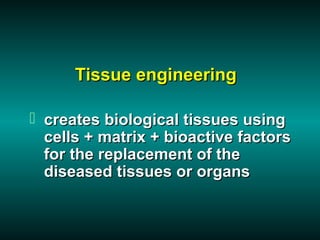
Tissue engineering

 creates biological tissues using
  cells + matrix + bioactive factors
  for the replacement of the
  diseased tissues or organs
BMP                         mitogenic
       synthetic matrices


                  chemotactic adhesion
stem cell

                      progenitor cell
      induction

                   biological polymers
 cohesion


TGF               conduction
Autologous chondrocyte
        implantation

(Carticel - Genzyme Tissue Repair)
Key concepts
Chondrocyte implantation: 6 months
   evidence of hyaline cartilage formation
     chondrocytes are in lacunae
     columnar organisation
     integrated into subchondral bone
Articular cartilage has a highly
 sophisticated ultrastructure
Gene therapy

Gene therapy can be effected by
 ex vivo modification with the
  gene re-introduced into the
  body after modification or
 in vivo modification which is
  done in situ
Can these strategies exert
structure modifying effects to
counteract the disease process?
The delivery of genes that
encode the anti-arthritic proteins
may present a biological drug
delivery system
                      Hendon et al 1999


             but...

Safety is an overriding concern
Gene delivery vector delivers a
stable gene which permits
stable and regulated production
of therapeutic proteins
 suppression of the activities of
  lymphocyte co-stimulatory
  molecules
 against anti-lymphocyte antigens
  (CDH)
 suppression of IL-1 and TNFα
                                 etc
Strategies for gene therapy
           in arthritis

 gene replacement
 - substitution of a non-active or
   defective gene, e.g. type II
   collagen mutation in familial OA
 gene addition
  e.g. IL-1 receptor antagonist
  and
 gene control, where the
  expression of a gene is controlled
  e.g. for a specific cytokine
 onset of OA may be prevented
  or delayed by transfection of
  articular cartilage chondrocytes
  with HPV proto-oncogens which
  will slow the progression of
  chondrocyte senescence or
  replace senescent cells
2000
Biological solutions will supersede
     biomechanical solutions

    Prevention will reduce the
        need for surgery

              but…
2010
25% of the population will be
         ≥ 60 years

40% of these will have arthritis
THR is still in the ascendency
  for the foreseeable future
A surgeon should be as
knowledgeable of the biological
consequences of implanting the
material and prostheses he uses
as the physician is about the side
effects of any drugs he prescribes
Many mountains climbed...


  ...many yet to conquer

Total Hip Arthroplasty

  • 1.
    TOTAL HIP ARTHROPLASTY Many mountains climbed - many yet to conquer
  • 2.
    HISTORICAL REVIEW The present,like a note of music, is nothing but as it appertains to what is past and what is to come Walter Landau
  • 3.
  • 4.
  • 6.
  • 7.
  • 8.
  • 9.
    Austin Moore Thompson
  • 10.
  • 11.
  • 12.
  • 15.
    The cart hasbeen put before the horse: the artificial joint has been made and used, and now we are trying to find out how and why it fails Charnley 1956
  • 16.
    Charnley’s 3 majorcontributions  low friction torque arthroplasty  introduction of high density polyethylene  use of acrylic bone cement to secure implant fixation to bone
  • 18.
    Survivorship  81% at25 year follow-up (revision of any component as end point) Berry et al 2002  77% at 25 year follow-up (revision of any component as end point) Callaghan et al 2000 (also Kavanagh, Wroblewski, Older, etc)
  • 19.
    Why change componentdesign? Are we addressing a non-problem?
  • 20.
    Two basic designconcepts  composite beam  taper slip
  • 21.
    Composite beam “Shape closed”design Roughened surfaces and precoating contribute to perfect bond between stem and cement
  • 22.
    Taper slip Highly polisheddouble tapered stem Designed to settle in the cement mantle thus re-engaging the taper and becoming progressively more stable
  • 23.
    Debonding at thecement-metal interface represents the initiation of loosening of cemented femoral components Harris 1992 Slip between metal and cement is essential to protect the cement- bone interface Fowler et al 1988
  • 24.
    Triple tapered stem ?improves loading of the calcar and preservation of the bone in the long term
  • 25.
    “I think mymajor contribution was the concept of achieving fixation entirely by means of cement” Charnley 1970
  • 26.
    Cement is agrout not a glue  the surface area of the truncated cone of cement presents a much larger surface area than the stem  when loaded, a cemented prosthesis transfers the load to the endosteal surface through hundreds of trabeculae
  • 27.
  • 28.
    Can we improvethe mechanical properties of cement? Norwegian Hip Study 1987-99 → probably not
  • 29.
    There is nosuch thing as a small change
  • 30.
    Exeter - surface finish matte 10% revised at 10 years  polished 2.5% revised at 10 years
  • 32.
    3M Capital stem 6 year survival of modular flanged stem: 84%  ? rounded medial and lateral surfaces below the shoulder reduced torsional stability ? Material (titanium)
  • 33.
    CEMENT DISEASE Jones & Hungerford 1987 → cementless fixation
  • 34.
    CEMENT DISEASE Particledisease Particle access disease
  • 35.
    CEMENTLESS FIXATION Objectives Primary  immediate press-fit stability  durable biological fixation Secondary  biomechanical compatibility Avoid thigh pain stress protection osteopenia
  • 36.
    Distal fixation maypredispose to  thigh pain  proximal stress protection osteopenia
  • 37.
    Reducing the stiffnessof the stem can reduce thigh pain and reduce proximal stress protection osteopenia
  • 38.
    Bioactive coatings  tricalciumphosphate  hydroxyapatite
  • 39.
    Makes the osteocytemore athletic Can bridge gaps up to 2mm
  • 40.
    Mid-term results withthe cementless hip replacement  100% survival of the femoral component at 10 years Archibeck et al 2001  99% survival of an HA coated femoral stem at 9-12 years McNally et al 2000
  • 41.
    CEMENTED FIXATION Mechanical interlock:static: quality of bone, cement and consequently fixation degrade with time CEMENTLESS FIXATION Biological osseo-integration: dynamic: bone replaced and quality of fixation maintained
  • 42.
    “Periprosthetic osteolysis is theleading problem in contemporary THR” Harris 1995
  • 43.
  • 44.
     prevent particleaccess  ↓ number of particles  inhibit cellular response (“pharmacological”)
  • 45.
    PREVENT PARTICLE ACCESS Cementlessimplantation  enhanced circumferential osseo-integration (? bioactive coating)
  • 46.
    Cemented implantation  effectivecementation to avoid early bone cement interface lucencies
  • 47.
    Ritter et al(1999) demonstrated 38-fold increase of cup loosening associated with wear if early post- operative x-ray demonstrated bone cement lucency in zone 1
  • 48.
    Interface can besealed to exclude wear debris with PTFE GORE-TEX membrane + butyl cyanoacrylate glue Bhumbra et al 1999
  • 49.
     physical seal - membrane excludes fibrous ingrowth and enhances osteogenesis ↓  secondary biological seal
  • 53.
  • 54.
    The great tragedyof science - the slaying of a beautiful hypothesis by an ugly fact Thomas Huxley
  • 55.
    Highly cross-linked polyethylene  ↓ wear  ↓ # toughness  more vulnerable to abrasive environment
  • 56.
    In an abrasiveenvironment ↓ fracture toughness associated with an increased number of particles and an increased number in the biologically active range “Watch this space”
  • 57.
    Hard-on-hard bearings Ceramic  ↓surface roughness (Ra 0.02)  wettability ↓ coefficient of friction  hard - not scratch sensitive
  • 58.
    Ceramic-ceramic  alumina mustbe of high quality (roughness/sphericity)  tight tolerances must be maintained in the manufacture of the bearing surfaces  clearance must be <10 µ m
  • 59.
    acetab ular implan t should not be implan ted too
  • 60.
    Advantages  low coefficientof friction  does not degrade with time  minimal wear  0.25 microns per year  4000 x less than M/P coupling Dorlot 1992  alumina is an inert material and the wear particles excite a limited inflammatory response Lerouge et al 1992
  • 61.
    Disadvantages  brittle  do not mix and match femoral heads and morse tapers  avoid scratching the morse taper and clean thoroughly before applying the head  avoid heavy hammering
  • 62.
    1978 - 2000 > 3000 Al/Al couples  1 # head  1 # socket Witvoet 1999  1763 femoral heads  1 # (0.06%) Fritz and Gleitz 1996
  • 64.
  • 65.
    Look for newideas in old books, because old ideas are found in new books
  • 66.
    Early metal-on-metal articulations hada high rate of early loosening and failure  stainless steel  small clearance ↓  equatorial bearing with ↑ frictional torque
  • 67.
    Clearance  optimised clearance↑ contact area but avoids equatorial bearing (minimum 30 - 50 µ m)  ↓ angle of convergence ↑ thickness of fluid film → ? fluid film lubrication
  • 69.
    Metal-metal couple  wear80 times less than metal on polyethylene Metasul  25 µ m during first million cycles then 4 - 10 µ m per million cycles Nelson and Dyson
  • 70.
    Polyethylene Metal-Metal Ceramic-Ceramic Wear volume mm3/year 30 1.6 1 Particle size (mode) nm 300 30 30 and 500 Number of particles 500 50 000 1 000 to 10 000 billion/year
  • 71.
    Small particles donot excite an inflammatory response but are biologically active
  • 73.
    Inhibition of cellularresponse  bisphosphonates directly inhibit osteoclastic activity  reduce mechanically related loosening of hip prostheses
  • 74.
     established ovinemodel of hemi- arthroplasty where significant stress-shielding of the calcar and medial cortex results in significant bone resorption at 6 - 12 months
  • 78.
    Hip resurfacing Smith Petersen developeda CoCr resurfacing head in the 1930s Charnley used a resurfacing design in the 1960s  teflon-on-teflon bearing  very low friction  very high wear!!
  • 79.
    Resurfacing arthroplasty (RA) 1970s/1980s Wagner Wagner  ICLH  Tharies etc Freeman ICLH
  • 80.
    Large heads  “highwear” bearings Thin polyethylene  → catastrophic failure of the cup
  • 81.
    Tharies - clinicalresults Failed Wagner device
  • 82.
    Large bore metal-on-metal articulations  McKee Farrar  Ring  Muller
  • 83.
    Poor early results poor materials  poor tolerances  equatorial bearing
  • 84.
     later implantshave better tolerances and polar bearing  good long-term results with excellent wear characteristics
  • 86.
     the 20year survivorship for metal-on-metal was better than for metal-UHMWPE Jacobsson, Djerf & Wahlstrim 1996
  • 88.
    RA is not new  neither is a metal-on-metal couple Improved technology has produced a reconciliation and a happy marriage RA MoM
  • 89.
    FUTURE TRENDS - ACLINICAL PERSPECTIVE
  • 90.
    Coatings have faileddue to harsh environment which has often led to separation of the coating However, if successful they could:  improve wear  reduce friction  improve biocompatibility
  • 92.
    Surgical technique  instrumentationto provide reproducibility (in everyone’s hands!)
  • 93.
    Implant  proximal loading  conservative  no thigh pain  reduced proximal stress protection
  • 95.
    PROXIMA  conservative metaphyseal loading implant  lends itself to MIS
  • 97.
    Conservative implants Neck Fixation Short Stem Resurfacing Sulzer: TTP Waldemar-Link: CFP Midland Medical: BHR Eska: Cut2000 Zimmer: Mayo Wright Medical: Conserve Eska: Cigar Sulzer: Stellcor Corin: Cormet 2000 SHO: Biodinamica
  • 98.
    Surgical technique  image guided systems  minimal access surgery
  • 99.
    Minimal access surgery  instruments Position and cut head Enlarge hole splitting Drill head head into four sections Enlarged view of oscillating saw
  • 100.
  • 102.
    Conservative philosophy Ifyour preferred hip will outlast the patient → use it Otherwise...
  • 103.
    Preserve bone stock Thinkabout the next operation
  • 104.
    Biological solutions  bonehas the intrinsic capacity to regenerate structurally and functionally
  • 105.
     articular cartilage,menisci, tendons and ligaments have little or no ability to regenerate a replica of normal tissue
  • 106.
    Tissue engineering  createsbiological tissues using cells + matrix + bioactive factors for the replacement of the diseased tissues or organs
  • 107.
    BMP mitogenic synthetic matrices chemotactic adhesion stem cell progenitor cell induction biological polymers cohesion TGF conduction
  • 108.
    Autologous chondrocyte implantation (Carticel - Genzyme Tissue Repair)
  • 109.
    Key concepts Chondrocyte implantation:6 months  evidence of hyaline cartilage formation  chondrocytes are in lacunae  columnar organisation  integrated into subchondral bone
  • 110.
    Articular cartilage hasa highly sophisticated ultrastructure
  • 113.
    Gene therapy Gene therapycan be effected by  ex vivo modification with the gene re-introduced into the body after modification or  in vivo modification which is done in situ
  • 114.
    Can these strategiesexert structure modifying effects to counteract the disease process?
  • 115.
    The delivery ofgenes that encode the anti-arthritic proteins may present a biological drug delivery system Hendon et al 1999 but... Safety is an overriding concern
  • 116.
    Gene delivery vectordelivers a stable gene which permits stable and regulated production of therapeutic proteins
  • 117.
     suppression ofthe activities of lymphocyte co-stimulatory molecules  against anti-lymphocyte antigens (CDH)  suppression of IL-1 and TNFα etc
  • 118.
    Strategies for genetherapy in arthritis  gene replacement - substitution of a non-active or defective gene, e.g. type II collagen mutation in familial OA
  • 119.
     gene addition e.g. IL-1 receptor antagonist and  gene control, where the expression of a gene is controlled e.g. for a specific cytokine
  • 120.
     onset ofOA may be prevented or delayed by transfection of articular cartilage chondrocytes with HPV proto-oncogens which will slow the progression of chondrocyte senescence or replace senescent cells
  • 121.
    2000 Biological solutions willsupersede biomechanical solutions Prevention will reduce the need for surgery but…
  • 122.
    2010 25% of thepopulation will be ≥ 60 years 40% of these will have arthritis
  • 123.
    THR is stillin the ascendency for the foreseeable future
  • 124.
    A surgeon shouldbe as knowledgeable of the biological consequences of implanting the material and prostheses he uses as the physician is about the side effects of any drugs he prescribes
  • 126.
    Many mountains climbed... ...many yet to conquer