

Presented by:
Vijendra Chandravanshi
Vinit Khushalani
Vishakha Bhagwat
MBA II sem
Sesa Goa Limited is multinational iron-ore producer and exporter with
operations in the states of Goa and Karnataka in India and
in Liberia, West Africa. It is India's largest producer and exporter of iron
ore in the private sector, with production of above 21 million tonnes of
iron ore in fiscal year 2010.
 An expression that breaks return on equity (ROE) down into three
parts:
 Profit margin, Total assets turnover and financial leverage. It is also
known as “Du Pont Analysis”
 ROE: Profit margin(Profit/sales)*total assets
turnover(sales/assets)*equity multiplier(assets/equity)
 If ROE is unsatisfactory, the Du pont identify helps locate the part of
the business that is underperforming
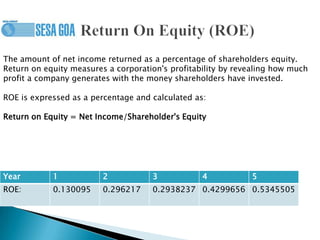
The amount of net income returned as a percentage of shareholders equity.
Return on equity measures a corporation's profitability by revealing how much
profit a company generates with the money shareholders have invested.
ROE is expressed as a percentage and calculated as:
Return on Equity = Net Income/Shareholder's Equity
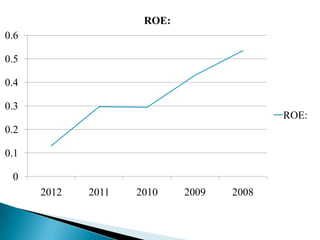
Year 1 2 3 4 5
ROE: 0.130095 0.296217 0.2938237 0.4299656 0.5345505
0
0.1
0.2
0.3
0.4
0.5
0.6
2012 2011 2010 2009 2008
ROE:
ROE:
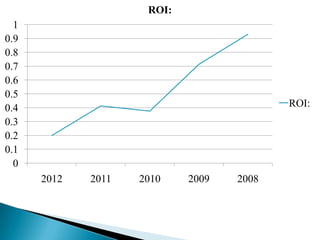
A performance measure used to evaluate the efficiency of an investment
or to compare the efficiency of a number of different investments. To
calculate ROI, the benefit (return) of an investment is divided by the cost
of the investment; the result is expressed as a percentage or a ratio.
The return on investment formula:
ROI = Earning After Tax/ Net Worth
Year 1 2 3 4 5
ROI: 0.199106 0.412867 0.3754739 0.7132414 0.9304583
0
0.1
0.2
0.3
0.4
0.5
0.6
0.7
0.8
0.9
1
2012 2011 2010 2009 2008
ROI:
ROI:
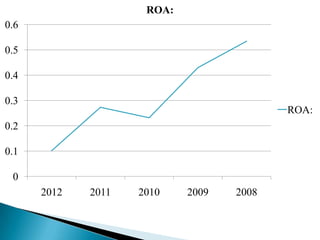
An indicator of how profitable a company is relative to its total assets.
ROA gives an idea as to how efficient management is at using its assets
to generate earnings. Calculated by dividing a company's annual earnings
by its total assets, ROA is displayed as a percentage. Sometimes this is
referred to as "return on investment".
The formula for return on assets is:
ROA = Net Income/ Net Assets
Year 1 2 3 4 5
ROA: 0.101739 0.273309 0.2318778 0.4297839 0.5345505
0
0.1
0.2
0.3
0.4
0.5
0.6
2012 2011 2010 2009 2008
ROA:
ROA:
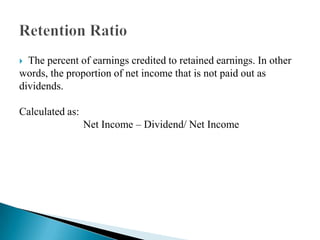
 The percent of earnings credited to retained earnings. In other
words, the proportion of net income that is not paid out as
dividends.
Calculated as:
Net Income – Dividend/ Net Income
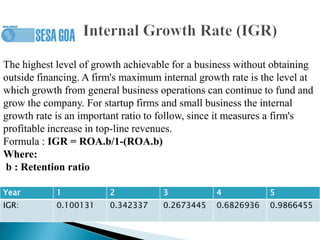
The highest level of growth achievable for a business without obtaining
outside financing. A firm's maximum internal growth rate is the level at
which growth from general business operations can continue to fund and
grow the company. For startup firms and small business the internal
growth rate is an important ratio to follow, since it measures a firm's
profitable increase in top-line revenues.
Formula : IGR = ROA.b/1-(ROA.b)
Where:
b : Retention ratio
Year 1 2 3 4 5
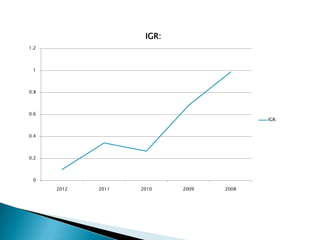
IGR: 0.100131 0.342337 0.2673445 0.6826936 0.9866455
0
0.2
0.4
0.6
0.8
1
1.2
2012 2011 2010 2009 2008
IGR:
IGR:
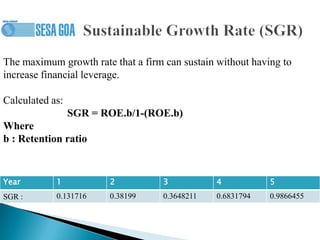
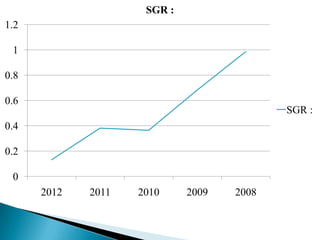
The maximum growth rate that a firm can sustain without having to
increase financial leverage.
Calculated as:
SGR = ROE.b/1-(ROE.b)
Where
b : Retention ratio
Year 1 2 3 4 5
SGR : 0.131716 0.38199 0.3648211 0.6831794 0.9866455
0
0.2
0.4
0.6
0.8
1
1.2
2012 2011 2010 2009 2008
SGR :
SGR :
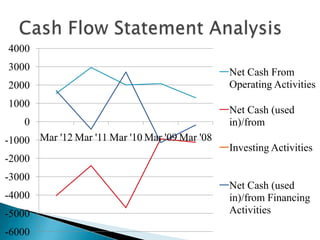
-6000
-5000
-4000
-3000
-2000
-1000
0
1000
2000
3000
4000
Mar '12 Mar '11 Mar '10 Mar '09 Mar '08
Net Cash From
Operating Activities
Net Cash (used
in)/from
Investing Activities
Net Cash (used
in)/from Financing
Activities
Du pont analysis

Du pont analysis

  • 1.
    Presented by: Vijendra Chandravanshi VinitKhushalani Vishakha Bhagwat MBA II sem
  • 2.
    Sesa Goa Limitedis multinational iron-ore producer and exporter with operations in the states of Goa and Karnataka in India and in Liberia, West Africa. It is India's largest producer and exporter of iron ore in the private sector, with production of above 21 million tonnes of iron ore in fiscal year 2010.
  • 3.
     An expressionthat breaks return on equity (ROE) down into three parts:  Profit margin, Total assets turnover and financial leverage. It is also known as “Du Pont Analysis”  ROE: Profit margin(Profit/sales)*total assets turnover(sales/assets)*equity multiplier(assets/equity)  If ROE is unsatisfactory, the Du pont identify helps locate the part of the business that is underperforming
  • 4.
    The amount ofnet income returned as a percentage of shareholders equity. Return on equity measures a corporation's profitability by revealing how much profit a company generates with the money shareholders have invested. ROE is expressed as a percentage and calculated as: Return on Equity = Net Income/Shareholder's Equity Year 1 2 3 4 5 ROE: 0.130095 0.296217 0.2938237 0.4299656 0.5345505
  • 5.
  • 6.
    A performance measureused to evaluate the efficiency of an investment or to compare the efficiency of a number of different investments. To calculate ROI, the benefit (return) of an investment is divided by the cost of the investment; the result is expressed as a percentage or a ratio. The return on investment formula: ROI = Earning After Tax/ Net Worth Year 1 2 3 4 5 ROI: 0.199106 0.412867 0.3754739 0.7132414 0.9304583
  • 7.
  • 8.
    An indicator ofhow profitable a company is relative to its total assets. ROA gives an idea as to how efficient management is at using its assets to generate earnings. Calculated by dividing a company's annual earnings by its total assets, ROA is displayed as a percentage. Sometimes this is referred to as "return on investment". The formula for return on assets is: ROA = Net Income/ Net Assets Year 1 2 3 4 5 ROA: 0.101739 0.273309 0.2318778 0.4297839 0.5345505
  • 9.
  • 10.
     The percentof earnings credited to retained earnings. In other words, the proportion of net income that is not paid out as dividends. Calculated as: Net Income – Dividend/ Net Income
  • 11.
    The highest levelof growth achievable for a business without obtaining outside financing. A firm's maximum internal growth rate is the level at which growth from general business operations can continue to fund and grow the company. For startup firms and small business the internal growth rate is an important ratio to follow, since it measures a firm's profitable increase in top-line revenues. Formula : IGR = ROA.b/1-(ROA.b) Where: b : Retention ratio Year 1 2 3 4 5 IGR: 0.100131 0.342337 0.2673445 0.6826936 0.9866455
  • 12.
  • 13.
    The maximum growthrate that a firm can sustain without having to increase financial leverage. Calculated as: SGR = ROE.b/1-(ROE.b) Where b : Retention ratio Year 1 2 3 4 5 SGR : 0.131716 0.38199 0.3648211 0.6831794 0.9866455
  • 14.
  • 15.
    -6000 -5000 -4000 -3000 -2000 -1000 0 1000 2000 3000 4000 Mar '12 Mar'11 Mar '10 Mar '09 Mar '08 Net Cash From Operating Activities Net Cash (used in)/from Investing Activities Net Cash (used in)/from Financing Activities