




DEFINITION
 The dividend payout ratio is the amount of
dividends paid to stockholders relative to
the amount of total net income of a
company.
 ALSO, DIVIDEND PAYOUT RATIO=
Dividend per share/earning per share
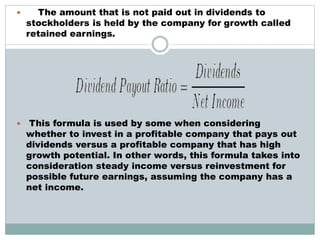
 The amount that is not paid out in dividends to
stockholders is held by the company for growth called
retained earnings.
 This formula is used by some when considering
whether to invest in a profitable company that pays out
dividends versus a profitable company that has high
growth potential. In other words, this formula takes into
consideration steady income versus reinvestment for
possible future earnings, assuming the company has a
net income.
HOW TO
CALCULATE
DIVIDEND PAYOUT
RATIO?
 Determine the net income of the company
i.e Income after all expenses and corporate
tax.
 Determine the dividend payment level. This is
normally predetermined by the company's board
of directors and approved by members at the
annual general meeting e.g use 0.4 for every
share.
 Divide the Dividends amount by
the net Income i.e Dividends/Net
income
 Remember strictly speaking dividend payout
ratio measures the dividend payout to common
shareholders as such the dividend attributable to
preferential shares will be subtracted from the
total dividends.
 Thus the new formula will be: Dividend payout
ratio=(Dividends-Preferred stock dividends)/Net
earnings.
 The ratio can also be calculated on a per unit basis thus:
Pay out Ratio=DPS(Dividend per share)/EPS(Earnings
per share)
ALSO……
 For example, a very low payout ratio indicates that a company is
primarily focused on retaining its earnings rather than paying out
dividends.
The payout ratio also indicates how well earnings support the
dividend payments: the lower the ratio, the more secure the
dividend because smaller dividends are easier to pay out than
larger dividends.
Why Dividend Payout Ratio is IMPORTANT?
 Some investors prefer long-term slow growth and want a company
to reinvest earnings back into the business to provide continued
growth. Other investors are looking for a cash payoff each quarter
since dividends have a tax advantaged status for now. These
calculations also determine if an investment is safe or higher risk.
The dividend payout ratio is also an indicator of how willing a
company is to pay its shareholders.
 A dividend payout ratio example can help a potential investor
find the best companies to invest in. However, dividend payout
ratios can be impacted by numerous factors. Different accounting
methods may result in different earnings per share figures.
Additionally, business in different stages of growth will have
different payout ratios.
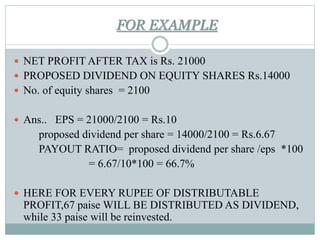
FOR EXAMPLE
 NET PROFIT AFTER TAX is Rs. 21000
 PROPOSED DIVIDEND ON EQUITY SHARES Rs.14000
 No. of equity shares = 2100
 Ans.. EPS = 21000/2100 = Rs.10
proposed dividend per share = 14000/2100 = Rs.6.67
PAYOUT RATIO= proposed dividend per share /eps *100
= 6.67/10*100 = 66.7%
 HERE FOR EVERY RUPEE OF DISTRIBUTABLE
PROFIT,67 paise WILL BE DISTRIBUTED AS DIVIDEND,
while 33 paise will be reinvested.
DIVIDEND PAYOUT RATIO

DIVIDEND PAYOUT RATIO

  • 2.
    DEFINITION  The dividendpayout ratio is the amount of dividends paid to stockholders relative to the amount of total net income of a company.  ALSO, DIVIDEND PAYOUT RATIO= Dividend per share/earning per share
  • 3.
     The amountthat is not paid out in dividends to stockholders is held by the company for growth called retained earnings.  This formula is used by some when considering whether to invest in a profitable company that pays out dividends versus a profitable company that has high growth potential. In other words, this formula takes into consideration steady income versus reinvestment for possible future earnings, assuming the company has a net income.
  • 4.
  • 5.
     Determine thenet income of the company i.e Income after all expenses and corporate tax.
  • 6.
     Determine thedividend payment level. This is normally predetermined by the company's board of directors and approved by members at the annual general meeting e.g use 0.4 for every share.
  • 7.
     Divide theDividends amount by the net Income i.e Dividends/Net income
  • 8.
     Remember strictlyspeaking dividend payout ratio measures the dividend payout to common shareholders as such the dividend attributable to preferential shares will be subtracted from the total dividends.
  • 9.
     Thus thenew formula will be: Dividend payout ratio=(Dividends-Preferred stock dividends)/Net earnings.  The ratio can also be calculated on a per unit basis thus: Pay out Ratio=DPS(Dividend per share)/EPS(Earnings per share)
  • 10.
    ALSO……  For example,a very low payout ratio indicates that a company is primarily focused on retaining its earnings rather than paying out dividends. The payout ratio also indicates how well earnings support the dividend payments: the lower the ratio, the more secure the dividend because smaller dividends are easier to pay out than larger dividends.
  • 11.
    Why Dividend PayoutRatio is IMPORTANT?  Some investors prefer long-term slow growth and want a company to reinvest earnings back into the business to provide continued growth. Other investors are looking for a cash payoff each quarter since dividends have a tax advantaged status for now. These calculations also determine if an investment is safe or higher risk. The dividend payout ratio is also an indicator of how willing a company is to pay its shareholders.
  • 12.
     A dividendpayout ratio example can help a potential investor find the best companies to invest in. However, dividend payout ratios can be impacted by numerous factors. Different accounting methods may result in different earnings per share figures. Additionally, business in different stages of growth will have different payout ratios.
  • 13.
    FOR EXAMPLE  NETPROFIT AFTER TAX is Rs. 21000  PROPOSED DIVIDEND ON EQUITY SHARES Rs.14000  No. of equity shares = 2100  Ans.. EPS = 21000/2100 = Rs.10 proposed dividend per share = 14000/2100 = Rs.6.67 PAYOUT RATIO= proposed dividend per share /eps *100 = 6.67/10*100 = 66.7%  HERE FOR EVERY RUPEE OF DISTRIBUTABLE PROFIT,67 paise WILL BE DISTRIBUTED AS DIVIDEND, while 33 paise will be reinvested.