
www.dts-solution.com
Software Defined Security
DTS Solution
Overview
Software Defined Networking
SDN – Introduction
SDN separates the data and control planes of the network
and provides interfaces/APIs to provision services
collectively in the network using external systems rather
than configuring individual device.
•Control Plane:
•Logic for controlling forwarding behavior.
•Examples: routing protocols, network, middlebox, configuration.
•Data Plane:
–Forward traffic according to control plane logic Examples: IP forwarding,Layer 2 switching
SDN - Introduction
www.dts-solution.com
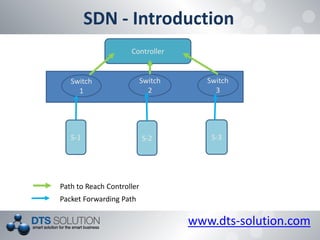
Controller
Switch
1
Switch
2
Switch
3
S-1 S-2 S-3
Path to Reach Controller
Packet Forwarding Path
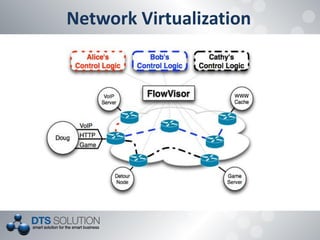
Network Virtualization
• Network Virtualization
o Decouple the application from the underlying hardware
o Representation of one or more logical
network topologies on the same infrastructure. e.g, VLANs
Multiple logical routers on a single platform
Resource isolation in CPU, memory, bandwidth, forwarding tables,...
o Customizable routing and forwarding software
o Separate logical network from the infrastructure
o General purpose CPUs for the control plane
o Network processors and FPGAs for data plan
• Network Programmability
o "The first step in creating an improved future is developing the ability to envision it.“
o Implementaition: mininet (open source, Linux based)
Network Virtualization
• SDN separates data plane and control plane
• Virtual networks separate logical and physical networks
• SDN can be a useful tool for implementing virtual
networks
Network Virtualization
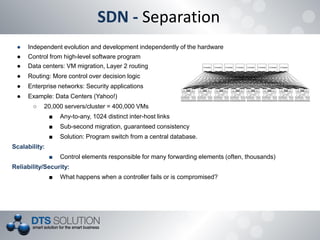
SDN - Separation
● Independent evolution and development independently of the hardware
● Control from high-level software program
● Data centers: VM migration, Layer 2 routing
● Routing: More control over decision logic
● Enterprise networks: Security applications
● Example: Data Centers (Yahoo!)
○ 20,000 servers/cluster = 400,000 VMs
■ Any-to-any, 1024 distinct inter-host links
■ Sub-second migration, guaranteed consistency
■ Solution: Program switch from a central database.
Scalability:
■ Control elements responsible for many forwarding elements (often, thousands)
Reliability/Security:
■ What happens when a controller fails or is compromised?
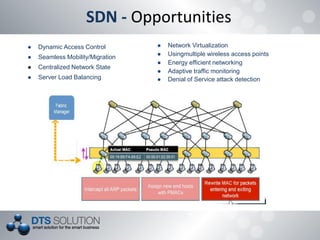
SDN - Opportunities
● Dynamic Access Control
● Seamless Mobility/Migration
● Centralized Network State
● Server Load Balancing
● Network Virtualization
● Usingmultiple wireless access points
● Energy efficient networking
● Adaptive traffic monitoring
● Denial of Service attack detection
SDN - Challenges in separation
• Control and data plane separation
o Scalability:Routing decisions for many routers
o Reliability: Correct operation under failure
o Consistency: Ensuring consistency across multiple control
replicas
• Hierarchy, aggregation, clever state mangement and distribution
SDN & Security
● The flow paradigm is ideal for security processing because it offers an end-to-end,
service-oriented connectivity model that is not bound by traditional routing
constraints.
● Logically centralized control allows for effective performance and threat monitoring
across the entire network.
● Granular policy management can be based on application, service, organization, and
geographical criteria rather than physical configuration.
● Resource-based security policies enable consolidated management of diverse devices
with various threat risks, from highly secure firewalls and security appliances to access
devices.
● Dynamic and flexible adjustment of security policy is provided under programmatic
control.
● Flexible path management achieves rapid containment and isolation of intrusions
without impacting other network users
SDN - Implementation
● OpenFlow: SDN and OpenFlow are often
used (incorrectly) interchangeably
○ opendaylight (java)
○ NOX, POX (python implementation)
○ Beacon
● Juniper Contrail
● Cisco One
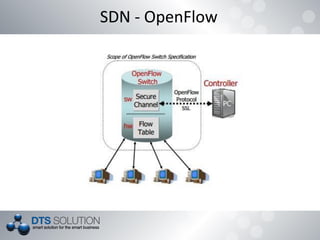
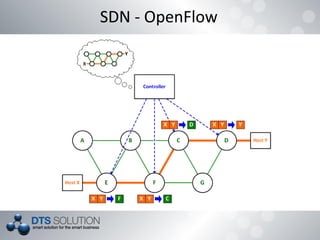
SDN - OpenFlow
OpenStandard and OpenSource
OpenFlow controller:
A software which runs on a standard hardware
OpenFlow enabled switch: openvswitch, hp,
ibm and now juniper
SDN - OpenFlow
SDN - OpenFlow
SDN - OpenFlow
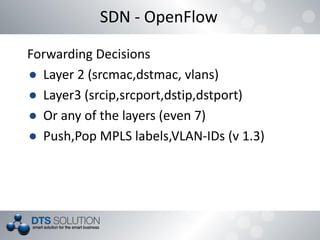
Forwarding Decisions
● Layer 2 (srcmac,dstmac, vlans)
● Layer3 (srcip,srcport,dstip,dstport)
● Or any of the layers (even 7)
● Push,Pop MPLS labels,VLAN-IDs (v 1.3)
SDN - Mininet
• Network virtualization tool that works on Linux
• Emulate your network before going to
production (multiple DP, MPLS L2,3 VPNs)
SDN - OVS (OpenVSwitch)
o OpenSource virtual switch, can be used as control plane
on real switches or between VMs same as VMware
switch.
o has its own controller which behaves like a hub
o Can connect to a separate OpenFlow controller.
o Used in mininet to emulate Network Virtualization and
KVM for switching between VMs
SDN - OpenFlow Applications
• Load balancer: A simple switch can be
used for server and/or link load balancing
• Packet Filter: A simple switch can be used
to filter traffic.
• Policy routing:
DTS Solution - Software Defined Security v1.0

DTS Solution - Software Defined Security v1.0

  • 1.
  • 2.
  • 3.
  • 4.
    SDN – Introduction SDNseparates the data and control planes of the network and provides interfaces/APIs to provision services collectively in the network using external systems rather than configuring individual device. •Control Plane: •Logic for controlling forwarding behavior. •Examples: routing protocols, network, middlebox, configuration. •Data Plane: –Forward traffic according to control plane logic Examples: IP forwarding,Layer 2 switching
  • 5.
    SDN - Introduction www.dts-solution.com Controller Switch 1 Switch 2 Switch 3 S-1S-2 S-3 Path to Reach Controller Packet Forwarding Path
  • 6.
    Network Virtualization • NetworkVirtualization o Decouple the application from the underlying hardware o Representation of one or more logical network topologies on the same infrastructure. e.g, VLANs Multiple logical routers on a single platform Resource isolation in CPU, memory, bandwidth, forwarding tables,... o Customizable routing and forwarding software o Separate logical network from the infrastructure o General purpose CPUs for the control plane o Network processors and FPGAs for data plan • Network Programmability o "The first step in creating an improved future is developing the ability to envision it.“ o Implementaition: mininet (open source, Linux based)
  • 7.
    Network Virtualization • SDNseparates data plane and control plane • Virtual networks separate logical and physical networks • SDN can be a useful tool for implementing virtual networks
  • 8.
  • 9.
    SDN - Separation ●Independent evolution and development independently of the hardware ● Control from high-level software program ● Data centers: VM migration, Layer 2 routing ● Routing: More control over decision logic ● Enterprise networks: Security applications ● Example: Data Centers (Yahoo!) ○ 20,000 servers/cluster = 400,000 VMs ■ Any-to-any, 1024 distinct inter-host links ■ Sub-second migration, guaranteed consistency ■ Solution: Program switch from a central database. Scalability: ■ Control elements responsible for many forwarding elements (often, thousands) Reliability/Security: ■ What happens when a controller fails or is compromised?
  • 10.
    SDN - Opportunities ●Dynamic Access Control ● Seamless Mobility/Migration ● Centralized Network State ● Server Load Balancing ● Network Virtualization ● Usingmultiple wireless access points ● Energy efficient networking ● Adaptive traffic monitoring ● Denial of Service attack detection
  • 11.
    SDN - Challengesin separation • Control and data plane separation o Scalability:Routing decisions for many routers o Reliability: Correct operation under failure o Consistency: Ensuring consistency across multiple control replicas • Hierarchy, aggregation, clever state mangement and distribution
  • 12.
    SDN & Security ●The flow paradigm is ideal for security processing because it offers an end-to-end, service-oriented connectivity model that is not bound by traditional routing constraints. ● Logically centralized control allows for effective performance and threat monitoring across the entire network. ● Granular policy management can be based on application, service, organization, and geographical criteria rather than physical configuration. ● Resource-based security policies enable consolidated management of diverse devices with various threat risks, from highly secure firewalls and security appliances to access devices. ● Dynamic and flexible adjustment of security policy is provided under programmatic control. ● Flexible path management achieves rapid containment and isolation of intrusions without impacting other network users
  • 13.
    SDN - Implementation ●OpenFlow: SDN and OpenFlow are often used (incorrectly) interchangeably ○ opendaylight (java) ○ NOX, POX (python implementation) ○ Beacon ● Juniper Contrail ● Cisco One
  • 14.
    SDN - OpenFlow OpenStandardand OpenSource OpenFlow controller: A software which runs on a standard hardware OpenFlow enabled switch: openvswitch, hp, ibm and now juniper
  • 15.
  • 16.
  • 17.
    SDN - OpenFlow ForwardingDecisions ● Layer 2 (srcmac,dstmac, vlans) ● Layer3 (srcip,srcport,dstip,dstport) ● Or any of the layers (even 7) ● Push,Pop MPLS labels,VLAN-IDs (v 1.3)
  • 18.
    SDN - Mininet •Network virtualization tool that works on Linux • Emulate your network before going to production (multiple DP, MPLS L2,3 VPNs)
  • 19.
    SDN - OVS(OpenVSwitch) o OpenSource virtual switch, can be used as control plane on real switches or between VMs same as VMware switch. o has its own controller which behaves like a hub o Can connect to a separate OpenFlow controller. o Used in mininet to emulate Network Virtualization and KVM for switching between VMs
  • 20.
    SDN - OpenFlowApplications • Load balancer: A simple switch can be used for server and/or link load balancing • Packet Filter: A simple switch can be used to filter traffic. • Policy routing: