Bruce Davie
Systems Approach, LLC
Software-Defined Networks
A Systems Approach
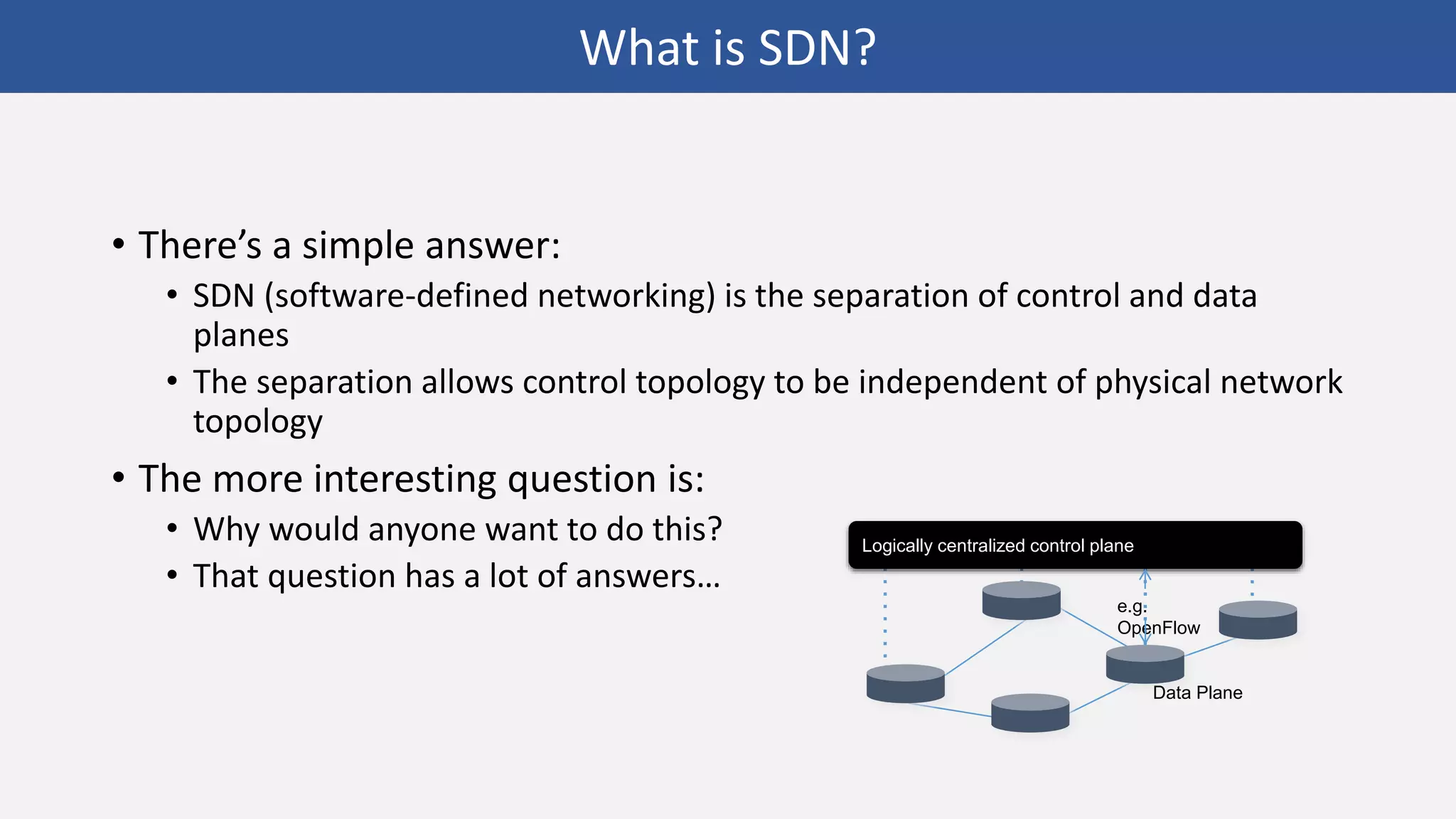
• There’s a simple answer:
• SDN (software-defined networking) is the separation of control and data
planes
• The separation allows control topology to be independent of physical network
topology
• The more interesting question is:
• Why would anyone want to do this?
• That question has a lot of answers…
Logically centralized control plane
Data Plane
e.g.
OpenFlow
What is SDN?
• History of SDN
• Challenges faced by IP networks
• SDN architecture
• Case Studies:
• Network Virtualization
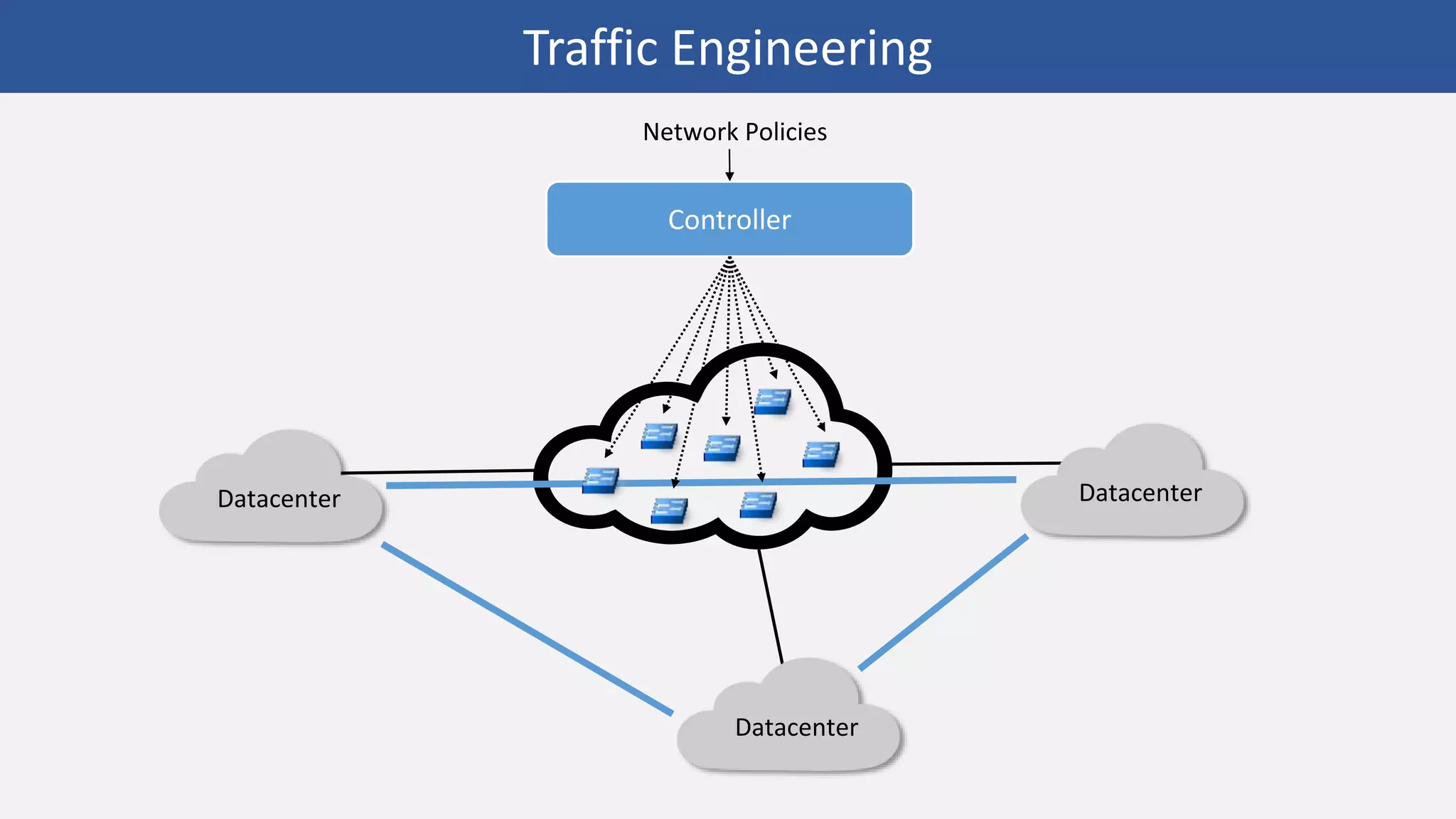
• Traffic Engineering
• SD-WAN
• Bare metal switching
Outline
A Revolution in Networking
• 4D, Greenberg et al. – part of a broader set of “Clean Slate” initiatives
• Ipsilon General Switch Management Protocol – RFC 2297 (1996)
• IETF Forces WG (2001-2015!!)
• Ethane (2007)
Foundations of SDN
• Lack of abstractions
• Inability to express intent
• Unpredictable outcome from complex distributed algorithms
• Interactions among protocols (e.g. IGP & EGP)
• Can’t manage a device unless it’s properly configured
• bootstrap issue – control & management plane dependent on correct data
plane
• Fragility, risk of change
• Glacial pace of innovation
Challenges with IP networks
Terminal Protocol: Telnet Terminal Protocol: SSH
1996 2016
Evolution of network provisioning: 1996-2016
• Centralizing the control plane enables more powerful abstractions
• E.g. X and Y should be able to communicate
• Express intent network-wide
• Distributed systems techniques to make central control scalable and
fault tolerant
• Central control means a single API for the network, rather than an API
per box
• Networks provisioned by software, not humans
• Disaggregation → innovation
• Network-wide intent → better security
Key SDN Insights
Specialized
OS
Specialized
Hardware
App
App
App
App
App
App
Specialized
Applications
Open Interface
Linux
Mac
OS
Windows or or
Open Interface
Microprocessors
Disaggregation of computing Industry
Specialized
OS
Specialized
Hardware
App
App
App
App
App
App
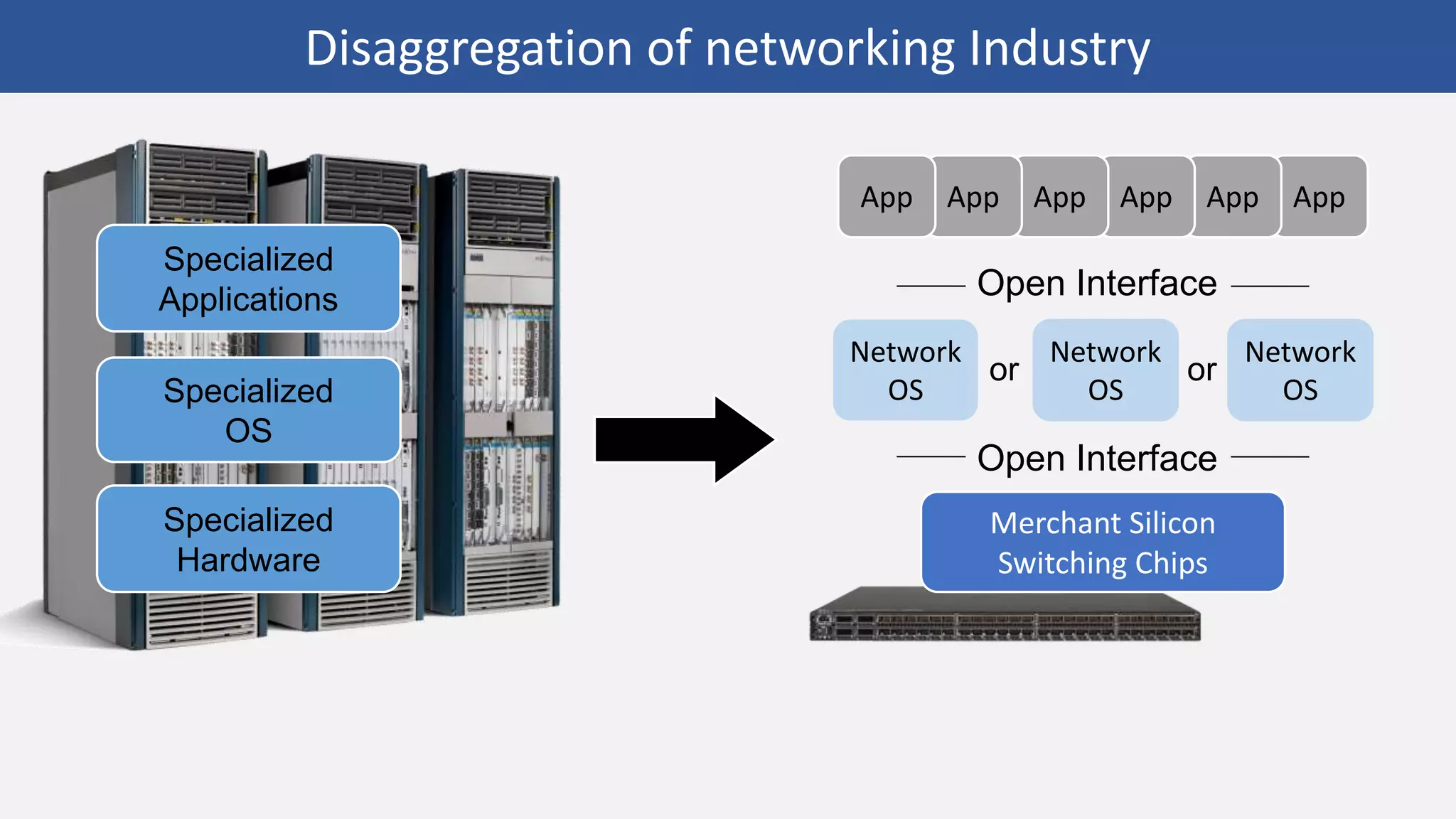
Specialized
Applications
Open Interface
Open Interface
Merchant Silicon
Switching Chips
Network
OS
or or
Network
OS
Network
OS
Disaggregation of networking Industry
• Just because an idea has been tried before without success doesn’t
mean it’s a bad idea
Random side observation
SDN Architecture
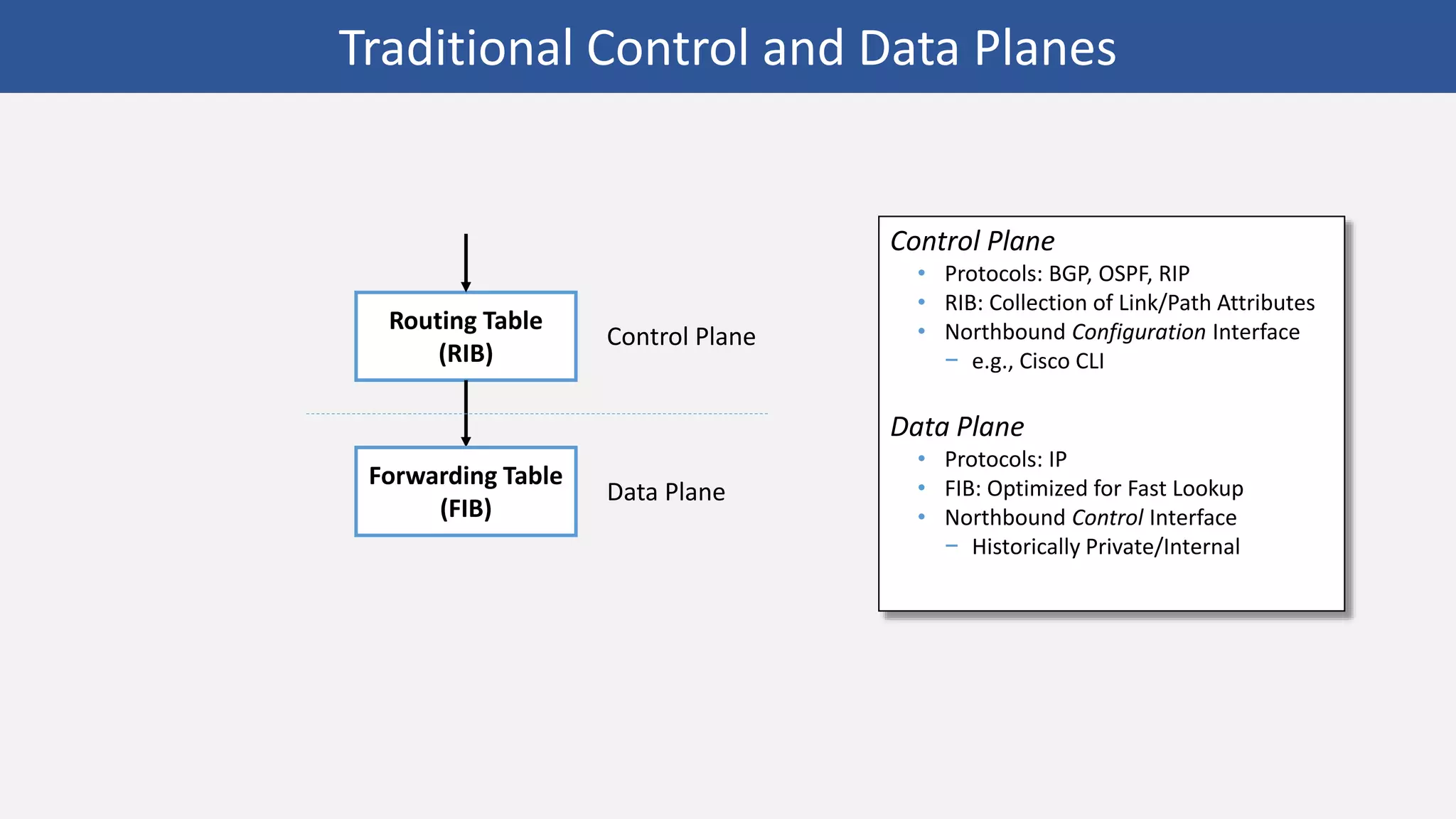
Routing Table
(RIB)
Forwarding Table
(FIB)
Data Plane
Control Plane
Traditional Control and Data Planes
Control Plane
• Protocols: BGP, OSPF, RIP
• RIB: Collection of Link/Path Attributes
• Northbound Configuration Interface
− e.g., Cisco CLI
Data Plane
• Protocols: IP
• FIB: Optimized for Fast Lookup
• Northbound Control Interface
− Historically Private/Internal
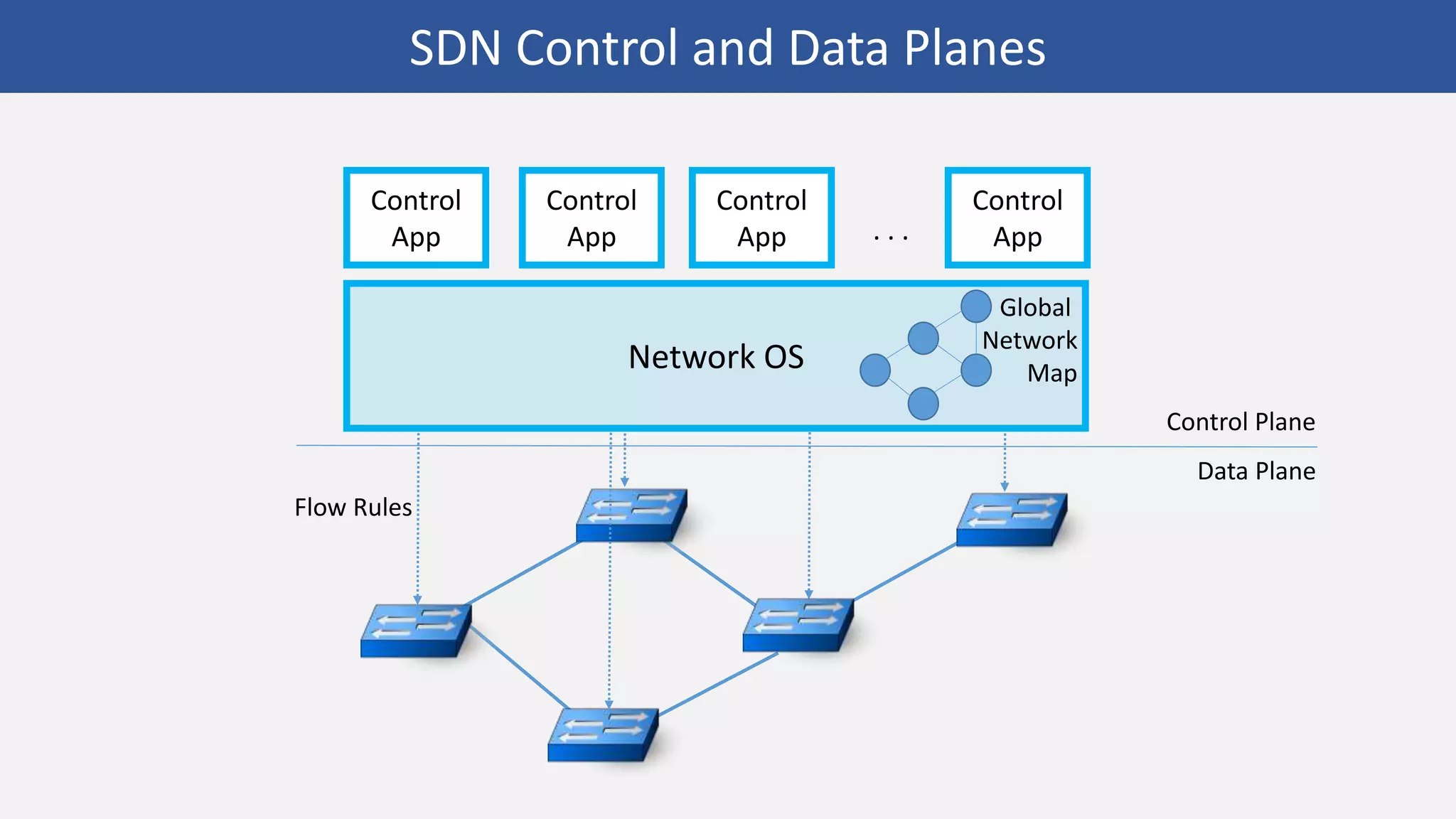
Control
App . . .
Control Plane
Data Plane
Flow Rules
Control
App
Control
App
Control
App
Network OS
Global
Network
Map
SDN Control and Data Planes
OpenFlow Switch
Table
0
Table
1
Table
n
Execute
Action
Set
. . .
Packet
In
Packet
Out
Action
Set = {}
Action
Set
Packet +
Metadata
Action
Set
Packet
OpenFlow-style data plane
(MAC) (VLAN) (IP)
MAC
Header
… Payload …
IP
Header
TCP/UDP
Header
Src
Addr
Dst
Addr Type Src
Addr
Dst
Addr
Proto
… … …
Src
Port
Dst
Port
…
VLAN ID
Ctl
Type
Optional 802.1Q
VLAN Tag
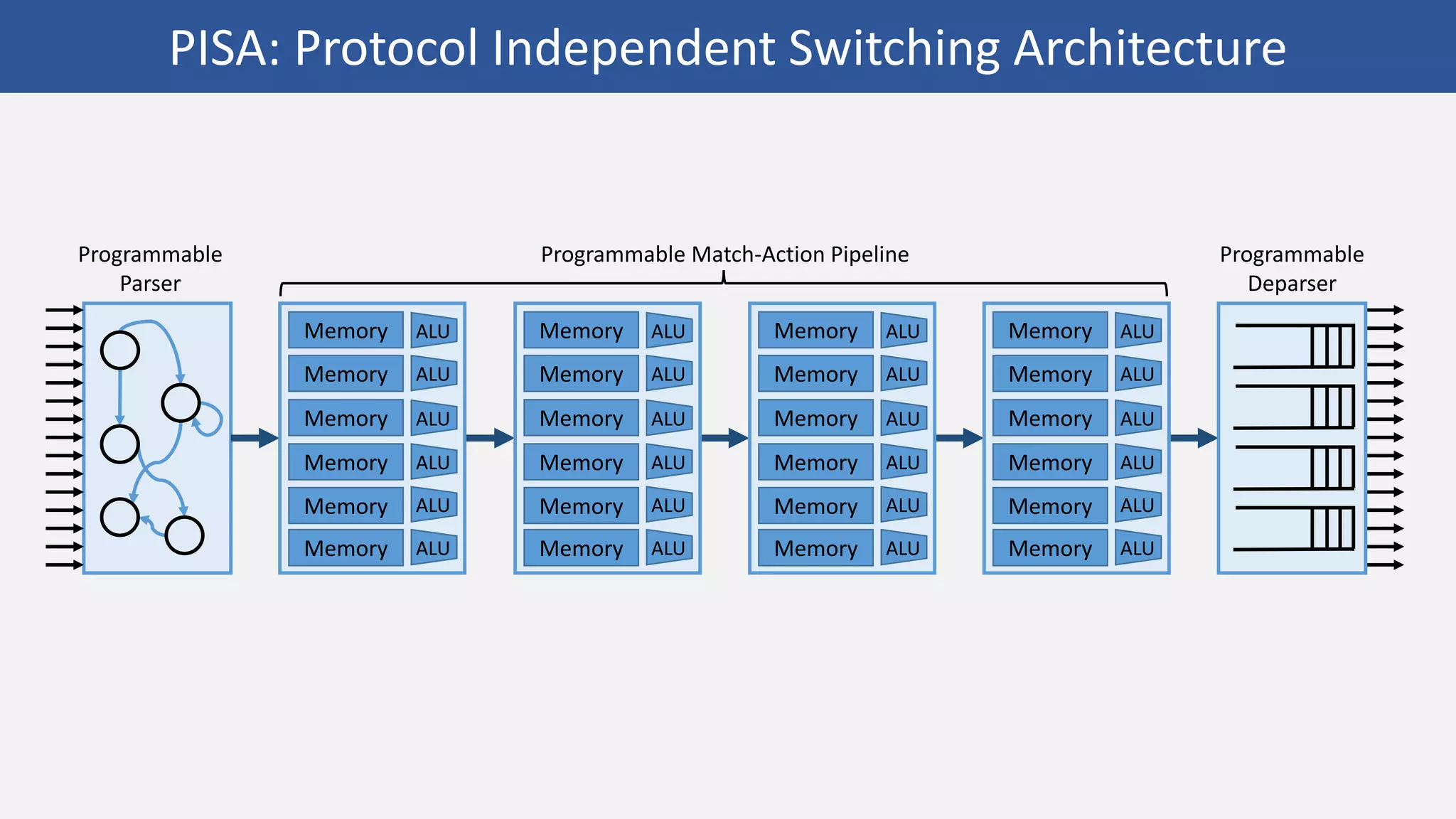
Programmable
Parser
Programmable
Deparser
Programmable Match-Action Pipeline
Memory
Memory
Memory
Memory
Memory
Memory
ALU
ALU
ALU
ALU
ALU
ALU
Memory
Memory
Memory
Memory
Memory
Memory
ALU
ALU
ALU
ALU
ALU
ALU
Memory
Memory
Memory
Memory
Memory
Memory
ALU
ALU
ALU
ALU
ALU
ALU
Memory
Memory
Memory
Memory
Memory
Memory
ALU
ALU
ALU
ALU
ALU
ALU
PISA: Protocol Independent Switching Architecture
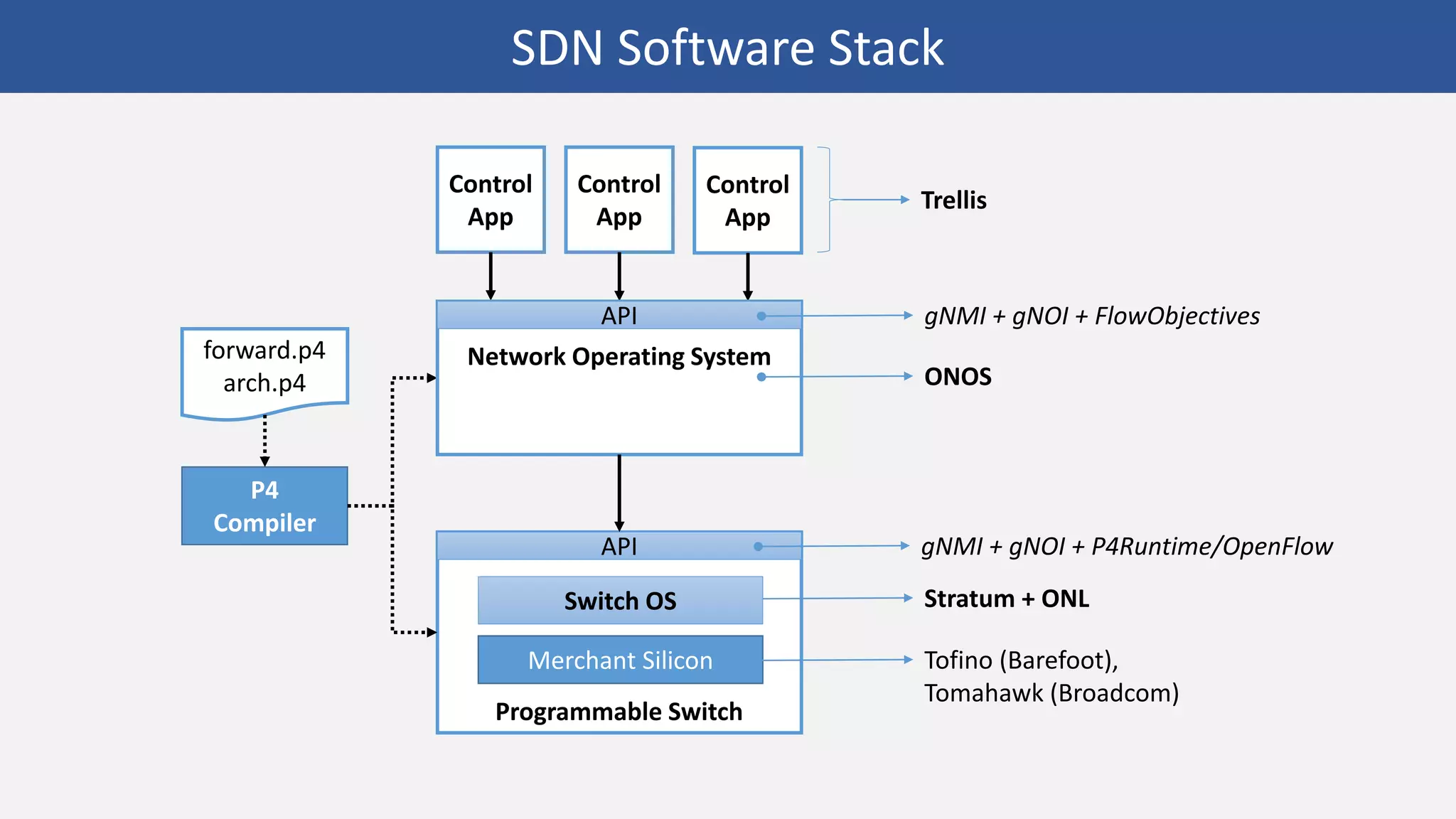
Programmable Switch
API
Merchant Silicon
Stratum + ONL
gNMI + gNOI + P4Runtime/OpenFlow
Tofino (Barefoot),
Tomahawk (Broadcom)
forward.p4
arch.p4
P4
Compiler
Control
App
Control
App
Control
App
gRPC
Trellis
Network Operating System
gRPC
API
Switch OS
ONOS
gNMI + gNOI + FlowObjectives
SDN Software Stack
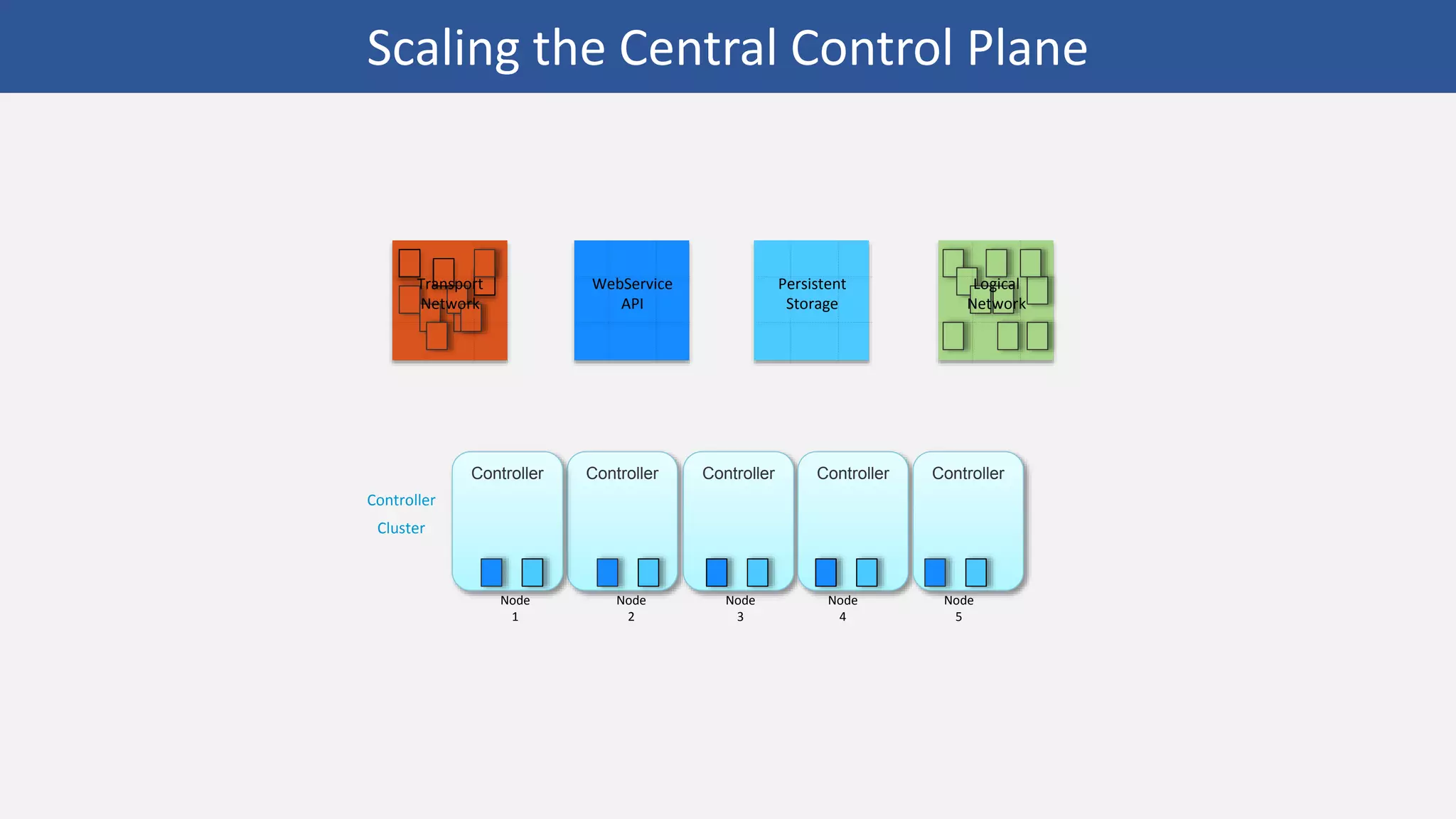
Scaling the Central Control Plane
Controller Controller Controller Controller
Controller
Node
5
Node
4
WebService
API
Persistent
Storage
Logical
Network
Transport
Network
Node
1
Node
2
Node
3
Controller
Cluster
Summary
Definition of SDN
A network in which the control plane is physically separate from the forwarding plane,
and a single control plane controls several forwarding devices. – Nick McKeown (2013)
Dimensions
• Disaggregated Control and Data planes
• Centralized vs Decentralized Control Plane
• Fixed-Function vs Programmable Data Plane
Phases of SDN
• Phase 1: Network operators took ownership of the control plane.
• Phase 1a: Non-traditional entrants to the networking business (via disaggregation)
• Phase 2: Network operators are taking ownership of the data plane.
• Network Virtualization
• SD-WAN
• Traffic Engineering
• Bare Metal Switching
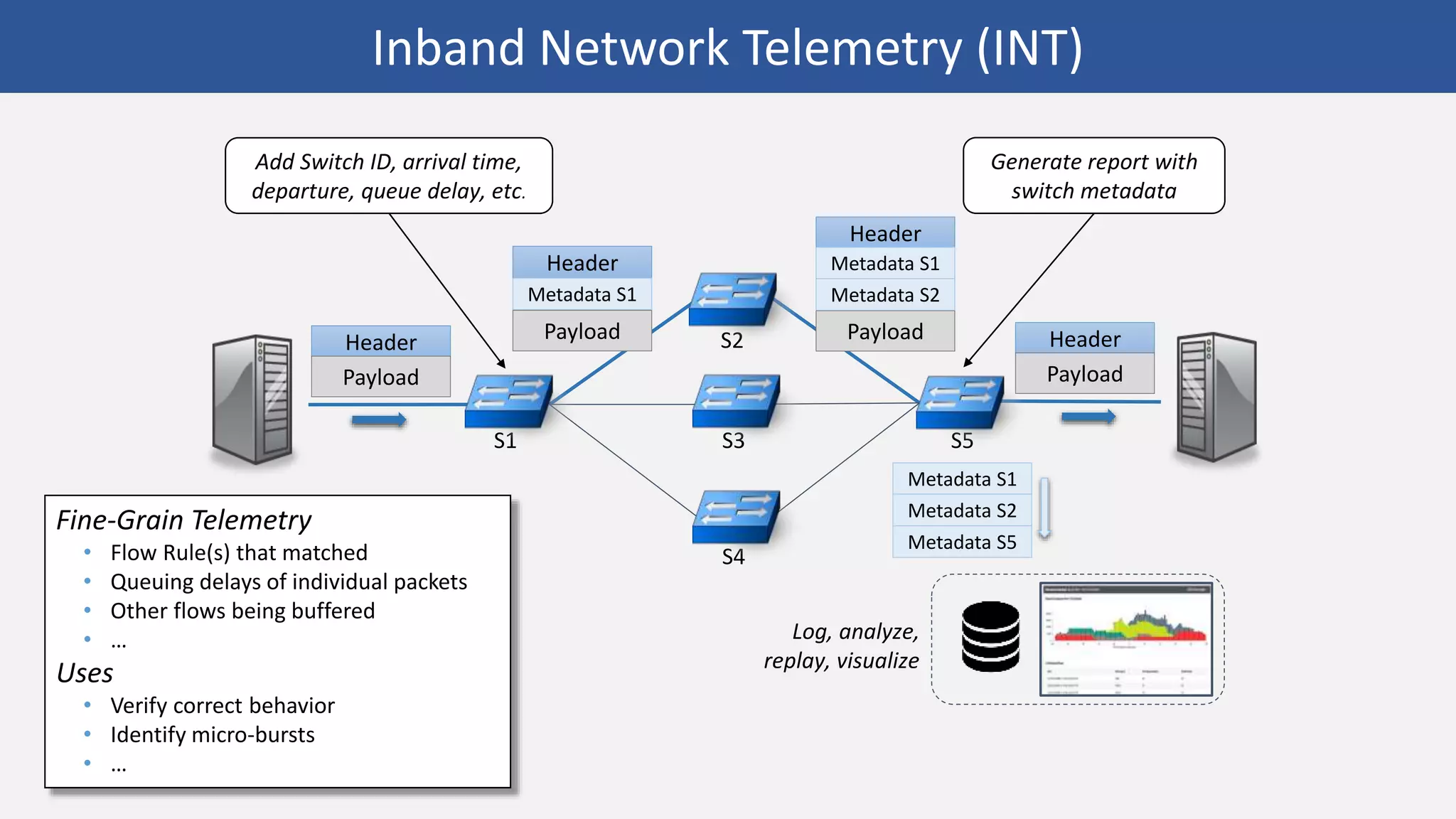
• Inband Network Telemetry
Use Cases
Physical Compute & Memory
Hypervisor
Requirement: x86
Virtual
Machine
Virtual
Machine
Virtual
Machine
Application Application Application
x86 Environment
Physical Network
Network Virtualization Platform
Requirement: IP Transport
Virtual
Network
Virtual
Network
Virtual
Network
Workload Workload Workload
L2, L3, L4-7 Network Services
Decoupled
Network Virtualization – An Analogy
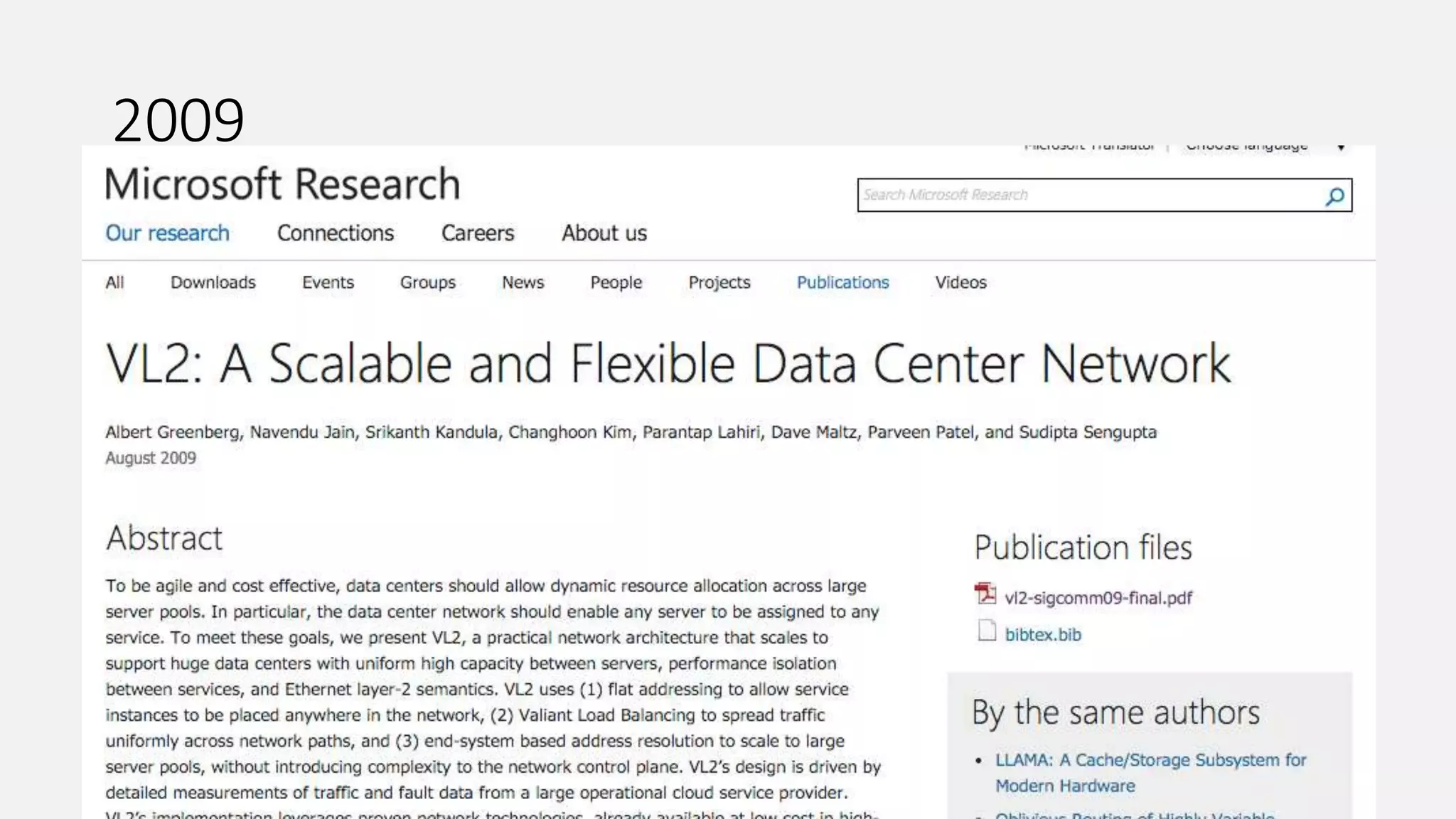
2009
22
2012
23
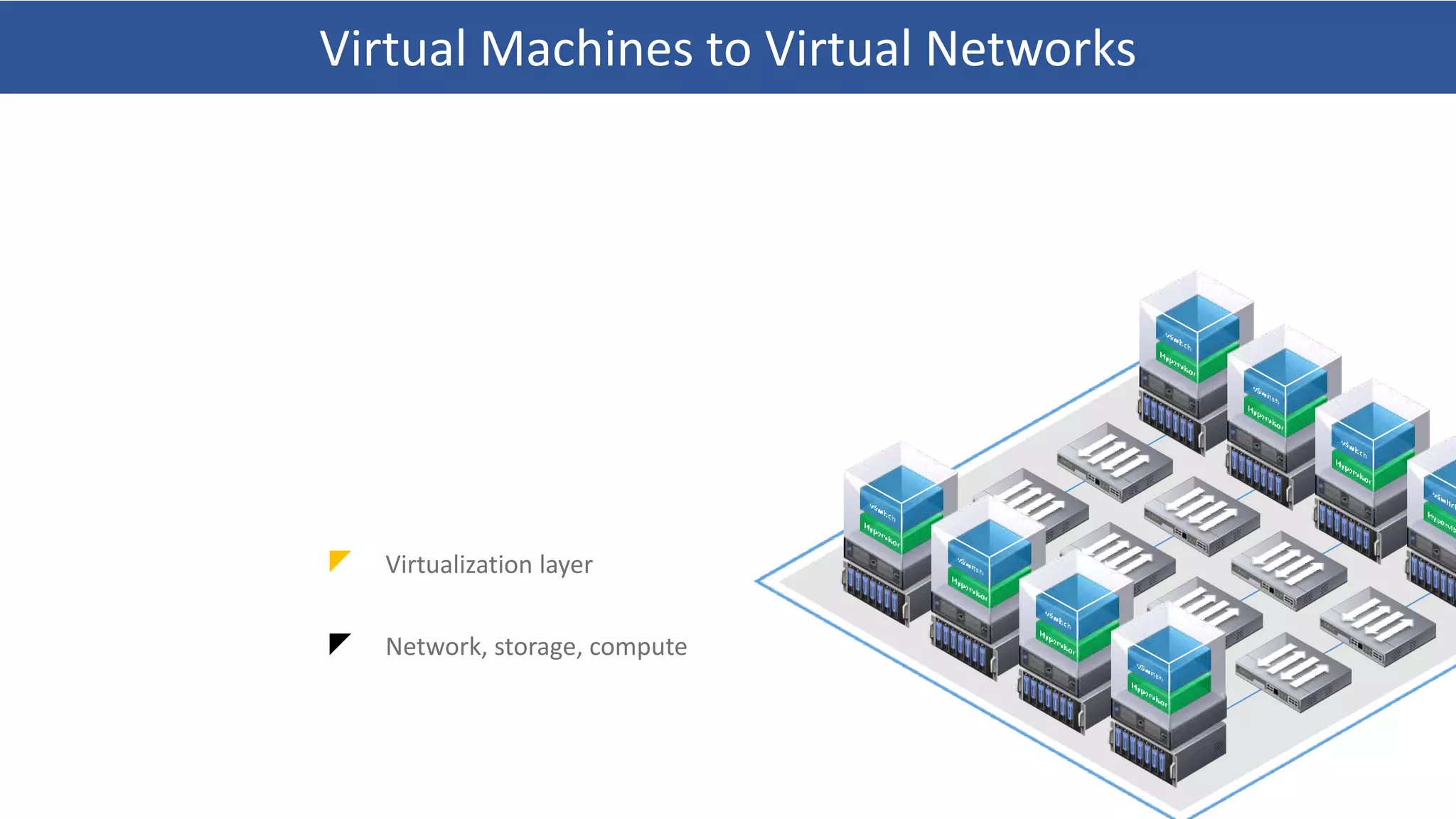
Network, storage, compute
Virtualization layer
Virtual Machines to Virtual Networks
Network, storage, compute
Virtualization layer
“Network hypervisor”
Virtual Data Centers
Virtual Machines to Virtual Networks
Cloud Consumption
Manager
Controller
Data Plane
• Self Service Portal
• OpenStack, Kubernetes, etc
• High–Performance Data Plane
• Scale-out Distributed Forwarding Model
• Single configuration portal
• REST API entry-point
• Manages Logical networks
• Run-time state
• Scale out, HA
• Separation of Control and Data Plane
Distributed Services
• Logical Switch
• Distributed Logical Router
• Firewall
• Load Balancer
Virtual Edge
26
Network Virtualization Components
MANAGEMENT
PLANE
CONTROL
PLANE
DATA
PLANE
Translated State
Discovered State
Network topology
request
Request stored
and acknowledged
Calculate data
plane state
Identify data plane
resources
Desired State
Realized State
Management, Control and Data Planes
Perimeter-centric network security has proven insufficient
Internet
Today’s security model focuses on perimeter
defense
IT Spend Security Spend Security Breaches
But continued security breaches show this model is
not enough
Problem: Data Center Network Security
App VLAN
DMZ VLAN
Services VLAN
DB VLAN
Perimeter
firewall
Inside
firewall
Finance
Finance
Finance
HR
HR
HR
IT
IT
IT
AD NTP DHCP DNS CERT
Microsegmentation and Zero Trust
 Historically challenging to troubleshoot connectivity between VMs
• Is the problem in vswitch or physical network?
• What’s the path through the physical network?
• Is there a (misconfigured) middlebox in the path?
 Network virtualization gives us tools to handle this:
• Decomposition: separate the physical from the virtual
• Global view: see all the logical network state (port stats, drops, etc.) and tunnel
health from the controller API
• Synthetic traffic: insert packets at vswitch as if the VM generated them
Visibility: changing the laws of physics
• 90% of Fortune 100 have deployed network virtualization
• Foundational to hyperscale data centers
• Network configuration no longer the “long pole”
• A key step towards better network security (but much work remains)
• Increasingly important for microservices, kubernetes etc.
• Commodifying effect on physical networking
• Service Mesh can be viewed as a form of Network Virtualization
Network Virtualization – Discussion
SD-WAN
Cloud Services
Corporate
Datacenter
Branch
SD-WAN Controller
Main Office
SD-WAN Edge
Overlay Tunnel
Network Policies
Datacenter
Datacenter
Datacenter
Traffic Engineering
Controller
Network Policies
Leaf Leaf Leaf Leaf
Spine
Spine Spine
Datacenter Switching Fabric
Leaf-Spine Topology
• Leaf Switches = Top-of-Rack (ToR)
• Optimized for East-West Traffic
• Built-in Redundancy (not shown)
• Scale with additional layers
Well-Established in Commodity Clouds
• Bare-Metal Switches
• Control Plane running in the cloud
Internet
Leaf-Spine Switching Fabric
Trellis Design
• Intra-Rack: L2 Domain within L3 Subnet
• Inter-Rack: L3 Routing between Subnets
• Segment Routing across Fabric
Trellis Features
• VLANs / QinQ
• End-to-End L2 Tunnels
• IPv4 / IPv6 Routing
• Multicast (with IGMP)
• ARP (IPv4) / NDP (IPv6)
• DHCPv4 / DHCPv6
• High Availability
Leaf Leaf Leaf Leaf
Spine
Spine Spine
S1
Add Switch ID, arrival time,
departure, queue delay, etc.
Log, analyze,
replay, visualize
Generate report with
switch metadata
Header
Metadata S1
Payload
Header
Payload
Header
Payload
Header
Metadata S1
Payload
Metadata S2
Metadata S1
Metadata S2
Metadata S5
S2
S3
S4
S5
Inband Network Telemetry (INT)
Fine-Grain Telemetry
• Flow Rule(s) that matched
• Queuing delays of individual packets
• Other flows being buffered
• …
Uses
• Verify correct behavior
• Identify micro-bursts
• …
• Scale
• Stability & Correctness
• Timeliness
• Inter-domain
SDN Challenges
Discussion

10. Lec X- SDN.pptx

  • 1.
    Bruce Davie Systems Approach,LLC Software-Defined Networks A Systems Approach
  • 2.
    • There’s asimple answer: • SDN (software-defined networking) is the separation of control and data planes • The separation allows control topology to be independent of physical network topology • The more interesting question is: • Why would anyone want to do this? • That question has a lot of answers… Logically centralized control plane Data Plane e.g. OpenFlow What is SDN?
  • 3.
    • History ofSDN • Challenges faced by IP networks • SDN architecture • Case Studies: • Network Virtualization • Traffic Engineering • SD-WAN • Bare metal switching Outline
  • 4.
    A Revolution inNetworking
  • 5.
    • 4D, Greenberget al. – part of a broader set of “Clean Slate” initiatives • Ipsilon General Switch Management Protocol – RFC 2297 (1996) • IETF Forces WG (2001-2015!!) • Ethane (2007) Foundations of SDN
  • 6.
    • Lack ofabstractions • Inability to express intent • Unpredictable outcome from complex distributed algorithms • Interactions among protocols (e.g. IGP & EGP) • Can’t manage a device unless it’s properly configured • bootstrap issue – control & management plane dependent on correct data plane • Fragility, risk of change • Glacial pace of innovation Challenges with IP networks
  • 7.
    Terminal Protocol: TelnetTerminal Protocol: SSH 1996 2016 Evolution of network provisioning: 1996-2016
  • 8.
    • Centralizing thecontrol plane enables more powerful abstractions • E.g. X and Y should be able to communicate • Express intent network-wide • Distributed systems techniques to make central control scalable and fault tolerant • Central control means a single API for the network, rather than an API per box • Networks provisioned by software, not humans • Disaggregation → innovation • Network-wide intent → better security Key SDN Insights
  • 9.
  • 10.
    Specialized OS Specialized Hardware App App App App App App Specialized Applications Open Interface Open Interface MerchantSilicon Switching Chips Network OS or or Network OS Network OS Disaggregation of networking Industry
  • 11.
    • Just becausean idea has been tried before without success doesn’t mean it’s a bad idea Random side observation
  • 12.
  • 13.
    Routing Table (RIB) Forwarding Table (FIB) DataPlane Control Plane Traditional Control and Data Planes Control Plane • Protocols: BGP, OSPF, RIP • RIB: Collection of Link/Path Attributes • Northbound Configuration Interface − e.g., Cisco CLI Data Plane • Protocols: IP • FIB: Optimized for Fast Lookup • Northbound Control Interface − Historically Private/Internal
  • 14.
    Control App . .. Control Plane Data Plane Flow Rules Control App Control App Control App Network OS Global Network Map SDN Control and Data Planes
  • 15.
    OpenFlow Switch Table 0 Table 1 Table n Execute Action Set . .. Packet In Packet Out Action Set = {} Action Set Packet + Metadata Action Set Packet OpenFlow-style data plane (MAC) (VLAN) (IP) MAC Header … Payload … IP Header TCP/UDP Header Src Addr Dst Addr Type Src Addr Dst Addr Proto … … … Src Port Dst Port … VLAN ID Ctl Type Optional 802.1Q VLAN Tag
  • 16.
  • 17.
    Programmable Switch API Merchant Silicon Stratum+ ONL gNMI + gNOI + P4Runtime/OpenFlow Tofino (Barefoot), Tomahawk (Broadcom) forward.p4 arch.p4 P4 Compiler Control App Control App Control App gRPC Trellis Network Operating System gRPC API Switch OS ONOS gNMI + gNOI + FlowObjectives SDN Software Stack
  • 18.
    Scaling the CentralControl Plane Controller Controller Controller Controller Controller Node 5 Node 4 WebService API Persistent Storage Logical Network Transport Network Node 1 Node 2 Node 3 Controller Cluster
  • 19.
    Summary Definition of SDN Anetwork in which the control plane is physically separate from the forwarding plane, and a single control plane controls several forwarding devices. – Nick McKeown (2013) Dimensions • Disaggregated Control and Data planes • Centralized vs Decentralized Control Plane • Fixed-Function vs Programmable Data Plane Phases of SDN • Phase 1: Network operators took ownership of the control plane. • Phase 1a: Non-traditional entrants to the networking business (via disaggregation) • Phase 2: Network operators are taking ownership of the data plane.
  • 20.
    • Network Virtualization •SD-WAN • Traffic Engineering • Bare Metal Switching • Inband Network Telemetry Use Cases
  • 21.
    Physical Compute &Memory Hypervisor Requirement: x86 Virtual Machine Virtual Machine Virtual Machine Application Application Application x86 Environment Physical Network Network Virtualization Platform Requirement: IP Transport Virtual Network Virtual Network Virtual Network Workload Workload Workload L2, L3, L4-7 Network Services Decoupled Network Virtualization – An Analogy
  • 22.
  • 23.
  • 24.
    Network, storage, compute Virtualizationlayer Virtual Machines to Virtual Networks
  • 25.
    Network, storage, compute Virtualizationlayer “Network hypervisor” Virtual Data Centers Virtual Machines to Virtual Networks
  • 26.
    Cloud Consumption Manager Controller Data Plane •Self Service Portal • OpenStack, Kubernetes, etc • High–Performance Data Plane • Scale-out Distributed Forwarding Model • Single configuration portal • REST API entry-point • Manages Logical networks • Run-time state • Scale out, HA • Separation of Control and Data Plane Distributed Services • Logical Switch • Distributed Logical Router • Firewall • Load Balancer Virtual Edge 26 Network Virtualization Components
  • 27.
    MANAGEMENT PLANE CONTROL PLANE DATA PLANE Translated State Discovered State Networktopology request Request stored and acknowledged Calculate data plane state Identify data plane resources Desired State Realized State Management, Control and Data Planes
  • 28.
    Perimeter-centric network securityhas proven insufficient Internet Today’s security model focuses on perimeter defense IT Spend Security Spend Security Breaches But continued security breaches show this model is not enough Problem: Data Center Network Security
  • 29.
    App VLAN DMZ VLAN ServicesVLAN DB VLAN Perimeter firewall Inside firewall Finance Finance Finance HR HR HR IT IT IT AD NTP DHCP DNS CERT Microsegmentation and Zero Trust
  • 30.
     Historically challengingto troubleshoot connectivity between VMs • Is the problem in vswitch or physical network? • What’s the path through the physical network? • Is there a (misconfigured) middlebox in the path?  Network virtualization gives us tools to handle this: • Decomposition: separate the physical from the virtual • Global view: see all the logical network state (port stats, drops, etc.) and tunnel health from the controller API • Synthetic traffic: insert packets at vswitch as if the VM generated them Visibility: changing the laws of physics
  • 31.
    • 90% ofFortune 100 have deployed network virtualization • Foundational to hyperscale data centers • Network configuration no longer the “long pole” • A key step towards better network security (but much work remains) • Increasingly important for microservices, kubernetes etc. • Commodifying effect on physical networking • Service Mesh can be viewed as a form of Network Virtualization Network Virtualization – Discussion
  • 32.
    SD-WAN Cloud Services Corporate Datacenter Branch SD-WAN Controller MainOffice SD-WAN Edge Overlay Tunnel Network Policies
  • 33.
  • 34.
    Leaf Leaf LeafLeaf Spine Spine Spine Datacenter Switching Fabric Leaf-Spine Topology • Leaf Switches = Top-of-Rack (ToR) • Optimized for East-West Traffic • Built-in Redundancy (not shown) • Scale with additional layers Well-Established in Commodity Clouds • Bare-Metal Switches • Control Plane running in the cloud Internet
  • 35.
    Leaf-Spine Switching Fabric TrellisDesign • Intra-Rack: L2 Domain within L3 Subnet • Inter-Rack: L3 Routing between Subnets • Segment Routing across Fabric Trellis Features • VLANs / QinQ • End-to-End L2 Tunnels • IPv4 / IPv6 Routing • Multicast (with IGMP) • ARP (IPv4) / NDP (IPv6) • DHCPv4 / DHCPv6 • High Availability Leaf Leaf Leaf Leaf Spine Spine Spine
  • 36.
    S1 Add Switch ID,arrival time, departure, queue delay, etc. Log, analyze, replay, visualize Generate report with switch metadata Header Metadata S1 Payload Header Payload Header Payload Header Metadata S1 Payload Metadata S2 Metadata S1 Metadata S2 Metadata S5 S2 S3 S4 S5 Inband Network Telemetry (INT) Fine-Grain Telemetry • Flow Rule(s) that matched • Queuing delays of individual packets • Other flows being buffered • … Uses • Verify correct behavior • Identify micro-bursts • …
  • 37.
    • Scale • Stability& Correctness • Timeliness • Inter-domain SDN Challenges
  • 38.

Editor's Notes

  • #3 CP is important; OF is a detail
  • #8 Could mention MPLS as example of how hard innovation was pre SDN
  • #16 Non intuitive: you need a model of the data plane to be able to separate it from control
  • #27 Hyperv possible
  • #28 Show a logical topology getting mapped from top to bottom with animation
  • #30 All Apps on a VLAN can communicate freely Once one App is compromised, lateral movement cannot be restricted Micro-segmentation can granularly control apps even on shared VLAN
  • #38 Scale example – from NSX-mh to NSX-T (fewer hosts etc), API scale for NSX-T
  • #39 What do you think is next? – Fully automated networks? Does the innovation argument hold up? How does BGP play into this? Interdomain still seems broken. Architecture papers are the exception. Networking people love protocols.