


Blended Learning
DTS ProgrammeWorkshop – May 2015
Overview
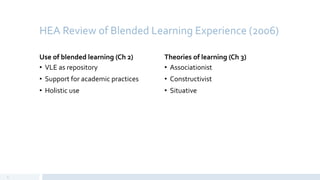
• Comments on the HEA article?
• Defining blended learning
• Location and time
• Constructive alignment
• Your experiences of blended learning
• Digital literacies
• Digital learners
• Digital visitors and residents
• Designing a learning event with technology
• Academic practices
• Some useful educational technologies (‘edtech’)
2
HEA Review of Blended Learning Experience (2006)
Use of blended learning (Ch 2)
• VLE as repository
• Support for academic practices
• Holistic use
Theories of learning (Ch 3)
• Associationist
• Constructivist
• Situative
3
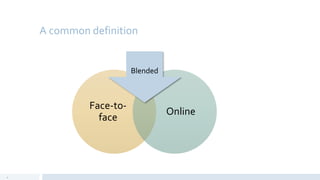
A common definition
Face-to-
face
Online
4
Blended
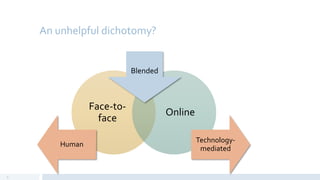
An unhelpful dichotomy?
Face-to-
face
Online
5
Blended
Human
Technology-
mediated
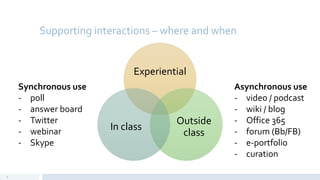
Supporting interactions – where and when
Experiential
Outside
class
In class
6
Synchronous use
- poll
- answer board
- Twitter
- webinar
- Skype
Asynchronous use
- video / podcast
- wiki / blog
- Office 365
- forum (Bb/FB)
- e-portfolio
- curation
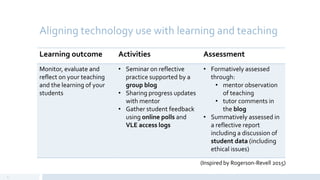
Aligning technology use with learning and teaching
7
Learning outcome Activities Assessment
Monitor, evaluate and
reflect on your teaching
and the learning of your
students
• Seminar on reflective
practice supported by a
group blog
• Sharing progress updates
with mentor
• Gather student feedback
using online polls and
VLE access logs
• Formatively assessed
through:
• mentor observation
of teaching
• tutor comments in
the blog
• Summatively assessed in
a reflective report
including a discussion of
student data (including
ethical issues)
(Inspired by Rogerson-Revell 2015)
Digital literacies
Digital learners
Digital learners
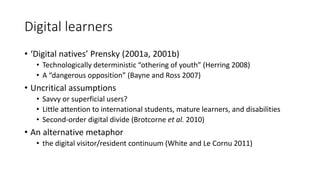
• ‘Digital natives’ Prensky (2001a, 2001b)
• Technologically deterministic “othering of youth” (Herring 2008)
• A “dangerous opposition” (Bayne and Ross 2007)
• Uncritical assumptions
• Savvy or superficial users?
• Little attention to international students, mature learners, and disabilities
• Second-order digital divide (Brotcorne et al. 2010)
• An alternative metaphor
• the digital visitor/resident continuum (White and Le Cornu 2011)
Digital lecturers
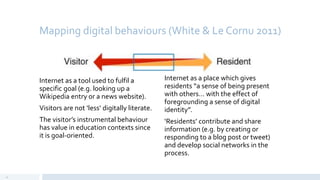
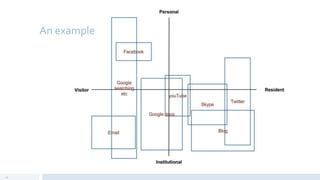
Mapping digital behaviours (White & Le Cornu 2011)
Internet as a tool used to fulfil a
specific goal (e.g. looking up a
Wikipedia entry or a news website).
Visitors are not ‘less’ digitally literate.
The visitor’s instrumental behaviour
has value in education contexts since
it is goal-oriented.
Internet as a place which gives
residents “a sense of being present
with others… with the effect of
foregrounding a sense of digital
identity”.
‘Residents’ contribute and share
information (e.g. by creating or
responding to a blog post or tweet)
and develop social networks in the
process.
12
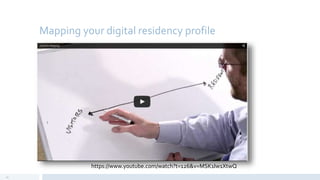
Mapping your digital residency profile
13
https://www.youtube.com/watch?t=126&v=MSK1Iw1XtwQ
An example
14
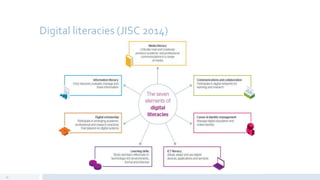
Digital literacies (JISC 2014)
15
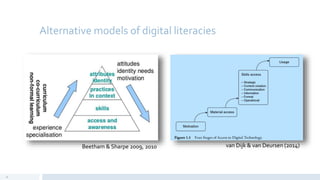
Alternative models of digital literacies
16
van Dijk & van Deursen (2014)Beetham & Sharpe 2009, 2010
Coffee break
Design task
Digital pedagogy: aligning technology
• Select a learning event (course, module, or lecture)
• List the intended learning outcome(s)
• Consider student needs
• Select a technology
• What issues for you?
• What issues for students?
• Fit for purpose?
• Present to your group
19
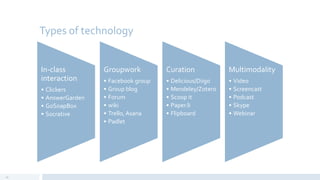
Types of technology
In-class
interaction
• Clickers
• AnswerGarden
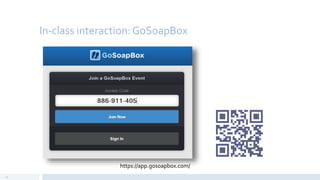
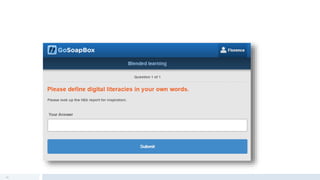
• GoSoapBox
• Socrative
Groupwork
• Facebook group
• Group blog
• Forum
• wiki
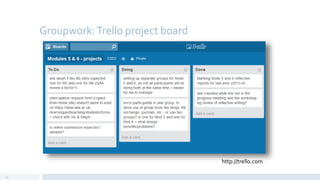
• Trello, Asana
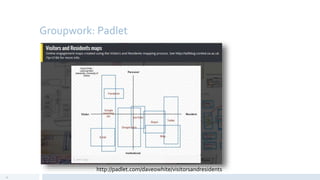
• Padlet
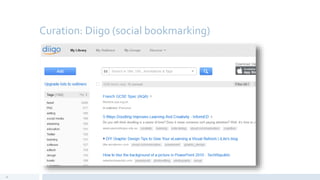
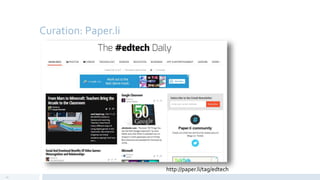
Curation
• Delicious/Diigo
• Mendeley/Zotero
• Scoop it
• Paper.li
• Flipboard
Multimodality
• Video
• Screencast
• Podcast
• Skype
• Webinar
20
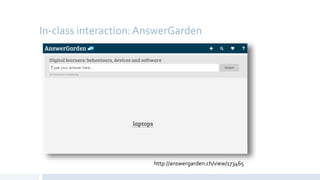
In-class interaction:AnswerGarden
http://answergarden.ch/view/173465
In-class interaction: GoSoapBox
22
https://app.gosoapbox.com/
23
Groupwork: Padlet
24
http://padlet.com/daveowhite/visitorsandresidents
Groupwork:Trello project board
25
http://trello.com
Curation: Diigo (social bookmarking)
26
Curation: Paper.li
27
http://paper.li/tag/edtech
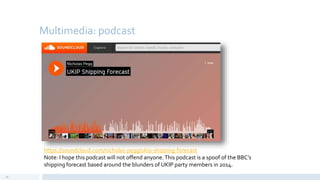
Multimedia: podcast
28
https://soundcloud.com/nicholas-pegg/ukip-shipping-forecast
Note: I hope this podcast will not offend anyone.This podcast is a spoof of the BBC’s
shipping forecast based around the blunders of UKIP party members in 2014.
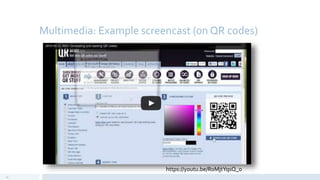
Multimedia: Example screencast (on QR codes)
29
https://youtu.be/RoMjtYqsQ_0
In summary
• Align technology to learning outcomes, activities and assessment
• Consider where and when to use learning technologies
• Starting small is OK
• Start introducing technology in the first year
• Map your strengths and play to them
• Play to your students’ strengths too
• Consider the professional value of technology for students’ future careers
30
31
References
• Bayne, S., and J. Ross (2007) ‘The ‘digital native’ and ‘digital immigrant’: a dangerous opposition’. In Annual Conference of the Society for Research into Higher
Education. Brighton.Accessed from: http://www.malts.ed.ac.uk/staff/sian/natives_final.pdf.
• Biggs, J.B. andTang,C.S. (2011) Teaching For Quality Learning At University:What the Student Does. 4th ed. Maidenhead:Open University Press.
• Brotcorne, P., Damhuis, L., Laurent,V.,Valenduc,G., andVendramin, P. (2010) The Second Order Digital Divide:Synthesis of the Research Report [online]
Namur, BE: Foundation Université-Travail.
• Herring, S.C. (2008) ‘Questioning the Generational Divide:Technological Exoticism and AdultConstructions of OnlineYouth Identity’. In Buckingham, D. (ed)
Youth, Identity, and Digital Media. Cambridge, MA: MIT Press, 71–92
• Mayes,T. and de Freitas, S. (2007) ‘Learning and E-Learning:The Role ofTheory’. In Beetham, H. and Sharpe, R. (eds) Rethinking Pedagogy in the Digital Age.
London: Routledge, 13–25
• McLoughlin, C.E. and Alam, S.L. (2014) ‘A Case Study of Instructor Scaffolding UsingWeb 2.0Tools toTeach Social Informatics’. Journal of Information
Systems Education 25 (2), 125-136
• Prensky, M. (2001a) ‘Digital Natives, Digital Immigrants - Part I’. On the Horizon, 9 (5), 1–6.
• Prensky, M. (2001b) ‘Digital Natives, Digital Immigrants - Part II: DoThey ReallyThink Differently?’. On the Horizon, 9 (6), 1–9.
• Rogerson-Revell, P. (2015) ‘ConstructivelyAligningTechnologies with Learning andAssessment in a Distance Education Master’s Programme’. Distance
Education 36 (1), 129–147
• Sharpe, R., Benfield,G., Roberts,G., and Francis, R. (2006) The Undergraduate Experience of Blended E-Learning: A Review of UK Literature and Practice
[online]York: Higher EducationAcademy.Accessed from http://wales.heacademy.ac.uk/assets/documents/archive/blended_elearning_exec_summary_1.pdf
• Van Dijk, J.A.G.M. and van Deursen, A.J.A.M. (2014) DigitalSkills: Unlocking the Information Society. Basingstoke: Palgrave Macmillan
• White, D.S., and A. Le Cornu (2011). ‘Visitors and residents: a new typology for online engagement’. First Monday, 16 (9). Accessed from:
http://firstmonday.org/article/view/3171/3049
32

UEA DTS programme - Blended learning workshop (May 2015)

  • 1.
  • 2.
    Overview • Comments onthe HEA article? • Defining blended learning • Location and time • Constructive alignment • Your experiences of blended learning • Digital literacies • Digital learners • Digital visitors and residents • Designing a learning event with technology • Academic practices • Some useful educational technologies (‘edtech’) 2
  • 3.
    HEA Review ofBlended Learning Experience (2006) Use of blended learning (Ch 2) • VLE as repository • Support for academic practices • Holistic use Theories of learning (Ch 3) • Associationist • Constructivist • Situative 3
  • 4.
  • 5.
  • 6.
    Supporting interactions –where and when Experiential Outside class In class 6 Synchronous use - poll - answer board - Twitter - webinar - Skype Asynchronous use - video / podcast - wiki / blog - Office 365 - forum (Bb/FB) - e-portfolio - curation
  • 7.
    Aligning technology usewith learning and teaching 7 Learning outcome Activities Assessment Monitor, evaluate and reflect on your teaching and the learning of your students • Seminar on reflective practice supported by a group blog • Sharing progress updates with mentor • Gather student feedback using online polls and VLE access logs • Formatively assessed through: • mentor observation of teaching • tutor comments in the blog • Summatively assessed in a reflective report including a discussion of student data (including ethical issues) (Inspired by Rogerson-Revell 2015)
  • 8.
  • 9.
  • 10.
    Digital learners • ‘Digitalnatives’ Prensky (2001a, 2001b) • Technologically deterministic “othering of youth” (Herring 2008) • A “dangerous opposition” (Bayne and Ross 2007) • Uncritical assumptions • Savvy or superficial users? • Little attention to international students, mature learners, and disabilities • Second-order digital divide (Brotcorne et al. 2010) • An alternative metaphor • the digital visitor/resident continuum (White and Le Cornu 2011)
  • 11.
  • 12.
    Mapping digital behaviours(White & Le Cornu 2011) Internet as a tool used to fulfil a specific goal (e.g. looking up a Wikipedia entry or a news website). Visitors are not ‘less’ digitally literate. The visitor’s instrumental behaviour has value in education contexts since it is goal-oriented. Internet as a place which gives residents “a sense of being present with others… with the effect of foregrounding a sense of digital identity”. ‘Residents’ contribute and share information (e.g. by creating or responding to a blog post or tweet) and develop social networks in the process. 12
  • 13.
    Mapping your digitalresidency profile 13 https://www.youtube.com/watch?t=126&v=MSK1Iw1XtwQ
  • 14.
  • 15.
  • 16.
    Alternative models ofdigital literacies 16 van Dijk & van Deursen (2014)Beetham & Sharpe 2009, 2010
  • 17.
  • 18.
  • 19.
    Digital pedagogy: aligningtechnology • Select a learning event (course, module, or lecture) • List the intended learning outcome(s) • Consider student needs • Select a technology • What issues for you? • What issues for students? • Fit for purpose? • Present to your group 19
  • 20.
    Types of technology In-class interaction •Clickers • AnswerGarden • GoSoapBox • Socrative Groupwork • Facebook group • Group blog • Forum • wiki • Trello, Asana • Padlet Curation • Delicious/Diigo • Mendeley/Zotero • Scoop it • Paper.li • Flipboard Multimodality • Video • Screencast • Podcast • Skype • Webinar 20
  • 21.
  • 22.
  • 23.
  • 24.
  • 25.
  • 26.
    Curation: Diigo (socialbookmarking) 26
  • 27.
  • 28.
    Multimedia: podcast 28 https://soundcloud.com/nicholas-pegg/ukip-shipping-forecast Note: Ihope this podcast will not offend anyone.This podcast is a spoof of the BBC’s shipping forecast based around the blunders of UKIP party members in 2014.
  • 29.
    Multimedia: Example screencast(on QR codes) 29 https://youtu.be/RoMjtYqsQ_0
  • 30.
    In summary • Aligntechnology to learning outcomes, activities and assessment • Consider where and when to use learning technologies • Starting small is OK • Start introducing technology in the first year • Map your strengths and play to them • Play to your students’ strengths too • Consider the professional value of technology for students’ future careers 30
  • 31.
  • 32.
    References • Bayne, S.,and J. Ross (2007) ‘The ‘digital native’ and ‘digital immigrant’: a dangerous opposition’. In Annual Conference of the Society for Research into Higher Education. Brighton.Accessed from: http://www.malts.ed.ac.uk/staff/sian/natives_final.pdf. • Biggs, J.B. andTang,C.S. (2011) Teaching For Quality Learning At University:What the Student Does. 4th ed. Maidenhead:Open University Press. • Brotcorne, P., Damhuis, L., Laurent,V.,Valenduc,G., andVendramin, P. (2010) The Second Order Digital Divide:Synthesis of the Research Report [online] Namur, BE: Foundation Université-Travail. • Herring, S.C. (2008) ‘Questioning the Generational Divide:Technological Exoticism and AdultConstructions of OnlineYouth Identity’. In Buckingham, D. (ed) Youth, Identity, and Digital Media. Cambridge, MA: MIT Press, 71–92 • Mayes,T. and de Freitas, S. (2007) ‘Learning and E-Learning:The Role ofTheory’. In Beetham, H. and Sharpe, R. (eds) Rethinking Pedagogy in the Digital Age. London: Routledge, 13–25 • McLoughlin, C.E. and Alam, S.L. (2014) ‘A Case Study of Instructor Scaffolding UsingWeb 2.0Tools toTeach Social Informatics’. Journal of Information Systems Education 25 (2), 125-136 • Prensky, M. (2001a) ‘Digital Natives, Digital Immigrants - Part I’. On the Horizon, 9 (5), 1–6. • Prensky, M. (2001b) ‘Digital Natives, Digital Immigrants - Part II: DoThey ReallyThink Differently?’. On the Horizon, 9 (6), 1–9. • Rogerson-Revell, P. (2015) ‘ConstructivelyAligningTechnologies with Learning andAssessment in a Distance Education Master’s Programme’. Distance Education 36 (1), 129–147 • Sharpe, R., Benfield,G., Roberts,G., and Francis, R. (2006) The Undergraduate Experience of Blended E-Learning: A Review of UK Literature and Practice [online]York: Higher EducationAcademy.Accessed from http://wales.heacademy.ac.uk/assets/documents/archive/blended_elearning_exec_summary_1.pdf • Van Dijk, J.A.G.M. and van Deursen, A.J.A.M. (2014) DigitalSkills: Unlocking the Information Society. Basingstoke: Palgrave Macmillan • White, D.S., and A. Le Cornu (2011). ‘Visitors and residents: a new typology for online engagement’. First Monday, 16 (9). Accessed from: http://firstmonday.org/article/view/3171/3049 32