Laura Gogia, MD, PhD
@googleguacamole • www.lauragogia.com
Division of Learning Innovation & Student Success
March 16, 2016
EDU-BLOGGING:
A launch pad for
connectivity,
metacognition & personal
learning networks Photo Credit: Terranceandbecky.com
Photo credit: Flickr User Anonymous Account
BLOG
“a website containing a writer's own experiences, observations,
opinions, etc., and often having images and links to other
websites.” (Dictionary.com)
“diary of thoughts, ideas, and
innovations…” (Goyal, 2012)
“updated frequently” (Merriam Webster)
“often with opportunities for
readers to respond” (Sullivan, 2008).
EDU-BLOG:
Blogging for educational purposes.
A launch pad for
connectivity,
metacognition, &
personal learning
networks.
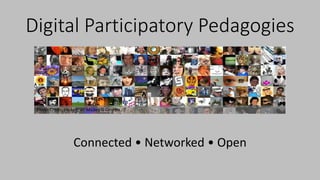
Digital Participatory Pedagogies
Photo Credit: Flickr User Mickey G Ottowa
Connected • Networked • Open
Open.
Photo Credit: Flickr User Tanakawho
Opening the borders
between classrooms &
the world.
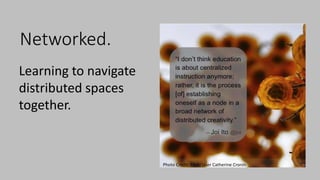
Networked.
Photo Credit: Flickr User Catherine Cronin
Learning to navigate
distributed spaces
together.
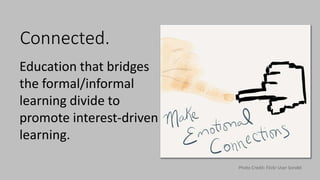
Connected.
Photo Credit: Flickr User Sorokti
Education that bridges
the formal/informal
learning divide to
promote interest-driven
learning.
Connectivity:
Connecting current thoughts &
experience with & across people,
contexts, & times.
SOCIAL LEARNING THEORIES
Bandura, 1977; Bruner, 1960; Harel & Papert, 1991;
Lave & Wenger, 1991; Mezirow, 1991; Vygotsky, 1980
KNOWLEDGE TRANSFER
Bransford, Brown, & Cocking, 2010; Anderson,
Krathwohl, & Bloom, 2001
SCHEMA, THRESHOLD & CONCEPT MAPPING
Ausubel,1968; Bruner, 1966; Downes, 2006; Meyer &
Land 2003; Novak & Canas, 2008; Piaget, 1983;
Vygotsky, 1980
People
Concepts
Space and Time
Connectivity draws from:
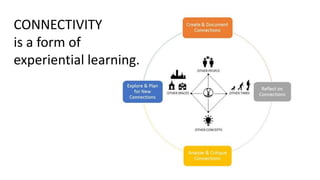
CONNECTIVITY
is a form of
experiential learning.
AGGREGATING:
Collecting from the
information stream
ORGANIZATING: Filtering
information to make it
manageable
ANALYZING:
Understanding
implications & critiquing
sources
REPURPOSING:
Synthesizing &
transforming
information pieces
FEEDING FORWARD:
Sharing new knowledge
to receive feedback &
assist others
(Connectivist) Digital Workflow
Downes, 2008; Kop, 2011
What sort of pedagogical strategies are
associated with these educational principles?
Connected.
Networked.
Open.
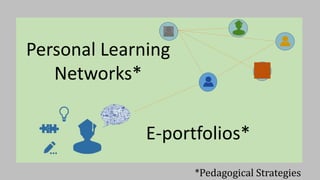
E-portfolios*
Personal Learning
Networks*
*Pedagogical Strategies
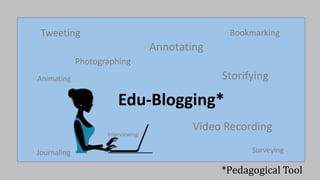
Edu-Blogging*
Journaling
Tweeting
Photographing
Video Recording
Storifying
Annotating
Animating
Bookmarking
Surveying
Interviewing
*Pedagogical Tool
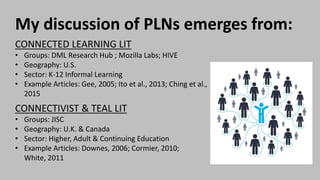
My discussion of PLNs emerges from:
CONNECTED LEARNING LIT
• Groups: DML Research Hub ; Mozilla Labs; HIVE
• Geography: U.S.
• Sector: K-12 Informal Learning
• Example Articles: Gee, 2005; Ito et al., 2013; Ching et al.,
2015
CONNECTIVIST & TEAL LIT
• Groups: JISC
• Geography: U.K. & Canada
• Sector: Higher, Adult & Continuing Education
• Example Articles: Downes, 2006; Cormier, 2010;
White, 2011
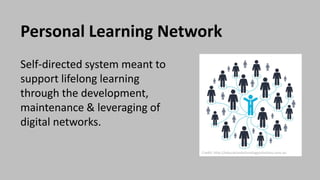
Personal Learning Network
Credit: http://educationtechnologysolutions.com.au
Self-directed system meant to
support lifelong learning
through the development,
maintenance & leveraging of
digital networks.
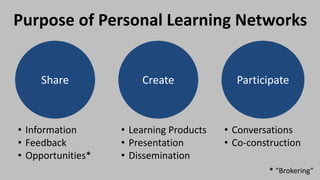
Purpose of Personal Learning Networks
Create ParticipateShare
• Information
• Feedback
• Opportunities*
• Learning Products
• Presentation
• Dissemination
• Conversations
• Co-construction
* “Brokering”
• Connectivist alternative [augmentation] to learning
communities found in learning management systems.
Personal Learning Network
Cormier, 2010; Downes, 2007; Gee, 2005
Personal Learning Networks
Control of learning Orientation of learning
Increase in scope
Three ways to think about PLNs.
People &
Topics
Digital
Platforms
(Cormier, 2010)
Digital
Workflow
AGGREGATION: Collecting
from the information
stream
ORGANIZATION: Filtering
information to make it
manageable
ANALYSIS: Understanding
implications & critiquing
sources
REPURPOSING:
Synthesizing &
transforming information
pieces
FEEDING FORWARD:
Sharing new knowledge to
receive feedback & assist
others
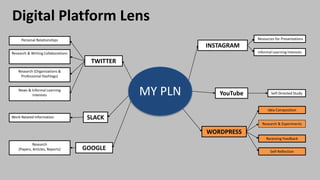
SLACK
My PLN
GOOGLE
TWITTER
YouTube
WORDPRESS
INSTAGRAM
Research
(Papers, Articles, Reports)
Self-Reflection
Idea Composition
Receiving Feedback
Self-Directed Study
Work-Related Information
Resources for Presentations
Informal Learning Interests
Research & Experiments
Personal Relationships
Research & Writing Collaborations
Research (Organizations &
Professional Hashtags)
News & Informal Learning
Interests MY PLN
Digital Platform Lens
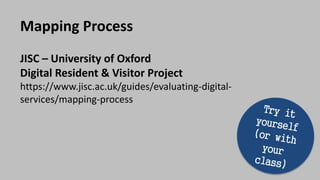
JISC – University of Oxford
Digital Resident & Visitor Project
https://www.jisc.ac.uk/guides/evaluating-digital-
services/mapping-process
Mapping Process
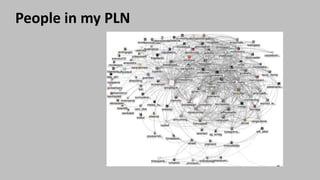
People in my PLN
Self-Brokered
Opportunities
• Started an internationally attended journal club
• Been mentioned in international publications
• Peer-reviewed journal article
• Conference steering committee
• Invited seminars, panel talks, conference
presentations (Local & International)
• Countless conversations, research assistance,
mentoring, & support
Digital Workflow: An example
I participate in the Twitter component of a c-MOOC.
Through my Twitter interactions related to this hashtag, I become
recognized as someone researching connected learning.
I share my mock prospectus slides on my blog (via an embed
from slideshare.net)
I promote my blog post on Twitter, using the c-MOOC hashtag.
The same people with whom I tweet in the c-MOOC look at my
presentation and comment on my blog post.
I notice a trend in the comments (both on my blog and Twitter)
towards an interesting research question.
I propose the research question and summarize the
comments through a Storify (which I publish on my blog and
promote through Twitter).
Several scholars express interest; we communicate through
google plus and arrange times for regular google hangouts.
We collaborate via google hangout and google docs towards a
conference proposal and publications.
We become friends as well as professional colleagues.
Take Home Points
• PLNs are systemic approaches to student success &
are based on the development of sustainable personal
relationships.
• Student blogs provide a docking space & “calling card”
• Public nature broadens scope of access & audience
Shifting Gears…
E-Portfolios
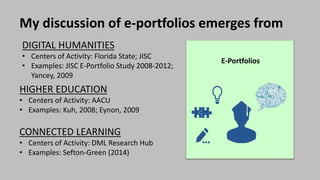
My discussion of e-portfolios emerges from
DIGITAL HUMANITIES
• Centers of Activity: Florida State; JISC
• Examples: JISC E-Portfolio Study 2008-2012;
Yancey, 2009
HIGHER EDUCATION
• Centers of Activity: AACU
• Examples: Kuh, 2008; Eynon, 2009
CONNECTED LEARNING
• Centers of Activity: DML Research Hub
• Examples: Sefton-Green (2014)
E-Portfolios
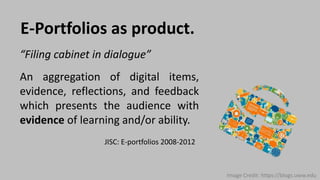
E-Portfolios as product.
“Filing cabinet in dialogue”
An aggregation of digital items,
evidence, reflections, and feedback
which presents the audience with
evidence of learning and/or ability.
Image Credit: https://blogs.uww.edu
JISC: E-portfolios 2008-2012
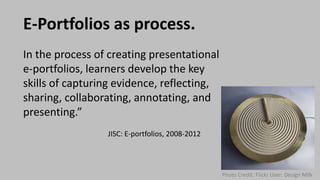
E-Portfolios as process.
In the process of creating presentational
e-portfolios, learners develop the key
skills of capturing evidence, reflecting,
sharing, collaborating, annotating, and
presenting.”
JISC: E-portfolios, 2008-2012
Photo Credit: Flickr User: Design Milk
E-Portfolios
• Easier to share with a variety of stakeholders
• More likely to be used longitudinally through
a student’s learning journey, rather than
isolated to one discipline, context, or course.
• More opportunities for presenting evidence
• Consistent with UDL principles
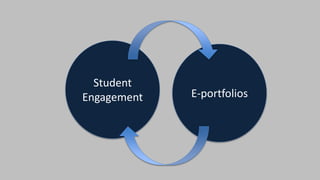
• Higher levels of student engagement
(Eynon, 2009; Yancey, McElroy, & Powers, 2012)
E-Portfolios support multimodal
expression.
Photo Credit: marketingland.com
E-portfolios support hyperlinking.
• Connect posts with other web documents to
provide source, background, or supportive
information.
• Order and reorder learning points and
accomplishments….In doing so, unexpected
patterns emerge across academic achievements,
professional pursuits, and personal interests
Student
Engagement E-portfolios
One-size-fits-all approaches to e-
portfolios do not work very well. So I’m
not suggesting that.
However, in terms of e-portfolios, some
component of blogging makes sense.
An E-Portfolio
An E-Portfolio
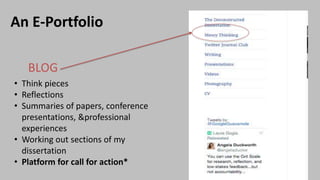
BLOG
• Think pieces
• Reflections
• Summaries of papers, conference
presentations, &professional
experiences
• Working out sections of my
dissertation
• Platform for call for action*
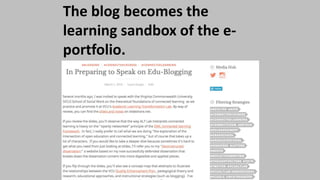
The blog becomes the
learning sandbox of the e-
portfolio.
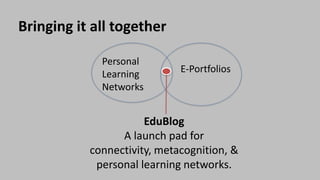
Bringing it all together
E-Portfolios
Personal
Learning
Networks
EduBlog
A launch pad for
connectivity, metacognition, &
personal learning networks.

EDU-BLOGGING: A launch pad for connectivity, metacognition & personal learning networks

  • 1.
    Laura Gogia, MD,PhD @googleguacamole • www.lauragogia.com Division of Learning Innovation & Student Success March 16, 2016 EDU-BLOGGING: A launch pad for connectivity, metacognition & personal learning networks Photo Credit: Terranceandbecky.com
  • 2.
    Photo credit: FlickrUser Anonymous Account BLOG “a website containing a writer's own experiences, observations, opinions, etc., and often having images and links to other websites.” (Dictionary.com) “diary of thoughts, ideas, and innovations…” (Goyal, 2012) “updated frequently” (Merriam Webster) “often with opportunities for readers to respond” (Sullivan, 2008).
  • 3.
  • 4.
    A launch padfor connectivity, metacognition, & personal learning networks.
  • 5.
    Digital Participatory Pedagogies PhotoCredit: Flickr User Mickey G Ottowa Connected • Networked • Open
  • 6.
    Open. Photo Credit: FlickrUser Tanakawho Opening the borders between classrooms & the world.
  • 7.
    Networked. Photo Credit: FlickrUser Catherine Cronin Learning to navigate distributed spaces together.
  • 8.
    Connected. Photo Credit: FlickrUser Sorokti Education that bridges the formal/informal learning divide to promote interest-driven learning.
  • 9.
    Connectivity: Connecting current thoughts& experience with & across people, contexts, & times.
  • 10.
    SOCIAL LEARNING THEORIES Bandura,1977; Bruner, 1960; Harel & Papert, 1991; Lave & Wenger, 1991; Mezirow, 1991; Vygotsky, 1980 KNOWLEDGE TRANSFER Bransford, Brown, & Cocking, 2010; Anderson, Krathwohl, & Bloom, 2001 SCHEMA, THRESHOLD & CONCEPT MAPPING Ausubel,1968; Bruner, 1966; Downes, 2006; Meyer & Land 2003; Novak & Canas, 2008; Piaget, 1983; Vygotsky, 1980 People Concepts Space and Time Connectivity draws from:
  • 11.
    CONNECTIVITY is a formof experiential learning.
  • 12.
    AGGREGATING: Collecting from the informationstream ORGANIZATING: Filtering information to make it manageable ANALYZING: Understanding implications & critiquing sources REPURPOSING: Synthesizing & transforming information pieces FEEDING FORWARD: Sharing new knowledge to receive feedback & assist others (Connectivist) Digital Workflow Downes, 2008; Kop, 2011
  • 13.
    What sort ofpedagogical strategies are associated with these educational principles? Connected. Networked. Open.
  • 14.
  • 15.
  • 16.
    My discussion ofPLNs emerges from: CONNECTED LEARNING LIT • Groups: DML Research Hub ; Mozilla Labs; HIVE • Geography: U.S. • Sector: K-12 Informal Learning • Example Articles: Gee, 2005; Ito et al., 2013; Ching et al., 2015 CONNECTIVIST & TEAL LIT • Groups: JISC • Geography: U.K. & Canada • Sector: Higher, Adult & Continuing Education • Example Articles: Downes, 2006; Cormier, 2010; White, 2011
  • 17.
    Personal Learning Network Credit:http://educationtechnologysolutions.com.au Self-directed system meant to support lifelong learning through the development, maintenance & leveraging of digital networks.
  • 18.
    Purpose of PersonalLearning Networks Create ParticipateShare • Information • Feedback • Opportunities* • Learning Products • Presentation • Dissemination • Conversations • Co-construction * “Brokering”
  • 19.
    • Connectivist alternative[augmentation] to learning communities found in learning management systems. Personal Learning Network Cormier, 2010; Downes, 2007; Gee, 2005
  • 20.
    Personal Learning Networks Controlof learning Orientation of learning Increase in scope
  • 21.
    Three ways tothink about PLNs. People & Topics Digital Platforms (Cormier, 2010) Digital Workflow AGGREGATION: Collecting from the information stream ORGANIZATION: Filtering information to make it manageable ANALYSIS: Understanding implications & critiquing sources REPURPOSING: Synthesizing & transforming information pieces FEEDING FORWARD: Sharing new knowledge to receive feedback & assist others
  • 22.
    SLACK My PLN GOOGLE TWITTER YouTube WORDPRESS INSTAGRAM Research (Papers, Articles,Reports) Self-Reflection Idea Composition Receiving Feedback Self-Directed Study Work-Related Information Resources for Presentations Informal Learning Interests Research & Experiments Personal Relationships Research & Writing Collaborations Research (Organizations & Professional Hashtags) News & Informal Learning Interests MY PLN Digital Platform Lens
  • 23.
    JISC – Universityof Oxford Digital Resident & Visitor Project https://www.jisc.ac.uk/guides/evaluating-digital- services/mapping-process Mapping Process
  • 24.
  • 25.
    Self-Brokered Opportunities • Started aninternationally attended journal club • Been mentioned in international publications • Peer-reviewed journal article • Conference steering committee • Invited seminars, panel talks, conference presentations (Local & International) • Countless conversations, research assistance, mentoring, & support
  • 26.
    Digital Workflow: Anexample I participate in the Twitter component of a c-MOOC. Through my Twitter interactions related to this hashtag, I become recognized as someone researching connected learning. I share my mock prospectus slides on my blog (via an embed from slideshare.net) I promote my blog post on Twitter, using the c-MOOC hashtag. The same people with whom I tweet in the c-MOOC look at my presentation and comment on my blog post.
  • 27.
    I notice atrend in the comments (both on my blog and Twitter) towards an interesting research question. I propose the research question and summarize the comments through a Storify (which I publish on my blog and promote through Twitter). Several scholars express interest; we communicate through google plus and arrange times for regular google hangouts. We collaborate via google hangout and google docs towards a conference proposal and publications. We become friends as well as professional colleagues.
  • 28.
    Take Home Points •PLNs are systemic approaches to student success & are based on the development of sustainable personal relationships. • Student blogs provide a docking space & “calling card” • Public nature broadens scope of access & audience
  • 29.
  • 30.
    My discussion ofe-portfolios emerges from DIGITAL HUMANITIES • Centers of Activity: Florida State; JISC • Examples: JISC E-Portfolio Study 2008-2012; Yancey, 2009 HIGHER EDUCATION • Centers of Activity: AACU • Examples: Kuh, 2008; Eynon, 2009 CONNECTED LEARNING • Centers of Activity: DML Research Hub • Examples: Sefton-Green (2014) E-Portfolios
  • 31.
    E-Portfolios as product. “Filingcabinet in dialogue” An aggregation of digital items, evidence, reflections, and feedback which presents the audience with evidence of learning and/or ability. Image Credit: https://blogs.uww.edu JISC: E-portfolios 2008-2012
  • 32.
    E-Portfolios as process. Inthe process of creating presentational e-portfolios, learners develop the key skills of capturing evidence, reflecting, sharing, collaborating, annotating, and presenting.” JISC: E-portfolios, 2008-2012 Photo Credit: Flickr User: Design Milk
  • 33.
    E-Portfolios • Easier toshare with a variety of stakeholders • More likely to be used longitudinally through a student’s learning journey, rather than isolated to one discipline, context, or course.
  • 34.
    • More opportunitiesfor presenting evidence • Consistent with UDL principles • Higher levels of student engagement (Eynon, 2009; Yancey, McElroy, & Powers, 2012) E-Portfolios support multimodal expression. Photo Credit: marketingland.com
  • 35.
    E-portfolios support hyperlinking. •Connect posts with other web documents to provide source, background, or supportive information. • Order and reorder learning points and accomplishments….In doing so, unexpected patterns emerge across academic achievements, professional pursuits, and personal interests
  • 36.
  • 37.
    One-size-fits-all approaches toe- portfolios do not work very well. So I’m not suggesting that. However, in terms of e-portfolios, some component of blogging makes sense.
  • 38.
  • 39.
    An E-Portfolio BLOG • Thinkpieces • Reflections • Summaries of papers, conference presentations, &professional experiences • Working out sections of my dissertation • Platform for call for action*
  • 40.
    The blog becomesthe learning sandbox of the e- portfolio.
  • 41.
    Bringing it alltogether E-Portfolios Personal Learning Networks EduBlog A launch pad for connectivity, metacognition, & personal learning networks.

Editor's Notes

  • #3 Definitions – many of us understand what a blog is. If you are less familiar, I like the dictionary.com definition as a base: A website containing one’s own experiences, often with images and links to other websites. Others have likened it to a diary - not necessarily like a 12 year old’s journal, but more like a scholarly journal of thoughts, ideas, and innovations. Blogs are typically updated frequently and the often give readers the opportunity to respond.
  • #4 Stick an edu- in front of it and it just becomes a faster way of saying course-related or educational-related blogging.
  • #5 Today, I’m going to make an argument – that public edu-blogging is an essential element of digital age education, because a student blog acts as a launchpad for connectivity, metacognition, and personal learning networks.
  • #6 By way of a brief review, digitally networked spaces are being explored as potential areas for relevant, engaging, and participatory learning. These educational environments run on the power of three intertwined concepts – open, networked, and connected.
  • #7 Openness refers to education which is accessible and shared with others on a global scale. Open educators are interested in all aspects of equitable and accessible education including but not limited to the optimization of course formats and costs of educational materials and programming.
  • #8 Networked emphasizes the impact and experience of decentralized or distributed information sources in the digital world. It focuses attention on the importance of interpersonal connection between learners and their peers, instructors, and other people. The goal of networked educators is to create digital learning communities that promote collaborative and cooperative learning. Networked learning spaces facilitate interaction and knowledge co-construction with the purpose of enabling students to function in and even leverage digital, decentralized environments.
  • #9 Connected learning emphasizes the overlap between the diverse spaces in which people learn, including personal passion projects, peer organizations and cultures, and academic environments. Connected educators help student explore, develop, and drive their own learning lives, the compilation of informal and formal learning experiences that make up the student’s learner identity.
  • #10 Last time we discussed that one of the pedagogical goals that ties these research communities and educational philosophies together is connectivity: the act of connecting current thought and experience with and across networks of people, other concepts, contexts, and times to create knowledge and inform future action.
  • #11 As we discussed last time, connectivity draws from social learning theory, schema theory, threshold concepts, and concept mapping and knowledge transfer research to suggest
  • #12 that students learning through the active, experiential process of making connections, reflecting on them, analyzing them, and making plans around what to connect next.
  • #13 Digital educators are equally interested in supporting student development of digital workflows. In particular, connectivist-based scholars make the argument that students must develop skills necessary to filter, organize, remix, repurpose, and disseminate information.
  • #14 So what sort of pedagogical strategies are associated with these educational principles?
  • #15 Both the connectivist and connected learning literatures tend to point toward the benefits of personal learning networks and e-portfolio systems.
  • #16 This is not to say that these are the only strategies associated with these pedagogical approaches, however I’m going to focus on these because of the role that blogging can potentially play in both This becomes a useful moment to point out that blogging is a pedagogical tool , and it works within a system of digital and analogue tools and platforms that allow students to create personal learning networks and e-portfolios.
  • #17 My discussion of PLNs emerges from the connected learning, connectivist, and technology-enhanced active learning literature.
  • #18 A PLN is a elf-directed systems meant to support lifelong learning through the development, maintenance, and leveraging of digital learning communities
  • #19 The purpose of PLNs is to act as a platform for sharing information, feedback, and learning opportunities – and the connected learners call this last act “brokering” Creating learning products, an act that comes with directly related skills around presentation and information dissemination Participating in conversations and co-construction of knowledge A quick note on brokering – according to Ching, faculty can use their PLNS to connect students with relevant learning opportunities such as events programs, internships, people, and other resources, theeboy supporting the ongoing development of students’ personalized, interest-driven learning. These faculty help seed the students’ personal learning networks and assist them in developing the necessary skills to develop and leverage them for themselves, so that students can eventually “self-broker.” In this way, plns become a sustainable source of lifelong learning, social capital, and opportunity.
  • #20 P>NS emerged in the mid-2000s as a connectivist alternative to the closed educational spaces associated with learning management systems.
  • #21 To summarize the differences between PLNs and LMS’s, PLNs: Shift ownership of learning, knowledge, and social capital from the institution to the student Shift the orientation of the learning from the individual course to more holistic and longitudinal definitons of learning (i.e.co-curricular, extracurricular, and home) Increase the scope of potential resources from institution-based peers and instructors to the world. This last point is particularly important for students seeking mentorship and opportunities around niche or locally underrepresented interests.
  • #22 There are at least three ways to conceptualize personal learning networks: digital platforms, people and topics, and digital workflows. The first requires the participant to create a concept map of the digital platforms and then identify how they use them. There is research to suggest that the creation of these concept maps and ensuing reflection and discussion can increase efficiency and engagement in digital workflows (i.e. productivity). The JISC-funded Digital Residents and Visitors Project provides a nice explanation of this process, as well as ideas for how to use it in a workshop or professional development setting.
  • #24 The JISC-funded Digital Residents and Visitors Project provides a nice explanation of this process, as well as ideas for how to use it in a workshop or professional development setting.
  • #25 Another way of looking at this is through the lens of people. This is a snapshot (October 2015) of the people in my personal learning network, seen through the lens of my Twitter interactions.  Twitter is my primary digital residence. Approximately 40 of the listed individuals are academicians who work in areas related to digital pedagogies.  Only ten are from my institution (and would therefore be available to me in a hypothetical university-based LMS). My relationships with those beyond my institution have yielded opportunities to publish in peer-reviewed journals, present at national and internationalconferences, give invited lectures, participate on conference steering committees.
  • #27 So, the role of blogging in a PLN is best demonstrated through a discussion of PLNs as digital workflow. DML Research Hub collects stories and supports ethnographic and case student research about how students use personal learning networks to support their learning, but I’m going to supply you with one of my own. In the fall of 2014, I participated in the Twitter component of DML Research Hub’s Connected Courses, a connectivist MOOC.   Through my Twitter interactions related to the course, I became recognized in this community as someone who researched connected learning.   Around that same time, I was developing and presenting a mock prospectus.  I posted my mock prospectus slides on slideshare.net, embedded that presentation in a blog post that explained my research I promoted my blog post on Twitter, using the c-MOOC hashtag so it would reach all those people who I was talking to about connected learning. Well, those people took a look at my presentation and gave me feedback both on Twitter and on my blog post.
  • #28 I noticed a trend in the comments that pointed to additional research questions.   I summarized the commentary and my argument for potential research collaboration in a Storify, which I also embedded in a blog post and promoted on Twitter using the courses hashtag.   Several scholars expressed interest in collaboration.   We spent the next 18 months communicating through Google hangouts, Google docs, and Google plus to develop conference proposals and publications.  Ultimately, we became friends and professional colleagues.
  • #29  Take Home Point:  Personal Learning Networks are systemic approaches to student success based on the development of sustainable personal relationships   However, in terms of logistics and necessary digital tools, student blog spaces provide a student controlled “dock” (or launch pad) for displaying calls to action and facilitating the organization of collaborative efforts.   Blogs provide spaces for longer format proposals  and a “calling card” that wrangles a decentralized digital identity so that potential collaborators and employers may come to know who and what an individual might be able to achieve.   the blog posts must be public or else they cannot perform these necessary functions in a true PLN.
  • #31 My understanding of e-portfolios emerges from the digital humanities, higher education, and connected learning literatures.
  • #32 E-porfolios can be defined as products and processes for learning. In terms of being a product, e-portfolios are an aggregation of digital items, evidence, reflections and feedback which presents the audience of evidence of learning and/or ability.
  • #33 However, only some components of the e-portfolio are “presentational;” In fact, many aspects of the e-portfolio are process-related, an experimental learning sandbox in which students develop the key skills of capturing evidence, reflecting, sharing, collaborating, annotating, and presenting. Digital, electronic, or e-portfolios help students demonstrate coherence and integrated learning while developing a sense for connections, reflectiveness, and intellectual community (St. Olaf College, 2015). They are most often defined as a “set of materials gathered for a particular purpose and audience, and narrated or introduced by means of a reflective text” (Yancey, 2004, p. 94) and are most commonly associated with progressive educational approaches. The digital platforms used in the creation of e-portfolios provide several pedagogical affordances not found in paper-based formats.
  • #35 E-portfolios support also multimodal expression, which provides more opportunities for presenting evidence; encouraging students to express themselves through different modalities is consistent with universal design for learning and it has been associated with higher levels of student engagement.
  • #36 Hyperlinks in e-portfolios allow students to connect content of their posts with other web documents, providing source, background, and supporting information. Moreover hyperlinks, along with categories and tags enable students to order and reorder, link, unlink, and relink their learning points and accomplishments….In doing so, unexpected patterns and connections emerge across academic achievements, professional pursuits, and personal interests
  • #37 However, not all e-portfolio programs are created equal. Yancey found that students were most engaged in their e-portfolio projects when they had the most agency and choice over their e-portfolios in terms of aesthetics and structure.
  • #38 A student blog can act as the entire portfolio or some procedural aspect (“the experimental sandbox”) for the e-portfolio.
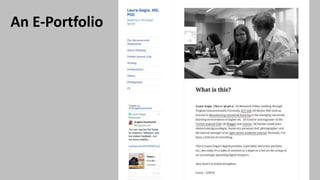
  • #39 My e-portfolio is an aggregation hub for reigning in the digital sprawl of my digital presence. It acts as a personal dashboard.
  • #40 There are presentational components like the CV, videos, and writing links. There are links to active collaborative projects. The dashboard includes Twitter and Instagram feeds to offer a real time perspective on my activity.
  • #42 The purpose of this post was to introduce personal learning networks and e-portfolios as two pedagogical strategies that embody digital participatory cultures and learning while also showing promise in terms of enhancing student engagement and success.  Both of these strategies represent the development of "systems" - in terms of crossing digital (and nondigital) platforms and resources and in terms of spanning academic courses, informal learning spaces, and time.  Blogging can and should play a role in both of these systems - it's not the only platform required (because systems always have more than one platform, right?), but it is one that plays an important role in both: In a PLN, a student blog offers a student-controlled long-form platform for calls to action, other proposals, and organization.  In an e-portfolio, a student blog offers a platform for connecting, reflecting, presenting, and experimenting.  Do you see the overlap?  I'm hoping that it is clear. When students blog in public, the space simultaneously acts as a launch pad for PLN and e-portfolio activity.  Does every blog post need to be public?  Of course not.  Do students need to be provided with opportunities to learn about Internet safety, privacy, copyright and ownership, and voice?  Of course. Does every blog need to be easy to find?  Of course not.  However, providing students with opportunity to work in public opens the doors to tremendous potential for learning and professional growth, while giving them control (agency, choice) over their own education.  It's worth the consideration.