
Working with Wikis: Learning & Collaboration in a Virtual SpaceNathan Whitley-GrassiState University of New York, Empire State College, Niagara Frontier Center
Why are we here?Recent surveys of top companies found that collaboration was one of the most highly valued skills in new college graduates.How do we facilitate collaboration & collaborative learning to support this statement in a blended or hybrid format?
Why not a CMS?It is best to choose a tool that fits your needs rather than creating a need to fit the tool.Course Management System expansion can be expensive, time consuming, and often does not usually allow for student co-created content developmentThird party software provides users with additional free and flexible tools
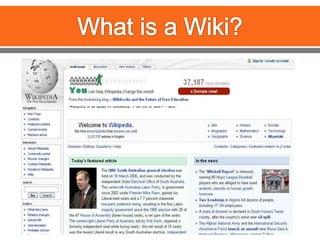
What is a Wiki?
What is a Wiki?Wikis are editable websitesRequire very little technical “know how” to editWard Cunningham – Wiki Wiki Web (1991)“The simplest online database that could possibly work”Wiki – Hawaiian word for “fast”
http://www.flickr.com/photos/elkit/114382996/
Why a Wiki?No HTML knowledge requiredShare knowledge quicklyEasy way to collaborateRevert back to old versionsFollow who’s done what, when, & where
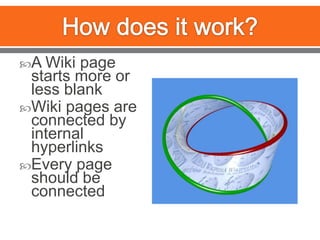
How does it work?A Wiki page starts more or less blankWiki pages are connected by internal hyperlinks Every page should be connected
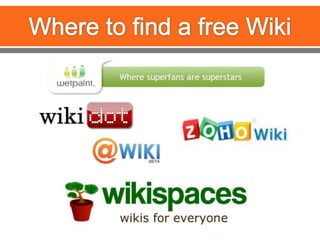
Where to find a free Wiki
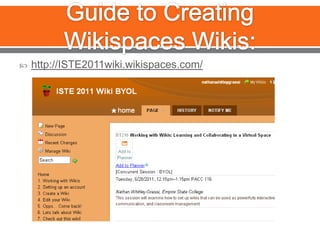
Guide to Creating Wikispaces Wikis:http://ISTE2011wiki.wikispaces.com/
Collaboration:Creates communities of practiceCollaborative learning communitiesThe cooperative learning paradigm:Positive interdependence of membersIndividual accountabilityPeer-to-peer interactionUse of communication skills
Learning & Engagement: Constructivist Theory – Individual Unit of InstructionCollaboration is at the heart of learningDeeper level of knowledge generationActive and manipulative learningInitiative, creativity, and critical thinking skillsLearning communitiesShared goal for learning
Collaboration With WikisCollaboration does not just happenRequires planning on the instructors partAnd don’t forget to Scream….Set the stageCreate the environmentRelease of responsibilityEncourage collaborationAssess regularlyMotivate learners
Learning Communities:Are not just group assignments:Learning communities require a higher level collaborationThis is usually brought about by creating: A shared sense of communityA group value systemA common community goalHabituation
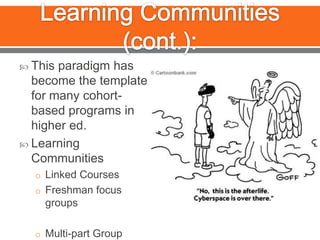
Learning Communities (cont.):This paradigm has become the template for many cohort-based programs in higher ed.Learning Communities Linked CoursesFreshman focus groupsMulti-part Group Assignments?
Forming Learning Communities:A shared sense of communityThe AssignmentRequires interactionStudents depend on one anotherA common community goalCreate a scoring system that examines both individual and group efforts.A group value systemAs students depend...Feel a responsibility to each otherObligationMake it FUN???HabituationIcebreakerStudents need to feel confortable with each otherA Place to call homeThe Wiki!
Mediation Models:How can we use Wikis in Collaborative learning?Student Control? Group Control? Instructor Control?Self MediatedEach student has own wikiStudents visit other wikis of group membersGroup MediatedEach group has their own spaceStudent each have a page linked together from a community homeShared SpaceThe group participates in collective activities on one page.Instructor/Class MediatedEach group has a page as part of a larger class wide wiki
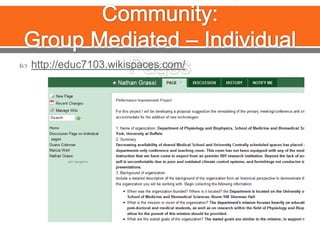
Sample Learning Community:Group Mediated – Individual Pageshttp://educ7103.wikispaces.com/
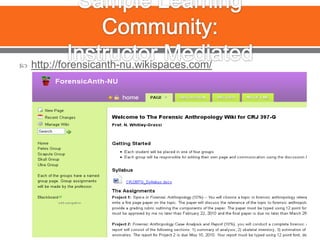
Sample Learning Community:Instructor Mediatedhttp://forensicanth-nu.wikispaces.com/
Additional Wiki Uses:Assembling sources for research projectsConstruct annotated bibliographyPublishing course resourcesConcept mapping or brainstormingStudent comment and revision
Questions?http://www.realestatewebmasters.com/blogs/calzephyr/7696/show/Nathan.Whitley-Grassi@ESC.edu
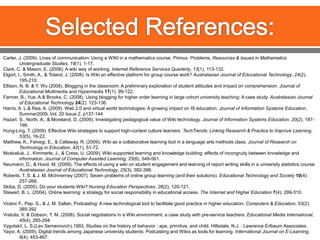
Selected References:Carter, J. (2009). Lines of communication: Using a WIKI in a mathematics course. Primus: Problems, Resources & Issues in Mathematics Undergraduate Studies, 19(1), 1-17.Clark, C. & Mason, E. (2008). A wiki way of working. Internet Reference Services Quarterly, 13(1), 113-132.Elgort, I., Smith, A., & Toland, J. (2008). Is Wiki an effective platform for group course work? Australasian Journal of Educational Technology, 24(2), 195-210.Ellison, N. B. & Y. Wu (2008). Blogging in the classroom: A preliminary exploration of student attitudes and impact on comprehension. Journal of Educational Multimedia and Hypermedia17(1): 99-122.Farmer, B.; Yue, A.& Brooks, C. (2008). Using blogging for higher order learning in large cohort university teaching: A case study. Australasian Journal of Educational Technology24(2): 123-136.Harris, A. L.& Rea, A. (2009). Web 2.0 and virtual world technologies: A growing impact on IS education. Journal of Information Systems Education, Summer2009, Vol. 20 Issue 2, p137-144Hazari, S., North, A., & Moreland, D. (2009). Investigating pedagogical value of Wiki technology. Journal of Information Systems Education, 20(2), 187-198.Hung-Ling, T. (2009). Effective Wiki strategies to support high-context culture learners. TechTrends: Linking Research & Practice to Improve Learning, 53(5), 16-22.Matthew, K., Felvegi, E., & Callaway, R. (2009). Wiki as a collaborative learning tool in a language arts methods class. Journal of Research on Technology in Education, 42(1), 51-72.Moskaliuk, J., Kimmerle, J., & Cress, U. (2009). Wiki-supported learning and knowledge building: effects of incongruity between knowledge and information. Journal of Computer Assisted Learning, 25(6), 549-561.Neumann, D., & Hood, M. (2009). The effects of using a wiki on student engagement and learning of report writing skills in a university statistics course. Australasian Journal of Educational Technology, 25(3), 382-398.Roberts, T. S. & J. M. McInnerney (2007). Seven problems of online group learning (and their solutions). Educational Technology and Society10(4): 257-268.Skiba, D. (2005). Do your students Wiki? Nursing Education Perspectives, 26(2), 120-121.Stewart, B. L. (2004). Online learning: a strategy for social responsibility in educational access. The Internet and Higher Education7(4): 299-310.	Vicenc F., Pep, S., & J. M. Sallan, Podcasting: A new technological tool to facilitate good practice in higher education. Computers & Education, 53(2): 385-392Vratulis, V. & Dobson, T. M. (2008). Social negotiations in a Wiki environment: a case study with pre-service teachers. Educational Media International, 45(4), 285-294.Vygotskiĭ, L. S.(Lev Semenovich),1993. Studies on the history of behavior : ape, primitive, and child. Hillsdale, N.J. : Lawrence Erlbaum Associates. Yayoi, A. (2009). Digital trends among Japanese university students: Podcasting and Wikis as tools for learning. International Journal on E-Learning, 8(4), 453-467. 

Working with wikis

  • 1.
    Working with Wikis:Learning & Collaboration in a Virtual SpaceNathan Whitley-GrassiState University of New York, Empire State College, Niagara Frontier Center
  • 2.
    Why are wehere?Recent surveys of top companies found that collaboration was one of the most highly valued skills in new college graduates.How do we facilitate collaboration & collaborative learning to support this statement in a blended or hybrid format?
  • 3.
    Why not aCMS?It is best to choose a tool that fits your needs rather than creating a need to fit the tool.Course Management System expansion can be expensive, time consuming, and often does not usually allow for student co-created content developmentThird party software provides users with additional free and flexible tools
  • 4.
  • 5.
    What is aWiki?Wikis are editable websitesRequire very little technical “know how” to editWard Cunningham – Wiki Wiki Web (1991)“The simplest online database that could possibly work”Wiki – Hawaiian word for “fast”
  • 6.
  • 7.
    Why a Wiki?NoHTML knowledge requiredShare knowledge quicklyEasy way to collaborateRevert back to old versionsFollow who’s done what, when, & where
  • 8.
    How does itwork?A Wiki page starts more or less blankWiki pages are connected by internal hyperlinks Every page should be connected
  • 10.
    Where to finda free Wiki
  • 11.
    Guide to CreatingWikispaces Wikis:http://ISTE2011wiki.wikispaces.com/
  • 12.
    Collaboration:Creates communities ofpracticeCollaborative learning communitiesThe cooperative learning paradigm:Positive interdependence of membersIndividual accountabilityPeer-to-peer interactionUse of communication skills
  • 13.
    Learning & Engagement:Constructivist Theory – Individual Unit of InstructionCollaboration is at the heart of learningDeeper level of knowledge generationActive and manipulative learningInitiative, creativity, and critical thinking skillsLearning communitiesShared goal for learning
  • 14.
    Collaboration With WikisCollaborationdoes not just happenRequires planning on the instructors partAnd don’t forget to Scream….Set the stageCreate the environmentRelease of responsibilityEncourage collaborationAssess regularlyMotivate learners
  • 15.
    Learning Communities:Are notjust group assignments:Learning communities require a higher level collaborationThis is usually brought about by creating: A shared sense of communityA group value systemA common community goalHabituation
  • 16.
    Learning Communities (cont.):Thisparadigm has become the template for many cohort-based programs in higher ed.Learning Communities Linked CoursesFreshman focus groupsMulti-part Group Assignments?
  • 17.
    Forming Learning Communities:Ashared sense of communityThe AssignmentRequires interactionStudents depend on one anotherA common community goalCreate a scoring system that examines both individual and group efforts.A group value systemAs students depend...Feel a responsibility to each otherObligationMake it FUN???HabituationIcebreakerStudents need to feel confortable with each otherA Place to call homeThe Wiki!
  • 18.
    Mediation Models:How canwe use Wikis in Collaborative learning?Student Control? Group Control? Instructor Control?Self MediatedEach student has own wikiStudents visit other wikis of group membersGroup MediatedEach group has their own spaceStudent each have a page linked together from a community homeShared SpaceThe group participates in collective activities on one page.Instructor/Class MediatedEach group has a page as part of a larger class wide wiki
  • 19.
    Sample Learning Community:GroupMediated – Individual Pageshttp://educ7103.wikispaces.com/
  • 20.
    Sample Learning Community:InstructorMediatedhttp://forensicanth-nu.wikispaces.com/
  • 21.
    Additional Wiki Uses:Assemblingsources for research projectsConstruct annotated bibliographyPublishing course resourcesConcept mapping or brainstormingStudent comment and revision
  • 22.
  • 23.
    Selected References:Carter, J.(2009). Lines of communication: Using a WIKI in a mathematics course. Primus: Problems, Resources & Issues in Mathematics Undergraduate Studies, 19(1), 1-17.Clark, C. & Mason, E. (2008). A wiki way of working. Internet Reference Services Quarterly, 13(1), 113-132.Elgort, I., Smith, A., & Toland, J. (2008). Is Wiki an effective platform for group course work? Australasian Journal of Educational Technology, 24(2), 195-210.Ellison, N. B. & Y. Wu (2008). Blogging in the classroom: A preliminary exploration of student attitudes and impact on comprehension. Journal of Educational Multimedia and Hypermedia17(1): 99-122.Farmer, B.; Yue, A.& Brooks, C. (2008). Using blogging for higher order learning in large cohort university teaching: A case study. Australasian Journal of Educational Technology24(2): 123-136.Harris, A. L.& Rea, A. (2009). Web 2.0 and virtual world technologies: A growing impact on IS education. Journal of Information Systems Education, Summer2009, Vol. 20 Issue 2, p137-144Hazari, S., North, A., & Moreland, D. (2009). Investigating pedagogical value of Wiki technology. Journal of Information Systems Education, 20(2), 187-198.Hung-Ling, T. (2009). Effective Wiki strategies to support high-context culture learners. TechTrends: Linking Research & Practice to Improve Learning, 53(5), 16-22.Matthew, K., Felvegi, E., & Callaway, R. (2009). Wiki as a collaborative learning tool in a language arts methods class. Journal of Research on Technology in Education, 42(1), 51-72.Moskaliuk, J., Kimmerle, J., & Cress, U. (2009). Wiki-supported learning and knowledge building: effects of incongruity between knowledge and information. Journal of Computer Assisted Learning, 25(6), 549-561.Neumann, D., & Hood, M. (2009). The effects of using a wiki on student engagement and learning of report writing skills in a university statistics course. Australasian Journal of Educational Technology, 25(3), 382-398.Roberts, T. S. & J. M. McInnerney (2007). Seven problems of online group learning (and their solutions). Educational Technology and Society10(4): 257-268.Skiba, D. (2005). Do your students Wiki? Nursing Education Perspectives, 26(2), 120-121.Stewart, B. L. (2004). Online learning: a strategy for social responsibility in educational access. The Internet and Higher Education7(4): 299-310. Vicenc F., Pep, S., & J. M. Sallan, Podcasting: A new technological tool to facilitate good practice in higher education. Computers & Education, 53(2): 385-392Vratulis, V. & Dobson, T. M. (2008). Social negotiations in a Wiki environment: a case study with pre-service teachers. Educational Media International, 45(4), 285-294.Vygotskiĭ, L. S.(Lev Semenovich),1993. Studies on the history of behavior : ape, primitive, and child. Hillsdale, N.J. : Lawrence Erlbaum Associates. Yayoi, A. (2009). Digital trends among Japanese university students: Podcasting and Wikis as tools for learning. International Journal on E-Learning, 8(4), 453-467.