
Student voice, intermediary genres, and social bookmarking WDHE conference, June 2010Florence Dujardin & Kirstie EdwardsSheffield Hallam University
OverviewContext: pilot use of social bookmarking in an online Master’s courseSocial media and social bookmarkingMethodology: action researchFindings: cautiously positiveDiscussion: value of social bookmarkingAction points
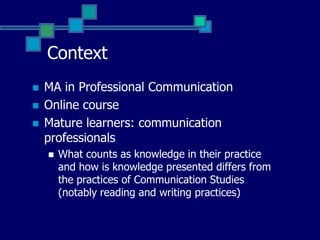
Context MA in Professional CommunicationOnline courseStudent profile:mature learners – ‘digital immigrants’ (Prensky 2001)communication professionals – what counts as knowledge in their practice and how they present it differs from the practices of Communication Studies (notably reading and writing practices)
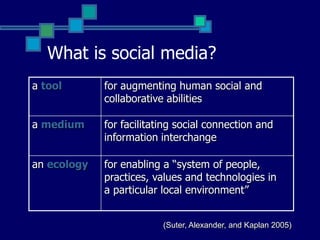
What is social media?And should we care?(Suter, Alexander, and Kaplan 2005)
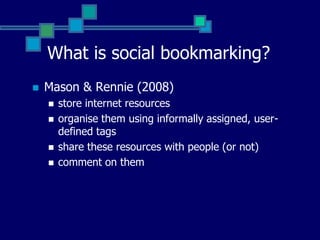
What is social bookmarking?Mason & Rennie (2008):store internet resources online (not your PC)organise them using user-defined tagsshare them with people (or not)comment on them (or not)The ‘ecology’ view of social media:practices: reading, note-taking, ‘talk about texts’value: ‘criticality’people: students, tutor (and External Examiner)
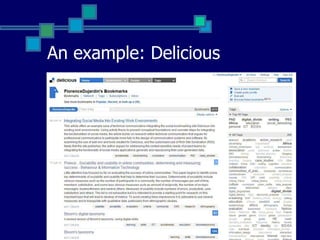
An example: Delicious
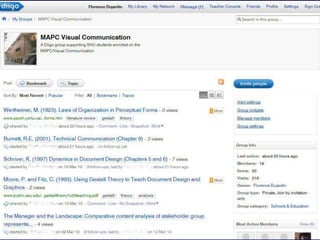
Which application?Many different applications: Delicious, Connotea, CiteULike, Zotero, Diigo, etc. Why Diigo? It is designed for education: privacy (group accessible by invitation only)threaded discussion about bookmarks‘topic’ facilityextract entries made by individual students
Diigo taskPreparing for the end-of-module essayIncrease ‘criticality’ (Ridley 2004) towards readingsDrafting ideas and develop a personal stanceShare notes and get comments from peersLetting off steam about the literatureAssessed (up to 10% of module mark)Content: minimum of 5 texts (up to 2%)Sociability: minimum of 5 comments on peers’ work (up to 2%)Quality: Summary and value of each text (up to 6%)
Research questionsLiteratureSocial bookmarking seems to help students engage with the literatureEvidence is mostly about undergraduates doing campus-based courses – using DeliciousWhat uses and benefits for an online MA?offer a type of informal learning with peers?support appropriation of disciplinary knowledge?enable a pedagogy inspired by ‘Academic Literacies’ (Lea, Street, Lillis, Ivanič, Barton)
MethodologyCase study - loop 1 of a wider action research project on using social media with e-learners15 Diigo ‘contributors’: 8 women7 men (incl. 1 late contributor and a non-contributor)Online methods Questionnaire to find out about social media skillsInterviews to capture experiencesObservation / content analysis
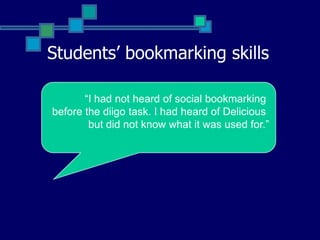
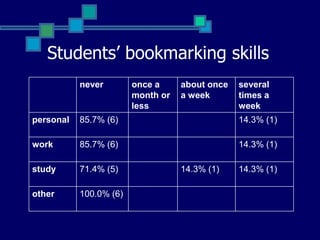
Students’ bookmarking skills“I had not heard of social bookmarking before the diigo task. I had heard of Delicious but did not know what it was used for.”Only 3 students out of 12 use social bookmarking.
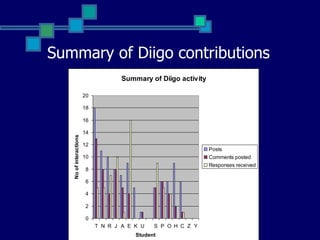
Summary of Diigo contributions
What happened?
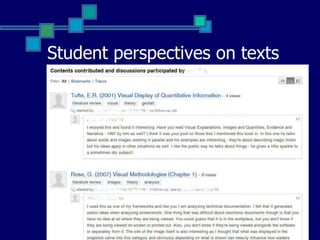
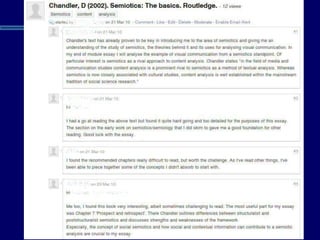
Student perspectives on texts
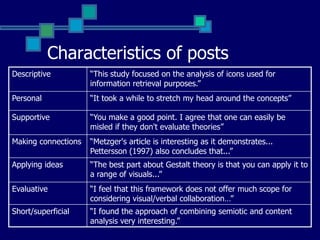
Characteristics of posts
Student views (end of week 1)Students felt well preparedSome technical glitchesCan’t link PDF filesProblems with password-protected articles accessed via university libraryWhat does it feel to share?in the beginning I was worriedI find it a bit strangeI feel fairly comfortablea feeling of pressure as though I am in competition
Thoughts in reading peers’ posts?Useful to gain other perspectivesComments helped form opinions on what I have read“I was going to reject Harrison’s model but after reading peer comments I read it again and thought I could use it”The level of discusses [sic] stayed superficialIt helped me assuage my fearsA useful task?Interesting to get to know a social bookmarking toolUseful, especially when readings are consistently taggedIt’s prompted me to think deeper about the texts
Student views (exit)Helpful for writing your essay? (mixed)I didn’t use the comments I or others madeInteresting but I had already done a lot of readingIt enable to read in a structured way and also to record my thoughtsIt focused my mind and sharing info enriched the learning processReassurance that my ideas were on the right trackLinks with other pieces of research
Repeat the Diigo task? Yes (phew)Certainly good to repeat the task… better to have it assessedA good way to expose people to this sort of facilityI must admit, I’m enjoying it. In fact, it’s sort of addictiveIt gives me a sense of achievementWe didn’t all use Diigo to its full potential
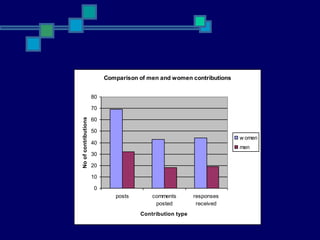
SummaryReasonably positive feedback about the social bookmarking task and its assessmentAn informal learning space (a strong ‘social presence’: supportive, sharing)Some appropriation of academic texts(some ‘cognitive presence’: connections with practice and evaluation)Superficial (‘satisficing’: shorter comments, more descriptive – esp. male students)
Impact on marks?In 2009-10
Range: 50 – 94 %
Average: 65 %In 2008-9Range: 39 – 61 % Average: 42 %
Action pointsRepeat but embed in a core moduleStart early the module (Webb 2009)Support students before and during the tasknot just technical aspectsencourage and support criticality more actively (e.g. through the ‘topic’ facility)Encourage and support social taggingLink to employability (and widening participation)
To concludeInteresting experiment with social bookmarking (Diigo)Reasonably positive student feedbackRefinements neededWorth revisiting (loop 2)Potential to help mature e-learners to develop a personal stance towards academic literature

Student voice and social bookmarking

  • 1.
    Student voice, intermediarygenres, and social bookmarking WDHE conference, June 2010Florence Dujardin & Kirstie EdwardsSheffield Hallam University
  • 2.
    OverviewContext: pilot useof social bookmarking in an online Master’s courseSocial media and social bookmarkingMethodology: action researchFindings: cautiously positiveDiscussion: value of social bookmarkingAction points
  • 3.
    Context MA inProfessional CommunicationOnline courseStudent profile:mature learners – ‘digital immigrants’ (Prensky 2001)communication professionals – what counts as knowledge in their practice and how they present it differs from the practices of Communication Studies (notably reading and writing practices)
  • 4.
    What is socialmedia?And should we care?(Suter, Alexander, and Kaplan 2005)
  • 5.
    What is socialbookmarking?Mason & Rennie (2008):store internet resources online (not your PC)organise them using user-defined tagsshare them with people (or not)comment on them (or not)The ‘ecology’ view of social media:practices: reading, note-taking, ‘talk about texts’value: ‘criticality’people: students, tutor (and External Examiner)
  • 6.
  • 7.
    Which application?Many differentapplications: Delicious, Connotea, CiteULike, Zotero, Diigo, etc. Why Diigo? It is designed for education: privacy (group accessible by invitation only)threaded discussion about bookmarks‘topic’ facilityextract entries made by individual students
  • 8.
    Diigo taskPreparing forthe end-of-module essayIncrease ‘criticality’ (Ridley 2004) towards readingsDrafting ideas and develop a personal stanceShare notes and get comments from peersLetting off steam about the literatureAssessed (up to 10% of module mark)Content: minimum of 5 texts (up to 2%)Sociability: minimum of 5 comments on peers’ work (up to 2%)Quality: Summary and value of each text (up to 6%)
  • 9.
    Research questionsLiteratureSocial bookmarkingseems to help students engage with the literatureEvidence is mostly about undergraduates doing campus-based courses – using DeliciousWhat uses and benefits for an online MA?offer a type of informal learning with peers?support appropriation of disciplinary knowledge?enable a pedagogy inspired by ‘Academic Literacies’ (Lea, Street, Lillis, Ivanič, Barton)
  • 10.
    MethodologyCase study -loop 1 of a wider action research project on using social media with e-learners15 Diigo ‘contributors’: 8 women7 men (incl. 1 late contributor and a non-contributor)Online methods Questionnaire to find out about social media skillsInterviews to capture experiencesObservation / content analysis
  • 11.
    Students’ bookmarking skills“Ihad not heard of social bookmarking before the diigo task. I had heard of Delicious but did not know what it was used for.”Only 3 students out of 12 use social bookmarking.
  • 12.
    Summary of Diigocontributions
  • 14.
  • 15.
  • 17.
  • 18.
    Student views (endof week 1)Students felt well preparedSome technical glitchesCan’t link PDF filesProblems with password-protected articles accessed via university libraryWhat does it feel to share?in the beginning I was worriedI find it a bit strangeI feel fairly comfortablea feeling of pressure as though I am in competition
  • 19.
    Thoughts in readingpeers’ posts?Useful to gain other perspectivesComments helped form opinions on what I have read“I was going to reject Harrison’s model but after reading peer comments I read it again and thought I could use it”The level of discusses [sic] stayed superficialIt helped me assuage my fearsA useful task?Interesting to get to know a social bookmarking toolUseful, especially when readings are consistently taggedIt’s prompted me to think deeper about the texts
  • 20.
    Student views (exit)Helpfulfor writing your essay? (mixed)I didn’t use the comments I or others madeInteresting but I had already done a lot of readingIt enable to read in a structured way and also to record my thoughtsIt focused my mind and sharing info enriched the learning processReassurance that my ideas were on the right trackLinks with other pieces of research
  • 21.
    Repeat the Diigotask? Yes (phew)Certainly good to repeat the task… better to have it assessedA good way to expose people to this sort of facilityI must admit, I’m enjoying it. In fact, it’s sort of addictiveIt gives me a sense of achievementWe didn’t all use Diigo to its full potential
  • 22.
    SummaryReasonably positive feedbackabout the social bookmarking task and its assessmentAn informal learning space (a strong ‘social presence’: supportive, sharing)Some appropriation of academic texts(some ‘cognitive presence’: connections with practice and evaluation)Superficial (‘satisficing’: shorter comments, more descriptive – esp. male students)
  • 23.
  • 24.
  • 25.
    Average: 65 %In2008-9Range: 39 – 61 % Average: 42 %
  • 26.
    Action pointsRepeat butembed in a core moduleStart early the module (Webb 2009)Support students before and during the tasknot just technical aspectsencourage and support criticality more actively (e.g. through the ‘topic’ facility)Encourage and support social taggingLink to employability (and widening participation)
  • 27.
    To concludeInteresting experimentwith social bookmarking (Diigo)Reasonably positive student feedbackRefinements neededWorth revisiting (loop 2)Potential to help mature e-learners to develop a personal stance towards academic literature