GOVERNMENT COLLEGE OF ENGINEERING, CHANDRAPUR
DEPARTMENT OF ELECTRONICS AND TELECOMMUNICATION ENGINEERING
2013-14
“ DTMF (Dual Tone Multi Frequency) Based
Load Control.”
CONTENTS
• Why DTMF based different load control?
• Operation
• Circuit Diagram
• Component List
• Microcontroller
• DTMF Decoder
• Advantages
• Applications
• Conclusion
• Reference
WHY DTMF BASED DIFFERENT LOAD
CONTROL?
In industries, the loads are spread over a
large area and thus, operating these loads is a very
tiresome and difficult task. In agricultural fields
also, pumps and other loads are connected over a
large area and hence it is difficult for the farmer to
operate all the loads and similarly for house hold
loads. Keeping these problems in mind, the
proposed system has been designed which uses
DTMF technology to control the loads remotely.
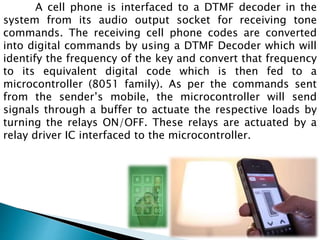
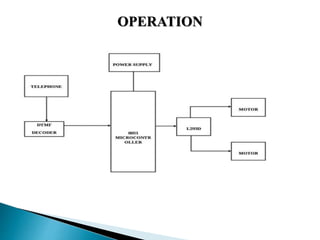
A cell phone is interfaced to a DTMF decoder in the
system from its audio output socket for receiving tone
commands. The receiving cell phone codes are converted
into digital commands by using a DTMF Decoder which will
identify the frequency of the key and convert that frequency
to its equivalent digital code which is then fed to a
microcontroller (8051 family). As per the commands sent
from the sender’s mobile, the microcontroller will send
signals through a buffer to actuate the respective loads by
turning the relays ON/OFF. These relays are actuated by a
relay driver IC interfaced to the microcontroller.
OPERATION
CIRCUIT DIAGRAM
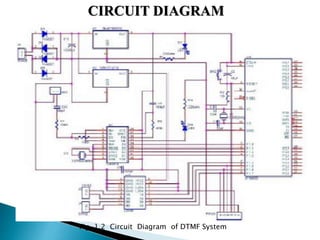
Fig. 1.2 Circuit Diagram of DTMF System
COMPONENTS NEEDED
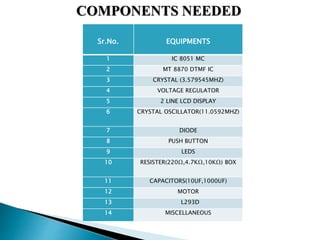
Sr.No. EQUIPMENTS
1 IC 8051 MC
2 MT 8870 DTMF IC
3 CRYSTAL (3.579545MHZ)
4 VOLTAGE REGULATOR
5 2 LINE LCD DISPLAY
6 CRYSTAL OSCILLATOR(11.0592MHZ)
7 DIODE
8 PUSH BUTTON
9 LEDS
10 RESISTER(220Ω,4.7KΩ,10KΩ) BOX
11 CAPACITORS(10UF,1000UF)
12 MOTOR
13 L293D
14 MISCELLANEOUS
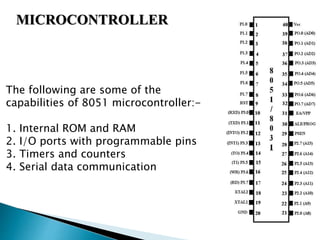
MICROCONTROLLER
The following are some of the
capabilities of 8051 microcontroller:-
1. Internal ROM and RAM
2. I/O ports with programmable pins
3. Timers and counters
4. Serial data communication
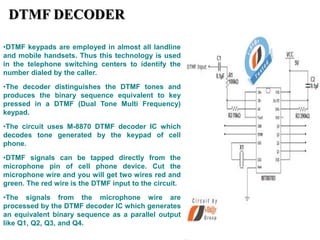
DTMF DECODER
•DTMF keypads are employed in almost all landline
and mobile handsets. Thus this technology is used
in the telephone switching centers to identify the
number dialed by the caller.
•The decoder distinguishes the DTMF tones and
produces the binary sequence equivalent to key
pressed in a DTMF (Dual Tone Multi Frequency)
keypad.
•The circuit uses M-8870 DTMF decoder IC which
decodes tone generated by the keypad of cell
phone.
•DTMF signals can be tapped directly from the
microphone pin of cell phone device. Cut the
microphone wire and you will get two wires red and
green. The red wire is the DTMF input to the circuit.
•The signals from the microphone wire are
processed by the DTMF decoder IC which generates
an equivalent binary sequence as a parallel output
like Q1, Q2, Q3, and Q4.
ADVANTAGES
 No need to go on field.
 Higher Reliability.
 Cost Effective.
 Many devices can be controlled through single command.
APPLICATIONS
 Industrial Automation.
 Security Purpose.
 For long distance contorlling.
CONCLUSION
We have discussed the purpose, use and
implementation of mobile communication system to control
speed of DC motor from remote area using mobile. To
achieve this, we have used the concept of relay operation
using decoding of DUAL TONE MULTI FREQUENCY SIGNALING
(DTMF) produced by mobile.
We will design a hardware module connected with a
prototype load as DC motor and have perform precise
control and speed tests as well as braking. Its efficiency is
relatively high as compared to the other similar methods.
 All datasheets from www.datasheetcatalog.com
 www.Thomson.com/learning
 About AT89s8252 from www.atmel.com
 www.triindia.co.in
 THE 8051 MICROCONTROLLER & EMBEDDED SYSTEMS USING ASSEMBLY
& C- PROGRAMING by Kenneth J. Ayala, Cangage Learning publication.
 The Microcontroller Idea Book by Jan Axelson, Penram International
Publishing (INDIA) Pvt. Ltd.
 Electronics Project HAND BOOK by Amrit Bir Tiwina, BPB Publication.
 Microcontroller Architecture , Programing ,Interfacing & System Design.
By Raj Kamal , PEARSON Publication.
 Millman’s Electronics & Device & Circuits . by Jacob Millman , Tata
Mcgraw-Hill Publishing Company Ltd. Pvt.
REFERENCES
DTMF  based Different Load control

DTMF based Different Load control

  • 1.
    GOVERNMENT COLLEGE OFENGINEERING, CHANDRAPUR DEPARTMENT OF ELECTRONICS AND TELECOMMUNICATION ENGINEERING 2013-14 “ DTMF (Dual Tone Multi Frequency) Based Load Control.”
  • 2.
    CONTENTS • Why DTMFbased different load control? • Operation • Circuit Diagram • Component List • Microcontroller • DTMF Decoder • Advantages • Applications • Conclusion • Reference
  • 3.
    WHY DTMF BASEDDIFFERENT LOAD CONTROL? In industries, the loads are spread over a large area and thus, operating these loads is a very tiresome and difficult task. In agricultural fields also, pumps and other loads are connected over a large area and hence it is difficult for the farmer to operate all the loads and similarly for house hold loads. Keeping these problems in mind, the proposed system has been designed which uses DTMF technology to control the loads remotely.
  • 4.
    A cell phoneis interfaced to a DTMF decoder in the system from its audio output socket for receiving tone commands. The receiving cell phone codes are converted into digital commands by using a DTMF Decoder which will identify the frequency of the key and convert that frequency to its equivalent digital code which is then fed to a microcontroller (8051 family). As per the commands sent from the sender’s mobile, the microcontroller will send signals through a buffer to actuate the respective loads by turning the relays ON/OFF. These relays are actuated by a relay driver IC interfaced to the microcontroller.
  • 5.
  • 6.
    CIRCUIT DIAGRAM Fig. 1.2Circuit Diagram of DTMF System
  • 7.
    COMPONENTS NEEDED Sr.No. EQUIPMENTS 1IC 8051 MC 2 MT 8870 DTMF IC 3 CRYSTAL (3.579545MHZ) 4 VOLTAGE REGULATOR 5 2 LINE LCD DISPLAY 6 CRYSTAL OSCILLATOR(11.0592MHZ) 7 DIODE 8 PUSH BUTTON 9 LEDS 10 RESISTER(220Ω,4.7KΩ,10KΩ) BOX 11 CAPACITORS(10UF,1000UF) 12 MOTOR 13 L293D 14 MISCELLANEOUS
  • 8.
    MICROCONTROLLER The following aresome of the capabilities of 8051 microcontroller:- 1. Internal ROM and RAM 2. I/O ports with programmable pins 3. Timers and counters 4. Serial data communication
  • 9.
    DTMF DECODER •DTMF keypadsare employed in almost all landline and mobile handsets. Thus this technology is used in the telephone switching centers to identify the number dialed by the caller. •The decoder distinguishes the DTMF tones and produces the binary sequence equivalent to key pressed in a DTMF (Dual Tone Multi Frequency) keypad. •The circuit uses M-8870 DTMF decoder IC which decodes tone generated by the keypad of cell phone. •DTMF signals can be tapped directly from the microphone pin of cell phone device. Cut the microphone wire and you will get two wires red and green. The red wire is the DTMF input to the circuit. •The signals from the microphone wire are processed by the DTMF decoder IC which generates an equivalent binary sequence as a parallel output like Q1, Q2, Q3, and Q4.
  • 10.
    ADVANTAGES  No needto go on field.  Higher Reliability.  Cost Effective.  Many devices can be controlled through single command.
  • 11.
    APPLICATIONS  Industrial Automation. Security Purpose.  For long distance contorlling.
  • 12.
    CONCLUSION We have discussedthe purpose, use and implementation of mobile communication system to control speed of DC motor from remote area using mobile. To achieve this, we have used the concept of relay operation using decoding of DUAL TONE MULTI FREQUENCY SIGNALING (DTMF) produced by mobile. We will design a hardware module connected with a prototype load as DC motor and have perform precise control and speed tests as well as braking. Its efficiency is relatively high as compared to the other similar methods.
  • 13.
     All datasheetsfrom www.datasheetcatalog.com  www.Thomson.com/learning  About AT89s8252 from www.atmel.com  www.triindia.co.in  THE 8051 MICROCONTROLLER & EMBEDDED SYSTEMS USING ASSEMBLY & C- PROGRAMING by Kenneth J. Ayala, Cangage Learning publication.  The Microcontroller Idea Book by Jan Axelson, Penram International Publishing (INDIA) Pvt. Ltd.  Electronics Project HAND BOOK by Amrit Bir Tiwina, BPB Publication.  Microcontroller Architecture , Programing ,Interfacing & System Design. By Raj Kamal , PEARSON Publication.  Millman’s Electronics & Device & Circuits . by Jacob Millman , Tata Mcgraw-Hill Publishing Company Ltd. Pvt. REFERENCES