Project By:
1. Kevin Nesamani
2. Sourabh Mokashi
3. Nikhil Mashke
 What is a Mobile controlled [DTMF] ROBOT?
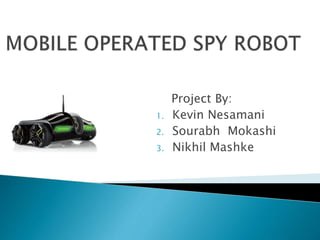
DTMF Mobile ROBO is a machine that can be controlled with a mobile . In
this project, the robot is controlled by a mobile phone that makes a call to
the mobile phone attached to the robot. In the course of a call, if any button
is pressed, a tone corresponding to the button pressed is heard at the other
end of the call. This tone is called "Dual Tone Multiple-Frequency" (DTMF)
tone. The robot perceives this DTMF tone with the help of the phone
stacked on the robot. The received tone is processed by the microcontroller
with the help of DTMF decoder. The microcontroller then transmits the
signal to the motor driver ICs to operate the motors & our robot starts
moving
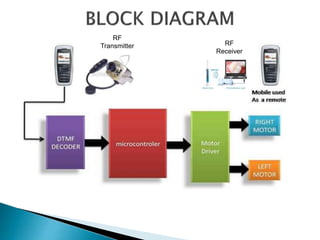
RF
Transmitter RF
Receiver
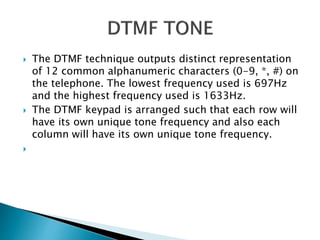
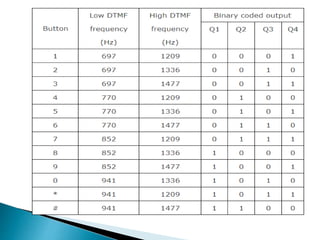
 The DTMF technique outputs distinct representation
of 12 common alphanumeric characters (0-9, *, #) on
the telephone. The lowest frequency used is 697Hz
and the highest frequency used is 1633Hz.
 The DTMF keypad is arranged such that each row will
have its own unique tone frequency and also each
column will have its own unique tone frequency.

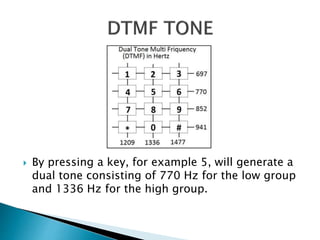
 By pressing a key, for example 5, will generate a
dual tone consisting of 770 Hz for the low group
and 1336 Hz for the high group.
 DTMF keypads are employed in almost all landline and
mobile handsets. Thus this technology is used in the
telephone switching centers to identify the number dialed
by the caller.
 The decoder distinguishes the DTMF tones and produces
the binary sequence equivalent to key pressed in a DTMF
(Dual Tone Multi Frequency) keypad.
 The circuit uses M-8870 DTMF decoder IC which decodes
tone generated by the keypad of cell phone.
 The signals from the microphone wire are processed by
the DTMF decoder IC which generates an equivalent binary
sequence as a parallel output like Q1, Q2, Q3, and Q4.
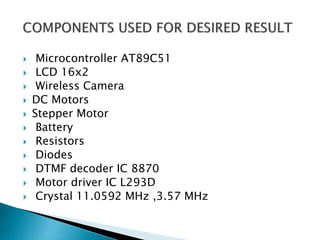
 Microcontroller AT89C51
 LCD 16x2
 Wireless Camera
 DC Motors
 Stepper Motor
 Battery
 Resistors
 Diodes
 DTMF decoder IC 8870
 Motor driver IC L293D
 Crystal 11.0592 MHz ,3.57 MHz
 Item Cost(Rs.)
 PCM Manufacturing cost 700
 Wireless Camera 1700
 Battery [12V 1.3 A] 800
 Discrete components 600
 DC geared motors [4 nos.] 800
 Chasis [Metal or wooden] 1000
 Mobile phone 900
 LCD 400
 Stepper Motor 300
 Miscellaneous 500
 Total: 7,700.00
 Wireless control
 Surveillance System.
 Takes in use of the mobile technology which is almost
available everywhere.
 This wireless device has no boundry of range and can
be controlled as far as network of cell phone
 Cell phone bill.
 Mobile batteries drain out early so charging problem.
 Not flexible with all cell phones as only a particular
cell phone whose earpiece is attached can only be used.
 Scientific
 Industrial Applications
 Military and Law Enforcement
 Spying and Security
 Search and Rescue
 Recreation and Hobby
 http://www.8051projects.info/
 http://www.instructables.com/
 The 8051 Microcontroller and Embedded Systems – Mazidi.
 Schenker, L (1960), "Pushbutton Calling with a Two-Group Voice-
Frequency Code", The Bell system technical journal 39 (1): 235–255,
ISSN 0005-8580
 “DTMF Tester” , ‘Electronics For You’ Magazine , Edition (June 2003)
 http://www.alldatasheet.com/
Mobile operated spy robot

Mobile operated spy robot

  • 1.
    Project By: 1. KevinNesamani 2. Sourabh Mokashi 3. Nikhil Mashke
  • 2.
     What isa Mobile controlled [DTMF] ROBOT? DTMF Mobile ROBO is a machine that can be controlled with a mobile . In this project, the robot is controlled by a mobile phone that makes a call to the mobile phone attached to the robot. In the course of a call, if any button is pressed, a tone corresponding to the button pressed is heard at the other end of the call. This tone is called "Dual Tone Multiple-Frequency" (DTMF) tone. The robot perceives this DTMF tone with the help of the phone stacked on the robot. The received tone is processed by the microcontroller with the help of DTMF decoder. The microcontroller then transmits the signal to the motor driver ICs to operate the motors & our robot starts moving
  • 3.
  • 4.
     The DTMFtechnique outputs distinct representation of 12 common alphanumeric characters (0-9, *, #) on the telephone. The lowest frequency used is 697Hz and the highest frequency used is 1633Hz.  The DTMF keypad is arranged such that each row will have its own unique tone frequency and also each column will have its own unique tone frequency. 
  • 5.
     By pressinga key, for example 5, will generate a dual tone consisting of 770 Hz for the low group and 1336 Hz for the high group.
  • 6.
     DTMF keypadsare employed in almost all landline and mobile handsets. Thus this technology is used in the telephone switching centers to identify the number dialed by the caller.  The decoder distinguishes the DTMF tones and produces the binary sequence equivalent to key pressed in a DTMF (Dual Tone Multi Frequency) keypad.  The circuit uses M-8870 DTMF decoder IC which decodes tone generated by the keypad of cell phone.  The signals from the microphone wire are processed by the DTMF decoder IC which generates an equivalent binary sequence as a parallel output like Q1, Q2, Q3, and Q4.
  • 8.
     Microcontroller AT89C51 LCD 16x2  Wireless Camera  DC Motors  Stepper Motor  Battery  Resistors  Diodes  DTMF decoder IC 8870  Motor driver IC L293D  Crystal 11.0592 MHz ,3.57 MHz
  • 9.
     Item Cost(Rs.) PCM Manufacturing cost 700  Wireless Camera 1700  Battery [12V 1.3 A] 800  Discrete components 600  DC geared motors [4 nos.] 800  Chasis [Metal or wooden] 1000  Mobile phone 900  LCD 400  Stepper Motor 300  Miscellaneous 500  Total: 7,700.00
  • 10.
     Wireless control Surveillance System.  Takes in use of the mobile technology which is almost available everywhere.  This wireless device has no boundry of range and can be controlled as far as network of cell phone
  • 11.
     Cell phonebill.  Mobile batteries drain out early so charging problem.  Not flexible with all cell phones as only a particular cell phone whose earpiece is attached can only be used.
  • 12.
     Scientific  IndustrialApplications  Military and Law Enforcement  Spying and Security  Search and Rescue  Recreation and Hobby
  • 13.
     http://www.8051projects.info/  http://www.instructables.com/ The 8051 Microcontroller and Embedded Systems – Mazidi.  Schenker, L (1960), "Pushbutton Calling with a Two-Group Voice- Frequency Code", The Bell system technical journal 39 (1): 235–255, ISSN 0005-8580  “DTMF Tester” , ‘Electronics For You’ Magazine , Edition (June 2003)  http://www.alldatasheet.com/