Design Decisions
Afaq Mansoor Khan
Teacher: Mr. Ahsan Ashfaq
Subject: Software Architecture & Design
Architectural Design Decisions
“In software engineering and software architecture design, design
decisions address architecturally significant requirements; they are
perceived as hard to make and/or costly to change.”
It is called also architecture strategies and tactics.
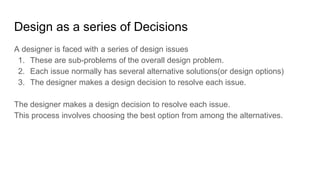
Design as a series of Decisions
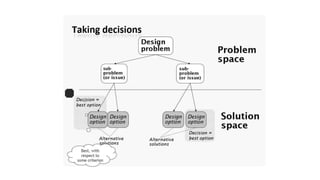
A designer is faced with a series of design issues
1. These are sub-problems of the overall design problem.
2. Each issue normally has several alternative solutions(or design options)
3. The designer makes a design decision to resolve each issue.
The designer makes a design decision to resolve each issue.
This process involves choosing the best option from among the alternatives.
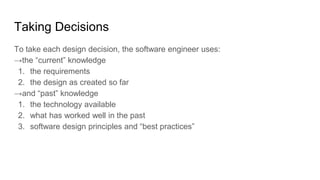
Taking Decisions
To take each design decision, the software engineer uses:
→the “current” knowledge
1. the requirements
2. the design as created so far
→and “past” knowledge
1. the technology available
2. what has worked well in the past
3. software design principles and “best practices”
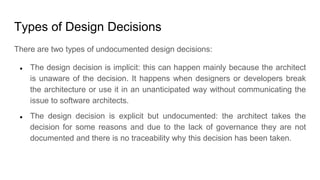
Types of Design Decisions
There are two types of undocumented design decisions:
● The design decision is implicit: this can happen mainly because the architect
is unaware of the decision. It happens when designers or developers break
the architecture or use it in an unanticipated way without communicating the
issue to software architects.
● The design decision is explicit but undocumented: the architect takes the
decision for some reasons and due to the lack of governance they are not
documented and there is no traceability why this decision has been taken.
Notations and Tools
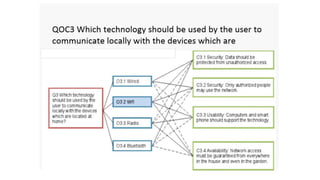
QOC
Questions, Options, Criteria
1. Questions: key design issues
2. Options: possible answers
3. Criteria: assess and compare the options
Tools
Archium: A meta-model and tool developed my Anton Jansen et al
ADDSS: a web based tool developed by Rafael Capilla et al
AREL: a rationale based model developed by Antony Tang et al
DAMSAK: Data Model for Software Architecture Knowledge developed by Babar
et al developed by Babar et al
PAKME : a tool that supports DAMSAK
SEURAT: Software Engineering using Rationale, which integrates tools for
rationale capture, visualization, and use into a standard software engineering
environment
Why are the architecture decisions important?
1) We can consider it as a way of thinking to summarize why we needed this
decision and why we decided this change to happen and chose this option for
it.
2) It will provide a way of traceability of these decisions as we know why we took
them, what are the concerns and business requirements related to these
decisions, who are the contributors to these decisions.
References
1) https://melsatar.blog/2017/04/29/architectural-design-decisions/
2) https://www.infoq.com/articles/sustainable-architectural-design-decisions/
3) https://medium.com/omarelgabrys-blog/design-decisions-ac852e28270e
4) https://stal.blogspot.com/2010/03/implicit-versus-explicit.html

Software Architecture Design Decisions

  • 1.
    Design Decisions Afaq MansoorKhan Teacher: Mr. Ahsan Ashfaq Subject: Software Architecture & Design
  • 2.
    Architectural Design Decisions “Insoftware engineering and software architecture design, design decisions address architecturally significant requirements; they are perceived as hard to make and/or costly to change.” It is called also architecture strategies and tactics.
  • 3.
    Design as aseries of Decisions A designer is faced with a series of design issues 1. These are sub-problems of the overall design problem. 2. Each issue normally has several alternative solutions(or design options) 3. The designer makes a design decision to resolve each issue. The designer makes a design decision to resolve each issue. This process involves choosing the best option from among the alternatives.
  • 5.
    Taking Decisions To takeeach design decision, the software engineer uses: →the “current” knowledge 1. the requirements 2. the design as created so far →and “past” knowledge 1. the technology available 2. what has worked well in the past 3. software design principles and “best practices”
  • 6.
    Types of DesignDecisions There are two types of undocumented design decisions: ● The design decision is implicit: this can happen mainly because the architect is unaware of the decision. It happens when designers or developers break the architecture or use it in an unanticipated way without communicating the issue to software architects. ● The design decision is explicit but undocumented: the architect takes the decision for some reasons and due to the lack of governance they are not documented and there is no traceability why this decision has been taken.
  • 7.
  • 8.
    QOC Questions, Options, Criteria 1.Questions: key design issues 2. Options: possible answers 3. Criteria: assess and compare the options
  • 10.
    Tools Archium: A meta-modeland tool developed my Anton Jansen et al ADDSS: a web based tool developed by Rafael Capilla et al AREL: a rationale based model developed by Antony Tang et al DAMSAK: Data Model for Software Architecture Knowledge developed by Babar et al developed by Babar et al PAKME : a tool that supports DAMSAK SEURAT: Software Engineering using Rationale, which integrates tools for rationale capture, visualization, and use into a standard software engineering environment
  • 11.
    Why are thearchitecture decisions important? 1) We can consider it as a way of thinking to summarize why we needed this decision and why we decided this change to happen and chose this option for it. 2) It will provide a way of traceability of these decisions as we know why we took them, what are the concerns and business requirements related to these decisions, who are the contributors to these decisions.
  • 12.
    References 1) https://melsatar.blog/2017/04/29/architectural-design-decisions/ 2) https://www.infoq.com/articles/sustainable-architectural-design-decisions/ 3)https://medium.com/omarelgabrys-blog/design-decisions-ac852e28270e 4) https://stal.blogspot.com/2010/03/implicit-versus-explicit.html