MIS - UNIT 5
Decision Support System (DSS)
A decision support system (DSS) is an information system application that assists
decision-making. DSS tends to be used in planning, analyzing alternatives, and
trial and error search for solution. The elements of the decision support system
include a database, model base & software. The main application areas of DSS are
Production, finance and marketing.
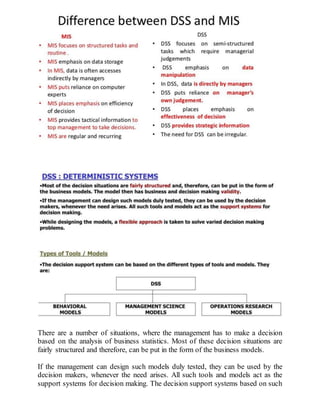
DSS can be differentiated from MIS on the basis of processing the information.
MIS processes data to convert it into information. DSS processes information to
support the decision making process of a manager.
Concept and Philosophy
Decision supportsystems (DSS) are interactive software-based systems intended to
help managers in decision-making by accessing large volumes of information
generated from various related information systems involved in organizational
business processes, such as9 office automation system, transaction processing
system, etc.
DSS uses the summary information, exceptions, patterns, and trends using the
analytical models. A decision support system helps in decision-making but does
not necessarily give a decision itself. The decision makers compile useful
information from raw data, documents, personal knowledge, and/or business
models to identify and solve problems and make decisions.
Programmed and Non-programmed Decisions
There are two types of decisions - programmed and non-programmed decisions.
Programmed decisions are basically automated processes, general routine work,
where −
 These decisions have been taken several times.
 These decisions follow some guidelines or rules.
For example, selecting a reorder level for inventories, is a programmed decision.
Non-programmed decisions occur in unusual and non-addressed situations, so −
 It would be a new decision.
 There will not be any rules to follow.
 These decisions are made based on the available information.
 These decisions are based on the manger's discretion, instinct, perception
and judgment.
For example, investing in a new technology is a non-programmed decision.
Decision support systems generally involve non-programmed decisions. Therefore,
there will be no exact report, content, or format for these systems. Reports are
generated on the fly.
Attributes of a DSS
 Adaptability and flexibility
 High level of Interactivity
 Ease of use
 Efficiency and effectiveness
 Complete control by decision-makers
 Ease of development
 Extendibility
 Support for modeling and analysis
 Support for data access
 Standalone, integrated, and Web-based
Characteristics of a DSS
 Support for decision-makers in semi-structured and unstructured problems.
 Support for managers at various managerial levels, ranging from top
executive to line managers.
 Support for individuals and groups. Less structured problems often requires
the involvement of several individuals from different departments and
organization level.
 Support for interdependent or sequential decisions.
 Support for intelligence, design, choice, and implementation.
 Support for variety of decision processes and styles.
 DSSs are adaptive over time.
Benefits of DSS
 Improves efficiency and speed of decision-making activities.
 Increases the control, competitiveness and capability of futuristic decision-
making of the organization.
 Facilitates interpersonal communication.
 Encourages learning or training.
 Since it is mostly used in non-programmed decisions, it reveals new
approaches and sets up new evidences for an unusual decision.
 Helps automate managerial processes.
Components of a DSS
Following are the components of the Decision Support System −
 Database Management System (DBMS) − To solve a problem the
necessary data may come from internal or external database. In an
organization, internal data are generated by a system such as TPS and MIS.
External data come from a variety of sources such as newspapers, online
data services, databases (financial, marketing, human resources).
 ModelManagement System − It stores and accesses models that managers
use to make decisions. Such models are used for designing manufacturing
facility, analyzing the financial health of an organization, forecasting
demand of a product or service, etc.
Support Tools − Support tools like online help; pulls down menus, user
interfaces, graphical analysis, error correction mechanism, facilitates the
user interactions with the system.
Classification of DSS
There are several ways to classify DSS. Hoi Apple and Whinstone classifies DSS
as follows −
 Text Oriented DSS − It contains textually represented information that
could have a bearing on decision. It allows documents to be electronically
created, revised and viewed as needed.
 Database Oriented DSS − Database plays a major role here; it contains
organized and highly structured data.
 Spreadsheet Oriented DSS − It contains information in spread sheets that
allows create, view, modify procedural knowledge and also instructs the
system to execute self-contained instructions. The most popular tool is Excel
and Lotus 1-2-3.
 Solver Oriented DSS − It is based on a solver, which is an algorithm or
procedure written for performing certain calculations and particular program
type.
 Rules Oriented DSS − It follows certain procedures adopted as rules.
 Rules Oriented DSS − Procedures are adopted in rules oriented DSS.
Export system is the example.
 Compound DSS − It is built by using two or more of the five structures
explained above.
Types of DSS
Following are some typical DSSs −
 Status Inquiry System − It helps in taking operational, management level,
or middle level management decisions, for example daily schedules of jobs
to machines or machines to operators.
 Data Analysis System − It needs comparative analysis and makes use of
formula or an algorithm, for example cash flow analysis, inventory analysis
etc.
 Information Analysis System − In this system data is analyzed and the
information report is generated. For example, sales analysis, accounts
receivable systems, market analysis etc.
 Accounting System − It keeps track of accounting and finance related
information, for example, final account, accounts receivables, accounts
payables, etc. that keep track of the major aspects of the business.
 Model Based System − Simulation models or optimization models used for
decision-making are used infrequently and creates general guidelines for
operation or management.
Objectives of DSS
• To save time and effort in decision making process.
• To help in processing the collected data and in producing a suggested solution to a problem.
• To provide sophisticated and fast analysis of vast amount of data and information.
• To provide support for decision maker at all management levels mainly in semi-structured or
unstructured situation by bringing together human judgement and computerized information.
• To promote learning, which leads to new demands and refinement of application.
• To provide efficient and effective solution of every complex problem.
• To check the impact of changes on the proposed solution with help of “what-if” analysis
• To use the goal seeking analysis to find the value of the inputs necessary to achieve a desired
level of output.
Capabilities of DSS
• Support for problem solving Phase
• Support for different decision frequencies
• Support for different problem structures
• Support for various decision-making levels
There are a number of situations, where the management has to make a decision
based on the analysis of business statistics. Most of these decision situations are
fairly structured and therefore, can be put in the form of the business models.
If the management can design such models duly tested, they can be used by the
decision makers, whenever the need arises. All such tools and models act as the
support systems for decision making. The decision support systems based on such
tools or models have found extensive use, as a number of computer based software
tools and packages are available at a very reasonable price.
The origin of these tools and models lie in the Business Management, the
Management Science and the Operations Research.
Some are universally known and proven tools and have application in the Business
Management.
1. The most significant advantage of the decision support system is its use in
sensitizing the decisions and assessing its implications on the result or business
performance.
2. The second advantage of such system is in focusing on the critical issues in
business.
3. The third advantage of the decision support system is that it provides higher
management ability to delegate decision making to the lower level once the tools
and the models are tested.
TYPES OF TOOLS/ MODELS:
The decision support system can be based on the different types of tools and
models.
1. Behavioral models:
These models are useful in understanding the behavior amongst the business
variables. The decision maker can then make decisions giving due regard to such
behavioral relationships.
E.g. The trends analysis, forecasting, and the statistical analysis models. The trend
analysis indicates how different variables behave in trend setting in the past and
hence in the future. A regression model shows the correlation between one or more
variables. It also helps in identifying the influence of one variable on the other.
These types of models are largely used in process control, manufacturing,
agricultural sciences, medicines, psychology and marketing. The behavioral
analysis can be used to set the points for alert, alarm and action for the decision
maker.
2. Management science models:
These models are developed on the principles of business management, accounting
and econometrics. There are also management systems, which can be converted
into the decision support system models.
E.g. The budgetary systems, the cost accounting systems, the system of capital
budgeting for better return on the investment, the ABC analysis, the control of
inventory through the maximum-minimum levels, the MRP systems, etc are the
examples of the use of the management science in the materials management.
Production planning and control, scheduling and loading systems are the examples
in Production Management. Manpower planning and forecasting is the example in
Personnel Management.
Some of these models can be used straight away in the design of the decision
support system. While some others require the use of management principles and
practices, most of the procedure based decision making models belong to this
category. Such models take away the personal bias of the decision maker.
3. Operations research (OR) Models:
The Operations Research (OR) models are mathematical models. These models
represent a real life problem situation in terms of the variables, constants and
parameters expressed in algebraic equations. Since, the models are mathematical;
there are solutions to these problems. In arriving the solution, methods or calculus,
matrix algebra, probability, and set theory are used. These models have clarity to
the extent that each of them has a set of assumptions which must be true in real
life. Further, if the assumptions are valid, the solutions offered are realistic and
practical; the model represents the real life problem situation.
The OR models address themselves to two or more aspects of the decision
situation. In business and industry, there are a number of situations where one type
of cost is controlled, the other cost goes up. This play balanced at a point is an
optimum point which finds a solution to minimize certain aspects of constraints.
In manufacturing business, the maximization of profit with an appropriate product
mix, within the capacity and the market constraint. The allocation of an inventory
to the various destinations with the least transportation costs. The minimization of
capital blocked in the inventory and simultaneously meeting the market demand or
the production requirement. The inventory control models offer an optimum
solution, where the cost of inventory and the cost of ordering or set up is balanced.
Some problems do not precisely fall in the category of the standard OR models. In
such cases, the problems are solved by using a simulation approach. This approach
uses a random occurrence of a large number of events, determines the status of the
system and evaluates its cost of operations.
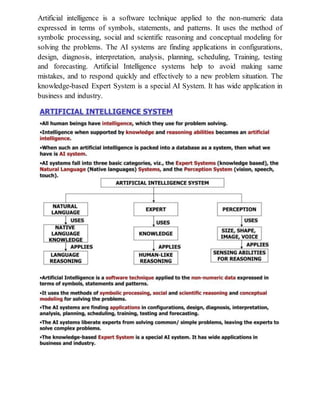
Artificial Intelligence (AI) System:
All human beings have intelligence which they use for problem solving.
Intelligence when supported by knowledge and reasoning abilities becomes an
artificial intelligence. When such an artificial intelligence is packed into a database
as a AI system.AI system falls into three basic categories, the Expert systems
(knowledge based), the Natural Language (Native languages) Systems, and the
Perception System (vision, speech, touch)
Artificial intelligence is a software technique applied to the non-numeric data
expressed in terms of symbols, statements, and patterns. It uses the method of
symbolic processing, social and scientific reasoning and conceptual modeling for
solving the problems. The AI systems are finding applications in configurations,
design, diagnosis, interpretation, analysis, planning, scheduling, Training, testing
and forecasting. Artificial Intelligence systems help to avoid making same
mistakes, and to respond quickly and effectively to a new problem situation. The
knowledge-based Expert System is a special AI System. It has wide application in
business and industry.
Knowledge Based Expert System (KBES): -
Decision making or problem solving is a unique situation 12ith uncertainty and
complexity, dominated by the flexible systems (open system), the unstructured
situations, and the knowledge based expert system, (KBES).
The generalized problem solving approach considers the generally applicable
constraints, examines all possible alternatives and selects one by trial and error
method with reference to a goal. The knowledge based problem solving approach
considers the specific constraints within a domain, examines the limited problem
alternatives within a knowledge domain and selects the one with knowledge based
reasoning with reference to a goal.
The KBES considers knowledge as the base. Knowledge is with experienced
people and experience, is wide and distributed. Hence, a system is required which
will hold the knowledge of experienced people and provide an application path to
solve the problem. Such a system eliminates the knowledge bottleneck.
To build a knowledge-based system certain prerequisites are required. The first
prerequisite is that a person with the ability to solve with knowledge-based
reasoning should be available. The second prerequisite is that such an expert
should be able to articulate the knowledge to the specific problem characteristics.
Knowledge in the KBES is defined as a mix of theory of the subject, knowledge of
its application, organized information and the data of problems and its solutions,
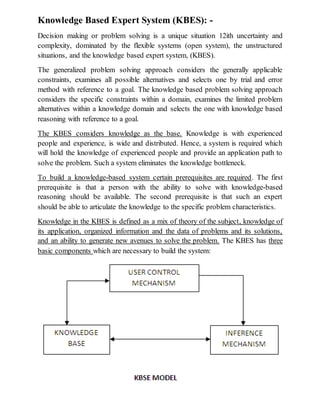
and an ability to generate new avenues to solve the problem. The KBES has three
basic components which are necessary to build the system:
Knowledge base: It is a database of knowledge consisting of the theoretical
foundations, facts, judgments, rules, formulae, intuition, and experience. It is a
structural storage with facilities of easy access.
Inference mechanismc
Use control mechanism: It is a tool applied to the inference mechanism to select,
interpret and deduct or infer. The user control mechanism uses the knowledge base
in guiding the inference process.
These three components are independent of each other. This helps in modifying the
system without affecting all the components. The KBES database, stores the data,
the cause-and-effect relation rules, and the probability information on event
occurrences.
KBES stores and uses knowledge, accepts judgments, questions intelligently,
draws inferences, provides explanation with reasons, offers advice and prompts
further queries for confirmation.
The knowledge data base uses certain methods of knowledge representation. These
methods are- Semantic Networks, Frames and Rules.
Semantic networks:
Knowledge is represented on the principles of predicate functions and the symbolic
data structures which have a meaning built into it are known as semantics. A
semantic network is a network of nodes and arcs connecting the nodes. The node
represents an entity and the arc represents association with a true and false
meaning built into it. The association and meaning uses the principle of
inheritance. E.g., all animals with four legs have a tail and a dog has four legs,
hence the dog has a tail. The system inherits from the fact that the dog has four
legs hence the dog is an animal and therefore, a dog has a tail or not.
e.g. If the table in the room is big, It would be inferred as conference room table. If
the knowledge base has elliptical shape as an attribute of the table then it is correct.
The characteristics of a variety of tables are used to represent knowledge on table.
A table in a drawing room inherits the characteristics of a table in a drawing room.
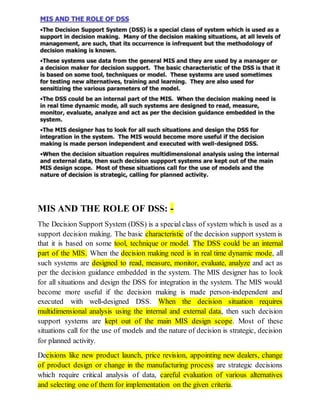
MIS AND THE ROLE OF DSS: -
The Decision Support System (DSS) is a special class of system which is used as a
support decision making. The basic characteristic of the decision support system is
that it is based on some tool, technique or model. The DSS could be an internal
part of the MIS. When the decision making need is in real time dynamic mode, all
such systems are designed to read, measure, monitor, evaluate, analyze and act as
per the decision guidance embedded in the system. The MIS designer has to look
for all situations and design the DSS for integration in the system. The MIS would
become more useful if the decision making is made person-independent and
executed with well-designed DSS. When the decision situation requires
multidimensional analysis using the internal and external data, then such decision
support systems are kept out of the main MIS design scope. Most of these
situations call for the use of models and the nature of decision is strategic, decision
for planned activity.
Decisions like new product launch, price revision, appointing new dealers, change
of product design or change in the manufacturing process are strategic decisions
which require critical analysis of data, careful evaluation of various alternatives
and selecting one of them for implementation on the given criteria.
The decision support system plays a dominant role in the management information
system, as a support to decision making.
Transaction Processing System:
TPS processestransaction and produces reports. It represents the automation of the
fundamental, routine processing used to support business operations. It does not
provide any information to the user to his/her decision-making. TPS uses data and
produces data as shown in the following diagram.
Previously, TPS was known as Management Information System. Prior to
computers, data processing was performed manually or with simple machines. The
domain of TPS is at the lowest level of the management hierarchy of an
organization.
Transaction ProcessingSystem(TPS) records or process the data resulting from the
business transactions(i.e.) it records and process the business transactions and it
supports the day to day operations. Examples:
– entry system,
le system,
Transaction Processing System(TPS) is the oldest type of information system and
can be called as the ―work horse‖ in the industry of IS, for the last 50 years.
Generally, transactions are processed in the following 2 basic ways.
(a) Online Batch Transaction Processing, and,
(b) Online Realtime Batch Transaction Processing(OLRTP)
They are explaned as follows:
(a) Online Batch Transaction Processing: Online involves a direct connection
between the operator and the TPS program, and so they provide immediate results.
In case of Batch Processing, transactions are grouped together and processed
periodically as a unit.
Example: We can take the case of Cheque processing system in a bank. Here, all
the cheques which are received in a particular time frame, say, on a particular day,
are first grouped together. Then, they are sorted out by the account number and
processed in a batch.
(b) Online Realtime Transaction Processing(OLRTP): Real time processing means
that, not only the input data is processed immediately, but, the output results are
available fast enough so as to meet the immediate information needs of the end-
user.
Here, data are processed immediately after a transaction occurs.
Example: Airlines enquiry for ticketing, railway ticketing, point-of-sale(POS)
systems at many retail stores use electronic cash register terminals to electronically
capture and transmit the sales data over the telecommunications links to the
regional computer centers for the immediate(real-time) or nightly(batch)
processing.
Enterprise Management System
• Enterprise Management Systems (EMS) Are Large- scale Application Software
Packages that SupportBusiness Processes, Information Flows, Reporting, and Data
Analytics In Complex Organizations.
• In today’s age of information and technology the way business being operated
has changed completely. The business needs of today have changed and the
response that is expected from the business enterprise by the customer is instant.
• Today’s business enterprise thrive on information, they are information hungry
and in a such scenario the system that is developed and implemented by the
enterprise should consider the complete enterprise and the effect a event would
have on enterprise.
• The system need to be automated in accordance with the need of the business
enterprise, interfacing with other system need to also be done.
• What we need is an enterprise wide system that caters to the need which is an
integrated system using modern technology of communication and information
processing as a support and such a system is the Enterprise Management System.
• Enterprise Management System is made up system which when implement in an
integrated manner with an aim to coordinate and bring about cooperation within a
function of an enterprise.
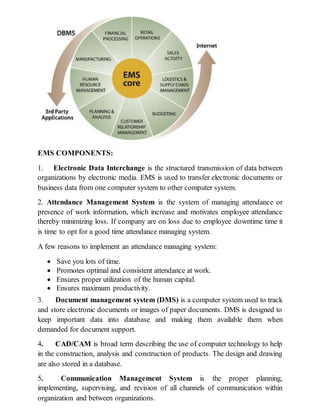
• Enterprise Management System (EMS) is made up of integrated Enterprise
Resource Planning (ERP), Supply Chain Management (SCM), and Customer
Relationship Management (CRM).
The crucial component of EMS is the ERP which controls the support systems
like;
ERP: Enterprise Resource planning Systems.
EDI: Electronic Data Interchange System for commerce, communication and
action.
CAD/CAM/CAE: Computer Aided Design/Manufacturing/Engineering System
for production management.
AMS: Attendance Management System; that is, employee attendance and presence
management for the role management or data capture systems on floors, in stores,
at gates etc.
DMS: Document Management System, which are, imaging, copying and text
management and dispatching document, DBMS.
CMS: Communication Management Systems, such as, paying, cordless, mobile,
telephone systems and audio-video system.
SMS: Security Management Systems such as the close-circuit television, alarm or
warning systems, movement tracing system, etc.
The ERP plays the pivotal role of taking the major decision and executing of
this decision the enterprise revolves around the ERP. The EMS manages the
function of the enterprise with support of ERP. EMS provides the vital information
needed by the middle as well as the top management to aid their decision making.
EMS COMPONENTS:
1. Electronic Data Interchange is the structured transmission of data between
organizations by electronic media. EMS is used to transfer electronic documents or
business data from one computer system to other computer system.
2. Attendance Management System is the system of managing attendance or
presence of work information, which increase and motivates employee attendance
thereby minimizing loss. If company are on loss due to employee downtime time it
is time to opt for a good time attendance managing system.
A few reasons to implement an attendance managing system:
 Save you lots of time.
 Promotes optimal and consistent attendance at work.
 Ensures proper utilization of the human capital.
 Ensures maximum productivity.
3. Document management system (DMS) is a computer system used to track
and store electronic documents or images of paper documents. DMS is designed to
keep important data into database and making them available them when
demanded for document support.
4. CAD/CAM is broad term describing the use of computer technology to help
in the construction, analysis and construction of products. The design and drawing
are also stored in a database.
5. Communication Management System is the proper planning,
implementing, supervising, and revision of all channels of communication within
organization and between organizations.
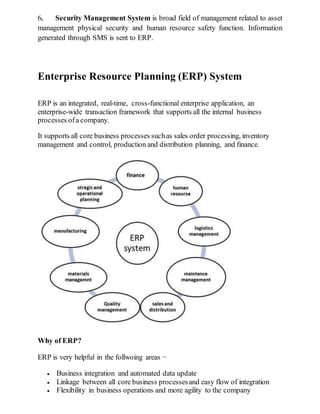
6. Security Management System is broad field of management related to asset
management physical security and human resource safety function. Information
generated through SMS is sent to ERP.
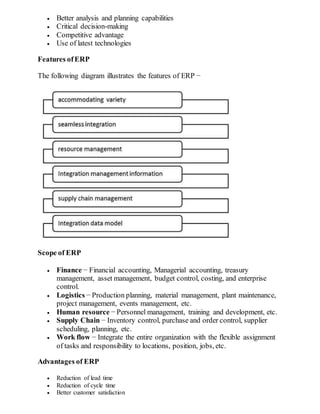
Enterprise Resource Planning (ERP) System
ERP is an integrated, real-time, cross-functional enterprise application, an
enterprise-wide transaction framework that supports all the internal business
processes ofa company.
It supports all core business processes suchas sales order processing, inventory
management and control, production and distribution planning, and finance.
Why of ERP?
ERP is very helpful in the follwoing areas −
 Business integration and automated data update
 Linkage between all core business processesand easy flow of integration
 Flexibility in business operations and more agility to the company
 Better analysis and planning capabilities
 Critical decision-making
 Competitive advantage
 Use of latest technologies
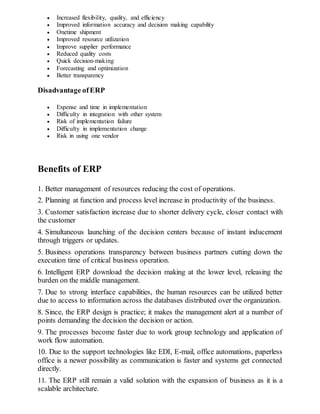
Features ofERP
The following diagram illustrates the features of ERP −
Scope of ERP
 Finance − Financial accounting, Managerial accounting, treasury
management, asset management, budget control, costing, and enterprise
control.
 Logistics − Production planning, material management, plant maintenance,
project management, events management, etc.
 Human resource − Personnel management, training and development, etc.
 Supply Chain − Inventory control, purchase and order control, supplier
scheduling, planning, etc.
 Work flow − Integrate the entire organization with the flexible assignment
of tasks and responsibility to locations, position, jobs, etc.
Advantages of ERP
 Reduction of lead time
 Reduction of cycle time
 Better customer satisfaction
 Increased flexibility, quality, and efficiency
 Improved information accuracy and decision making capability
 Onetime shipment
 Improved resource utilization
 Improve supplier performance
 Reduced quality costs
 Quick decision-making
 Forecasting and optimization
 Better transparency
Disadvantage ofERP
 Expense and time in implementation
 Difficulty in integration with other system
 Risk of implementation failure
 Difficulty in implementation change
 Risk in using one vendor
Benefits of ERP
1. Better management of resources reducing the cost of operations.
2. Planning at function and process level increase in productivity of the business.
3. Customer satisfaction increase due to shorter delivery cycle, closer contact with
the customer
4. Simultaneous launching of the decision centers because of instant inducement
through triggers or updates.
5. Business operations transparency between business partners cutting down the
execution time of critical business operation.
6. Intelligent ERP download the decision making at the lower level, releasing the
burden on the middle management.
7. Due to strong interface capabilities, the human resources can be utilized better
due to access to information across the databases distributed over the organization.
8. Since, the ERP design is practice; it makes the management alert at a number of
points demanding the decision the decision or action.
9. The processes become faster due to work group technology and application of
work flow automation.
10. Due to the support technologies like EDI, E-mail, office automations, paperless
office is a newer possibility as communication is faster and systems get connected
directly.
11. The ERP still remain a valid solution with the expansion of business as it is a
scalable architecture.
12. Due to the client/server architecture, the application of the object technology
and use at the front and tools, the process changes can be easily the user service
can be maintained at higher level.
13. The ERP implementation automatically leads to the usage of the best business
procedures bringing the consistency of operation in the world of business.
14. With the use of data warehousing and data reverse engineering, management
becomes knowledge driven and the organization becomes a learned one.
15. The ERP scope can be enlarged through the internet/intranet access, making
the ERP sensitive to the date of events in the business, market and technology.
16. The quantity of decision making improves as the user decision maker is made
alert and knowledgeable and better informed dynamically.
17. The tools available to the decision maker are friendly whereby he is equipped
to make decision and execute it simultaneously.
EMS & MIS
There is a qualitative change in MIS due to the complexity of business operation
and the risk involved in handling the business. The management focus is shifting
from the function to the process, i.e. the management requires the information
support in the process management and not in the function management. The
process definition now goes beyond the organization boundary. It connects the
organization to the other agencies. The emphasis is on the automation of processes
with strong information technology implementation. Today’s enterprise has ERP,
SCM, CRM implementation are up and running effectively. An integrated system
of ERP, SCM and CRM is called an EMS.
The MIS is now required to maximize the process productivity and performance.
The decision-making support is required for the process optimization. The decision
models are built across the business management functions. Besides the normal
MIS reports required for the top management, the top management also needs a set
of the additional reports, where the critical business processes and the critical
success factors are a focus area.
The EMS solution caters to these requirements easily. The ERP solution is an
integrated solution. The solution operation is seamless, disregarding the hardware
or the software platform. The EMS solution takes care of data integrity and
consistency across the extended organization.
In today’s competitive world, the shift of decision-making is towards strategic
management of the business. The EMS solution, due to its scopeand coverage, and
supported by a variety of tools enables strategic management based on the strategic
information for decision-making.
The management attention on the focused area is easily possible. The conventional
MIS design is more or less embedded in the ERP solution. They provide all the
routine reports at any time for the middle management of the organization. The
EMS over and above this; provides an executive information for the strategic
management of business. It helps to formulate the strategies to achieve the business
goals. The EMS design provides transparency to the users of information giving
them an access to the sensitive information to locate, define and resolve the
problems.
The ERP enables the work group management efficiently and effectively. The
effective uses of the variety of tools, like the data replication, the work flow
automation, the EDI, the EIS, the bar coding, the paging systems are build in ERP.
The effective use of these variety of tools also speeds up processing, cuts down the
operation cycle time and raises the ability of the management to take decisions.
Once the ERP is built in the organization, it takes care of the data, the information
and its storage and therefore, provides the capability to modify the MIS from time-
to-time as per the changing information needs.
All the ERP solution use the client-server architecture in the solution, where the
data processing and the application level processing logic is taken care in the
server level giving freedom to the user, as a client, to define the problem and
evolve the solution using the front-end tools. The front end hardware and the tools
are so powerful that an individual can develop his own MIS based on his decision-
making information needs beside the usual MIS like corporate, functional, etc. the
decision maker can operate as an individual in isolation from others, if need be.
The ERP through such an MIS design improves the decision-making skills of the
individuals very effectively. It provides an autonomy in a global system operations
with the ERP, the MIS design is more flexible highly decision intensive and
efficient.
EMS, an integrated ERP, SRM and CRM are also so advanced that most of the
operational decisions are automated in the EMS. The decisions at the middle
management level are delegated to functional systems. Managers at this level are
empowered through information support to make decision. Main focus of MIS in
enterprise environment is to support strategic management decisions at top
management level. ERP system supports management in decision-making of
capacity allocation, scheduling of jobs and so on.
MIS focuses on resources, planning and control. MIS point out shortfalls and under
utilization of capacity. In SCM, MIS focus is on value of chain of supply chain. In
CRM, MIS focuses on decision related to improving customer relations.
EMS benefits can be summarized in three classes’ namely operational, business
and management. In operational benefits, significant benefits are in cost and
delivery of goods, due to the reduced processing cycle. It also increases resources,
resource productivity. The business benefits are improvement in profits and higher
level of ROI. Management benefits are in the area of strategic information
management and its application for strategic analysis and decision-making.
EMS solutions have proved more powerful due to business rules embedded in the
process, automation of decision analysis and decision-making and generation of
knowledge database. The solutions are advanced in technology application
enabling seamless flow of information and integration of other technologies such
as bar coding, automated data capturing on shop floor, EDI, internet etc.

Mis notes unit 5 -BBA/BCA

  • 1.
    MIS - UNIT5 Decision Support System (DSS) A decision support system (DSS) is an information system application that assists decision-making. DSS tends to be used in planning, analyzing alternatives, and trial and error search for solution. The elements of the decision support system include a database, model base & software. The main application areas of DSS are Production, finance and marketing. DSS can be differentiated from MIS on the basis of processing the information. MIS processes data to convert it into information. DSS processes information to support the decision making process of a manager. Concept and Philosophy Decision supportsystems (DSS) are interactive software-based systems intended to help managers in decision-making by accessing large volumes of information generated from various related information systems involved in organizational business processes, such as9 office automation system, transaction processing system, etc. DSS uses the summary information, exceptions, patterns, and trends using the analytical models. A decision support system helps in decision-making but does not necessarily give a decision itself. The decision makers compile useful information from raw data, documents, personal knowledge, and/or business models to identify and solve problems and make decisions. Programmed and Non-programmed Decisions There are two types of decisions - programmed and non-programmed decisions. Programmed decisions are basically automated processes, general routine work, where −  These decisions have been taken several times.  These decisions follow some guidelines or rules. For example, selecting a reorder level for inventories, is a programmed decision. Non-programmed decisions occur in unusual and non-addressed situations, so −
  • 2.
     It wouldbe a new decision.  There will not be any rules to follow.  These decisions are made based on the available information.  These decisions are based on the manger's discretion, instinct, perception and judgment. For example, investing in a new technology is a non-programmed decision. Decision support systems generally involve non-programmed decisions. Therefore, there will be no exact report, content, or format for these systems. Reports are generated on the fly. Attributes of a DSS  Adaptability and flexibility  High level of Interactivity  Ease of use  Efficiency and effectiveness  Complete control by decision-makers  Ease of development  Extendibility  Support for modeling and analysis  Support for data access  Standalone, integrated, and Web-based Characteristics of a DSS  Support for decision-makers in semi-structured and unstructured problems.  Support for managers at various managerial levels, ranging from top executive to line managers.  Support for individuals and groups. Less structured problems often requires the involvement of several individuals from different departments and organization level.  Support for interdependent or sequential decisions.  Support for intelligence, design, choice, and implementation.  Support for variety of decision processes and styles.  DSSs are adaptive over time. Benefits of DSS  Improves efficiency and speed of decision-making activities.  Increases the control, competitiveness and capability of futuristic decision- making of the organization.  Facilitates interpersonal communication.  Encourages learning or training.  Since it is mostly used in non-programmed decisions, it reveals new approaches and sets up new evidences for an unusual decision.
  • 3.
     Helps automatemanagerial processes. Components of a DSS Following are the components of the Decision Support System −  Database Management System (DBMS) − To solve a problem the necessary data may come from internal or external database. In an organization, internal data are generated by a system such as TPS and MIS. External data come from a variety of sources such as newspapers, online data services, databases (financial, marketing, human resources).  ModelManagement System − It stores and accesses models that managers use to make decisions. Such models are used for designing manufacturing facility, analyzing the financial health of an organization, forecasting demand of a product or service, etc. Support Tools − Support tools like online help; pulls down menus, user interfaces, graphical analysis, error correction mechanism, facilitates the user interactions with the system. Classification of DSS There are several ways to classify DSS. Hoi Apple and Whinstone classifies DSS as follows −  Text Oriented DSS − It contains textually represented information that could have a bearing on decision. It allows documents to be electronically created, revised and viewed as needed.  Database Oriented DSS − Database plays a major role here; it contains organized and highly structured data.  Spreadsheet Oriented DSS − It contains information in spread sheets that allows create, view, modify procedural knowledge and also instructs the system to execute self-contained instructions. The most popular tool is Excel and Lotus 1-2-3.  Solver Oriented DSS − It is based on a solver, which is an algorithm or procedure written for performing certain calculations and particular program type.  Rules Oriented DSS − It follows certain procedures adopted as rules.  Rules Oriented DSS − Procedures are adopted in rules oriented DSS. Export system is the example.  Compound DSS − It is built by using two or more of the five structures explained above. Types of DSS Following are some typical DSSs −
  • 4.
     Status InquirySystem − It helps in taking operational, management level, or middle level management decisions, for example daily schedules of jobs to machines or machines to operators.  Data Analysis System − It needs comparative analysis and makes use of formula or an algorithm, for example cash flow analysis, inventory analysis etc.  Information Analysis System − In this system data is analyzed and the information report is generated. For example, sales analysis, accounts receivable systems, market analysis etc.  Accounting System − It keeps track of accounting and finance related information, for example, final account, accounts receivables, accounts payables, etc. that keep track of the major aspects of the business.  Model Based System − Simulation models or optimization models used for decision-making are used infrequently and creates general guidelines for operation or management. Objectives of DSS • To save time and effort in decision making process. • To help in processing the collected data and in producing a suggested solution to a problem. • To provide sophisticated and fast analysis of vast amount of data and information. • To provide support for decision maker at all management levels mainly in semi-structured or unstructured situation by bringing together human judgement and computerized information. • To promote learning, which leads to new demands and refinement of application. • To provide efficient and effective solution of every complex problem. • To check the impact of changes on the proposed solution with help of “what-if” analysis • To use the goal seeking analysis to find the value of the inputs necessary to achieve a desired level of output. Capabilities of DSS • Support for problem solving Phase • Support for different decision frequencies • Support for different problem structures • Support for various decision-making levels
  • 5.
    There are anumber of situations, where the management has to make a decision based on the analysis of business statistics. Most of these decision situations are fairly structured and therefore, can be put in the form of the business models. If the management can design such models duly tested, they can be used by the decision makers, whenever the need arises. All such tools and models act as the support systems for decision making. The decision support systems based on such
  • 6.
    tools or modelshave found extensive use, as a number of computer based software tools and packages are available at a very reasonable price. The origin of these tools and models lie in the Business Management, the Management Science and the Operations Research. Some are universally known and proven tools and have application in the Business Management. 1. The most significant advantage of the decision support system is its use in sensitizing the decisions and assessing its implications on the result or business performance. 2. The second advantage of such system is in focusing on the critical issues in business. 3. The third advantage of the decision support system is that it provides higher management ability to delegate decision making to the lower level once the tools and the models are tested. TYPES OF TOOLS/ MODELS: The decision support system can be based on the different types of tools and models. 1. Behavioral models: These models are useful in understanding the behavior amongst the business variables. The decision maker can then make decisions giving due regard to such behavioral relationships. E.g. The trends analysis, forecasting, and the statistical analysis models. The trend analysis indicates how different variables behave in trend setting in the past and hence in the future. A regression model shows the correlation between one or more variables. It also helps in identifying the influence of one variable on the other. These types of models are largely used in process control, manufacturing, agricultural sciences, medicines, psychology and marketing. The behavioral analysis can be used to set the points for alert, alarm and action for the decision maker. 2. Management science models: These models are developed on the principles of business management, accounting and econometrics. There are also management systems, which can be converted into the decision support system models. E.g. The budgetary systems, the cost accounting systems, the system of capital budgeting for better return on the investment, the ABC analysis, the control of inventory through the maximum-minimum levels, the MRP systems, etc are the examples of the use of the management science in the materials management. Production planning and control, scheduling and loading systems are the examples
  • 7.
    in Production Management.Manpower planning and forecasting is the example in Personnel Management. Some of these models can be used straight away in the design of the decision support system. While some others require the use of management principles and practices, most of the procedure based decision making models belong to this category. Such models take away the personal bias of the decision maker. 3. Operations research (OR) Models: The Operations Research (OR) models are mathematical models. These models represent a real life problem situation in terms of the variables, constants and parameters expressed in algebraic equations. Since, the models are mathematical; there are solutions to these problems. In arriving the solution, methods or calculus, matrix algebra, probability, and set theory are used. These models have clarity to the extent that each of them has a set of assumptions which must be true in real life. Further, if the assumptions are valid, the solutions offered are realistic and practical; the model represents the real life problem situation. The OR models address themselves to two or more aspects of the decision situation. In business and industry, there are a number of situations where one type of cost is controlled, the other cost goes up. This play balanced at a point is an optimum point which finds a solution to minimize certain aspects of constraints. In manufacturing business, the maximization of profit with an appropriate product mix, within the capacity and the market constraint. The allocation of an inventory to the various destinations with the least transportation costs. The minimization of capital blocked in the inventory and simultaneously meeting the market demand or the production requirement. The inventory control models offer an optimum solution, where the cost of inventory and the cost of ordering or set up is balanced. Some problems do not precisely fall in the category of the standard OR models. In such cases, the problems are solved by using a simulation approach. This approach uses a random occurrence of a large number of events, determines the status of the system and evaluates its cost of operations. Artificial Intelligence (AI) System: All human beings have intelligence which they use for problem solving. Intelligence when supported by knowledge and reasoning abilities becomes an artificial intelligence. When such an artificial intelligence is packed into a database as a AI system.AI system falls into three basic categories, the Expert systems (knowledge based), the Natural Language (Native languages) Systems, and the Perception System (vision, speech, touch)
  • 8.
    Artificial intelligence isa software technique applied to the non-numeric data expressed in terms of symbols, statements, and patterns. It uses the method of symbolic processing, social and scientific reasoning and conceptual modeling for solving the problems. The AI systems are finding applications in configurations, design, diagnosis, interpretation, analysis, planning, scheduling, Training, testing and forecasting. Artificial Intelligence systems help to avoid making same mistakes, and to respond quickly and effectively to a new problem situation. The knowledge-based Expert System is a special AI System. It has wide application in business and industry.
  • 9.
    Knowledge Based ExpertSystem (KBES): - Decision making or problem solving is a unique situation 12ith uncertainty and complexity, dominated by the flexible systems (open system), the unstructured situations, and the knowledge based expert system, (KBES). The generalized problem solving approach considers the generally applicable constraints, examines all possible alternatives and selects one by trial and error method with reference to a goal. The knowledge based problem solving approach considers the specific constraints within a domain, examines the limited problem alternatives within a knowledge domain and selects the one with knowledge based reasoning with reference to a goal. The KBES considers knowledge as the base. Knowledge is with experienced people and experience, is wide and distributed. Hence, a system is required which will hold the knowledge of experienced people and provide an application path to solve the problem. Such a system eliminates the knowledge bottleneck. To build a knowledge-based system certain prerequisites are required. The first prerequisite is that a person with the ability to solve with knowledge-based reasoning should be available. The second prerequisite is that such an expert should be able to articulate the knowledge to the specific problem characteristics. Knowledge in the KBES is defined as a mix of theory of the subject, knowledge of its application, organized information and the data of problems and its solutions, and an ability to generate new avenues to solve the problem. The KBES has three basic components which are necessary to build the system:
  • 10.
    Knowledge base: Itis a database of knowledge consisting of the theoretical foundations, facts, judgments, rules, formulae, intuition, and experience. It is a structural storage with facilities of easy access. Inference mechanismc Use control mechanism: It is a tool applied to the inference mechanism to select, interpret and deduct or infer. The user control mechanism uses the knowledge base in guiding the inference process. These three components are independent of each other. This helps in modifying the system without affecting all the components. The KBES database, stores the data, the cause-and-effect relation rules, and the probability information on event occurrences. KBES stores and uses knowledge, accepts judgments, questions intelligently, draws inferences, provides explanation with reasons, offers advice and prompts further queries for confirmation. The knowledge data base uses certain methods of knowledge representation. These methods are- Semantic Networks, Frames and Rules. Semantic networks: Knowledge is represented on the principles of predicate functions and the symbolic data structures which have a meaning built into it are known as semantics. A semantic network is a network of nodes and arcs connecting the nodes. The node represents an entity and the arc represents association with a true and false meaning built into it. The association and meaning uses the principle of inheritance. E.g., all animals with four legs have a tail and a dog has four legs, hence the dog has a tail. The system inherits from the fact that the dog has four legs hence the dog is an animal and therefore, a dog has a tail or not. e.g. If the table in the room is big, It would be inferred as conference room table. If the knowledge base has elliptical shape as an attribute of the table then it is correct. The characteristics of a variety of tables are used to represent knowledge on table. A table in a drawing room inherits the characteristics of a table in a drawing room.
  • 11.
    MIS AND THEROLE OF DSS: - The Decision Support System (DSS) is a special class of system which is used as a support decision making. The basic characteristic of the decision support system is that it is based on some tool, technique or model. The DSS could be an internal part of the MIS. When the decision making need is in real time dynamic mode, all such systems are designed to read, measure, monitor, evaluate, analyze and act as per the decision guidance embedded in the system. The MIS designer has to look for all situations and design the DSS for integration in the system. The MIS would become more useful if the decision making is made person-independent and executed with well-designed DSS. When the decision situation requires multidimensional analysis using the internal and external data, then such decision support systems are kept out of the main MIS design scope. Most of these situations call for the use of models and the nature of decision is strategic, decision for planned activity. Decisions like new product launch, price revision, appointing new dealers, change of product design or change in the manufacturing process are strategic decisions which require critical analysis of data, careful evaluation of various alternatives and selecting one of them for implementation on the given criteria.
  • 12.
    The decision supportsystem plays a dominant role in the management information system, as a support to decision making. Transaction Processing System: TPS processestransaction and produces reports. It represents the automation of the fundamental, routine processing used to support business operations. It does not provide any information to the user to his/her decision-making. TPS uses data and produces data as shown in the following diagram. Previously, TPS was known as Management Information System. Prior to computers, data processing was performed manually or with simple machines. The domain of TPS is at the lowest level of the management hierarchy of an organization. Transaction ProcessingSystem(TPS) records or process the data resulting from the business transactions(i.e.) it records and process the business transactions and it supports the day to day operations. Examples: – entry system, le system, Transaction Processing System(TPS) is the oldest type of information system and can be called as the ―work horse‖ in the industry of IS, for the last 50 years. Generally, transactions are processed in the following 2 basic ways. (a) Online Batch Transaction Processing, and, (b) Online Realtime Batch Transaction Processing(OLRTP) They are explaned as follows: (a) Online Batch Transaction Processing: Online involves a direct connection between the operator and the TPS program, and so they provide immediate results.
  • 13.
    In case ofBatch Processing, transactions are grouped together and processed periodically as a unit. Example: We can take the case of Cheque processing system in a bank. Here, all the cheques which are received in a particular time frame, say, on a particular day, are first grouped together. Then, they are sorted out by the account number and processed in a batch. (b) Online Realtime Transaction Processing(OLRTP): Real time processing means that, not only the input data is processed immediately, but, the output results are available fast enough so as to meet the immediate information needs of the end- user. Here, data are processed immediately after a transaction occurs. Example: Airlines enquiry for ticketing, railway ticketing, point-of-sale(POS) systems at many retail stores use electronic cash register terminals to electronically capture and transmit the sales data over the telecommunications links to the regional computer centers for the immediate(real-time) or nightly(batch) processing. Enterprise Management System • Enterprise Management Systems (EMS) Are Large- scale Application Software Packages that SupportBusiness Processes, Information Flows, Reporting, and Data Analytics In Complex Organizations. • In today’s age of information and technology the way business being operated has changed completely. The business needs of today have changed and the response that is expected from the business enterprise by the customer is instant. • Today’s business enterprise thrive on information, they are information hungry and in a such scenario the system that is developed and implemented by the enterprise should consider the complete enterprise and the effect a event would have on enterprise. • The system need to be automated in accordance with the need of the business enterprise, interfacing with other system need to also be done. • What we need is an enterprise wide system that caters to the need which is an integrated system using modern technology of communication and information processing as a support and such a system is the Enterprise Management System.
  • 14.
    • Enterprise ManagementSystem is made up system which when implement in an integrated manner with an aim to coordinate and bring about cooperation within a function of an enterprise. • Enterprise Management System (EMS) is made up of integrated Enterprise Resource Planning (ERP), Supply Chain Management (SCM), and Customer Relationship Management (CRM). The crucial component of EMS is the ERP which controls the support systems like; ERP: Enterprise Resource planning Systems. EDI: Electronic Data Interchange System for commerce, communication and action. CAD/CAM/CAE: Computer Aided Design/Manufacturing/Engineering System for production management. AMS: Attendance Management System; that is, employee attendance and presence management for the role management or data capture systems on floors, in stores, at gates etc. DMS: Document Management System, which are, imaging, copying and text management and dispatching document, DBMS. CMS: Communication Management Systems, such as, paying, cordless, mobile, telephone systems and audio-video system. SMS: Security Management Systems such as the close-circuit television, alarm or warning systems, movement tracing system, etc. The ERP plays the pivotal role of taking the major decision and executing of this decision the enterprise revolves around the ERP. The EMS manages the function of the enterprise with support of ERP. EMS provides the vital information needed by the middle as well as the top management to aid their decision making.
  • 15.
    EMS COMPONENTS: 1. ElectronicData Interchange is the structured transmission of data between organizations by electronic media. EMS is used to transfer electronic documents or business data from one computer system to other computer system. 2. Attendance Management System is the system of managing attendance or presence of work information, which increase and motivates employee attendance thereby minimizing loss. If company are on loss due to employee downtime time it is time to opt for a good time attendance managing system. A few reasons to implement an attendance managing system:  Save you lots of time.  Promotes optimal and consistent attendance at work.  Ensures proper utilization of the human capital.  Ensures maximum productivity. 3. Document management system (DMS) is a computer system used to track and store electronic documents or images of paper documents. DMS is designed to keep important data into database and making them available them when demanded for document support. 4. CAD/CAM is broad term describing the use of computer technology to help in the construction, analysis and construction of products. The design and drawing are also stored in a database. 5. Communication Management System is the proper planning, implementing, supervising, and revision of all channels of communication within organization and between organizations.
  • 16.
    6. Security ManagementSystem is broad field of management related to asset management physical security and human resource safety function. Information generated through SMS is sent to ERP. Enterprise Resource Planning (ERP) System ERP is an integrated, real-time, cross-functional enterprise application, an enterprise-wide transaction framework that supports all the internal business processes ofa company. It supports all core business processes suchas sales order processing, inventory management and control, production and distribution planning, and finance. Why of ERP? ERP is very helpful in the follwoing areas −  Business integration and automated data update  Linkage between all core business processesand easy flow of integration  Flexibility in business operations and more agility to the company
  • 17.
     Better analysisand planning capabilities  Critical decision-making  Competitive advantage  Use of latest technologies Features ofERP The following diagram illustrates the features of ERP − Scope of ERP  Finance − Financial accounting, Managerial accounting, treasury management, asset management, budget control, costing, and enterprise control.  Logistics − Production planning, material management, plant maintenance, project management, events management, etc.  Human resource − Personnel management, training and development, etc.  Supply Chain − Inventory control, purchase and order control, supplier scheduling, planning, etc.  Work flow − Integrate the entire organization with the flexible assignment of tasks and responsibility to locations, position, jobs, etc. Advantages of ERP  Reduction of lead time  Reduction of cycle time  Better customer satisfaction
  • 18.
     Increased flexibility,quality, and efficiency  Improved information accuracy and decision making capability  Onetime shipment  Improved resource utilization  Improve supplier performance  Reduced quality costs  Quick decision-making  Forecasting and optimization  Better transparency Disadvantage ofERP  Expense and time in implementation  Difficulty in integration with other system  Risk of implementation failure  Difficulty in implementation change  Risk in using one vendor Benefits of ERP 1. Better management of resources reducing the cost of operations. 2. Planning at function and process level increase in productivity of the business. 3. Customer satisfaction increase due to shorter delivery cycle, closer contact with the customer 4. Simultaneous launching of the decision centers because of instant inducement through triggers or updates. 5. Business operations transparency between business partners cutting down the execution time of critical business operation. 6. Intelligent ERP download the decision making at the lower level, releasing the burden on the middle management. 7. Due to strong interface capabilities, the human resources can be utilized better due to access to information across the databases distributed over the organization. 8. Since, the ERP design is practice; it makes the management alert at a number of points demanding the decision the decision or action. 9. The processes become faster due to work group technology and application of work flow automation. 10. Due to the support technologies like EDI, E-mail, office automations, paperless office is a newer possibility as communication is faster and systems get connected directly. 11. The ERP still remain a valid solution with the expansion of business as it is a scalable architecture.
  • 19.
    12. Due tothe client/server architecture, the application of the object technology and use at the front and tools, the process changes can be easily the user service can be maintained at higher level. 13. The ERP implementation automatically leads to the usage of the best business procedures bringing the consistency of operation in the world of business. 14. With the use of data warehousing and data reverse engineering, management becomes knowledge driven and the organization becomes a learned one. 15. The ERP scope can be enlarged through the internet/intranet access, making the ERP sensitive to the date of events in the business, market and technology. 16. The quantity of decision making improves as the user decision maker is made alert and knowledgeable and better informed dynamically. 17. The tools available to the decision maker are friendly whereby he is equipped to make decision and execute it simultaneously. EMS & MIS There is a qualitative change in MIS due to the complexity of business operation and the risk involved in handling the business. The management focus is shifting from the function to the process, i.e. the management requires the information support in the process management and not in the function management. The process definition now goes beyond the organization boundary. It connects the organization to the other agencies. The emphasis is on the automation of processes with strong information technology implementation. Today’s enterprise has ERP, SCM, CRM implementation are up and running effectively. An integrated system of ERP, SCM and CRM is called an EMS. The MIS is now required to maximize the process productivity and performance. The decision-making support is required for the process optimization. The decision models are built across the business management functions. Besides the normal MIS reports required for the top management, the top management also needs a set of the additional reports, where the critical business processes and the critical success factors are a focus area. The EMS solution caters to these requirements easily. The ERP solution is an integrated solution. The solution operation is seamless, disregarding the hardware or the software platform. The EMS solution takes care of data integrity and consistency across the extended organization. In today’s competitive world, the shift of decision-making is towards strategic management of the business. The EMS solution, due to its scopeand coverage, and supported by a variety of tools enables strategic management based on the strategic information for decision-making.
  • 20.
    The management attentionon the focused area is easily possible. The conventional MIS design is more or less embedded in the ERP solution. They provide all the routine reports at any time for the middle management of the organization. The EMS over and above this; provides an executive information for the strategic management of business. It helps to formulate the strategies to achieve the business goals. The EMS design provides transparency to the users of information giving them an access to the sensitive information to locate, define and resolve the problems. The ERP enables the work group management efficiently and effectively. The effective uses of the variety of tools, like the data replication, the work flow automation, the EDI, the EIS, the bar coding, the paging systems are build in ERP. The effective use of these variety of tools also speeds up processing, cuts down the operation cycle time and raises the ability of the management to take decisions. Once the ERP is built in the organization, it takes care of the data, the information and its storage and therefore, provides the capability to modify the MIS from time- to-time as per the changing information needs. All the ERP solution use the client-server architecture in the solution, where the data processing and the application level processing logic is taken care in the server level giving freedom to the user, as a client, to define the problem and evolve the solution using the front-end tools. The front end hardware and the tools are so powerful that an individual can develop his own MIS based on his decision- making information needs beside the usual MIS like corporate, functional, etc. the decision maker can operate as an individual in isolation from others, if need be. The ERP through such an MIS design improves the decision-making skills of the individuals very effectively. It provides an autonomy in a global system operations with the ERP, the MIS design is more flexible highly decision intensive and efficient. EMS, an integrated ERP, SRM and CRM are also so advanced that most of the operational decisions are automated in the EMS. The decisions at the middle management level are delegated to functional systems. Managers at this level are empowered through information support to make decision. Main focus of MIS in enterprise environment is to support strategic management decisions at top management level. ERP system supports management in decision-making of capacity allocation, scheduling of jobs and so on. MIS focuses on resources, planning and control. MIS point out shortfalls and under utilization of capacity. In SCM, MIS focus is on value of chain of supply chain. In CRM, MIS focuses on decision related to improving customer relations. EMS benefits can be summarized in three classes’ namely operational, business and management. In operational benefits, significant benefits are in cost and delivery of goods, due to the reduced processing cycle. It also increases resources, resource productivity. The business benefits are improvement in profits and higher level of ROI. Management benefits are in the area of strategic information management and its application for strategic analysis and decision-making.
  • 21.
    EMS solutions haveproved more powerful due to business rules embedded in the process, automation of decision analysis and decision-making and generation of knowledge database. The solutions are advanced in technology application enabling seamless flow of information and integration of other technologies such as bar coding, automated data capturing on shop floor, EDI, internet etc.