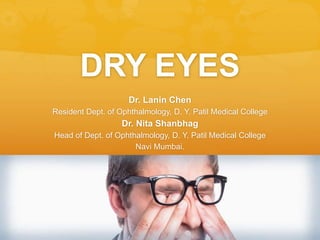
DRY EYES
Dr. Lanin Chen
Resident Dept. of Ophthalmology, D. Y. Patil Medical College
Dr. Nita Shanbhag
Head of Dept. of Ophthalmology, D. Y. Patil Medical College
Navi Mumbai.
DEFINITION
Dry eye syndrome is a multifactorial disease
of the tears and ocular surface that results in
symptoms of discomfort, visual disturbance, tear
film instability and potential damage to the ocular
surface. It is accompanied by increased osmolarity
of the tear film and inflammation of the ocular
surface.
The ocular surface, 2007, pp. 77. 2007 Report of the International Dry Eye
Workshop (DEWS). [Online] Tear Film and Ocular Surface Society. Available
at www.tearfilm.org/dewsreport
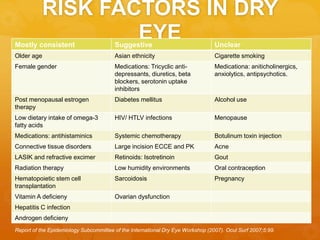
RISK FACTORS IN DRY
EYEMostly consistent Suggestive Unclear
Older age Asian ethnicity Cigarette smoking
Female gender Medications: Tricyclic anti-
depressants, diuretics, beta
blockers, serotonin uptake
inhibitors
Medicationa: aniticholinergics,
anxiolytics, antipsychotics.
Post menopausal estrogen
therapy
Diabetes mellitus Alcohol use
Low dietary intake of omega-3
fatty acids
HIV/ HTLV infections Menopause
Medications: antihistaminics Systemic chemotherapy Botulinum toxin injection
Connective tissue disorders Large incision ECCE and PK Acne
LASIK and refractive excimer Retinoids: Isotretinoin Gout
Radiation therapy Low humidity environments Oral contraception
Hematopoietic stem cell
transplantation
Sarcoidosis Pregnancy
Vitamin A deficieny Ovarian dysfunction
Hepatitis C infection
Androgen deficieny
Report of the Epidemiology Subcommittee of the International Dry Eye Workshop (2007). Ocul Surf 2007;5:99.
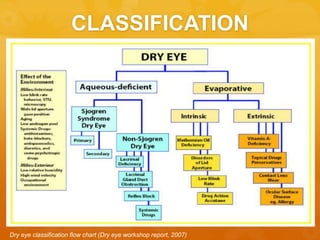
CLASSIFICATION
Dry eye classification flow chart (Dry eye workshop report, 2007)
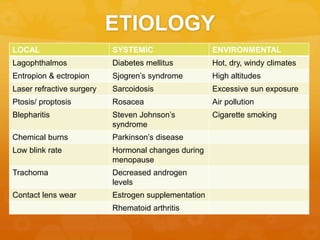
ETIOLOGY
LOCAL SYSTEMIC ENVIRONMENTAL
Lagophthalmos Diabetes mellitus Hot, dry, windy climates
Entropion & ectropion Sjogren’s syndrome High altitudes
Laser refractive surgery Sarcoidosis Excessive sun exposure
Ptosis/ proptosis Rosacea Air pollution
Blepharitis Steven Johnson’s
syndrome
Cigarette smoking
Chemical burns Parkinson’s disease
Low blink rate Hormonal changes during
menopause
Trachoma Decreased androgen
levels
Contact lens wear Estrogen supplementation
Rhematoid arthritis
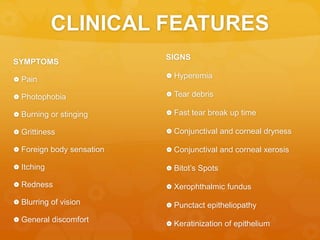
CLINICAL FEATURES
SYMPTOMS
 Pain
 Photophobia
 Burning or stinging
 Grittiness
 Foreign body sensation
 Itching
 Redness
 Blurring of vision
 General discomfort
SIGNS
 Hyperemia
 Tear debris
 Fast tear break up time
 Conjunctival and corneal dryness
 Conjunctival and corneal xerosis
 Bitot’s Spots
 Xerophthalmic fundus
 Punctact epitheliopathy
 Keratinization of epithelium
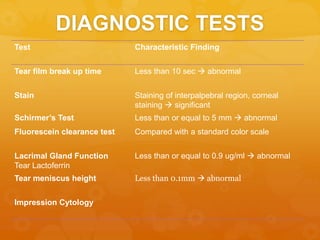
DIAGNOSTIC TESTS
Test Characteristic Finding
Tear film break up time Less than 10 sec  abnormal
Stain Staining of interpalpebral region, corneal
staining  significant
Schirmer’s Test Less than or equal to 5 mm  abnormal
Fluorescein clearance test Compared with a standard color scale
Lacrimal Gland Function
Tear Lactoferrin
Less than or equal to 0.9 ug/ml  abnormal
Tear meniscus height Less than 0.1mm  abnormal
Impression Cytology
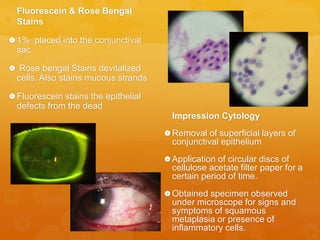
Fluorescein & Rose Bengal
Stains
1% placed into the conjunctival
sac.
 Rose bengal Stains devitalized
cells. Also stains mucous strands
Fluorescein stains the epithelial
defects from the dead
Impression Cytology
Removal of superficial layers of
conjunctival epithelium
Application of circular discs of
cellulose acetate filter paper for a
certain period of time.
Obtained specimen observed
under microscope for signs and
symptoms of squamous
metaplasia or presence of
inflammatory cells.
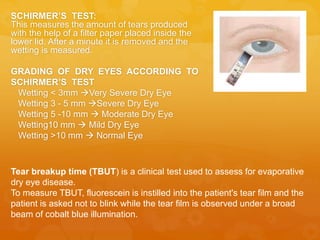
SCHIRMER’S TEST:
This measures the amount of tears produced
with the help of a filter paper placed inside the
lower lid. After a minute it is removed and the
wetting is measured.
GRADING OF DRY EYES ACCORDING TO
SCHIRMER’S TEST
Wetting < 3mm Very Severe Dry Eye
Wetting 3 - 5 mm Severe Dry Eye
Wetting 5 -10 mm  Moderate Dry Eye
Wetting10 mm  Mild Dry Eye
Wetting >10 mm  Normal Eye
Tear breakup time (TBUT) is a clinical test used to assess for evaporative
dry eye disease.
To measure TBUT, fluorescein is instilled into the patient's tear film and the
patient is asked not to blink while the tear film is observed under a broad
beam of cobalt blue illumination.
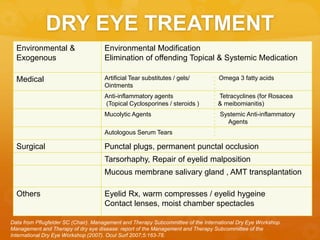
DRY EYE TREATMENT
Environmental &
Exogenous
Environmental Modification
Elimination of offending Topical & Systemic Medication
Medical Artificial Tear substitutes / gels/ Omega 3 fatty acids
Ointments
Anti-inflammatory agents Tetracyclines (for Rosacea
(Topical Cyclosporines / steroids ) & meibomianitis)
Mucolytic Agents Systemic Anti-inflammatory
Agents
Autologous Serum Tears
Surgical Punctal plugs, permanent punctal occlusion
Tarsorhaphy, Repair of eyelid malposition
Mucous membrane salivary gland , AMT transplantation
Others Eyelid Rx, warm compresses / eyelid hygeine
Contact lenses, moist chamber spectacles
Data from Pflugfelder SC (Chair). Management and Therapy Subcommittee of the International Dry Eye Workshop.
Management and Therapy of dry eye disease: report of the Management and Therapy Subcommittee of the
International Dry Eye Workshop (2007). Ocul Surf 2007;5:163-78.
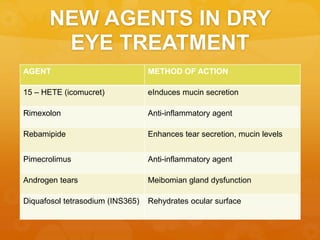
NEW AGENTS IN DRY
EYE TREATMENT
AGENT METHOD OF ACTION
15 – HETE (icomucret) eInduces mucin secretion
Rimexolon Anti-inflammatory agent
Rebamipide Enhances tear secretion, mucin levels
Pimecrolimus Anti-inflammatory agent
Androgen tears Meibomian gland dysfunction
Diquafosol tetrasodium (INS365) Rehydrates ocular surface
THANK YOU
Financial Disclosure: No author has a financial or proprietary
interest in any material or method mentioned.

Dry Eyes

  • 1.
    DRY EYES Dr. LaninChen Resident Dept. of Ophthalmology, D. Y. Patil Medical College Dr. Nita Shanbhag Head of Dept. of Ophthalmology, D. Y. Patil Medical College Navi Mumbai.
  • 2.
    DEFINITION Dry eye syndromeis a multifactorial disease of the tears and ocular surface that results in symptoms of discomfort, visual disturbance, tear film instability and potential damage to the ocular surface. It is accompanied by increased osmolarity of the tear film and inflammation of the ocular surface. The ocular surface, 2007, pp. 77. 2007 Report of the International Dry Eye Workshop (DEWS). [Online] Tear Film and Ocular Surface Society. Available at www.tearfilm.org/dewsreport
  • 3.
    RISK FACTORS INDRY EYEMostly consistent Suggestive Unclear Older age Asian ethnicity Cigarette smoking Female gender Medications: Tricyclic anti- depressants, diuretics, beta blockers, serotonin uptake inhibitors Medicationa: aniticholinergics, anxiolytics, antipsychotics. Post menopausal estrogen therapy Diabetes mellitus Alcohol use Low dietary intake of omega-3 fatty acids HIV/ HTLV infections Menopause Medications: antihistaminics Systemic chemotherapy Botulinum toxin injection Connective tissue disorders Large incision ECCE and PK Acne LASIK and refractive excimer Retinoids: Isotretinoin Gout Radiation therapy Low humidity environments Oral contraception Hematopoietic stem cell transplantation Sarcoidosis Pregnancy Vitamin A deficieny Ovarian dysfunction Hepatitis C infection Androgen deficieny Report of the Epidemiology Subcommittee of the International Dry Eye Workshop (2007). Ocul Surf 2007;5:99.
  • 4.
    CLASSIFICATION Dry eye classificationflow chart (Dry eye workshop report, 2007)
  • 5.
    ETIOLOGY LOCAL SYSTEMIC ENVIRONMENTAL LagophthalmosDiabetes mellitus Hot, dry, windy climates Entropion & ectropion Sjogren’s syndrome High altitudes Laser refractive surgery Sarcoidosis Excessive sun exposure Ptosis/ proptosis Rosacea Air pollution Blepharitis Steven Johnson’s syndrome Cigarette smoking Chemical burns Parkinson’s disease Low blink rate Hormonal changes during menopause Trachoma Decreased androgen levels Contact lens wear Estrogen supplementation Rhematoid arthritis
  • 6.
    CLINICAL FEATURES SYMPTOMS  Pain Photophobia  Burning or stinging  Grittiness  Foreign body sensation  Itching  Redness  Blurring of vision  General discomfort SIGNS  Hyperemia  Tear debris  Fast tear break up time  Conjunctival and corneal dryness  Conjunctival and corneal xerosis  Bitot’s Spots  Xerophthalmic fundus  Punctact epitheliopathy  Keratinization of epithelium
  • 7.
    DIAGNOSTIC TESTS Test CharacteristicFinding Tear film break up time Less than 10 sec  abnormal Stain Staining of interpalpebral region, corneal staining  significant Schirmer’s Test Less than or equal to 5 mm  abnormal Fluorescein clearance test Compared with a standard color scale Lacrimal Gland Function Tear Lactoferrin Less than or equal to 0.9 ug/ml  abnormal Tear meniscus height Less than 0.1mm  abnormal Impression Cytology
  • 8.
    Fluorescein & RoseBengal Stains 1% placed into the conjunctival sac.  Rose bengal Stains devitalized cells. Also stains mucous strands Fluorescein stains the epithelial defects from the dead Impression Cytology Removal of superficial layers of conjunctival epithelium Application of circular discs of cellulose acetate filter paper for a certain period of time. Obtained specimen observed under microscope for signs and symptoms of squamous metaplasia or presence of inflammatory cells.
  • 9.
    SCHIRMER’S TEST: This measuresthe amount of tears produced with the help of a filter paper placed inside the lower lid. After a minute it is removed and the wetting is measured. GRADING OF DRY EYES ACCORDING TO SCHIRMER’S TEST Wetting < 3mm Very Severe Dry Eye Wetting 3 - 5 mm Severe Dry Eye Wetting 5 -10 mm  Moderate Dry Eye Wetting10 mm  Mild Dry Eye Wetting >10 mm  Normal Eye Tear breakup time (TBUT) is a clinical test used to assess for evaporative dry eye disease. To measure TBUT, fluorescein is instilled into the patient's tear film and the patient is asked not to blink while the tear film is observed under a broad beam of cobalt blue illumination.
  • 10.
    DRY EYE TREATMENT Environmental& Exogenous Environmental Modification Elimination of offending Topical & Systemic Medication Medical Artificial Tear substitutes / gels/ Omega 3 fatty acids Ointments Anti-inflammatory agents Tetracyclines (for Rosacea (Topical Cyclosporines / steroids ) & meibomianitis) Mucolytic Agents Systemic Anti-inflammatory Agents Autologous Serum Tears Surgical Punctal plugs, permanent punctal occlusion Tarsorhaphy, Repair of eyelid malposition Mucous membrane salivary gland , AMT transplantation Others Eyelid Rx, warm compresses / eyelid hygeine Contact lenses, moist chamber spectacles Data from Pflugfelder SC (Chair). Management and Therapy Subcommittee of the International Dry Eye Workshop. Management and Therapy of dry eye disease: report of the Management and Therapy Subcommittee of the International Dry Eye Workshop (2007). Ocul Surf 2007;5:163-78.
  • 11.
    NEW AGENTS INDRY EYE TREATMENT AGENT METHOD OF ACTION 15 – HETE (icomucret) eInduces mucin secretion Rimexolon Anti-inflammatory agent Rebamipide Enhances tear secretion, mucin levels Pimecrolimus Anti-inflammatory agent Androgen tears Meibomian gland dysfunction Diquafosol tetrasodium (INS365) Rehydrates ocular surface
  • 12.
    THANK YOU Financial Disclosure:No author has a financial or proprietary interest in any material or method mentioned.